
LVT-110 · Lesson 3 of 12 · 19 min
Voltage, current, resistance and power
A low-voltage technician does not need an electrician's depth of electrical theory, but she needs enough to answer the questions the job asks every week. Will this power supply run these four cameras? Why does the card reader at the end of the corridor reset when the lock releases? Is this 24 V supply actually delivering 24 V? How much heat will this bundle of PoE cables make? This lesson covers the four basic quantities and the two relationships that answer most of those questions: Ohm's law and the power equation. Lesson 4 applies them to series and parallel circuits and to voltage drop on long cable runs.
Charge, current and voltage
Electricity is the movement of electric charge. In copper wire, the charge carriers are electrons, which drift through the metal when something pushes them. Current is the rate at which charge flows past a point in a circuit, measured in amperes, symbol A. One ampere is a large current in this trade; most devices draw tens or hundreds of milliamperes, mA, where one milliampere is a thousandth of an ampere. A card reader might draw 120 mA, a door contact sensor a few milliamperes, and a magnetic lock 500 mA.
Voltage is the push that drives current around a circuit. More precisely, it is the difference in electrical potential energy per unit of charge between two points, measured in volts, V. A battery or power supply creates a voltage between its terminals, and when a complete path, a circuit, connects those terminals through a load, current flows. Without a complete circuit there is voltage but no current, which is why a meter can read 24 V across the open terminals of a power supply while nothing is connected. A useful picture is water in a hose: voltage is like the pressure, current is like the flow, and a narrow nozzle restricts the flow the way a resistance does. The picture is not exact, but it makes the relationships easy to remember.
Voltage is always measured between two points. When a technician says that a terminal is at 24 V, she means 24 V above the circuit's reference point, usually the negative terminal of the supply or the circuit's common. A meter has two leads for exactly this reason.
Resistance and conductors
Resistance is the opposition a material offers to current, measured in ohms, symbol Ω. Conductors such as copper and aluminium have low resistance; insulators such as the PVC or fluoropolymer jacket of a cable have extremely high resistance. Every real conductor has some resistance, and it depends on four things: the material, the length, the cross-sectional area and the temperature. A longer wire has more resistance, in proportion to its length. A thicker wire has less, in proportion to its cross-sectional area. And the resistance of copper rises by about 0.4 percent for each degree Celsius of temperature rise, which matters in warm ceilings and in bundles of PoE cable.
Wire size in North America is given by the American Wire Gauge, AWG, in which a larger gauge number means a thinner wire. Each step of three gauge numbers roughly halves the cross-sectional area and doubles the resistance. Data cable uses 23 or 24 AWG conductors; access control and camera power cable typically uses 18 or 16 AWG; and speaker cable for paging may use 18 to 14 AWG. Lesson 4 uses the resistance of these sizes to calculate voltage drop.
| Size | Resistance per km at 20 °C | Typical use |
|---|---|---|
| 24 AWG | 84 Ω | Category 5e and 6 data cable |
| 22 AWG | 53 Ω | Door contacts, reader data, intercom |
| 18 AWG | 21 Ω | Lock and camera power, speaker lines |
| 16 AWG | 13 Ω | Longer lock and camera power runs |
| 14 AWG | 8.3 Ω | Long speaker runs, larger power feeds |
Ohm's law
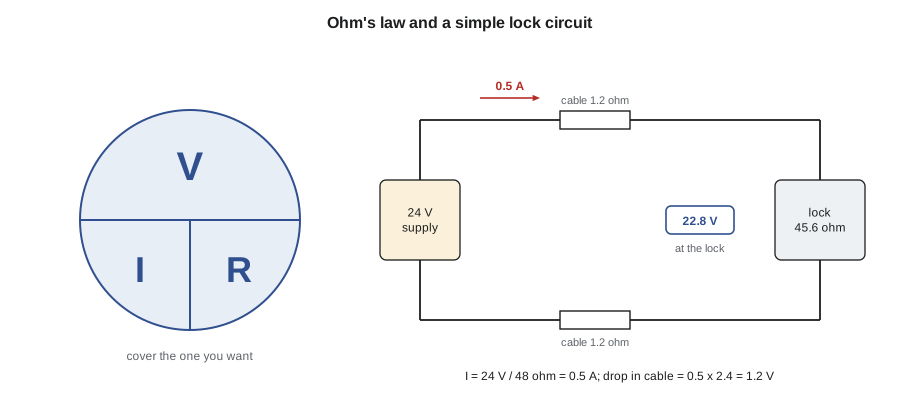
In 1827 Georg Ohm published the relationship that bears his name: in a conductor at constant temperature, the current is proportional to the voltage across it. The constant of proportionality is the resistance. Ohm's law can be written three ways, and a technician uses all three.
If a 24 V supply is connected across a lock coil with a resistance of 48 Ω, the current is 24 divided by 48, or 0.5 A. If a meter shows 11.6 V across a camera's input while a clamp meter shows 0.4 A flowing into it, the camera is behaving like a resistance of 29 Ω. And if a 0.5 A current flows through a cable loop with a resistance of 4 Ω, the voltage lost in the cable is 0.5 times 4, or 2 V.
Many electronic devices do not obey Ohm's law in the simple way a resistor does. A camera, a card reader or a PoE access point contains a switching power converter that draws whatever current it needs to produce its internal voltages: if the supply voltage falls, it draws more current to deliver the same power. That behaviour, called constant power, matters in Lesson 4, because it means voltage drop on a long run gets worse than a resistor calculation predicts.
Power and energy
Power is the rate at which energy is converted, from electrical energy into heat, light, sound or motion, measured in watts, W. In a DC circuit, power is the product of voltage and current. Combining that with Ohm's law gives two more forms, which are useful when one of the quantities is unknown.
The second form, I squared R, explains why connections and cables heat up. The power lost as heat in a conductor rises with the square of the current, so doubling the current through a cable quadruples the heat. A loose screw terminal with a resistance of 0.2 Ω carrying 2 A produces 0.8 W of heat in a tiny space, enough to discolour the terminal block over months. The same principle explains why PoE standards limit the current per conductor pair and why large bundles of PoE cable in a warm ceiling need attention.
Energy is power multiplied by time, measured in joules or, more practically, in watt-hours, Wh. A 10 W camera running for a day uses 240 Wh. Battery capacity is often given in ampere-hours, Ah, at a nominal voltage; multiplying the two gives watt-hours. A 12 V, 7 Ah battery holds about 84 Wh when new. Lesson 6 uses these figures to size backup batteries.
# Ohm's law and power calculator for common low-voltage loads
loads = [
    # name, supply volts, known: ("R", ohms) or ("I", amps) or ("P", watts)
    ("maglock coil", 24.0, ("R", 48.0)),
    ("card reader", 12.0, ("I", 0.12)),
    ("fixed camera", 12.0, ("P", 6.5)),
    ("door strike", 24.0, ("I", 0.45)),
    ("paging horn (as a load)", 24.0, ("R", 60.0)),
]
for name, v, (kind, x) in loads:
    if kind == "R":
        r = x; i = v / r
    elif kind == "I":
        i = x; r = v / i
    else:
        i = x / v; r = v / i
    p = v * i
print(f"{name:<24} {v:4.0f} V {i * 1000:6.0f} mA {r:7.1f} ohm {p:5.1f} W")maglock coil 24 V 500 mA 48.0 ohm 12.0 W card reader 12 V 120 mA 100.0 ohm 1.4 W fixed camera 12 V 542 mA 22.2 ohm 6.5 W door strike 24 V 450 mA 53.3 ohm 10.8 W paging horn (as a load) 24 V 400 mA 60.0 ohm 9.6 W
The table shows that the maglock draws the most current, 500 mA, and the card reader the least. When Maya later chooses a power supply output for these devices, she adds the currents at each voltage, not the watts across different voltages, because each output of a supply is rated in amperes at its voltage.
Direct and alternating current, briefly
The circuits in this lesson are direct current, DC: the current flows in one direction, and the voltage is steady. Batteries and most power supplies for cameras, readers and locks deliver DC. The building's power system delivers alternating current, AC, in which the voltage reverses direction 60 times a second. Some low-voltage devices, especially older cameras and some door hardware, run on 24 V AC from a small transformer, and paging speaker lines carry the audio signal itself as an AC voltage. Lesson 5 explains AC and how power supplies convert it to DC.
Measuring the four quantities
A multimeter measures voltage, current and resistance, and the way it does each is worth knowing because the wrong method damages meters and gives misleading readings. Voltage is measured across a component or between two points, with the meter in parallel with the circuit. Resistance is measured with the circuit de-energized and the component isolated, because the meter supplies its own small test current and any outside voltage spoils the reading or damages the meter. Current is measured in series, by opening the circuit and passing the current through the meter, or, much more conveniently and safely, with a clamp meter that senses the magnetic field around a single conductor. Lesson 9 covers meters and their safety ratings.
Dev teaches Maya one habit early: before measuring anything, say what the reading should be. If she expects 24 V and sees 21.5 V, she knows to look further. If she has no expectation, every reading looks fine.
Worked problem
Why the strike buzzes but does not release
At Riverside a new electric strike on a classroom corridor door buzzes when the reader grants access, but the door does not release. The strike is rated 24 V DC, 450 mA. Maya measures 24.1 V at the power supply output and 17.8 V at the strike's terminals while it is energized. The circuit uses about 90 m of 22 AWG cable. What is happening, and what does Dev change?
Show solution
- The voltage lost in the cable is 24.1 − 17.8 = 6.3 V.
- With 0.45 A flowing, Ohm's law gives the loop resistance as 6.3 / 0.45 = 14 Ω.
- That matches the table: 22 AWG is about 53 Ω per km per conductor, and 180 m of conductor out and back gives about 9.5 Ω at 20 °C, plus the strike's terminals and a splice in the ceiling. The run is simply too long for 22 AWG at this current, and a splice may be adding resistance.
- Dev re-runs the circuit in 18 AWG, whose loop resistance over the same distance is about 3.8 Ω. The drop falls to about 1.7 V, leaving 22.4 V at the strike, inside its operating range.
Answer: Excessive voltage drop in undersized cable left only 17.8 V at the strike; replacing the 22 AWG with 18 AWG fixed it.
Prefixes and estimating in your head
Low-voltage work uses a wide range of values, so metric prefixes appear constantly: milliamperes for device currents, kilohms for end-of-line resistors, megohms for insulation, milliwatts for optical power and kilowatt-hours for energy. One milliampere is 0.001 A, so 450 mA is 0.45 A; one kilohm is 1,000 Ω, so a 2.2 kΩ resistor is 2,200 Ω; one megohm is a million ohms. Mixing up a prefix is the most common arithmetic error in the trade, and the best defence is to convert everything to base units, amperes, volts and ohms, before calculating.
Dev also expects Maya to estimate quickly before she reaches for a calculator. A 24 V lock that draws half an ampere has a resistance near 50 Ω and uses about 12 W. Four such locks draw 2 A and about 48 W. A 12 V camera using 6 W draws half an ampere. If a calculation gives an answer far from the estimate, such as a lock current of 5 A, there is a slipped decimal point or a wrong prefix somewhere, and it should be found before anything is ordered or connected.
These estimates also help when reading datasheets, which often give power in watts for one device and current in milliamperes for the next. Converting both to the same quantity at the same voltage, as the calculator in this lesson does, makes them comparable.
Common mistakes
MistakeMeasuring resistance on a powered circuit.
InsteadDe-energize and isolate the component first.
MistakeAdding watts from outputs at different voltages to size one output.
InsteadAdd the currents drawn from each output at its own voltage.
MistakeExpecting a camera to draw less current when its supply voltage falls.
InsteadSwitching power converters draw more current at lower voltage.
MistakeIgnoring a warm terminal because the circuit is low voltage.
InsteadHeat is I²R; a loose low-voltage connection can still overheat.
MistakeTaking a reading without knowing what it should be.
InsteadPredict the reading first, then compare.
Summary and key terms
- Current is the flow of charge in amperes; voltage is the push between two points in volts; resistance opposes current in ohms.
- Conductor resistance rises with length and temperature and falls with cross-sectional area; higher AWG numbers mean thinner wire.
- Ohm's law: V = IR. Power: P = VI = I²R = V²/R. Energy is power multiplied by time.
- Electronic loads draw roughly constant power, so their current rises when their voltage falls.
- Voltage is measured in parallel, current in series or with a clamp meter, and resistance on an isolated, de-energized circuit.
- Ampere
- The unit of current, one coulomb of charge per second.
- Volt
- The unit of potential difference, one joule per coulomb.
- Ohm
- The unit of resistance; one volt drives one ampere through one ohm.
- Watt
- The unit of power, one joule per second.
- AWG
- American Wire Gauge, the North American system of wire sizes, in which larger numbers mean thinner wire.
- Constant-power load
- A load, such as a switching power converter, that draws more current as its supply voltage falls.
Practice problems
Work each problem on paper first, then reveal the answer to check.
A reader draws 150 mA at 12 V. What is its power?
Show answer
12 × 0.15 = 1.8 W.
A 24 V lock coil measures 32 Ω. What current does it draw?
Show answer
24 / 32 = 0.75 A.
A cable loop has 6 Ω resistance and carries 0.5 A. How much heat is produced in the cable?
Show answer
I²R = 0.25 × 6 = 1.5 W.
How much energy does a 12 W access point use in a week?
Show answer
12 × 24 × 7 = 2,016 Wh, about 2 kWh.
Lesson quiz · 5 questions
Score 60% or more to complete this lesson.
Create a free account to save your progress, take quizzes and earn a certificate.