
LVT-110 · Lesson 6 of 12 · 19 min
Batteries and backup power
Security, life safety and communication systems must keep working when the building's power fails. An access control system that loses power must leave doors in a safe, known state; an intrusion alarm must keep reporting; a paging system may be needed to direct an evacuation; a network closet may need to stay up long enough for an orderly shutdown. The low-voltage technician installs the batteries, battery-backed supplies and uninterruptible power supplies that make this possible, and calculates how long they will last. This lesson covers the batteries the trade uses, how standby time is calculated, and how batteries are installed and maintained safely.
How a battery stores energy
A battery is a set of electrochemical cells. Each cell has two electrodes in an electrolyte, and a chemical reaction between them produces a voltage that depends on the chemistry: about 2 V per cell for lead-acid, about 3.2 to 3.7 V for the common lithium chemistries. Cells are connected in series to build up the voltage; a 12 V lead-acid battery has six cells. Connecting batteries in series adds their voltages at the same ampere-hour capacity; connecting identical batteries in parallel adds their capacities at the same voltage. A 24 V access control supply typically uses two 12 V batteries in series.
A battery's capacity is given in ampere-hours, Ah, at a stated discharge rate, usually the 20-hour rate for small sealed lead-acid batteries. A 12 V, 7 Ah battery will deliver 0.35 A for 20 hours before reaching its end voltage of about 10.5 V. It will not deliver 7 A for one hour: at higher currents the usable capacity falls, an effect described by Peukert's law, so the capacity at a one-hour rate might be only about 60 to 70 percent of the 20-hour figure.
The batteries of the trade
Most backup batteries in access control, alarm and small network systems are valve-regulated lead-acid batteries, VRLA, often called sealed lead-acid or SLA. Their electrolyte is held in a glass mat or gel, they can be mounted in an enclosure without spilling, and they vent only small amounts of gas through a pressure valve under overcharge. They are inexpensive and tolerant of continuous float charging, which suits a battery that sits charged for years waiting for a power failure. Their life is about three to five years in a cool location and much less in a hot one: as a rule of thumb, every 8 to 10 °C above 25 °C halves their life.
Lithium iron phosphate batteries are replacing lead-acid in some products because they are lighter, last longer and tolerate more cycles. They need their own charger profile and battery management electronics, and they must never be substituted for lead-acid batteries in a supply not designed for them. Larger uninterruptible power supplies, UPS, in telecommunications rooms use either chemistry in battery packs or cabinets. Because a battery stores a large amount of energy in a small space, a short circuit across its terminals can melt a wrench, weld a ring to a terminal or start a fire. Batteries are dangerous even though their voltage is low.
Standby calculations
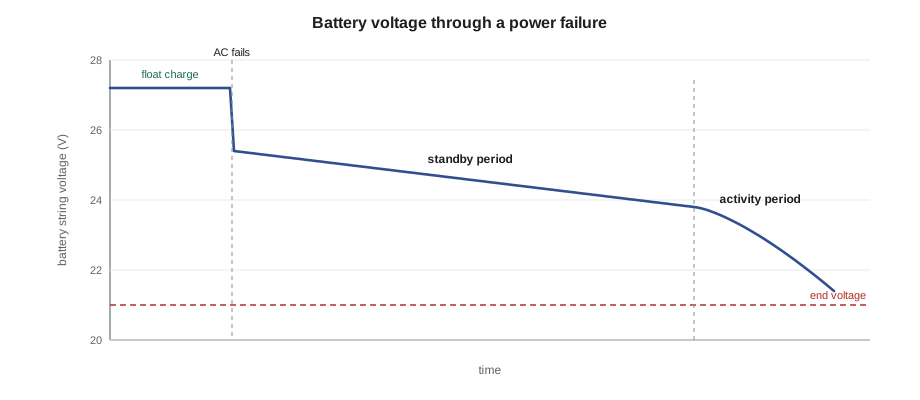
Backup requirements are usually written as two periods: a standby period during which the system idles at its normal load, followed by an alarm or activity period at a higher load. A fire alarm system's requirements are set by its own codes and are covered in the Fire Alarm Technician program. For access control and intrusion systems the specification or the certifying standard sets them; at Juniper Point, the specification calls for four hours of standby followed by fifteen minutes of full door activity.
The calculation adds the ampere-hours used in each period and then applies two correction factors. A temperature factor allows for reduced capacity in a cold location, and an aging or design factor, commonly 1.25, allows for the loss of capacity as the battery ages, so that the battery still meets the requirement near the end of its life rather than only when new.
# Battery sizing for a Juniper Point access control supply, 24 V (two 12 V batteries in series)
standby_a = 1.10      # locks held, readers and controllers idle
active_a = 2.40       # doors cycling, strikes energized, readers busy
t_standby = 4.0       # hours
t_active = 0.25       # hours (15 minutes)
aging = 1.25
temp_factor = 1.0   # capacity correction for the heated electrical room at about 20 °C
ah = (standby_a * t_standby + active_a * t_active) * aging / temp_factor
print(f"required capacity: {ah:.1f} Ah at 24 V")
for size in (7, 12, 18, 26, 40):
    if size >= ah:
        print(f"choose two 12 V {size} Ah batteries in series")
        break
print("check that the supply can charge it: about", round(size * 0.1, 1), "A charging at C/10 is typical for recovery")required capacity: 6.2 Ah at 24 V choose two 12 V 7 Ah batteries in series check that the supply can charge it: about 0.7 A charging at C/10 is typical for recovery
The calculation gives about 6.3 Ah, and the next standard size is 7 Ah. Sanjay often goes one size larger anyway, to 12 Ah, when the enclosure has room, because battery capacity is the cheapest margin in the system and loads have a habit of growing as owners add doors.
The equation contains brackets but the arithmetic is simple, and Maya should be able to do it on paper. What matters most is using the correct currents. The standby current is the system's normal draw, which includes the locks that are held energized: a maglock draws its current continuously while the door is locked, so a building full of maglocks has a high standby current, while electric strikes that are locked when unpowered draw current only when they release. That difference is one reason Sanjay prefers fail-secure strikes on doors where the fire code allows them.
Fail-safe and fail-secure
When power and the battery are exhausted, every electric lock goes to its unpowered state, and that state must be chosen deliberately. A fail-safe lock unlocks when it loses power: a maglock is always fail-safe, because it holds only while energized. A fail-secure lock stays locked without power: many electric strikes and electrified locksets are fail-secure, and remain free to open from the inside by the mechanical handle. The building and fire codes decide which may be used on which doors, especially on exit routes and stairwell doors, and on most egress doors the occupants must always be able to leave. The access control designer makes those choices with the architect and the authority having jurisdiction; the installer must install the lock that was specified and confirm its behaviour, never change it to save a few dollars of battery.
Many access control supplies also receive a signal from the fire alarm system. When the fire alarm operates, the supply drops power to the fail-safe locks on the designated doors so that they release, regardless of the battery. That interface is a fire alarm connection, and it is tested with the fire alarm technician present.
Uninterruptible power supplies
Network closets use uninterruptible power supplies to carry switches, routers and controllers through short outages and to allow orderly shutdown in long ones. Small UPS units plug into a receptacle and supply the equipment at 120 V AC from their batteries through an inverter; larger rack-mounted units may be hard-wired by the electrician. A UPS rating is given in volt-amperes and in watts, and its runtime depends on the load: halving the load more than doubles the runtime, again because of the battery's rate effect. Manufacturers publish runtime charts, and many UPS units report their load and estimated runtime on their displays and over the network.
# How long will a closet UPS carry its load? (simple estimate, illustrative battery)
battery_wh = 2 * 12 * 9.0          # two 12 V, 9 Ah batteries
inverter_eff = 0.88
usable = 0.80                      # fraction of the 20-hour capacity usable at these rates
for load_w in (150, 300, 450, 600):
    minutes = battery_wh * usable * inverter_eff / load_w * 60
print(f"load {load_w:3d} W: about {minutes:5.1f} min")load 150 W: about 60.8 min load 300 W: about 30.4 min load 450 W: about 20.3 min load 600 W: about 15.2 min
The estimate is rough; the manufacturer's runtime chart is more accurate because it includes the rate effect, which shortens runtime at heavy load more than this calculation suggests. The principle the numbers show is the important one: a closet UPS sized for short outages will not run a fully loaded PoE switch for hours.
Installing and maintaining batteries safely
Battery work follows a short list of rules that Cobalt Line enforces on every job.
- Remove rings, watches and metal jewellery, and use insulated tools when connecting batteries, so that nothing can bridge the terminals.
- Connect the batteries to each other first, then connect them to the supply last, with the supply's battery output switched off or its fuse removed; disconnect in the reverse order. Check polarity before the final connection.
- Use the battery type, voltage and capacity the supply is designed for, and never mix old and new batteries or different capacities in one string.
- Mark each battery with its installation date. Most specifications require replacement at three to five years, or sooner if a test shows lost capacity.
- Keep batteries out of hot spaces where possible, and leave room for ventilation; a swollen lead-acid battery has been overcharged or overheated and must be replaced.
- Wear eye protection, and treat a leaking or cracked battery as a chemical hazard, following the safety data sheet.
Maintenance checks include measuring the float voltage at the battery terminals, which should match the charger's setting, typically about 13.6 to 13.8 V per 12 V battery; checking the terminals for corrosion and tightness; and periodically testing the battery under load, either with a battery tester or by switching off the AC supply and confirming that the system runs on battery for the expected time while the battery voltage stays above its end voltage.
Worked problem
A lobby supply that fails its battery test
During Juniper Point's commissioning, Maya switches off the AC to the lobby access control supply. The system should run for four hours, but after 50 minutes the supply reports low battery. The batteries are two 12 V, 7 Ah units dated three months earlier; the standby current measures 1.9 A, not the 1.10 A in the design. What went wrong?
Show solution
- At 1.9 A the battery would deliver roughly 7 × 0.8 = 5.6 Ah at that rate, enough for only about three hours, even if new and full.
- 50 minutes suggests the batteries were not fully charged, or the load is even higher at times. Maya checks the charging: the batteries had been connected only the day before, and new batteries need a full day or more to charge.
- The higher standby current comes from two extra maglocks added to the lobby by a change order after the design was done.
- Sanjay recalculates: (1.9 × 4 + 3.2 × 0.25) × 1.25 = 10.5 Ah. Cobalt Line installs 12 Ah batteries, and the test is repeated after 48 hours of charging.
Answer: The batteries were undersized for a load that grew with a change order and had not been fully charged; recalculation and a retest fixed both.
Battery replacement is also a planned task, not an emergency. Cobalt Line's service department keeps a list of every battery it has installed, with its location and date, and schedules replacements before the batteries reach the end of their expected life. A battery that fails during a power outage fails at the worst possible moment, when the doors, alarms and network depend on it.
Common mistakes
MistakeUsing the 20-hour capacity for a heavy load.
InsteadUsable capacity falls at higher currents; allow for the rate effect.
MistakeLeaving out the aging factor.
InsteadMultiply by about 1.25 so the battery meets the requirement near end of life.
MistakeTesting standby on batteries installed the same day.
InsteadCharge fully, often 24 to 48 hours, before a standby test.
MistakeWearing a ring while connecting batteries.
InsteadRemove metal jewellery and use insulated tools.
MistakeReplacing a fail-secure strike with a fail-safe lock on site.
InsteadInstall what was specified; lock behaviour is a code decision.
Summary and key terms
- Batteries store chemical energy; series connections add voltage, parallel connections add capacity.
- Capacity in Ah is quoted at a slow rate; heavy loads get less, and heat shortens lead-acid life.
- Required capacity = (standby current × time + alarm current × time) × aging factor, corrected for temperature.
- Fail-safe locks release without power; fail-secure locks stay locked; the codes and the specification decide which is used.
- Batteries can deliver dangerous short-circuit currents; follow the connection order, use insulated tools and date every battery.
- Ampere-hour
- A measure of battery capacity: the current a battery delivers multiplied by the hours it can deliver it.
- VRLA battery
- A valve-regulated, sealed lead-acid battery used in most backup supplies.
- Float charging
- Holding a battery at a constant voltage that keeps it fully charged without overcharging.
- Aging factor
- A multiplier, commonly 1.25, that keeps a battery adequate as it loses capacity with age.
- Fail-safe lock
- A lock that releases when it loses power.
- Fail-secure lock
- A lock that stays locked when it loses power.
- UPS
- An uninterruptible power supply, which carries equipment through power failures on battery.
Practice problems
Work each problem on paper first, then reveal the answer to check.
Two 12 V, 7 Ah batteries are connected in series. What is the voltage and capacity?
Show answer
24 V, 7 Ah.
A system draws 0.8 A in standby for 24 hours and 2 A for 30 minutes. What capacity is required with a 1.25 aging factor?
Show answer
(19.2 + 1.0) × 1.25 = 25.3 Ah.
Why do maglocks raise the standby current while fail-secure strikes do not?
Show answer
Maglocks draw current all the time they are locked; strikes draw current only to release.
A 12 V battery on float reads 12.4 V. What does that suggest?
Show answer
It is not being float charged at its correct voltage, about 13.6 to 13.8 V; check the charger.
Lesson quiz · 5 questions
Score 60% or more to complete this lesson.
Create a free account to save your progress, take quizzes and earn a certificate.