
LVT-110 · Lesson 1 of 12 · 22 min
The low-voltage trade
Every modern building runs on two electrical systems. One is the power system that lights the rooms, runs the elevators and feeds the receptacles. The other is a web of smaller circuits that carry information and control: the data network, the Wi-Fi, the security cameras, the card readers and electric locks, the paging speakers, the conference room displays, the nurse call stations and the intercoms at the front door. Low-voltage technicians install, terminate, test and service that second system. This course is the first in the Low-Voltage Technician program, and it lays the foundations the rest of the program builds on: what low voltage means, the electricity an installer needs to understand, the hazards on a job site and how to control them, the tools and test equipment of the trade, the drawings that describe the work, and the rules about who is allowed to do it.
The course follows Maya Okonkwo through her first months as an apprentice with Cobalt Line Systems, a low-voltage and integration contractor based in Ottawa. Cobalt Line has about sixty technicians and works on schools, hospitals, office fit-outs, residential towers and warehouses. Maya's mentor is Dev Malhotra, a lead technician with eighteen years in the trade who started pulling cable for a telephone company and now runs crews of six to ten people. Colette Brennan is the project manager who keeps the jobs on schedule and on budget, Sanjay Iyer is the estimator and designer who turns architects' drawings into cabling and security layouts, and Greta Lindqvist is Cobalt Line's safety coordinator.
What low-voltage technicians do
The trade has grown out of several older ones. Telephone installers once ran copper pairs to every desk; security companies wired alarm panels and door contacts; sound contractors installed paging and background music; and electricians often did all of it as a sideline. Over the last thirty years those systems have converged on one technology. Telephones, cameras, access control panels, paging amplifiers, building controllers and even lights now connect to an Ethernet network, often draw their power from it, and are configured with a laptop. The modern low-voltage technician therefore needs a little of each older trade: the cabling discipline of the telephone installer, the device knowledge of the security technician, the audio sense of the sound contractor and the electrical safety habits of the electrician.
Most of Cobalt Line's work falls into a handful of system types, and the later courses in this program take them one at a time.
- Structured cabling: the horizontal and backbone copper and fibre cabling that carries data, voice and building systems, with its telecommunications rooms, racks, patch panels and pathways. LVT-120, LVT-130 and LVT-210 cover design, copper installation and fibre.
- Networking for installers: the switches, IP addressing, Power over Ethernet and wireless access points that the cabling connects. LVT-220 covers it from the installer's point of view.
- Security systems: intrusion alarms, access control with card readers and electric locks, and IP video surveillance. LVT-230 covers them.
- Audio-visual and paging: classroom and boardroom displays, sound reinforcement, paging and background music. LVT-310 covers them.
- Wireless and in-building coverage: Wi-Fi surveys, distributed antenna systems and the public safety radio coverage that fire departments rely on. LVT-320 covers them.
- Codes, bonding and grounding: the electrical code rules for communication and limited-energy circuits, cable ratings, firestopping and the bonding of telecommunications systems. LVT-330 covers them, and LVT-340 prepares for certification.
Fire alarm systems use many of the same skills but are governed by their own codes, standards and certifications, and the Fire Alarm Technician program covers them separately. A low-voltage technician will often work beside fire alarm technicians and must know not to disturb their circuits.
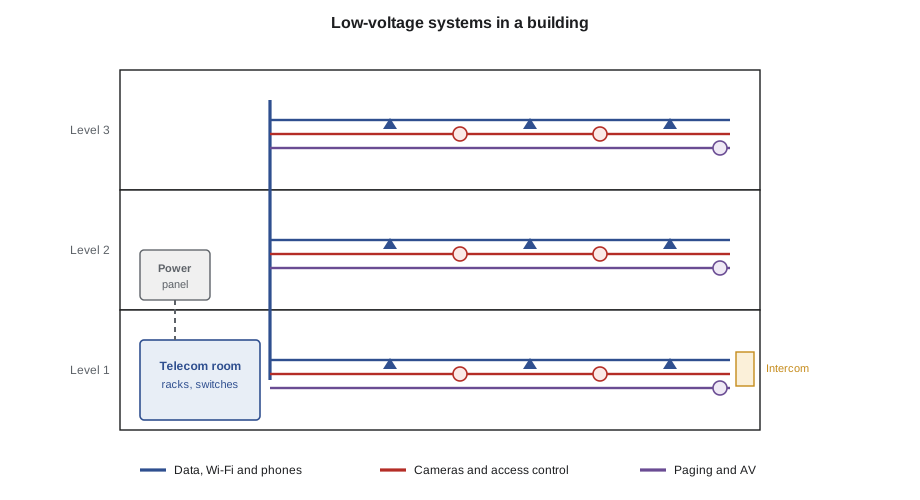
A day on the job
Maya's first assignment is Riverside Secondary School, a new three-storey building with about 900 data outlets, 120 wireless access points, 140 cameras, card readers on 60 doors, a paging system and a display in every classroom. Cobalt Line's crew of eight arrived when the building was closed in and the walls were framed. The day starts at 7:00 with a toolbox talk led by Dev, in which the crew reviews the day's tasks and the hazards that come with them: today, work on scissor lifts in the gymnasium, cable pulling through open ceilings in the second-floor corridor, and a shared work area with the drywall crew. Each technician signs the hazard assessment for the day before picking up tools.
The work itself is a mix of physical and careful tasks. In the morning Maya and another apprentice set up a cable cart with twelve boxes of category 6 cable and pull bundles from the second-floor telecommunications room to the classrooms along a cable tray, while Dev checks the route against the drawings and sets the bend radius at each turn. In the afternoon Maya labels the cable ends and helps Dev dress the cables into the rack. Before she leaves, she records the day's progress on the drawing: which outlets have cable pulled, which are terminated, which still need a pathway. That marked-up drawing is how Colette tracks the job, and at the end of the project it becomes part of the record that Cobalt Line hands to the school board.
A low-voltage career rarely stays in one place. After the rough-in at Riverside comes the termination and testing phase, then device installation as ceilings close, then commissioning, when cameras are aimed, card readers are enrolled and the paging zones are tuned. Experienced technicians often specialise: some become fibre splicers, some security or audio-visual programmers, some project leads or designers like Sanjay, and some move into service, where they troubleshoot systems in occupied buildings.
Why the trade's safety record depends on habits
Low-voltage work is often thought of as safe because the circuits themselves rarely carry enough voltage to give a dangerous shock. That reputation is only half true. The circuits Maya will install are mostly limited in energy, but she will work beside, above and inside the power system that feeds them, on ladders and lifts, in ceilings full of other trades' equipment, and on construction sites with every hazard a construction site has. Falls from ladders and lifts, cuts, eye injuries, strains from pulling and lifting, and contact with power conductors that were not supposed to be live are the injuries that actually happen to low-voltage technicians. The second half of this course is about those hazards: power system safety in Lesson 7, ladders, lifts, ceilings and confined spaces in Lesson 8, and safe tool use in Lesson 9.
Greta's view, which she repeats at every orientation, is that the trade's safety depends less on knowledge than on habits that hold up when the job is rushed: reading the hazard assessment rather than signing it blind, checking a ladder before climbing it, testing before touching, and stopping to ask when something looks wrong. Maya's first week includes Cobalt Line's orientation, WHMIS training, the working at heights training that Ontario requires for anyone using fall protection on a construction project and lift training before she operates a scissor lift.
The tools of the trade
A first-year apprentice carries a modest tool kit and borrows the specialised instruments from the company. Maya's own kit contains a pair of cable cutters, a cable jacket stripper, a punch-down tool, a set of screwdrivers, a utility knife with a retractable blade, side cutters, needle-nose pliers, a tape measure, a level, a flashlight and a headlamp, a marker and a pocket notebook, and a non-contact voltage tester. Cobalt Line supplies the power tools, the fish tapes and glow rods, the cable pulling equipment, the cable certifiers, the fibre test sets, the multimeters and the label printers. Lesson 9 covers those tools and the test equipment in detail.
Personal protective equipment is part of the kit too: safety boots, a hard hat, safety glasses, high-visibility clothing, work gloves and cut-resistant gloves for handling sharp metal studs and tray, hearing protection for noisy areas, and a harness and lanyard for work on boom lifts. Maya also learns early that a good technician carries a clean rag and a small brush: cable dressed neatly into a rack and a work area left clean at the end of the day are the visible signs of a careful installer, and customers and general contractors notice both.
Low voltage, limited energy and the electrical code
The phrase low voltage is used loosely in the trade, and it means different things to different people. To an electrician, low voltage can mean anything below about 750 V, which includes the 120 V receptacles and the 347/600 V lighting and motor circuits in a commercial building. To a low-voltage technician it means the limited-energy circuits that communication and control systems use: data cabling, 24 V access control power, the 12 V supplies for cameras and the 70 V speaker lines of a paging system. The electrical code makes the distinction precisely, and Lesson 2 explains it. In Canada, the Canadian Electrical Code covers these circuits in Section 16, for Class 1 and Class 2 circuits, and Section 60, for electrical communication systems; Ontario adopts the Code as the Ontario Electrical Safety Code.
The distinction matters for two reasons. First, it decides which installation rules apply: how cables must be rated for the spaces they pass through, how far they must be kept from power conductors and how they are protected. Second, it decides who may do the work. A low-voltage technician may install limited-energy circuits, but the power circuits that feed the equipment, and anything connected to them, belong to licensed electricians. Lesson 11 covers the licensing rules in each province.
# Sorting a job's circuits: limited-energy work or power work? (illustrative)
circuits = [
    ("data cabling to classroom outlets", "communication", 0),
    ("PoE to a wireless access point", "communication", 57),
    ("24 V DC lock power from a listed Class 2 supply", "class 2", 24),
    ("70 V paging speaker line", "class 2", 70),
    ("120 V receptacle for a camera power supply", "power", 120),
    ("347 V lighting circuit in the gym", "power", 347),
]
for name, kind, volts in circuits:
    who = "low-voltage technician" if kind in ("communication", "class 2") else "licensed electrician"
print(f"{name:<50} {volts:>4} V -> {who}")data cabling to classroom outlets 0 V -> low-voltage technician PoE to a wireless access point 57 V -> low-voltage technician 24 V DC lock power from a listed Class 2 supply 24 V -> low-voltage technician 70 V paging speaker line 70 V -> low-voltage technician 120 V receptacle for a camera power supply 120 V -> licensed electrician 347 V lighting circuit in the gym 347 V -> licensed electrician
The listing illustrates the point Dev makes on Maya's first day: the 70 V paging line operates at a higher voltage than the 24 V lock circuit, yet both are limited-energy circuits because their power sources are designed and listed to limit the energy they can deliver. The 120 V receptacle that feeds the camera power supply is a power circuit, however small its load. Voltage alone does not decide the class of a circuit; the source does.
Working with other trades
On a construction project the low-voltage contractor is usually a subcontractor, either to the electrical contractor or directly to the general contractor. Maya will share ceilings and walls with electricians, plumbers, sheet metal workers, sprinkler fitters and drywall crews, and the success of a job depends on coordination. The low-voltage crew needs the electricians to install conduit sleeves, backboxes and power for the telecommunications rooms; it needs the drywall crew to wait until cables are pulled before closing walls; and it needs the ceiling installers to leave tiles out until devices are installed. Colette attends the weekly coordination meeting where these sequences are agreed, and Dev reads the minutes every week so the crew knows what is coming.
Respect between trades is practical as well as polite. A cable bundle laid on top of a sprinkler pipe, tied to a ceiling grid wire or draped across a light fixture breaks the code and provokes conflict; a cable pathway that leaves room for the sheet metal crew earns cooperation. The rule Dev gives Maya is simple: never use another trade's equipment to support cable, and never move, open or disconnect another trade's work.
Customers, documentation and the end of a job
The low-voltage technician's work is largely invisible once ceilings and walls close, so documentation carries more weight than in many trades. Every cable has a unique label at both ends, every test result is saved and every device location is marked on the record drawings. At Riverside, the school board's IT department will use those records for twenty years to add outlets, find faults and plan upgrades. Lesson 10 covers drawings and documentation, and the capstone in Lesson 12 follows a small installation from the first site survey to the sign-off.
The trade also has a customer service side that new technicians underestimate. In occupied buildings like St. Brendan's Hospital, where Cobalt Line is adding an east wing, technicians work around patients, staff and visitors. They follow infection control rules for opening ceilings, keep corridors clear, explain what they are doing when asked and leave every room as clean as they found it. Dev's measure of a good service call is that the customer remembers the technician by name and wants the same one back.
Worked problem
Planning Maya's first-week priorities
On Maya's first Monday, Dev gives her four things to learn before Friday: the site's emergency procedures, the day's hazard assessment process, the labelling scheme for Riverside, and how to mark up the progress drawing. Which should come first, and why?
Show solution
- The emergency procedures come first, because they apply from the first minute on site: the muster point, the location of first aid, how to report an injury and who the site's first aid attendants are.
- The hazard assessment process comes next, because Maya must take part in it before any task each day.
- The labelling scheme and progress mark-up are quality tasks; they matter, but a mistake can be corrected, while a safety gap can cause an injury that cannot.
- Dev's order therefore follows a general rule: life safety first, then hazard control for the work, then the quality and documentation of the work itself.
Answer: Emergency procedures, then the hazard assessment process, then labelling and progress mark-up: safety knowledge first, quality knowledge second.
Common mistakes
MistakeAssuming low-voltage work carries no electrical risk.
InsteadThe circuits are limited, but technicians work beside live power systems and must treat every unknown conductor as live.
MistakeDeciding a circuit's class from its voltage alone.
InsteadThe listed power source decides whether a circuit is Class 2, Class 3 or a power circuit.
MistakeSupporting cable from sprinkler pipe, ceiling wires or another trade's equipment.
InsteadUse the pathways and supports provided for the cabling.
MistakeTreating labelling and records as paperwork to finish later.
InsteadLabel and record as the work is done; the records outlast the installation.
MistakeSigning a daily hazard assessment without reading it.
InsteadRead it, ask about anything unclear and add hazards that are missing.
Summary and key terms
- Low-voltage technicians install and service communication, security, audio-visual and control systems in buildings.
- Those systems have converged on Ethernet and IP, so the trade combines cabling, device, audio and safety skills.
- Limited-energy circuits are defined by their power sources, not by voltage alone; power circuits belong to licensed electricians.
- Most injuries in the trade come from falls, cuts, strains and contact with power systems, not from the limited-energy circuits.
- Coordination with other trades and careful documentation are part of the technician's job.
- Low-voltage technician
- A tradesperson who installs, terminates, tests and services communication and limited-energy systems.
- Limited-energy circuit
- A circuit whose power source limits the voltage, current and power it can deliver.
- Integration contractor
- A contractor that installs several building systems and connects them so they work together.
- Toolbox talk
- A short safety meeting at the start of a shift that reviews the day's tasks and hazards.
- Record drawings
- Drawings updated to show the work as it was actually installed.
Practice problems
Work each problem on paper first, then reveal the answer to check.
Name four system types a low-voltage contractor typically installs.
Show answer
Any four of: structured cabling, networks and wireless, access control, intrusion alarms, video surveillance, paging and audio-visual systems, in-building wireless coverage.
Why is a 70 V paging line treated as a limited-energy circuit while a 120 V receptacle is not?
Show answer
The paging amplifier is a listed power-limited source; the receptacle is fed from a building power circuit.
Which injuries are most common in low-voltage work?
Show answer
Falls from ladders and lifts, cuts, eye injuries, strains, and contact with power conductors.
Why do record drawings matter more in this trade than in many others?
Show answer
The work is hidden once walls and ceilings close, so the records are the only way to find and maintain it.
Lesson quiz · 5 questions
Score 60% or more to complete this lesson.
Create a free account to save your progress, take quizzes and earn a certificate.