
LES-217 · Lesson 7 of 12 · 19 min
OC spray: effects, policy and decontamination
▶ Video coming soon A video version of this lesson is on the way.
At 01:19 on Saturday, May 9, 2026, a doorman at the Dockside Social on Front Street waved down a passing patrol car. Two men had been arguing outside, and one, Shawn Petrie, 24, had knocked the other, Kai Lindqvist, 26, to the sidewalk and was kneeling over him, punching him in the head. Probationary Constable Sofia Reyes and her training officer, Constable Dev Malhotra, were out of the car within seconds. A crowd of about fifteen people was gathering.
Reyes shouted at Petrie to stop and get back. He ignored her and kept punching. She was about two metres away. She drew her OC spray, called out 'Police, stop, or you'll be sprayed,' and when he raised his fist again, she gave him one short burst. Petrie threw his hands to his face and fell sideways off Lindqvist. Malhotra handcuffed him. Desjardins pauses the video at that point. 'Everything in this course says force must stop a real threat, be proportionate and end when the threat ends,' he says. 'Petrie was hitting a man on the ground in the head. That is a threat of serious harm. Now watch what she does next, because that is where OC spray incidents go right or wrong.'
What OC spray is and how it works
OC spray contains oleoresin capsicum, an oily extract from hot peppers whose active compounds, the capsaicinoids, cause intense burning when they touch the eyes, skin and the lining of the nose, mouth and airways. It is an inflammatory agent rather than a tear gas, although people often confuse them. Within seconds, most people's eyes close involuntarily and water heavily, and they feel a burning sensation on the face. Many cough, have trouble catching their breath and produce mucus. The effects usually peak within a few minutes and fade gradually over about thirty to forty-five minutes, though some burning can last longer, especially without decontamination.
Police OC products differ in concentration and in how the spray is delivered, such as a stream, a cone-shaped mist, a foam or a gel. Agencies choose products to suit their needs; for example, streams and gels are less likely to drift onto bystanders than mists, which matters indoors and in crowds. Each officer is trained on the product they carry and must not alter it or carry a different one. As lesson 1 explained, aerosol irritant sprays for use on people are prohibited weapons for the public in Canada, and police carry them under the peace officer exemption.
Effectiveness and risks
OC spray is usually effective, but not always. In a study of 690 incidents published in 1999, often cited by the U.S. National Institute of Justice, OC was found effective in about 85 of every 100 cases under the broadest definition, and less effective when the person appeared to be under the influence of drugs. People who are highly agitated, intoxicated or in a mental health crisis may continue to fight despite the pain, and some people are simply less sensitive to it. Officers must therefore plan for it not working, just as with conducted energy weapons.
For most people OC spray causes severe discomfort but no lasting harm. The main serious risk is to breathing. People with asthma or other respiratory conditions can have a severe reaction. And the most dangerous period is often not the spraying itself but what happens afterwards: a person who is coughing, panicking and struggling to breathe, who is then held face down or with weight on their back, can suffer positional asphyxia. A 2003 study for the National Institute of Justice reviewed 63 deaths in custody that followed the use of OC spray. It found that OC contributed to the death in two cases, both involving people with asthma. In the rest, the deaths were attributed to drugs, disease, positional asphyxia or a combination. Desjardins asks the class what that finding means for officers. Priya answers: 'That the spray is rarely what kills people. What you do afterwards is.'
Other risks include eye injuries if the spray is used at very close range or if a person rubs their eyes, skin irritation that worsens if not washed, injuries from falls when a person is suddenly blinded, and contamination of bystanders, children, other officers and the person spraying. OC used in an enclosed space, such as a car, a cell or a small room, can affect everyone in it.
Policy limits
Most service policies treat OC spray as an intermediate weapon and set similar limits to those for other less-lethal weapons. It may be used to stop an assault or to overcome active resistance that is likely to cause injury, and not to punish, to make a passive person comply or to break up a peaceful gathering. Officers should give a warning when it is safe to do so, use the minimum amount needed, usually a short burst, and reassess before using more. Using OC on a person who is handcuffed and not posing a threat is prohibited in most policies. Policies also direct extra care with people who have known breathing problems, children, elderly people and people in confined spaces, and some prohibit use on people who are already restrained in a vehicle or cell.
Canadian courts and oversight bodies have found OC use excessive where it was used on people who were already controlled, or used to punish, and the same section 25 test applies as for any force.
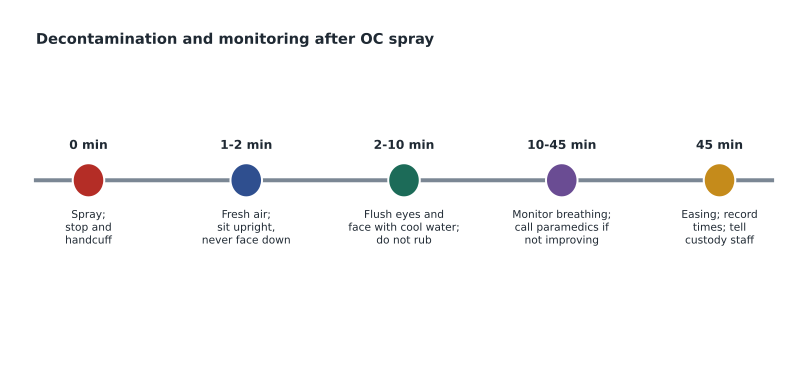
Decontamination: what Reyes did next
After Malhotra handcuffed Petrie, Reyes told him, 'You've been sprayed with pepper spray. It's going to burn for a while, but it will get better. We're going to help you. Breathe slowly.' They brought him to his feet and walked him about ten metres upwind, away from the crowd, and sat him on the edge of a planter rather than keeping him on the ground. Reyes took the decontamination kit from the patrol car, which in Port Ardent contains bottles of water and disposable towels, and flushed his eyes and face with water, telling him not to rub them. She asked whether he had asthma or any breathing problems; he said no. She asked whether he was wearing contact lenses; he was not. Malhotra radioed for paramedics, partly for Lindqvist's injuries and partly for Petrie.
Decontamination is not optional. It is part of the duty of care officers owe to a person they have taken into custody, and failing to provide it can be part of an excessive force finding. The basic steps are the same across most policies: get the person into fresh air and sitting or standing upright, never face down; reassure them and explain what is happening; flush the eyes and skin with large amounts of cool water; tell them not to rub; remove contact lenses if they can; remove contaminated clothing where practical; and monitor them closely, especially their breathing. Creams, lotions and oily substances generally should not be used because they can trap the OC on the skin. If breathing does not improve, or the person has asthma or another condition, call paramedics immediately.
The bystander problem appeared that night as well. Kai Lindqvist, still on the sidewalk, began coughing hard. He told Malhotra he had asthma. The OC had not been aimed at him, but some drifted onto him. Malhotra helped him sit up and move upwind, and found his inhaler in his jacket pocket. When paramedics arrived at 01:27, they assessed Lindqvist first. His breathing improved after his inhaler, and they treated a cut on his lip and a bruised cheekbone from the punches. Reyes had a small amount of OC on her hand and wrist from the spray drifting back; she rinsed it and reported it.
| Minute | Observation | Breathing |
|---|---|---|
| 0 | Sprayed; handcuffed | Strained |
| 2 | Moved upwind; sitting upright | Strained |
| 4 | Eyes and face flushed with water | Strained |
| 12 | Coughing less; talking normally | Normal |
| 30 | Eyes still red; burning easing | Normal |
| 45 | Symptoms much reduced | Normal |
Checked against the monitoring rules, the record shows that Petrie was upright within 2 minutes and flushed within 4, and that he was watched for 45 minutes. His breathing was never severe and was normal at the end, so the right step was to record it and brief custody staff; severe breathing at any point, or breathing that was not normal at the end, would have meant calling paramedics at once.
The record for Petrie, which Reyes wrote up afterwards, looked very much like this. Paramedics checked him at 01:32, found his breathing normal and his eyes irritated but not injured, and cleared him for custody. At the station, he was given a decontamination shower before being placed in a cell, and custody staff were told he had been sprayed and when. Haddad, reviewing the incident the following week, highlighted two things. First, Reyes gave a warning and used one short burst at a man who was actively attacking another person. Second, she began decontamination within about four minutes and monitored him throughout. 'That is a textbook OC incident,' Haddad says. 'The spray took a second. The care took an hour.'
After the incident
Petrie was charged with assault. In August 2026, he pleaded guilty and received a conditional sentence with probation and an anger management program. Lindqvist made a full recovery. Reyes filed a use-of-force report the same night, as Port Ardent's policy requires for any OC use, and Malhotra filed a separate report describing the handcuffing. Because Lindqvist was affected by drift, Haddad added a training note: in a crowd, consider whether the spray will reach bystanders and whether another option would stop the threat as quickly, and if OC is used, check everyone nearby afterwards.
Indoors, vehicles and crowds
Haddad stresses that OC spray behaves very differently in enclosed spaces. Inside a small apartment, a vehicle, a hallway or a cell, the irritant can hang in the air for a long time and affect everyone, including children, elderly people and pets in the next room. Ventilation is part of decontamination, and officers should open doors and windows where safe and warn anyone who must enter. In a crowd, a mist can drift onto many people at once. These are reasons to consider other options first, not reasons to stop carrying OC.
Shawn Petrie told Reyes afterwards, as he sat on the planter with water running down his face, that he had never been sprayed before and thought he was going blind. Reyes told him the burning would get better, and kept telling him every few minutes as it did. Haddad says that kind of reassurance is part of aftercare too, because fear makes breathing harder and makes people more likely to struggle.
Worked problem
Is OC appropriate here?
A woman who has been arrested for shoplifting is sitting in the back of a patrol car, handcuffed, shouting and kicking the inside of the door. She is not able to reach anyone. An officer suggests spraying her to make her stop. Is that appropriate?
Show solution
- She is handcuffed and inside a car; she cannot reach the officers.
- Kicking the door is damage and a nuisance, but not a threat of serious harm to anyone.
- OC in an enclosed vehicle would affect her severely and contaminate the car and anyone who opens it.
- Other options: talk, wait, call a supervisor, and use leg restraints under policy if she is likely to injure herself.
Answer: Using OC would almost certainly be excessive and against policy. The officers should de-escalate and use the lowest level of control needed for her safety.
Common mistakes
MistakeOC spray is harmless because it does not cause lasting injury.
InsteadMost people recover, but breathing problems, positional asphyxia and eye injuries can be serious.
MistakeDecontamination is a courtesy.
InsteadDecontamination is part of the duty of care, and failing to provide it can be part of an excessive force finding.
MistakeA sprayed person can be left on the ground until they calm down.
InsteadGet them upright and into fresh air quickly; face-down positions are dangerous.
MistakeOC is a good way to move a passive crowd.
InsteadOC is for stopping assaults or active resistance likely to cause injury, not for passive or peaceful people.
Summary and key terms
- OC spray is an inflammatory agent that causes intense burning, eye closure and coughing; effects usually ease within thirty to forty-five minutes.
- It is usually but not always effective, especially with intoxicated or agitated people.
- The main serious risks are breathing problems, especially with asthma, and positional asphyxia afterwards.
- Policy limits OC to assaults and active resistance likely to cause injury, with a warning where safe and the minimum amount needed.
- Decontamination means fresh air, an upright position, cool water flushing, no rubbing and close monitoring.
- Bystanders, officers and anyone in an enclosed space can be contaminated and must be checked.
- Oleoresin capsicum
- An oily extract from hot peppers; the active ingredient in OC spray.
- Decontamination
- Steps to remove OC and relieve its effects, mainly fresh air and cool water.
- Cross-contamination
- OC reaching people other than the person sprayed, including officers and bystanders.
- Positional asphyxia
- Inability to breathe adequately because of body position or pressure on the chest or back.
Practice problems
Work each problem on paper first, then reveal the answer to check.
Why did Desjardins say OC incidents go right or wrong after the spray?
Show answer
Because the most serious risks, such as breathing problems and positional asphyxia, arise afterwards, and decontamination and monitoring decide the outcome.
What did the 2003 NIJ study find about OC and deaths in custody?
Show answer
OC contributed to two of 63 deaths, both people with asthma; the others were due to drugs, disease, positional asphyxia or a combination.
List four decontamination steps.
Show answer
Any four of fresh air, an upright position, flushing with cool water, no rubbing, removing contact lenses, removing contaminated clothing and monitoring.
What training note did Haddad add after Dockside Social?
Show answer
In a crowd, consider drift onto bystanders, and if OC is used, check everyone nearby afterwards.
Lesson quiz · 5 questions
Score 60% or more to complete this lesson.
Create a free account to save your progress, take quizzes and earn a certificate.