
LES-217 · Lesson 6 of 12 · 20 min
Conducted energy weapons: policy limits and vulnerable people
▶ Video coming soon A video version of this lesson is on the way.
Halfway through the July 14 call at Maple Court, Okeke glanced at the conducted energy weapon on his belt and then deliberately turned his body so it was out of Walter Haines's sight. He explained why in his notes afterwards: 'Mr. Haines is 84 and frail, walks with a cane, and is standing on a hard floor beside a dresser. A fall would likely cause a serious injury. He is not attacking anyone. A conducted energy weapon is not an appropriate option in these circumstances, and the sight of it could make him more frightened.'
Desjardins reads the note aloud. 'That is the policy in action,' he says. 'Not just the law of force, which says force must be proportionate, but the specific limits that services have built around these weapons after years of inquiries, court cases and deaths. This lesson is about those limits and why they exist.'
Where the limits come from
The policy limits on conducted energy weapons in both countries come from a small number of sources. The most influential in Canada is the Braidwood Inquiry. Its 2009 report recommended that these weapons be used only when a person is causing bodily harm or will imminently cause bodily harm and no lesser option would prevent it; that de-escalation be used first with people who are emotionally disturbed; that a cycle last no longer than five seconds unless the officer believes the first cycle did not remove the risk; that paramedics be called in every medically high-risk situation; and that officers who carry the weapon have a defibrillator readily available. The federal government, provinces and the RCMP issued guidelines and changed policies in response, and service policies today usually reflect these principles.
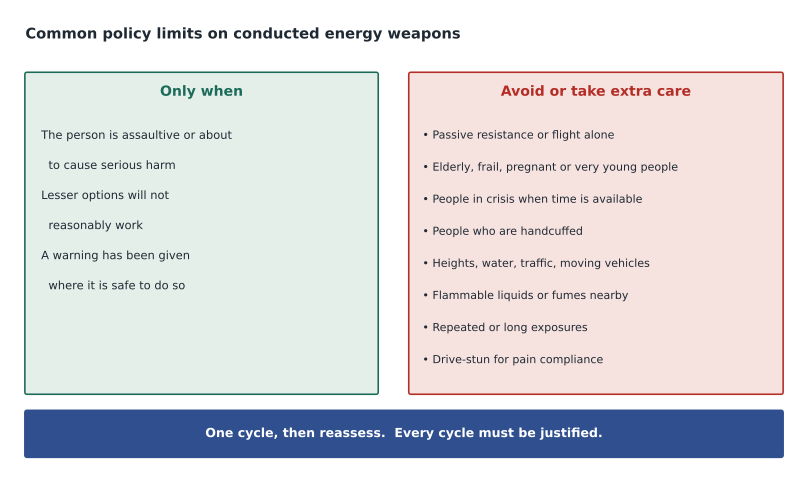
Port Ardent's policy, like most, combines these ideas. Haddad summarizes it for the class in six rules she says every officer who carries the weapon should be able to recite: use it only to stop a person who is assaultive or about to cause serious harm, not to make someone comply; give a warning when it is safe to do so; use one cycle and then reassess; justify every additional cycle separately and stay well within the exposure limit; avoid drive-stun except in the narrow circumstances policy allows; and treat every person exposed as needing medical assessment.
Passive resistance and flight
The clearest limit in modern policy is that conducted energy weapons are not for people who are only passively resisting. A person who sits down and refuses to move, holds onto a railing, goes limp or refuses to put their hands behind their back without threatening anyone is not a person these weapons are designed for. The Braidwood threshold of bodily harm excludes these situations, and so do most Canadian service policies. Officers have other options: time, talking, more officers, a supervisor, and physical control at the lowest level needed.
Flight on its own is also not usually enough. A person running away is not, by running, a threat to anyone. Policies typically require something more, such as a person fleeing from a serious violent offence who presents a danger to others. One reason is the fall risk: a person running at full speed who suddenly loses muscle control may hit the ground very hard.
Vulnerable people
Policies and guidelines in both countries identify people for whom the risk of serious injury is higher, and require officers to take extra care or to avoid the weapon except in the most serious situations. These include people who are elderly or frail, people who are visibly pregnant, children and people of small stature, people with known heart conditions, and people who are already exhausted or in severe distress. People in a mental health crisis are not necessarily at higher physical risk, but they are often confused, frightened and unable to follow commands, and inquiries in both countries have found that these weapons were used too quickly on people in crisis when more time and de-escalation might have resolved the situation.
Canadian human rights commissions and oversight bodies have also raised concerns that use of force, including conducted energy weapons, falls disproportionately on Indigenous, Black and other racialized people, and some services now collect and publish race-based use-of-force data, as Ontario's Anti-Racism Act framework requires. Desjardins tells the class that these concerns are part of why policies require detailed reporting and supervisory review of every use.
In the United States, the Ninth Circuit, sitting with a full panel of judges in Mattos v. Agarano in 2011, considered a case in which officers used a conducted energy weapon in drive-stun mode three times on a woman who was seven months pregnant and had refused to sign a traffic ticket. The court found the force excessive, though the officers received qualified immunity. Cases like this are why many agencies now specifically address pregnancy in their policies.
Dangerous environments
Some environments make conducted energy weapons especially dangerous. A person at the top of stairs, on a roof, a balcony, a ledge or a bridge railing may fall from height. A person in or beside water may drown if they lose muscle control. A person driving or riding a bicycle, motorcycle or vehicle may crash. A person in or near traffic may fall into the road. And a person who has been doused with gasoline or another flammable liquid, or who is in an area with flammable vapours, may catch fire, because the electrical arc can ignite them. Policies in both countries direct officers to avoid using the weapon in these situations except where the threat is so serious that the risk of the fall or fire is outweighed.
Students who took the emergency management course remember the September 9 gasoline tanker rollover. Haddad says that no officer at that scene would have been allowed to use a conducted energy weapon near the spill, whatever happened. 'The weapon makes a spark,' she says. 'You don't make sparks next to thirty thousand litres of gasoline.'
Handcuffed people and people in custody
Using a conducted energy weapon on a person who is already handcuffed, or locked in a cell or a police car, is one of the most serious concerns in policy. A restrained person is rarely an immediate threat that cannot be managed another way, and uses in these situations have often been found to be punitive. Most policies prohibit it except where the person is about to cause serious bodily harm and lesser options have failed. Canadian courts have held that force used on people in custody must still meet the section 25 test, and that force used to punish is never justified.
| Case | Conduct | Person and setting | Cautions |
|---|---|---|---|
| Ostrowski, Bayview Ave | Assaultive | 29; asphalt | No listed cautions; still requires a threat of harm and proportionality |
| Haines, Maple Court | Concerning, not assaultive | 84 and frail; hard floor | Elderly (84); frail, with a high fall-injury risk |
| Driver at tanker scene | Active resistance | 40; on the road; fuel fumes | Conduct below the threshold for an intermediate weapon; dangerous environment (road); flammable liquid or fumes nearby |
A screening like this is a prompt, not a permission. It cannot tell an officer that force is justified, only which features of the person and the setting make a particular weapon riskier and must be weighed and, afterwards, explained in the report. An officer who uses a conducted energy weapon despite a listed caution, for example on a person standing at the top of a staircase, must be able to say why the threat was serious enough to accept that risk and why no other option would do.
The screening shows no listed caution for Ostrowski, although Haddad notes that asphalt is still a hard surface, which is why the fall risk appears in the review. It lists two cautions for Haines, which is exactly what Okeke wrote in his notes. And it lists three for a hypothetical driver at the tanker scene, any one of which would make the weapon a very poor choice.
Repeated cycles and the fifteen-second guideline
Each cycle of a conducted energy weapon is a separate use of force. When a first cycle does not end the threat, the officer must reassess before using another: has the person stopped, are they still a threat, did the probes miss, is there another option, would handcuffing now be possible? The Braidwood Inquiry recommended no more than five seconds unless the officer believes the first cycle did not remove the risk of bodily harm, and Canadian policies generally treat multiple or long cycles as requiring careful justification and medical assessment. Most policies also say that more than one officer should not use a conducted energy weapon on the same person at the same time.
Desjardins tells the class that the cases that led to the strictest rules almost always involved multiple cycles: a person who was already on the ground, who could not comply because the current was making their muscles contract, receiving cycle after cycle because officers interpreted the involuntary movement as resistance. 'The person is not resisting when their muscles are locked,' he says. 'Training now teaches officers to recognize that, and policy now requires them to stop and reassess.'
Giving a warning
Policies in both countries generally require officers to give a warning before using a conducted energy weapon, when it is safe and practical to do so. A warning gives the person a last chance to comply, alerts other officers so that they are not caught by surprise, and is an important part of showing that the force was a last resort. At Bayview Avenue, Ruiz shouted a warning as Ostrowski stepped toward Bekele, and used the weapon only when Ostrowski took another step. 'There are times you cannot warn, because a warning would give someone the second they need to hurt someone,' Haddad says. 'But those times are rarer than people think, and if you did not warn, your report has to say why.'
Desjardins adds that the warning must be one the person can understand. Shouting at a person who is deaf, who does not speak the language or who is in a severe crisis may not count as a meaningful warning. Officers should use simple words, gestures and, where possible, a voice the person already knows, and give the person a real chance to respond.
Haddad finishes with a reminder that policy limits are not obstacles to good policing. 'Every one of these rules exists because somebody was hurt or killed in exactly that situation,' she says. 'The pregnant woman rule, the handcuffed person rule, the fifteen seconds, the stairs: behind each of them there is a family, an inquest or a lawsuit. When you follow them, you are learning from people who paid for the lesson.' She tells the class that officers who understand why a rule exists are far more likely to follow it under pressure than officers who have only memorized it.
Worked problem
Is a second cycle justified?
After one five-second cycle, a man who had been swinging a hammer at an officer falls and drops the hammer. He is on his stomach and his arms are moving. The hammer is about two metres away. Should the officer use a second cycle?
Show solution
- Reassess: the man has dropped the hammer and is on the ground.
- Movement just after a cycle may be involuntary or an attempt to get up, not necessarily an attack.
- Options: officers can move the hammer out of reach, give clear commands and handcuff him with enough officers.
- A second cycle would be justified only if he made a renewed attempt to cause serious harm that could not be managed another way.
Answer: A second cycle is not justified on these facts. The officers should control the hammer, communicate clearly and handcuff him, then get him up and arrange medical assessment.
Common mistakes
MistakeA conducted energy weapon is appropriate for anyone who refuses commands.
InsteadPolicy limits it to people who are assaultive or about to cause serious harm.
MistakeAn elderly person is less dangerous, so the weapon is less risky.
InsteadElderly and frail people face higher risk of serious injury from falls and other effects.
MistakeContinued movement after a cycle means the person is still resisting.
InsteadMovement may be involuntary; officers must reassess before any further cycle.
MistakeUsing the weapon on a handcuffed person is acceptable if they are swearing.
InsteadUse on restrained people is prohibited in most policies except to prevent serious bodily harm when lesser options have failed.
Summary and key terms
- The Braidwood Inquiry's recommendations shape Canadian policy limits on these weapons.
- Conducted energy weapons are not for passive resistance, and flight alone is usually not enough.
- Elderly, frail, pregnant, very young and medically vulnerable people face higher risk; people in crisis need time and de-escalation.
- Heights, water, traffic, vehicles and flammable substances make the weapon especially dangerous.
- Use on handcuffed or confined people is prohibited except in extreme circumstances.
- Every cycle must be justified separately; officers reassess after each one and stay within exposure limits.
- Bodily harm threshold
- The Braidwood recommendation that these weapons be used only when a person is causing or about to cause bodily harm.
- Reassessment
- Stopping after a cycle to check whether the threat continues and whether another option is available.
- Vulnerable person
- A person at higher risk of serious injury, such as an elderly, frail, pregnant or very young person.
Practice problems
Work each problem on paper first, then reveal the answer to check.
Why did Okeke turn the weapon out of Haines's sight?
Show answer
Because the weapon was not an appropriate option for a frail elderly man who was not attacking anyone, and seeing it could have frightened him more.
Name three dangerous environments for conducted energy weapon use.
Show answer
Any three of heights, stairs, water, traffic, moving vehicles and flammable liquids or vapours.
What should an officer do after one cycle?
Show answer
Stop and reassess whether the threat continues and whether another option will work.
What did Braidwood recommend about cycle length?
Show answer
No more than five seconds unless the first cycle did not remove the risk of bodily harm.
Lesson quiz · 5 questions
Score 60% or more to complete this lesson.
Create a free account to save your progress, take quizzes and earn a certificate.