
LES-217 · Lesson 10 of 12 · 20 min
Medical risks, aftercare and the duty of care
▶ Video coming soon A video version of this lesson is on the way.
Joan Ivey arrived at the Bayview Avenue laundromat at 19:51 on February 17, four minutes after Ruiz used his conducted energy weapon. Coutu had already sat Tyler Ostrowski up against the side of the patrol car, with his hands cuffed in front of him because his left wrist was swelling, and was talking to him. Ivey's first measurements are in her report, which she shares with the class with Ostrowski's names removed: heart rate 134 beats a minute, breathing fast, skin hot and sweaty, temperature 38.6 degrees, confused about where he was, and pain and deformity of the left wrist. One probe was lodged in his clothing; the other had penetrated the skin just below his left collarbone.
'Every one of those numbers worried me more than the probe,' Ivey tells the class. 'Fast heart, high temperature, confusion, after a period of agitation and probably stimulants. That is a person whose body is under extreme stress. The weapon cycle lasted five seconds. What his body had been doing for the half-hour before that is what could have killed him.' She and her partner put him on a monitor, gave him oxygen and took him to Port Ardent General, where he was kept under observation for about six hours.
The duty of care
Once police take a person into custody, they take on a legal duty to protect that person's health and safety, including getting them medical care when they need it. In Canada, this duty arises from the common law, provincial policing legislation and service policy, and coroners' inquests have repeatedly examined deaths in police custody and made recommendations about medical assessment and monitoring. In Ontario, a death in custody leads to a mandatory coroner's inquest in many circumstances, and the Special Investigations Unit investigates deaths and serious injuries involving police. In practice, the duty means officers must watch for signs of medical distress, call for medical help early, never leave a restrained or exposed person unmonitored, and pass on what they know to whoever takes over.
After a less-lethal weapon is used, the duty of care is more demanding, because the weapon adds risks of its own and the person is often already stressed, injured or intoxicated. Port Ardent's policy, like most, requires medical assessment by paramedics or at hospital for every person exposed to a conducted energy weapon, and for anyone who has been struck with a baton or impact munition, has a known medical condition, or does not recover as expected after OC spray. It also requires officers to tell custody staff, in writing, which weapon was used, when and for how long.
Medical red flags
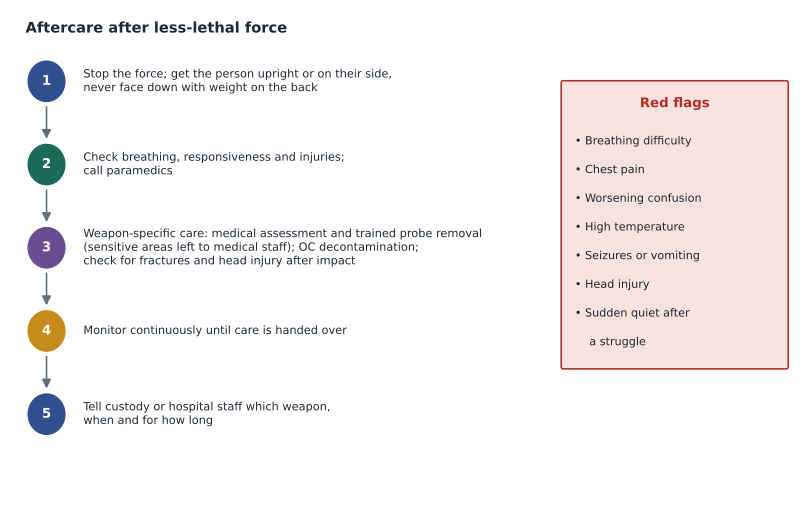
Some signs mean a person needs urgent medical care after any use of force, and especially after a less-lethal weapon. They include difficulty breathing or saying they cannot breathe; chest pain; loss of consciousness, even briefly; confusion that is getting worse; a very high temperature or hot, sweaty skin with extreme agitation; seizures; vomiting; a head injury, particularly with intoxication; severe pain that suggests a fracture; and any person who suddenly goes quiet and still after a struggle. That last sign is one of the most dangerous, because officers may mistake it for calm, when it can mean the person's heart or breathing is failing.
Desjardins spends time on a term students may see in older reports: excited delirium. For years, it was used to describe people who were extremely agitated, overheated and sometimes violent, often after taking stimulant drugs, and who sometimes died suddenly during or after restraint. The term has been widely rejected by medical organizations. In 2023, the American College of Emergency Physicians withdrew its 2009 paper that had supported it, and other major medical bodies have said it is not a recognized diagnosis and has been used to explain deaths that may have been caused or contributed to by restraint and force. Medical guidance now describes the underlying condition as hyperactive delirium with severe agitation, and treats it as a medical emergency requiring paramedics as soon as possible. 'Whatever word you use,' Desjardins says, 'the point is the same: a person in that state is a patient first. The more force and restraint you add, the higher the risk.'
Positioning and restraint after force
The most important aftercare step is often simply how the person is positioned. A person who has just been exposed to a conducted energy weapon or OC spray, who has been struggling, who is overweight, intoxicated or in a state of severe agitation, is at risk of positional asphyxia if they are held face down, especially with weight on their back. As the arrest course explained, officers should get the person onto their side or sitting up as soon as it is safe, avoid any pressure on the back, chest or neck, and watch their breathing constantly. A person who says 'I can't breathe' must be treated as a medical emergency.
At Bayview Avenue, Ostrowski was handcuffed during the cycle and sat up within about thirty seconds of falling. Coutu cuffed his hands in front rather than behind once she saw his wrist, which policy allows for an injury. Ruiz checked him for other injuries while Coutu kept talking. 'Six months later, the thing I'm proudest of on that call is the thirty seconds,' Coutu tells the class. 'Getting him up and breathing.'
Weapon-specific aftercare
For conducted energy weapons, policies generally require medical assessment of everyone exposed, and hospital assessment for anyone who has had a long or repeated exposure, who is in a high-risk group, who has a probe in a sensitive area, or who shows any red flag. Probes are treated as sharp biohazards. Only officers trained to do so may remove probes from non-sensitive areas, and probes in sensitive areas, including the face, neck, groin, breast and hands, are left for medical staff. The wounds are cleaned and covered, and the probes are kept as evidence. Following the Braidwood recommendations, Canadian policies emphasize calling paramedics early in medically high-risk situations and having a defibrillator available.
For OC spray, aftercare is the decontamination process from lesson 7: fresh air, upright position, cool water and monitoring, with paramedics called if breathing does not improve. For batons and impact munitions, officers must check for fractures, internal injuries and head injuries, and anyone struck on the head, neck, chest or abdomen, or with significant pain, needs medical assessment. In every case, officers must record what they saw, what care they gave and when, and who took over.
At Port Ardent General, the emergency physician who treated Ostrowski, Dr. Anika Rao, removed the probe from below his collarbone, cleaned the wound and ordered blood tests to check for muscle breakdown and other effects of his agitation and drug use. His wrist was X-rayed and found to be broken, and was set in a cast. His temperature and heart rate gradually came down. At about 02:00, once he was medically stable and calmer, a psychiatrist assessed him under Ontario's Mental Health Act, and he was admitted for several days of treatment.
| Person | Observed | Red flags | Action |
|---|---|---|---|
| Ostrowski, 19:51 | High temperature, worsening confusion, fast heart rate, wrist deformity | High temperature; worsening confusion | Urgent |
| Petrie, 01:32 | Red eyes, coughing easing | None listed | Continue monitoring and record |
| Training case D | Sudden quiet after struggle, lying face down | Sudden quiet after struggle | Urgent |
The red-flag list used for teaching is: breathing difficulty, chest pain, unresponsiveness, worsening confusion, high temperature, seizure, vomiting, head injury, and sudden quiet after a struggle. A fast heart rate or a deformed wrist still needs care, but neither on its own is on the list of signs that a person's life may be in danger.
The screening flags Ostrowski's high temperature and confusion, which is exactly why Ivey treated his overall condition as more serious than the probe or the broken wrist. It flags no red flags for Petrie after decontamination, although he still needed monitoring. And it flags the training case, in which a person who had been struggling suddenly went quiet while lying face down. Haddad tells the class that this is the scenario she drills most in requalification, because it is the one that has killed people in custody in both countries.
Handing over care
The duty of care does not end when the person is in a cell or at hospital. Officers must pass on what they know: which weapon was used and how many times or for how long, how the person was restrained and for how long, what injuries were seen, what the person said, whether they took drugs or alcohol, and any red flags. In Port Ardent, this goes on the prisoner's custody record and is read by the custody sergeant before the person is placed in a cell, as the arrest course described. At hospital, officers tell the triage nurse and the treating doctor directly.
Ivey adds that paramedics need the same information. 'If you tell me he was exposed for five seconds and sat up within thirty, that helps. If you tell me he was exposed three times and was face down for two minutes, that changes everything I do.'
Officers' own wellbeing
Aftercare also applies to officers. An officer who has used a less-lethal weapon, especially one that caused an injury, may feel shaken, worried about the investigation or replay the moment for weeks. Ruiz tells the class that he did not sleep well for several nights after Bayview Avenue, mostly because he kept wondering whether Ostrowski's injury could have been avoided. Port Ardent's peer support team contacted him the next day, and he spoke with the service's psychologist twice. 'Nobody told me I'd done anything wrong,' he says. 'But I still needed to talk it through.' Haddad tells the class that checking on the officers is part of every supervisor's job after a use of force, alongside checking on the person.
Officers can also be injured during these incidents, for example by OC drift, by a fall during a struggle, by contact with a probe or wire, or by the person they are trying to control. Those injuries must be reported, treated and recorded, both for the officer's health and because they are part of the full picture of what happened.
Joan Ivey also tells the class about the information she wishes officers always gave her when she arrives. 'Tell me what you saw before the force, not just after,' she says. 'How long was he running around? Was he hot to the touch? Did anyone see him take something? Did he hit his head on the way down? Those details change what I watch for in the ambulance and what the emergency doctor tests for, and sometimes they save a life.'
Worked problem
Recognizing an emergency
After a struggle in which OC spray was used, a man is handcuffed and lying face down on a sidewalk while officers wait for a transport van. At first he was shouting and kicking. Now he has gone quiet and still. One officer says he has finally calmed down. What should the officers do?
Show solution
- Treat the sudden quiet after a struggle as a possible medical emergency.
- Roll him onto his side or sit him up immediately and remove any weight from his back.
- Check his breathing and responsiveness; if he is not breathing normally, start emergency first aid and use a defibrillator if available.
- Call paramedics on a priority basis and tell them what force and restraint were used.
Answer: The officers must act immediately. Quiet and stillness after a struggle may mean the man cannot breathe, and every minute matters.
Common mistakes
MistakeIf the person is quiet, they have calmed down.
InsteadSudden quiet after a struggle can be a sign of a medical emergency.
MistakeMedical assessment is needed only if the person asks for it.
InsteadPolicy generally requires assessment after any conducted energy weapon exposure and after other less-lethal force with injury or risk.
MistakeOfficers may remove any probe at the scene.
InsteadOnly trained officers may remove probes from non-sensitive areas; probes in sensitive areas are left for medical staff.
MistakeExcited delirium is a reliable medical diagnosis.
InsteadMajor medical organizations have rejected the term; the condition is treated as a medical emergency, hyperactive delirium with severe agitation.
Summary and key terms
- Police owe a duty of care to people in custody, and deaths and serious injuries are examined by coroners and the Special Investigations Unit.
- Red flags include breathing difficulty, chest pain, worsening confusion, high temperature, seizures, head injury and sudden quiet after a struggle.
- Get the person upright or on their side quickly, avoid weight on the back, and monitor breathing constantly.
- Everyone exposed to a conducted energy weapon needs medical assessment; probes are biohazards and sensitive-area probes are left for medical staff.
- OC aftercare is decontamination; baton and impact munition aftercare includes checking for fractures and head injuries.
- Officers must hand over full information about the force used to custody and medical staff.
- Coroner's inquest
- A public hearing into a death, which can make recommendations to prevent future deaths.
- Duty of care
- The legal obligation to protect the health and safety of a person in custody.
- Hyperactive delirium with severe agitation
- A medical emergency involving extreme agitation and confusion, often with high temperature.
- Biohazard
- Material, such as a used probe, that may carry blood or infection.
Practice problems
Work each problem on paper first, then reveal the answer to check.
Why was Ivey more worried about Ostrowski's vital signs than the probe?
Show answer
His fast heart, high temperature and confusion after prolonged agitation and probable stimulants showed extreme physical stress.
Name four medical red flags after a use of force.
Show answer
Any four of breathing difficulty, chest pain, loss of consciousness, worsening confusion, high temperature, seizures, vomiting, head injury, severe pain and sudden quiet after a struggle.
Who may remove a probe from a sensitive area?
Show answer
Medical staff.
What information should officers hand over to custody or hospital staff?
Show answer
Which weapon was used and how, how the person was restrained, injuries, what they said, drugs or alcohol, and any red flags.
Lesson quiz · 5 questions
Score 60% or more to complete this lesson.
Create a free account to save your progress, take quizzes and earn a certificate.