
LES-217 · Lesson 11 of 12 · 20 min
Reporting, weapon data and oversight
▶ Video coming soon A video version of this lesson is on the way.
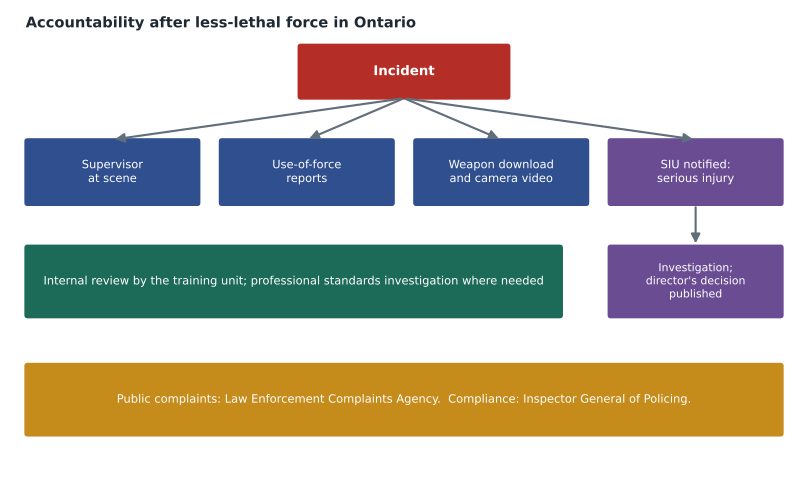
Sergeant Haddad arrived at the Bayview Avenue laundromat at 19:58 on February 17, eleven minutes after the conducted energy weapon was used. Port Ardent's policy requires a supervisor to attend every scene where one is used, and she was the closest. She checked that Ostrowski was with paramedics, that Hana Bekele was unhurt, and that both officers were all right. She photographed the scene, the broken bottle and the spent cartridge, made sure the probes and wires were collected, and told Ruiz to keep the weapon with him until a technician could download it. Because Ostrowski's wrist appeared to be broken, she then called the duty inspector. At 20:30, the service notified the Special Investigations Unit.
'The weapon took five seconds,' Haddad tells the class. 'The accountability took four months. That is how it should be. Every use of force belongs to the public, not to the officer who used it, and the public is entitled to know it was justified.'
Use-of-force reports
Almost every police service in both countries requires officers to write a use-of-force report whenever they use a less-lethal weapon, and many require one when they draw or display one. In Ontario, the regulation on use of force and weapons under the Community Safety and Policing Act requires a report in listed situations, such as when an officer uses a weapon other than a firearm on a person or uses physical force that causes an injury requiring medical attention, and many services add their own requirements, for example for displaying a conducted energy weapon. Since 2020, Ontario's reports have also collected the officer's perception of the person's race, under the province's anti-racism data standards, so that patterns can be analyzed and published. Other provinces have similar requirements.
A good use-of-force report describes, in the officer's own words and in the order things happened, what the officer saw and knew, what the person was doing, what options the officer considered, what force was used, exactly how and for how long, what happened next, what injuries were seen and what care was given. It avoids vague phrases such as 'the subject became combative' and replaces them with specific facts: 'He stepped toward Hana Bekele with the broken bottle raised to shoulder height.' It is written promptly, before the officer has watched the video if policy requires that, and it is reviewed by a supervisor. Reports that are later shown to be inaccurate can end careers, whatever the force itself.
Weapon data
Conducted energy weapons record data, and that data is one of the main ways services check reports. Most models log every time the weapon is switched on, every trigger pull, the length of each cycle, and the date and time. Newer models record more, and some automatically turn on nearby body-worn cameras when the weapon is drawn or armed. Port Ardent, like many services, downloads every weapon after any use and on a regular schedule, and audits the data against use-of-force reports. Body-worn camera video, dispatch recordings, witness statements and medical records complete the picture.
Ruiz's report said one cycle of five seconds. The download showed a function test at 18:58 and one trigger pull with the cartridge at 19:47:12 lasting five seconds. His body-worn camera, which turned on automatically when he drew the weapon, showed the warning, the cycle and the handcuffing. The weapon's clock was eleven seconds slow compared with the camera's clock, which the technician recorded; small clock differences are common, and services record and correct them rather than treating them as discrepancies.
| Weapon | Date | Logged | Reported | Result |
|---|---|---|---|---|
| CEW-14 | April 3 | 2 triggers | 2 triggers | Match |
| CEW-22 | May 17 | 1 arc display | No report | Discrepancy |
| CEW-09 | June 2 | 1 trigger | 1 trigger | Match |
| CEW-31 | June 20 | 1 arc display | 1 arc display | Match |
The audit compares counts for each weapon and date, so it catches both kinds of mistake: an event that was logged but not reported, as on CEW-22, and a report that describes more uses than the log shows, which would suggest an error in the report or a problem with the weapon's clock or memory. Either kind of discrepancy is resolved by asking the officer and recording the answer, and a pattern of them across a platoon is a supervision issue.
Five log entries were checked against the reports, and one did not match.
The audit table shows the kind of result a real audit produces. Most entries match. One does not: an arc display on CEW-22 in May that no report mentions. In Port Ardent's audit for the second quarter of 2026, two arc displays had not been reported. Both officers said they had shown the arc as a warning and the person had complied, and had not realized policy required a report. The service treated them as training issues, and Haddad added the reporting rule to the next requalification. 'If the audit had found an unreported trigger pull on a person, that would have been a very different conversation,' she says.
Supervisory review and early intervention
Every use-of-force report in Port Ardent is reviewed by a sergeant and then by the training unit, which looks for patterns: officers who use force more often than their peers, weapons or tactics that cause more injuries, locations or call types where force is common, and training needs. Many services in both countries use early intervention systems that track each officer's uses of force, complaints, collisions and other indicators and flag officers who may need support, retraining or closer supervision. These systems are not discipline in themselves; they are a way of catching problems early, and research suggests they work best when supervisors use them to help officers rather than to punish them.
Independent oversight
In Ontario, the Special Investigations Unit is a civilian agency that investigates incidents in which an officer's conduct may have caused death, serious injury, the discharge of a firearm at a person or a sexual assault. Its director decides whether there are reasonable grounds to believe an officer committed a criminal offence, and if so, lays charges; if not, the director publishes a report explaining why. Officers who are the subject of an investigation are not required to give statements or their notes, but witness officers must cooperate. Complaints from the public about officers' conduct are handled by the Law Enforcement Complaints Agency, which replaced the Office of the Independent Police Review Director in 2024 under the Community Safety and Policing Act, and the Inspector General of Policing oversees services' compliance with the law. Other provinces have similar civilian oversight agencies, such as the Independent Investigations Office in British Columbia and the Alberta Serious Incident Response Team.
The SIU investigated the Bayview Avenue incident. Investigators interviewed Hana Bekele, two other witnesses, Coutu as a witness officer and Ostrowski, and obtained the body-worn camera video, the weapon download and the medical records. Ruiz, as the subject officer, chose not to give a statement, as he was entitled to. In June 2026, the SIU director published a report concluding that there were no reasonable grounds to believe Ruiz had committed a criminal offence, because his use of the weapon was a reasonable response to an imminent threat of serious harm to Bekele, and the broken wrist was an unintended result of the fall.
Transparency
Many services now publish annual reports on use of force, including less-lethal weapons, broken down by weapon, outcome and, where collected, the race of the person. These reports allow the public, researchers and oversight bodies to see patterns that individual cases cannot show. Port Ardent's 2025 report, which Haddad hands out, shows that officers responded to about 61,000 calls and used a less-lethal weapon on a person 58 times: 23 conducted energy weapon cycles in probe mode, 4 in drive-stun mode, 27 uses of OC spray and 4 baton strikes, with no impact munitions used. Another 31 times, a conducted energy weapon or its arc was displayed without being fired, and the person complied. Haddad points out that the numbers are small compared with the number of calls, and that the display figures matter as much as the use figures.
Body-worn cameras and the record
Body-worn camera video has changed how less-lethal force is reviewed. It shows what the officer and the person said and did, the distances involved, the warning, the length of the force and the aftercare, and it often settles disputes that would once have been one person's word against another's. But Haddad warns that video has limits. A camera on an officer's chest does not see what the officer's eyes see, it can make distances look longer or shorter than they were, and it may miss things outside the frame, such as the side door at Bayview Avenue. 'Video is evidence, not the truth,' she says. 'Your report is where you explain what you saw that the camera did not.'
Ontario's regulations and many service policies set rules for when body-worn cameras must record and how long recordings are kept, and the SIU routinely obtains them. Port Ardent's cameras turn on automatically when an officer draws a conducted energy weapon, which is why both officers' videos captured the whole of the Bayview Avenue incident.
Complaints and public trust
Not every review of less-lethal force starts with a serious injury. Many begin with a complaint from the person, a family member or a witness. Complaints can be about the force itself, about rudeness, about how long aftercare took, or about what officers said. In Ontario, the Law Enforcement Complaints Agency receives public complaints and can investigate them itself or refer them to the service, with the agency overseeing the result. Haddad tells the class that how a service handles complaints about small incidents shapes public trust as much as how it handles the rare serious ones.
She describes a complaint from 2025 in which a man said an officer had threatened him with a conducted energy weapon during a traffic stop. The video showed the officer had put her hand on the weapon in its holster when the man reached under his seat, then took her hand away when he showed his wallet. The complaint was not upheld, but the review noted that the officer had not explained to the man afterwards why she had done it, and the training unit added that to its scenarios. 'Even when the force is justified,' Haddad says, 'an explanation afterwards can make the difference between a person who trusts us and a person who never calls us again.'
| Source | What it tells reviewers | Its limits |
|---|---|---|
| Use-of-force report | What the officer perceived and why they acted | Written by an involved officer |
| Body-worn camera | Words, actions, distances, timing | Limited field of view; distances can look different |
| Weapon download | Activations and their length | Says nothing about the threat or the probes |
| Witnesses | Independent accounts | Memory and viewpoint vary |
| Medical records | Injuries and care | May not show the cause of an injury |
Desjardins ends with a point about tone. Oversight, he says, is not an accusation. Most investigations of less-lethal force end with findings that the officer acted lawfully, as Bayview Avenue did, and officers who cooperate with oversight, write honest reports and keep good records generally come through it with their reputations intact. 'The officers who struggle with oversight are usually the ones who treat it as the enemy,' he says. 'The public gave you these weapons. Explaining how you used them is part of the deal.'
Haddad hands out a one-page checklist the service uses after every conducted energy weapon use: supervisor attends; scene photographed; probes, wires and cartridge collected; weapon downloaded; body-worn camera video tagged; medical care recorded; custody staff told; reports reviewed within a set time; and the officer offered peer support.
Worked problem
Writing a precise report
An officer's draft report reads: 'Subject was non-compliant and aggressive. I deployed OC. Subject was taken into custody without further incident and was decontaminated.' What should a supervisor ask the officer to add?
Show solution
- Who the person was, and what exactly they were doing: words, movements, distance, any weapon.
- What options the officer considered and why lesser options would not work.
- Whether a warning was given, how much OC was used and from what distance.
- What decontamination was given, when, by whom, and how the person's breathing was monitored.
- Any injuries, any effect on bystanders or officers, and who took over care.
Answer: The supervisor should return the report for specific facts, times and actions, so that anyone reading it can understand exactly what happened and why.
Common mistakes
MistakeA short report protects the officer.
InsteadVague reports raise questions; specific, accurate reports are the best protection.
MistakeThe weapon log is a substitute for the report.
InsteadThe log shows activations; the report explains what happened and why.
MistakeAn unreported arc display is not important.
InsteadPolicy requires displays to be reported, and audits check them.
MistakeThe SIU only investigates shootings.
InsteadThe SIU investigates deaths, serious injuries, firearm discharges at people and sexual assaults involving police.
Summary and key terms
- Every use of a less-lethal weapon, and often every display, must be reported promptly and specifically.
- Conducted energy weapon logs and body-worn camera video are audited against reports.
- Supervisors attend serious uses of force, and early intervention systems track patterns.
- Ontario's Special Investigations Unit investigates deaths and serious injuries involving police; the Law Enforcement Complaints Agency handles public complaints.
- Published annual reports let the public see patterns in less-lethal force.
- Accurate reporting is as important as justified force.
- Special Investigations Unit
- Ontario's civilian agency that investigates deaths, serious injuries, firearm discharges at people and sexual assaults involving police.
- Law Enforcement Complaints Agency
- The Ontario agency that handles public complaints about police since 2024.
- Use-of-force report
- A written report describing force used, why and what happened.
- Weapon download
- Data retrieved from a conducted energy weapon showing activations and their length.
- Early intervention system
- A system that tracks indicators such as force and complaints to flag officers who may need support.
Practice problems
Work each problem on paper first, then reveal the answer to check.
Why did the SIU or professional standards become involved at Bayview Avenue?
Show answer
Because Ostrowski suffered a serious injury, a broken wrist.
What did the weapon download show?
Show answer
A function test at 18:58 and one trigger pull of five seconds at 19:47:12.
What did the second-quarter audit find?
Show answer
Two arc displays that had not been reported.
Why do displays matter in annual reports?
Show answer
Because they show how often the weapon resolved a situation without being fired.
Lesson quiz · 5 questions
Score 60% or more to complete this lesson.
Create a free account to save your progress, take quizzes and earn a certificate.