
LES-206 · Lesson 8 of 12 · 20 min
Protective searches and searching vehicles, belongings and phones
▶ Video coming soon A video version of this lesson is on the way.
Before Mason Pruitt was arrested, Reyes saw the bag in the centre console. It was a clear plastic sandwich bag holding a few dozen small blue pills, sitting in the cup holder in full view of anyone standing at the driver's window with a flashlight. After Pruitt was handcuffed and searched, Malhotra searched the car. In the glove box he found a small digital scale and a box of small zip-top bags. On the passenger seat, one of Pruitt's two phones kept lighting up. The lock screen showed the first lines of new messages: 'u still good for 20' and 'where u at'. Malhotra photographed the screen without touching the phone, put both phones in a signal-blocking bag and did not try to open them.
Desjardins uses the Pruitt arrest to cover three kinds of searches that are not searches of the arrested person's body: protective searches during a detention, searches of vehicles and belongings, and searches of phones. Each has its own rules, and the rules in Canada and the United States differ more here than almost anywhere else in the course.
Protective searches during a detention
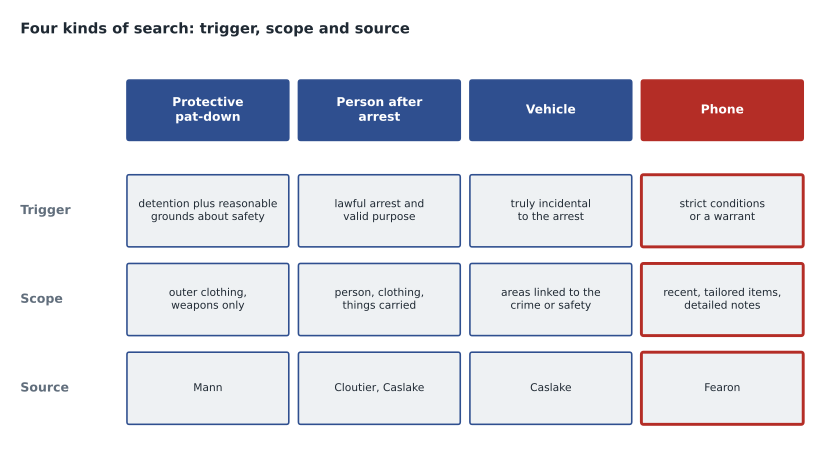
Before an arrest, officers sometimes detain a person briefly to investigate. A detention alone does not give a power to search. In R. v. Mann in 2004, the Supreme Court of Canada held that an officer conducting a lawful investigative detention may conduct a protective pat-down search if they have reasonable grounds to believe that their safety or the safety of others is at risk. The search is limited to what is necessary for safety: a pat-down of the outer clothing for weapons. Reaching into a pocket is justified only if the pat-down reveals something that could be a weapon. In Mann, the officer reached into a pocket after feeling something soft, found drugs, and the evidence was excluded because the search went beyond its safety purpose.
Haddad tells the class that the protective search is narrow for a reason: it exists to keep people safe, not to find evidence. 'If you feel something soft and you go into the pocket because you are curious, you are no longer doing a safety search,' she says. 'That is how good arrests get thrown out.'
Plain view
The bag of pills in Pruitt's console was not found by a search at all. Reyes saw it from a place she was lawfully entitled to be, the side of the car during a lawful traffic stop. Under the plain view doctrine, an officer who is lawfully in a place and inadvertently sees an item whose incriminating nature is immediately apparent may seize it without a warrant. A flashlight does not turn an observation into a search. Seeing the pills, together with Pruitt's nervousness and his hand going to his waistband, gave Reyes reasonable grounds to arrest him.
Searching a vehicle
In Canada, a vehicle can be searched incident to the arrest of its occupant if the search is truly incidental to the arrest and conducted reasonably, under R. v. Caslake. In Caslake, an officer searched a car six hours after the arrest as part of an inventory and found drugs; the Supreme Court held that the search was not truly incidental because the officer was not searching for a purpose connected to the arrest, although the evidence was admitted in that case. Malhotra's search of Pruitt's car was for evidence of trafficking, the offence for which Pruitt had been arrested, and it happened minutes after the arrest. The scale and the bags were evidence directly connected to that offence.
Desjardins draws a sharp line between a search for evidence of the offence and a general rummage. If Pruitt had been arrested on a warrant for an unpaid fine, there would have been no reason to think his car held evidence of that, and a search of the glove box would have been much harder to justify. 'The offence you arrested for tells you what you are looking for,' he says. 'What you are looking for tells you where you may look.'
Inventory searches and towed vehicles
When a vehicle is towed and impounded after an arrest, many services list its contents to protect the owner's property and protect the service from claims. In Canada, an inventory search must be authorized by law, such as a statute or regulation governing impounds, and Caslake made clear that an inventory done for administrative reasons cannot be relied on as a search incident to arrest. Officers should know what their province's law and their service's policy authorize. Pruitt's car was towed to the police lot and inventoried under policy by an officer who was not involved in the investigation.
Phones
Phones are the hardest search question in modern policing, because a phone holds far more about a person's life than anything else they carry: messages, photographs, location history, banking, health information and contacts. In R. v. Fearon in 2014, a four to three majority of the Supreme Court of Canada held that police may search a phone incident to arrest without a warrant, but only under strict conditions. The arrest must be lawful. The search must be truly incidental to the arrest, and where the purpose is finding evidence, only if the investigation would be stymied or significantly hampered without a prompt search. The nature and extent of the search must be tailored to that purpose, which usually means only recently sent or drafted messages, recent call logs and recent photographs. And officers must make detailed notes of what they examined, how and why. Any wider examination requires a warrant.
Malhotra and the detectives decided not to search Pruitt's phones under Fearon. The investigation would not be stymied without a prompt search: the phones were secured, nobody was at risk, and there was time to get a warrant. The lock-screen messages had been displayed without anyone touching the phone, so Malhotra photographed them and noted exactly how they appeared. Detectives applied for a warrant the next morning, and the phones were examined by the digital forensics unit under its terms. Desjardins tells the students that this is the safest approach in almost every case. 'If there is time to get a warrant, get one,' he says. 'A warrant takes a few hours. Losing a phone's evidence because you searched it unlawfully can lose the whole case.'
The students also discuss what officers should not do. They should not ask an arrested person to unlock a phone for them as a casual favour, scroll through photos 'to check whose phone it is', or look at a phone's contents in front of the person to provoke a reaction. Asking a detained person for their passcode can engage the right to silence and the right to counsel. Seizing a phone to preserve it is lawful incident to arrest; examining its contents is a separate question.
Belongings and containers
Bags, backpacks, purses and containers in a person's possession at arrest can be searched incident to the arrest within the limits already discussed. Belongings that are not in the person's possession, such as a suitcase in a hotel room or a bag left with a friend, generally need a warrant or another lawful basis. Officers should also be careful about items that belong to someone else: a passenger's purse in a car is not automatically searchable because the driver has been arrested. In Canada, the reasonableness of searching a passenger's belongings depends on its connection to the arrest and the passenger's own privacy interest.
| Question, in order | Practice case | If the answer is yes |
|---|---|---|
| 1. Was the arrest lawful? | yes | continue to question 2 (if no, no search incident to arrest is possible) |
| 2. Is there an imminent threat to someone's safety? | no | a narrow, urgent search may be justified; record everything |
| 3. Would the investigation be stymied without a prompt search? | no | check the strict conditions carefully; tailor and record any search |
| 4. Otherwise | phone secured in a signal-blocking bag | secure the phone and apply for a warrant |
In the practice case, the arrest is lawful but there is no urgency of either kind, so the answer is to secure the phone and apply for a warrant.
The decision tree reflects the safest practice in both countries. When the phone is secured and nobody is in danger, the answer is almost always to get a warrant.
| Item | How it was found or handled | Basis |
|---|---|---|
| Bag of pills in console | Seen during the traffic stop | Plain view; grounds for arrest |
| Folding knife, cash, keys | Search of Pruitt's person | Search incident to arrest |
| Scale and bags in glove box | Search of the car minutes after arrest | Search incident to arrest for evidence of trafficking (Caslake) |
| Lock-screen messages | Photographed without touching the phone | Displayed in plain view |
| Phone contents | Not searched at the scene | Warrant obtained next morning |
| Car contents after towing | Listed by an uninvolved officer | Inventory under policy |
Searches by consent
Officers sometimes ask people for permission to search when they have no other lawful power to do so. Consent can make a search lawful, but only if it is real. In R. v. Wills in 1992, the Ontario Court of Appeal set out the requirements that Canadian courts use: the person must have had the authority to consent; the consent must have been voluntary, not the product of coercion or oppressive conduct; the person must have been aware of the nature of the police conduct being requested and of their right to refuse; and they must have been aware of the potential consequences of giving consent. The Crown must prove valid consent on a balance of probabilities.
Desjardins warns the class that consent is fragile. A person who is under arrest, handcuffed and surrounded by officers may agree to almost anything, and a court may later find that they had no real choice. Consent also only extends as far as what was asked. If an officer asks to look in a person's car for weapons, the consent does not cover reading the papers in the glove box. And a person can withdraw consent at any time, after which the search must stop unless another power applies. For these reasons, many services discourage relying on consent after an arrest when another lawful power, or a warrant, is available.
In the Pruitt arrest, no one asked for consent. The search of his person and car relied on the arrest, and the phones waited for a warrant. Haddad says that is how it should be. 'If you have a power, use the power and record it,' she says. 'If you don't have a power, think hard before asking for consent from someone who is in handcuffs. Would a judge believe they really had a choice?'
Officers should also remember that a search of a vehicle or bag has to be recorded as carefully as a search of a person. The record should say where the officer looked, what they were looking for, what they found and where each item was found, because location often matters at trial. A scale in the glove box of a car that only Pruitt drove means something different from a scale found in a shared family car. Photographs taken before items are moved, and a sketch or note of where each item was, can answer questions that nobody thought to ask on the night. Malhotra photographed the console, the glove box and the passenger seat before touching anything.
Worked problem
A passenger and a phone
Officers arrest a driver for impaired driving. His passenger is not under arrest. On the back seat is the passenger's backpack, and the driver's phone is in the cup holder. What may officers search?
Show solution
- Driver's person: searchable incident to the lawful arrest.
- Car: a search for evidence of impaired driving, such as open alcohol, may be truly incidental; it should be limited to that purpose.
- Passenger's backpack: belongs to someone not under arrest; officers need a separate lawful basis.
- Driver's phone: seize it if needed; examining its contents generally requires a warrant.
Answer: The arrest supports a search of the driver and a limited search of the car; the passenger's bag and the phone's contents need more.
Common mistakes
MistakeA detention allows a full search.
InsteadA detention allows only a protective pat-down, and only on reasonable grounds about safety, under Mann.
MistakeFeeling something soft in a pocket justifies reaching in.
InsteadA protective search is for weapons; going beyond that purpose can lead to exclusion.
MistakeOfficers can always search a car after arresting the driver.
InsteadThe search must be connected to the offence or meet the specific legal test.
MistakeScrolling through a phone at the scene is fine if the arrest is lawful.
InsteadPhone searches incident to arrest are allowed only under Fearon's strict conditions; a warrant is usually the right choice.
Summary and key terms
- R. v. Mann allows a protective pat-down during a detention when safety is at risk, limited to weapons.
- Items in plain view from a lawful vantage point can be seized without a search.
- Vehicle searches incident to arrest must be truly incidental, as Caslake showed.
- Inventory searches must be authorized and cannot be a pretext.
- R. v. Fearon allows only tailored, recorded phone searches incident to arrest under strict conditions.
- When a phone is secured and nobody is at risk, apply for a warrant.
- Protective search
- A limited pat-down for weapons during a detention, under R. v. Mann.
- Plain view
- Seeing evidence from a place where the officer is lawfully entitled to be, without searching.
- Signal-blocking bag
- A bag that stops a phone from connecting to networks, preventing remote wiping.
- Inventory
- A listing of the contents of a seized vehicle or property under policy.
Practice problems
Work each problem on paper first, then reveal the answer to check.
Why could Reyes seize the bag of pills without a search?
Show answer
She saw it in plain view from a place she was lawfully entitled to be.
Why was the search of Pruitt's glove box justified?
Show answer
It was for evidence of the trafficking offence for which he was arrested, minutes after the arrest.
Why did officers not search Pruitt's phones?
Show answer
The investigation would not be stymied, so Fearon's conditions were not met; they got a warrant.
Why should officers not ask an arrested person to unlock their phone?
Show answer
It can engage the rights to silence and counsel and may be treated as questioning.
Lesson quiz · 5 questions
Score 60% or more to complete this lesson.
Create a free account to save your progress, take quizzes and earn a certificate.