
LES-206 · Lesson 6 of 12 · 20 min
Restraints and escorts: principles, risks and policy
▶ Video coming soon A video version of this lesson is on the way.
Dana Whitcomb walked out of Harbour Mall without handcuffs. Reyes and Malhotra took her through the staff corridor at the back of the pharmacy to the loading dock, where car 14 was parked, rather than through the main concourse. She sat in the back seat while Reyes completed the paperwork, and was released from the car in the same spot. Three hours later, Mason Pruitt was handcuffed on the shoulder of Lakeshore Road before he was searched. Riley Dunn was handcuffed on the sidewalk after a struggle. Desjardins asks the class why three people arrested on the same night by the same two officers were treated so differently. 'Because the law requires it,' Amara Okafor says. 'Restraints are a use of force. They have to be justified by the situation, not by habit.'
This lesson covers restraints and escorts as policy and principle. Physical techniques are taught and practised at the academy under qualified instructors, and they are not described here. What every officer must understand is when restraints are justified, what risks they create, how to reduce those risks and how to record what was done.
Restraints as a use of force
Handcuffs and other restraints limit a person's movement and are therefore a use of force. Like any force, they must be connected to a lawful purpose, such as preventing escape, protecting the officer, the person or others, or preventing the destruction of evidence, and they must be reasonable in the circumstances. Canadian courts have said that handcuffing is not automatic on every arrest. Officers must have a reason based on safety or the risk of flight, and unjustified or prolonged handcuffing can be part of a Charter breach. Most services' policies direct officers to handcuff people they transport in a police vehicle, because the back of a car is a confined space with the officer's back turned, but they also allow officers to use discretion where the risk is low, such as with a frail elderly person or a person with a disability that makes handcuffing unsafe.
Port Ardent's policy, which Haddad summarizes for the class, says officers should restrain arrested people who will be transported unless the officer judges that restraint would be unsafe or clearly unnecessary, and must record the reason either way. Reyes judged that Whitcomb, calm, cooperative and released from the car without being transported, did not need to be restrained. Malhotra agreed and noted it. 'She was never going anywhere, and putting her in cuffs in front of shoppers would have humiliated her for no reason,' Reyes told the class. 'If she had started to leave or had become upset, that would have changed.'
Applying restraints safely
Officers are trained to apply handcuffs in a way that controls the person while protecting both people from injury. The training covers positioning, communication and the steps that stop cuffs from tightening further after they are applied. The principles behind that training are what matter here.
- Explain before acting. Tell the person what you are going to do: 'I'm going to put handcuffs on you. Keep your hands where they are.'
- Check the fit. Cuffs should be secure enough that the person cannot slip out, but not so tight that they cut off circulation or damage nerves.
- Prevent tightening. Use the features that stop cuffs tightening further, as trained, and record that you did.
- Listen to complaints. If the person says the cuffs are too tight, check them and adjust if needed, and record what you found and did.
- Consider the person. Age, injuries, pregnancy, disability, body size and medical conditions can make standard positions unsafe, and policies allow alternatives.
- Recheck regularly. Swelling, struggling and long transports can change the fit.
When Pruitt was handcuffed on Lakeshore Road, he complained a few minutes later that his right wrist hurt. Reyes checked and found that the cuff had tightened against his wristbone during the search, when he had twisted. She adjusted it, as trained, and wrote down the time and what she had done. At the station, Larocque noted a red mark on his wrist at booking and had it photographed. 'That photograph protects him and it protects Reyes,' Larocque says. 'It shows the mark, and the notes show it was caught and fixed. Nobody has to guess what happened.'
Restraint and positional asphyxia
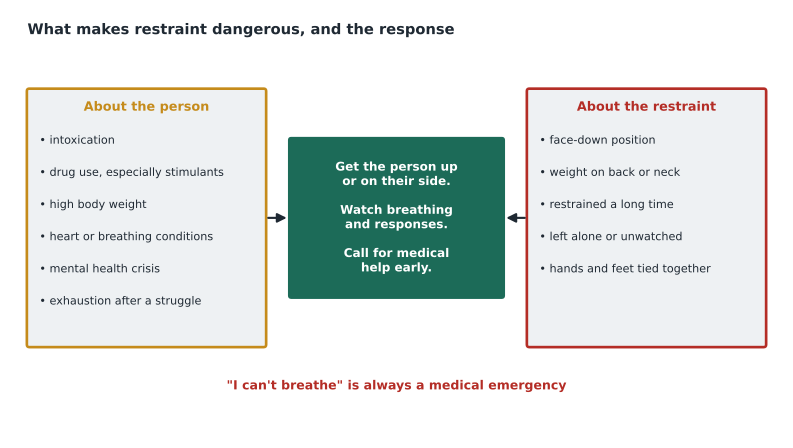
The most serious risk of restraint is death. Since at least the 1990s, research, coroners' inquests and government guidance bulletins have described cases in which people died suddenly while being restrained, often after a struggle, often face down, and often while intoxicated or in a mental health crisis. The term positional asphyxia, or restraint asphyxia, describes how a person's position and any weight on them can make it hard to breathe, especially when they are already exhausted, intoxicated or overweight. Some deaths involve other factors such as heart conditions, drug toxicity and extreme agitation. A person who is struggling may not be fighting the officers at all; they may be fighting to breathe.
Training and policy now emphasize a few clear rules. Avoid putting weight on a person's back or neck, especially once they are restrained. Get a restrained person off their stomach and into a seated position or onto their side, sometimes called the recovery position, as soon as it is safe. Never leave a restrained person face down, alone or unmonitored. Watch for signs of trouble, such as a person saying they cannot breathe, gasping, going quiet or limp, changing colour or becoming confused, and treat those signs as a medical emergency. Canadian coroners' inquests and provincial guidance have repeatedly made recommendations along these lines.
Desjardins tells the class to take one phrase from this lesson: 'I can't breathe' is always a medical emergency. 'Some people say it when they can breathe, because they are frightened or angry,' he says. 'You cannot know which is which. You get them up, you look, you listen and you call for help. There is no case in which an officer was harmed by sitting a restrained person up to check their breathing. There are many cases in which a person died because nobody did.'
Escorts and moving a restrained person
An escort is the way an officer walks with and guides a person, usually one who is restrained, from one place to another: from the sidewalk to the car, from the car to the station, from booking to a cell. The physical methods are taught at the academy. The principles are about control, safety and dignity. Officers should keep talking, tell the person where they are going and what will happen next, walk at a pace the person can manage, watch for uneven ground, steps, ice and doorways, and be ready to support a person who stumbles, especially when their hands are restrained behind them and they cannot break a fall. Intoxicated people like Riley Dunn are at particular risk of falling and hitting their heads.
When the officers walked Dunn to the car, Reyes stayed on his left and Malhotra on his right, and Malhotra kept up a commentary: 'Curb here, step down. Car's right there. Watch your head.' Dunn swore at them the whole way but did not stumble. At the car, they checked the back seat, as they had at the start of the shift, put him in, did up his seatbelt and checked that his hands and legs were clear of the door. Seatbelts matter: a person whose hands are restrained cannot brace in a sudden stop.
Other restraints and devices
Some services authorize additional restraints, such as leg restraints or devices that limit a person's ability to kick, and some authorize spit hoods, which cover a person's head to stop them spitting at officers. These devices carry additional risks, especially for breathing, and many services have restricted or reviewed them after deaths and inquest recommendations. Policies vary across Canadian services, and some have stopped using spit hoods or require supervisor approval and continuous monitoring. Restraining a person's hands and feet together behind their back, sometimes called hog-tying, has been prohibited or strongly discouraged by many agencies because of the risk of death. Officers must follow their own service's policy and training exactly, and should expect any use of these devices to be reviewed closely.
Removing restraints
Restraints should be removed as soon as they are no longer needed, and the removal is a point of risk because the person regains movement. In the cells, removal happens in a controlled way, usually with more than one officer present, after the person has been searched, and with communication about what will happen. Larocque's rule is that nobody stays in restraints in her cells unless they are actively trying to harm themselves or someone else, and then only with a supervisor's approval, constant monitoring and medical advice. 'Handcuffs are for getting someone safely from the street to my door,' she says. 'They are not for keeping someone in a cell.'
| Person | Restrained? | Reason recorded |
|---|---|---|
| Dana Whitcomb | No | Calm, cooperative, not transported; restraint unnecessary and would be humiliating in public |
| Riley Dunn | Yes, behind back | Assaultive and actively resisting; transport to station |
| Mason Pruitt | Yes, behind back | Arrest for a serious offence; hand had gone to waistband; transport to station |
| Pruitt wrist complaint | Cuff adjusted | Tightened during search; checked, adjusted, photographed at booking |
Restraining people with particular needs
Standard restraint positions are designed for an average adult, and many people do not fit that description. A person who is pregnant should not be placed face down at all, and restraint should avoid pressure on the abdomen; many policies allow handcuffing in front. An older person with arthritis, a shoulder injury or a joint replacement may be injured by having their hands pulled behind their back. A person who uses a wheelchair, crutches or a prosthetic limb needs a different approach to transport, and their mobility aids must travel with them. A person who is deaf may communicate by sign language, and restraining their hands behind them removes their ability to communicate; policies allow officers to restrain in front or to remove restraints at the station so the person can communicate with an interpreter.
Young people, especially children, should be restrained only when it is truly necessary, and for the shortest time possible. People with autism, dementia or some mental health conditions may react to touch and restraint with panic that looks like resistance. Officers should ask about needs where they can, look for medical alert bracelets and cards, and listen to family members or caregivers who are present. 'You will almost never regret asking,' Haddad says. 'You may regret not asking for the rest of your life.'
Every departure from standard practice should be recorded with the reason, and so should the decision to use standard practice when a person has a particular need. If an officer handcuffs a pregnant person behind her back because she was assaultive, the record should say so and explain how her safety was protected. If an officer transports an older man without handcuffs, the record should explain how the risk was assessed and managed. Records like these show that the decision was considered rather than automatic, which is what courts, oversight bodies and the person themselves will want to see.
Larocque adds that the people most at risk in restraint are often the ones officers least expect. A person who has been struggling for several minutes, who is very overweight, who has taken stimulants, or who is in a mental health crisis may suddenly stop resisting because they are exhausted or in medical trouble, not because they have given up. Officers should treat a sudden change from struggling to stillness as a warning sign and check immediately.
Worked problem
A restraint decision
An officer arrests a 78-year-old man for driving while prohibited. He walks with a cane, has a shoulder replacement and is calm. Policy says arrested people should normally be handcuffed for transport unless restraint would be unsafe or clearly unnecessary. What should the officer do?
Show solution
- Assess the risk: he is calm, frail and unlikely to flee or fight.
- Assess the safety of restraint: handcuffing behind his back could injure his shoulder and make him fall.
- Consider alternatives: transport without handcuffs with a second officer, or handcuffs in front if policy allows and some restraint is needed.
- Record the decision and the reasons.
Answer: Restraint is likely unsafe and unnecessary; the officer should use an alternative and record why.
Common mistakes
MistakeEvery arrested person must be handcuffed.
InsteadRestraint must be justified; policies allow discretion where it is unsafe or clearly unnecessary.
MistakeTight handcuffs are safer.
InsteadCuffs should be secure but not so tight that they cut off circulation or damage nerves.
MistakeA person who says 'I can't breathe' can breathe, because they are talking.
InsteadTreat it as a medical emergency: reposition, monitor and get help.
MistakeA restrained person who is calm can be left face down while officers deal with other things.
InsteadNever leave a restrained person face down or unmonitored.
Summary and key terms
- Restraints are a use of force and must be justified by safety, flight or evidence concerns.
- Canadian courts have said handcuffing is not automatic on every arrest.
- Apply restraints safely: explain, check fit, prevent tightening, listen to complaints and recheck.
- Positional asphyxia is a serious risk; avoid weight on the back or neck, get the person up or on their side and monitor breathing.
- Escorts should protect the person from falls and keep them informed.
- Additional devices carry extra risk and are tightly controlled by policy.
- Remove restraints as soon as they are no longer needed, in a controlled way.
- Restraint
- A device or method that limits a person's movement, such as handcuffs.
- Positional asphyxia
- Difficulty breathing caused by a person's body position and any weight on them, which can be fatal.
- Recovery position
- Lying on one side, which helps keep the airway open.
- Escort
- Walking with and guiding a person, usually one who is restrained.
- Spit hood
- A mesh covering placed over a person's head to stop spitting; tightly controlled because of breathing risks.
Practice problems
Work each problem on paper first, then reveal the answer to check.
Why was Dana Whitcomb not handcuffed?
Show answer
She was calm, cooperative and not transported, so restraint was unnecessary and would have been humiliating.
What did Reyes do when Pruitt complained his wrist hurt?
Show answer
Checked, found the cuff had tightened, adjusted it and recorded the time and action.
Name three signs that a restrained person is in medical trouble.
Show answer
Saying they cannot breathe, gasping, going quiet or limp, changing colour, becoming confused.
Why are seatbelts important for restrained people?
Show answer
With hands restrained they cannot brace themselves in a sudden stop.
Lesson quiz · 5 questions
Score 60% or more to complete this lesson.
Create a free account to save your progress, take quizzes and earn a certificate.