
LES-206 · Lesson 3 of 12 · 20 min
Rights on arrest and detention
▶ Video coming soon A video version of this lesson is on the way.
When Reyes told Dana Whitcomb she was under arrest, she followed with words she had practised dozens of times at the academy and read from a card in her notebook the first few months on the road. Whitcomb listened, nodded and asked one question: 'Do I have to call a lawyer?' Reyes explained that she did not have to, that it was her choice, and how she could do it if she wanted to. Whitcomb said she understood and did not want to. Reyes wrote down the time, the words she had used, Whitcomb's answer and the fact that Whitcomb had repeated it back in her own words.
Desjardins calls the moments after an arrest 'the rights moment'. It is short, it is often noisy, and it matters enormously. The law requires officers to tell people why they are being arrested and what rights they have, and it requires officers to respect those rights once they are asserted. Mistakes here are among the most common reasons statements and other evidence are excluded at trial. They are also among the easiest mistakes to avoid.
The right to know why
Section 10(a) of the Charter guarantees everyone on arrest or detention the right to be informed promptly of the reasons. Section 29(2) of the Criminal Code adds that a person making an arrest must, where it is feasible, give notice of the process or warrant under which the arrest is made, or the reason for it. The purpose is practical as well as principled: a person cannot meaningfully decide whether to speak to a lawyer, or whether to submit to the arrest, without knowing what it is about. Courts look at substance rather than precise words. Reyes told Whitcomb she was under arrest for stealing items from the pharmacy, which was enough.
Haddad tells the class that telling a person why they are being arrested is also a safety practice. 'People resist what they do not understand,' she says. 'When Riley Dunn was on the ground outside the Anchor Tavern, the first thing Malhotra said once he had control was “You are under arrest for assaulting the doorman.” He said it twice, calmly. It did not stop Dunn from swearing, but it gave him something to argue with other than our hands.'
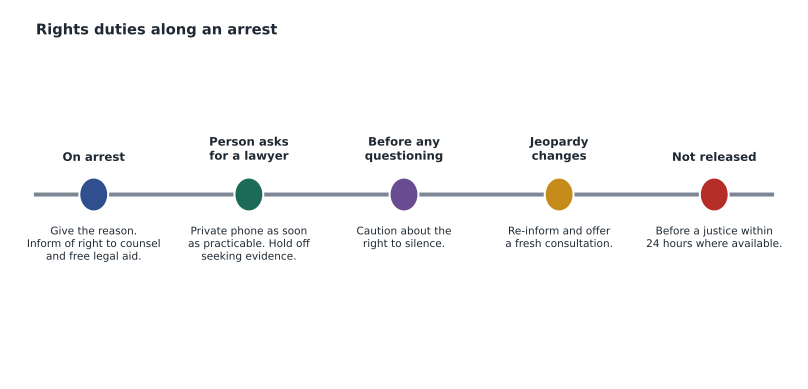
The right to counsel
Section 10(b) of the Charter guarantees everyone on arrest or detention the right to retain and instruct counsel without delay and to be informed of that right. The Supreme Court of Canada has described two kinds of duties. The informational duty requires police to tell the person about the right, including the availability of free, immediate advice from duty counsel and legal aid, as R. v. Brydges in 1990 and R. v. Bartle in 1994 explained. The implementational duties apply once the person says they want to speak to a lawyer: police must give a reasonable opportunity to do so, which usually means a telephone in private, and must hold off from trying to get evidence from the person until they have had that opportunity, as R. v. Manninen held in 1987.
The phrase 'without delay' means immediately. In R. v. Suberu in 2009, the Court held that the rights to counsel apply from the start of a detention, including an investigative detention, subject only to concerns for officer or public safety. In practice, Canadian officers give the rights to counsel as soon as the arrest is made and the scene is safe. They should also ask whether the person understood, and record the answer.
When the person does not understand
Riley Dunn was not in a state to understand much of anything when he was arrested. He smelled strongly of alcohol, his speech was slurred and he kept asking where his jacket was. Malhotra gave him his rights on the sidewalk, Dunn answered with a string of swearing, and Malhotra wrote: 'Did not appear to understand. Will re-advise.' At the station, the booking officer read the rights again; Dunn said 'whatever' and put his head down. Sergeant Larocque directed that the rights be given again once he was sober, and that no one try to get a statement from him in the meantime. At 07:30 the next morning, sober and quiet, Dunn was read his rights a third time, understood them and asked to speak to duty counsel, which he did by telephone in a private room. Canadian courts have said that where there are signs a person did not understand, police must take reasonable steps to make sure they do, which may include repeating the rights, using simpler words or an interpreter, or waiting until the person can understand.
The same care applies to people who do not speak English or French well, people who are deaf or hard of hearing, people with cognitive disabilities and young people. Young persons have additional protections under the Youth Criminal Justice Act, including the right to have a parent or other appropriate adult present during questioning and special rules about the admissibility of statements under section 146, which the students studied in the youth justice course. Officers should use interpreters, plain language and written versions of rights as needed. 'If you are not sure the person understood, they probably did not,' Larocque says. 'Try again, differently.'
Asserting the right: Mason Pruitt
When Reyes arrested Mason Pruitt on Lakeshore Road, she told him the reason, gave him his rights to counsel and the standard caution about the right to silence. Pruitt said, 'Yeah, I want a lawyer.' From that moment, the implementational duties applied. Reyes and Malhotra did not ask him anything about the pills or the messages on his phone. When Pruitt started talking in the car about how the pills were not his, Malhotra reminded him that he did not have to say anything and that he would be able to speak to a lawyer at the station, and wrote down what Pruitt said word for word. At the station, Larocque put him in the counsel room with a telephone and a list of lawyers, and Pruitt called a lawyer from the list. Only after that call did detectives offer him the chance to give a statement, which he declined.
Desjardins points out the difference between not questioning a person and refusing to listen. Officers do not have to stop a person from talking, but they must not prompt, encourage or bargain. Questions, comments designed to draw a response, or remarks such as 'you'll feel better if you get it off your chest' can all be treated as attempts to elicit evidence. Malhotra's approach, reminding Pruitt of his rights and writing down what he said, was the right one.
When circumstances change
If the investigation changes in a way that affects the person's jeopardy, such as a new and more serious charge, police must re-inform the person of their rights and give a fresh opportunity to consult counsel. R. v. Sinclair in 2010 confirmed that a person does not have a right to have a lawyer present throughout an interview in Canada, but does have a right to consult counsel again where there is a material change in circumstances, a new procedure such as a lineup is involved, or there is reason to believe the first consultation was not adequate. Reyes learned this lesson later that night when the drug unit, looking at the markings on Pruitt's pills, told detectives that some of them were likely counterfeit tablets containing fentanyl. The jeopardy had changed, and the detectives handled the rights again before any further step.
Other rights on arrest
Several other rights apply to people in custody. Section 10(c) of the Charter guarantees the right to have the lawfulness of a detention reviewed by habeas corpus. Section 503 of the Criminal Code requires that a person who is not released be brought before a justice without unreasonable delay and in any event within 24 hours where a justice is available. Foreign nationals have the right to have their consulate notified under the Vienna Convention on Consular Relations, and many services have a policy of asking every arrested person whether they are a citizen. People also have a right to medical care when they need it, which later lessons cover in detail.
| Moment | What the officer must do in Canada | Common mistake |
|---|---|---|
| On arrest | Give the reason and the right to counsel, including legal aid | Saying only "you are under arrest" |
| Before questioning | Give the caution about silence; hold off if counsel is requested | Starting with casual questions |
| Person asks for a lawyer | Provide a private phone and hold off questioning | Continuing to chat about the case |
| Person seems not to understand | Repeat, simplify, use an interpreter or wait | Writing "understood" without checking |
| Jeopardy changes | Re-inform and offer a fresh consultation | Relying on the first advice |
Calls to family and other requests
After Dana Whitcomb said she did not want a lawyer, she asked whether she could call her sister to tell her she would be late picking up her daughter from school. The Charter does not give a right to call family on arrest; section 10(b) is about counsel. But nothing prevented the call, and Port Ardent's policy allows officers to let a person make or arrange a call to family when it will not risk evidence or safety. Reyes let her call from her own phone, in Reyes's presence, and noted it. 'There was a child waiting at a school,' Reyes said. 'That's part of the duty of care too.'
Officers sometimes have good reasons to delay or refuse a call to someone other than a lawyer, for example when the person might warn an accomplice, arrange for evidence to be destroyed or contact a victim. Those reasons must be real and recorded. A blanket refusal to let anyone make any call is rarely justified. And no reason justifies delaying access to counsel once a person has asked for it, except a genuine and specific urgent safety concern, which must be recorded and must last only as long as the concern does.
Interpreters and plain language
When a person does not speak English or French well, officers should use an interpreter, in person or by telephone, rather than a family member, a bystander or a colleague who speaks a little of the language. Interpreters should interpret the rights word for word and then the person's response. Many services also have the rights printed in dozens of languages, which helps but does not replace an interpreter, because the person may not read well or may have questions. For people who are deaf, sign language interpreters are needed; writing back and forth may not be enough, especially for people whose first language is a sign language.
Plain language matters for everyone. Desjardins suggests that after reading the formal rights, officers ask the person to explain in their own words what they have been told. A person who says 'I can call a lawyer and it's free' has understood something important. A person who says 'I have to answer your questions' has not, and the officer needs to explain again. Writing down the person's own words protects everyone if the question is ever raised in court.
Rights and safety
Suberu allows officers to delay the rights to counsel for specific safety concerns, such as when the scene is not yet under control. Desjardins warns that these exceptions are narrow. 'If you use the safety exception to ask a person where they hid the drugs, you will lose the answer,' he says. 'If you use it to ask whether there is a needle in their pocket before you search them, you are using it the way it was meant.'
Worked problem
Recording the rights
An officer arrests a man for impaired driving at 01:12. She reads the rights from her card at 01:13. He says, 'Yes, I understand, I want my lawyer.' At 01:40 at the station, he speaks to a lawyer in a private room until 01:52. Write the key note entries.
Show solution
- 01:12 Arrested for impaired operation; told reason.
- 01:13 Read rights to counsel and caution from card; asked if understood; replied 'Yes, I understand, I want my lawyer.'
- 01:40 to 01:52 Spoke with a lawyer by telephone in the private room; door closed; no officer present.
- Record any statements the man volunteered, word for word, with the time.
Answer: Notes should record the time, the words used, the person's answer in their own words and every step taken to give access to counsel.
Common mistakes
MistakeRights only need to be given at the station.
InsteadThe rights to counsel apply without delay, meaning immediately on arrest, subject to safety.
MistakeIf a person asks for a lawyer, officers must stop them from talking.
InsteadOfficers must stop questioning and eliciting, but may record what the person volunteers.
MistakeA nod means the person understood.
InsteadAsk the person to explain in their own words, and repeat or simplify if needed.
MistakeOnce rights have been given, they never need to be given again.
InsteadA change in jeopardy or a new procedure may require fresh rights.
Summary and key terms
- Section 10(a) requires prompt reasons, and section 29(2) requires notice of the reason where feasible.
- Section 10(b) creates informational and implementational duties, as in Brydges, Bartle and Manninen.
- 'Without delay' means immediately, subject to safety, as R. v. Suberu held.
- Officers must take extra care when a person is intoxicated, young, does not share the officer's language or has a disability.
- A change in jeopardy may require fresh rights and a new chance to consult counsel, as R. v. Sinclair explained.
- Notes should record exactly what was said and how the person responded.
- Informational duty
- The duty to tell a detained person about the right to counsel and how to use it, including free legal advice.
- Duty counsel
- A lawyer, paid through legal aid, who gives free immediate advice to people in custody.
- Implementational duty
- The duty, once a person asks for counsel, to give a reasonable opportunity to consult and to stop trying to get evidence.
- Volunteered statement
- Something a person says without being questioned or prompted by police.
Practice problems
Work each problem on paper first, then reveal the answer to check.
Why does telling a person the reason for an arrest help safety?
Show answer
People resist what they do not understand; a clear reason gives them something to respond to other than force.
What did officers do because Riley Dunn did not understand his rights?
Show answer
They noted it, avoided seeking a statement and re-advised him when he was sober.
What should an officer do when an arrested person who has asked for a lawyer starts talking about the case?
Show answer
Not question or encourage, remind them of their rights and write down what they say.
What changed in Pruitt's case that required the rights to be handled again?
Show answer
The drug unit believed some pills were likely counterfeit tablets containing fentanyl, a change in his jeopardy.
Lesson quiz · 5 questions
Score 60% or more to complete this lesson.
Create a free account to save your progress, take quizzes and earn a certificate.