
LES-206 · Lesson 12 of 12 · 19 min
Capstone: documenting and reviewing an arrest
▶ Video coming soon A video version of this lesson is on the way.
Two weeks after the March 6 shift, Sergeant Haddad sat down with Reyes and Malhotra in a small meeting room with three files, the body-worn camera recordings, the in-car video, the custody records and the cell video. Sergeant Larocque joined them for the part of the review that covered the cells. Desjardins brings the review into the classroom as the course's capstone. 'Everything in this course comes together in two things,' he says. 'What you write down, and what you learn from it.'
The review is not a disciplinary process. Port Ardent, like many services, uses after-action reviews to turn ordinary work into lessons, to recognize what went well, and to catch small problems before they become large ones. Reviews are done for a sample of arrests, for every arrest involving force or injury, and for every strip search. The officers being reviewed contribute as much as the supervisor does.
Notes: the foundation of everything
Every part of the review depended on notes. In Wood v. Schaeffer in 2013, the Supreme Court of Canada described an officer's duty to prepare accurate, detailed and comprehensive notes as soon as practicable after an investigation, as an implicit part of an officer's duty. Notes are used to refresh the officer's memory in court, they are disclosed to the defence, and their quality affects the officer's credibility. Desjardins sets out the qualities of good arrest notes:
- Made at the time or as soon as practicable afterwards, with the time recorded.
- Specific: times, words used, the person's exact words, distances, positions, injuries and property.
- Complete: the grounds for each step, the rights given and responses, every search and its purpose, any force and why, and every medical observation.
- Honest: what the officer saw and did, including mistakes, not what they wish had happened.
- Their own: written by the officer, not copied from a partner or adjusted to match.
Haddad shows the class two versions of a note about the Dunn takedown. The first says: 'Male became combative and was taken to ground.' The second says: '21:51:58 Dunn pulled R arm out of my grip and turned away toward Dock St. I and PC Reyes took him to the ground on the sidewalk as trained. He kicked twice toward PC Reyes's legs. 21:52:31 handcuffed behind back, checked fit. 21:52:38 sat up. Blood in hair at back of head. Requested EMS.' 'The first note tells me nothing,' she says. 'The second tells me what happened, in what order and why. If this goes to court in a year, which one do you want to be reading from?'
Body-worn camera and notes
Body-worn cameras have changed how arrests are documented and reviewed. A recording shows things notes cannot, such as tone of voice and the exact sequence of events, but it also misses things an officer saw or felt, such as an object felt during a pat-down or a movement outside the camera's view. Notes and video work together. Services differ on whether officers may watch their recording before writing their notes and reports. Some Canadian services allow it and others restrict it, especially for incidents that will be investigated by an oversight body such as the Special Investigations Unit, where the concern is that viewing could shape an officer's account. Port Ardent allows officers to review footage for routine arrests and requires them to note in their report that they did so.
Malhotra's first use-of-force report on the Dunn arrest had described Dunn as kicking 'several times'. After he watched the recording during the review, he saw that Dunn had kicked twice, and that the second kick came after the handcuffs were partly on. He filed a supplementary report correcting it. Haddad noted that the correction was exactly what should happen. 'The recording didn't catch you out,' she told him. 'It made your report more accurate, and you corrected it yourself.'
The review
Haddad uses a simple scoring sheet with ten areas, each scored 0, 1 or 2. A score of 2 means the area was handled to the standard expected of an experienced officer; 1 means it was acceptable but with a clear improvement to make; 0 means it was below standard. The total is less important than the specific improvements it identifies.
| Area | Score | Reason |
|---|---|---|
| Authority for each arrest | 2 | Grounds clear and recorded for all three |
| Rights given and respected | 2 | Given promptly, repeated for Dunn, counsel respected for Pruitt, jeopardy change handled |
| Release decisions | 2 | Whitcomb released at the scene; Dunn released when sober with one connected condition |
| Approach and communication | 1 | Strong at the tavern; at the Pruitt stop, Reyes stood squarely at the window too close before seeing his hand move |
| Force | 2 | Lesser options tried, proportionate, ended promptly, reported |
| Restraints and positioning | 1 | Dunn sat up quickly; Pruitt's cuff tightened during the search and was not rechecked until he complained |
| Searches incident to arrest | 2 | Scope set by purpose in every case |
| Vehicle and phone | 2 | Glove box search linked to the offence; phones secured and a warrant obtained |
| Strip search and dignity | 2 | Grounds, authorization, same gender, privacy, staged, recorded |
| Medical care and documentation | 1 | Excellent medical care; first use-of-force report overstated the kicks and needed correcting |
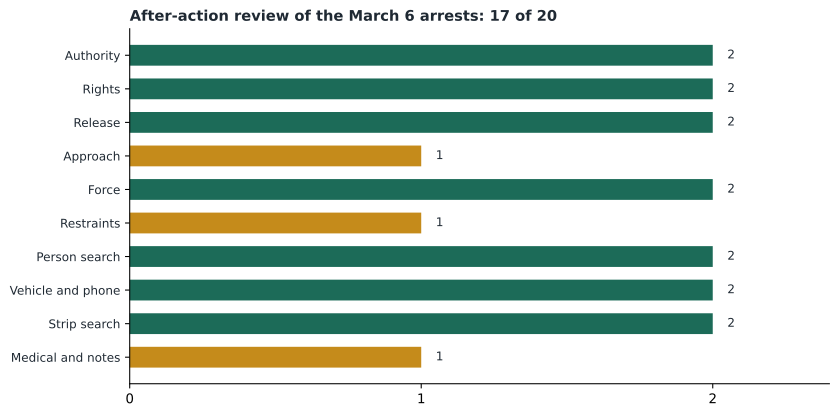
Adding the ten areas: seven scored 2 and three scored 1, so the total is 7 × 2 + 3 × 1 = 17 out of 20. The three areas marked 1 were approach and communication, restraints and positioning, and medical care and documentation.
The total is 17 out of 20. Haddad is clear that this is a very good result for a probationary officer and her coach, and that the three areas marked 1 are the useful part of the review. Each produced a specific change.
What changed
From the approach score, Reyes added a habit she now uses at every traffic stop: she pauses at the rear of the driver's door, where she can see the driver's hands and lap, before stepping forward to speak. Haddad added a short reminder about this to the platoon's next briefing. From the restraint score, Port Ardent's training unit added a line to the arrest checklist: recheck handcuff fit after any search or struggle, and again before transport. From the documentation score, the service's use-of-force report template was changed to prompt officers to state whether they reviewed video before writing and, if a count is given, how it was determined.
Larocque added one item from the cells. The review of the cell video showed that the officer checking Dunn at 04:10 had done exactly the right thing when he vomited, but that it took her ninety seconds to reach the sergeant by radio because the radio was on the desk. The custody area now requires the checking officer to carry a radio on every check. 'Ninety seconds was fine that night,' Larocque says. 'On another night it might not be.'
What happened next
Dana Whitcomb was accepted into the Crown's diversion program. She completed it in May 2026, including community service hours at a food bank and a meeting with the pharmacy manager, and the charge was withdrawn. She wrote a short letter to Reyes, care of the station, saying that she had been more frightened of being humiliated than of being charged, and thanking her for taking her out through the back. Reyes keeps it in her locker.
Riley Dunn pleaded guilty to assault in June 2026. He received a conditional discharge with twelve months of probation, a condition to complete an alcohol counselling program and a condition not to attend the Anchor Tavern. He made no complaint about the arrest. Through his lawyer, he asked that the officers be told he did not remember much of the night but had seen the video, and was grateful he had been taken to the hospital.
Mason Pruitt's case is still before the courts. A preliminary inquiry is scheduled for January 2027, and his lawyer has said she will challenge the strip search and the vehicle search. The prosecutor told Haddad that the notes, the custody record and the strip search report were among the most complete she had seen, and that whatever the court decides, it will be able to decide on a full and accurate record. Pruitt is presumed innocent, and the outcome of the case is for the court.
Lessons from the course
Desjardins closes the course where he began, with the two words on the whiteboard. He asks each student to name one practice from the course that makes an arrest more lawful and one that makes it more humane. Priya Sandhu chooses knowing your authority before you act, and asking the suicide question as if you care about the answer. Marco DiSanto chooses setting the scope of a search by its purpose, and sitting a restrained person up as soon as they stop resisting. Jesse Morningstar chooses giving rights again when circumstances change, and treating 'I can't breathe' as an emergency every time. Amara Okafor chooses getting a warrant for a phone when there is time, and walking a cooperative person out the back door instead of through a crowd.
'Every one of those is something you can do on your first shift,' Desjardins says. 'None of them requires years of experience. They require knowing the law, paying attention and caring about the person in front of you. Do those three things on every arrest, and you will spend your career being proud of what the recordings show.'
Learning from inquests and reviews
Desjardins reminds the class that many of the practices in this course were written in response to deaths. Coroner's inquests, independent investigations and civil cases in both countries have examined people who died after being restrained face down, people who died of head injuries in cells after being lodged as simply drunk, people who died of overdoses after swallowing drugs at arrest, and people who died by suicide in police custody after nobody asked about their risk. Their recommendations repeat the same themes: get people up after restraint, get medical assessment for head injuries and intoxication, rouse intoxicated people on every check, ask about suicide properly, pass on information at every handover and record checks honestly.
An after-action review is a small version of the same idea. It asks what happened, why, and what should change, without waiting for a tragedy to force the question. Haddad tells the class that the best reviews are the ones nobody would ever have noticed if they had not been done. 'Nobody would have known that the radio was on the desk,' she says. 'Nobody would have known that the cuff had tightened during the search. Now everyone knows, and the next person in those cells is a little safer because of it.'
Desjardins also asks the students to think about the officers' well-being in the review. Arrests that involve a struggle, an injury or a medical emergency can stay with officers for days. Reyes admitted during the review that she had replayed the moment Dunn's head came near the curb many times. Haddad told her that was normal, reminded her of the service's peer support team and asked her to speak to them, which she did. A good review looks after the people who did the work as well as the work itself.
Worked problem
Writing a review point
In a review, a supervisor finds that an officer's notes say a prisoner was 'checked regularly' in the cells, but the log shows a gap of 55 minutes between checks for a person on 15-minute checks. Write the review point and the change.
Show solution
- Describe the finding: one 55-minute gap in checks for a detainee on 15-minute checks, at a time when two other detainees were being booked.
- Score: 0 for monitoring, because the standard was not met, regardless of the outcome.
- Identify the cause: staffing during a busy period and no backup for checks.
- Change: the custody sergeant must call for an additional officer when checks cannot be maintained, and notes must record actual check times rather than general statements.
Answer: A good review point is specific, honest about the standard, focused on causes and leads to a concrete change.
Common mistakes
MistakeAfter-action reviews are for punishing mistakes.
InsteadThey turn ordinary work into lessons and catch small problems early.
MistakeGeneral notes are safer because they cannot be contradicted.
InsteadSpecific, timed notes are more credible and more useful in court.
MistakeIf video exists, notes do not matter.
InsteadVideo and notes work together; each records things the other misses.
MistakeCorrecting a report looks bad.
InsteadCorrecting it promptly and transparently is what professionals do.
Summary and key terms
- Wood v. Schaeffer describes an officer's duty to make accurate, detailed and comprehensive notes as soon as practicable.
- Good notes are timely, specific, complete, honest and the officer's own.
- Body-worn camera footage and notes work together; follow policy on viewing before writing.
- After-action reviews score specific areas and produce concrete changes.
- The March 6 review scored 17 out of 20 and led to changes in approach, restraint rechecks and report templates.
- Lawful and humane arrests depend on knowing the law, paying attention and caring about the person.
- After-action review
- A structured review of an incident to identify what went well and what to improve.
- Supplementary report
- A report filed to add to or correct an earlier report.
- Disclosure
- Providing the defence with the evidence, including officers' notes and recordings.
- Presumption of innocence
- The principle that an accused person is innocent unless proven guilty in court.
Practice problems
Work each problem on paper first, then reveal the answer to check.
What makes the second version of the takedown note better?
Show answer
It gives times, specific actions, the reason, the person's behaviour, the restraint check and the injury.
Why did Malhotra file a supplementary report?
Show answer
Reviewing the video showed Dunn kicked twice, not several times, so he corrected it.
What three areas scored 1, and what changed?
Show answer
Approach (pause at the rear of the door), restraints (recheck cuff fit after searches) and documentation (report template prompts).
Why does the course say Pruitt's case is for the court to decide?
Show answer
He is presumed innocent and his lawyer is challenging the searches; the outcome is not yet known.
Lesson quiz · 5 questions
Score 60% or more to complete this lesson.
Create a free account to save your progress, take quizzes and earn a certificate.