
LES-103 · Lesson 8 of 12 · 25 min
Sexual offences, threats and criminal harassment
▶ Video coming soon A video version of this lesson is on the way.
Professor Desjardins opens this lesson more carefully than any other. He reminds the class that statistically, several people in any room of thirty have experienced sexual violence, and that many never reported it. He tells them that the way a first officer responds to a disclosure shapes whether a survivor ever trusts the justice system again, and whether a case can be proved at all. Ms. Liu adds that sexual offence files are the ones where she most often sees good evidence lost in the first hour, and the ones where careful, respectful police work makes the biggest difference. This lesson covers the law of sexual offences and consent, offences involving children, and the related offences of threats and criminal harassment that so often come before or after violence. The goal is legal knowledge an officer can apply on a call, explained without graphic detail.
Why these offences need their own lesson
Sexual offences differ from other crimes against the person in three ways that matter to police. First, they are among the most underreported crimes. Statistics Canada's General Social Survey on Canadians' Safety has found that only about one in twenty sexual assaults is reported to police, far fewer than for other violent crimes. Second, they usually happen in private between people who know each other, so there are rarely independent witnesses, and the case often turns on what each person said and did and on the surrounding evidence. Third, the law has been reformed repeatedly to remove old rules that treated complainants unfairly, such as requirements that a complaint be made immediately or that the complainant's testimony be corroborated, and to limit questioning about a complainant's sexual history. Officers who still carry the old assumptions, for example that a real victim would have fought back, screamed or reported right away, can damage an investigation and a person.
Jesse Morningstar asks why the class is studying this in a first-year law course rather than leaving it to specialized investigators. Professor Desjardins answers that the patrol officer is almost always the first contact. The first officer takes the initial report, decides what evidence to protect, arranges medical care and support, and writes the notes that defence counsel will read line by line months later. Specialized sexual assault or special victims units take over the investigation, but they can only work with what the first officer preserved.
Sexual assault and consent in the Criminal Code
Canada abolished the separate offences of rape and indecent assault in 1983 and replaced them with three levels of sexual assault that mirror the assault offences of lesson 6. Sexual assault under section 271 is an assault committed in circumstances of a sexual nature, such that the sexual integrity of the victim is violated; the Supreme Court set out this test in R. v. Chase (1987), and it is judged objectively by looking at the part of the body touched, the nature of the contact, any words or gestures and all the circumstances. It is a hybrid offence with a maximum of ten years on indictment, or fourteen years where the complainant is under 16. Sexual assault with a weapon, threats to a third party or causing bodily harm, under section 272, carries up to fourteen years, with mandatory minimums where a firearm is used. Aggravated sexual assault, under section 273, is a sexual assault that wounds, maims, disfigures or endangers the life of the complainant, and carries up to life imprisonment. Because the offence is defined as a form of assault, no particular sexual act is required, and kissing or touching can be a sexual assault if the other elements are met.
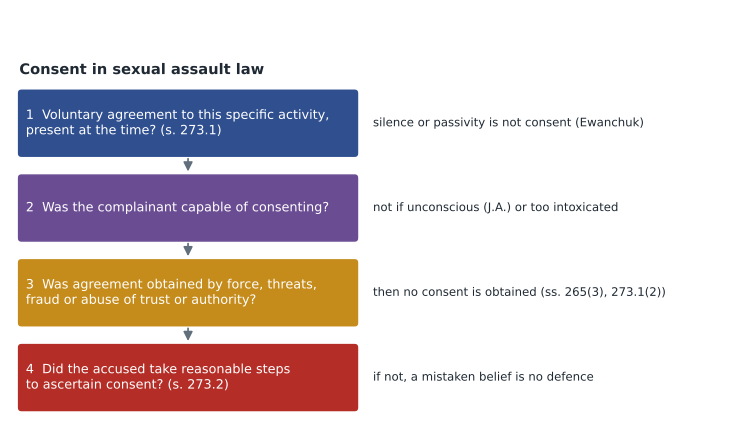
The heart of sexual assault law is consent. Section 273.1 defines consent as the voluntary agreement of the complainant to engage in the sexual activity in question, and since 2018 the section has said expressly that consent must be present at the time the activity occurs. The section lists situations in which no consent is obtained: the agreement is expressed by someone other than the complainant; the complainant is incapable of consenting, including because he or she is unconscious; the accused induces the activity by abusing a position of trust, power or authority; the complainant expresses, by words or conduct, a lack of agreement; or, having agreed, the complainant expresses by words or conduct a lack of agreement to continue. Section 265(3), from lesson 6, also applies: there is no consent where the complainant submits because of force, threats, fear or fraud.
The Supreme Court of Canada has given these provisions a strict reading. In R. v. Ewanchuk (1999), the Court held that there is no defence of implied consent: consent is judged by the complainant's actual state of mind at the time, and silence, passivity or ambiguous conduct is not consent. In R. v. J.A. (2011), the Court held that a person cannot consent in advance to sexual activity that will take place while he or she is unconscious. In R. v. Kirkpatrick (2022), the Court held that where a complainant agreed to sex only with a condom, sex without one is sex without consent to the activity in question. And in R. v. Barton (2019), the Court stressed that judges and juries must not rely on myths and stereotypes about how sexual assault victims behave.
Mistaken belief in consent
An accused can raise the defence that he or she honestly believed the complainant communicated consent, but section 273.2 limits it sharply. The belief is no defence if it arose from the accused's self-induced intoxication, recklessness or wilful blindness; if it was based on a situation in which no consent is obtained under section 273.1, such as consent expressed by a third party; or if the accused did not take reasonable steps, in the circumstances known to him or her at the time, to ascertain that the complainant was consenting. In R. v. Ewanchuk the Court added that the belief must be in communicated consent, by words or conduct, and that a belief that no means yes, or that the complainant's silence meant consent, is a mistake of law and no defence at all. For officers, this means investigations should capture the accused's own account of what steps were taken and what was said, which a lawful interview may obtain, as well as the complainant's level of intoxication, which bears on capacity.
Offences involving children and the age of consent
The age of consent to sexual activity in Canada is 16, under section 150.1. There are close-in-age exceptions: a 12- or 13-year-old can consent to activity with a partner less than two years older, and a 14- or 15-year-old with a partner less than five years older, provided the partner is not in a position of trust or authority, the young person is not dependent on the partner, and the relationship is not exploitative. For relationships of trust, authority or dependency, and for exploitative relationships, the age of protection is 18. The Criminal Code creates offences specific to children that do not depend on assault: sexual interference under section 151, touching a person under 16 for a sexual purpose; invitation to sexual touching under section 152; sexual exploitation of a young person by someone in a position of trust or authority under section 153; and luring a child by means of telecommunication under section 172.1. An accused cannot rely on a mistaken belief about a young person's age unless he or she took all reasonable steps to ascertain it, under section 150.1(4). Laws on child sexual abuse material, section 163.1 of the Criminal Code, carry severe penalties, and investigations are handled by specialized internet child exploitation units. A patrol officer who comes across such material, for example on a seized phone, should stop looking, secure the device and hand it to specialists rather than browsing it.
Calls involving children require the officer to work with child protection authorities. Every province requires anyone who has reasonable grounds to believe a child needs protection to report it to a children's aid society or child welfare agency, and police and child protection workers often interview children jointly at a child advocacy centre, so the child tells the story once, to trained interviewers, in a child-friendly room. Patrol officers should not conduct detailed interviews of young children. They should note the child's spontaneous words exactly, ensure the child is safe and leave the forensic interview to trained specialists.
Responding to a report of sexual assault
The first officer's priorities follow the pattern from earlier lessons: safety and medical care first, then evidence and investigation. Many hospitals have sexual assault and domestic violence treatment centres where specially trained nurses can treat injuries, offer medication to prevent pregnancy and sexually transmitted infection, and, with the person's consent, collect forensic evidence in a sexual assault evidence kit. Evidence is best collected within a few days, so officers should explain the option early, but the decision belongs to the survivor. In many places a kit can be collected and stored even if the person has not decided whether to report to police.
- Believe and support: listen without judgment, and avoid questions that sound like blame, such as why were you there or why didn't you leave.
- Ask only what is needed at first: what happened in brief, when and where, who the suspect is, and whether the person is hurt or in danger.
- Preserve evidence: advise the person, gently, that not bathing, changing or discarding clothing before the medical examination preserves evidence, but never insist.
- Protect the scene and digital evidence: secure the location, bedding and any items, and note phones, messages and social media that may hold communications before and after the event.
- Connect to support: offer victim services, a support person and information about what happens next, including the person's rights as a victim.
Investigators now use trauma-informed interviewing, which accounts for the way trauma can affect memory. People who have been through a traumatic event may remember sensory details vividly but have gaps, recall events out of order, or remember more after sleep. Fragmented accounts are not by themselves a sign of lying, and investigators often wait a sleep cycle or two before a full interview. Marco DiSanto recognizes this from his military training on critical incidents and says it matches what he saw after a training accident in his unit.
Two evidence rules affect what police gather. Section 276 of the Criminal Code, the rape shield provision upheld in R. v. Darrach (2000), bars evidence of a complainant's other sexual activity to support the inferences that she or he was more likely to have consented or is less worthy of belief, and requires a special hearing before any such evidence is used for another purpose. Sections 278.1 to 278.98 control access to a complainant's private records, such as counselling or medical records, and since 2019 the accused's own records of the complainant, such as private messages, can also require a hearing before use. Police should collect relevant communications, but should not go fishing in a complainant's private life.
Uttering threats
Uttering threats, under section 264.1, is committed by a person who, in any manner, knowingly utters, conveys or causes any person to receive a threat to cause death or bodily harm to any person, to burn, destroy or damage property, or to kill, poison or injure an animal or bird that is the property of any person. Threats of death or bodily harm carry up to five years on indictment; threats to property or animals carry up to two years. In R. v. McRae (2013), the Supreme Court held that the question is whether a reasonable person aware of the circumstances would perceive the words as a threat, and that the accused must have intended the words to intimidate or to be taken seriously. The threat need not be received by the intended target, and it does not matter whether the accused intended to carry it out. Threats can be made in person, by phone, in writing or online, including in posts that the target sees through others.
Linh Tran points out that most threats she sees online are made by people who will never act on them. Professor Desjardins agrees, but says officers cannot know that from the words alone. Threats are an important warning sign in domestic violence, workplace violence and school safety cases, and threat assessment teams look at the whole picture: the person's history of violence, access to weapons, recent losses or grievances, fixation on a target, and whether the threat is specific and actionable.
Criminal harassment
Criminal harassment, often called stalking, is in section 264. It is committed by a person who, without lawful authority and knowing that another person is harassed or recklessly as to whether the other person is harassed, engages in prohibited conduct that causes that other person reasonably, in all the circumstances, to fear for his or her safety or the safety of anyone known to them. The prohibited conduct is repeatedly following the person or anyone known to them; repeatedly communicating with them, directly or indirectly; besetting or watching the place where they live, work or happen to be; or engaging in threatening conduct directed at them or a member of their family. It carries up to ten years on indictment. Fear for safety includes psychological safety, and courts have held that a single act of threatening conduct can be enough under the last branch. A related offence, under section 162.1, prohibits publishing, distributing or making available an intimate image of a person knowing that the person did not consent, or being reckless about it.
Stalking cases are built over time, so the officer's most important tool is documentation. Victims should be encouraged to keep a log of every incident with the date, time, place, what happened and any witnesses, and to preserve messages, call logs, voicemails and screenshots with dates visible. Officers should check for previous reports, peace bonds or release conditions that the conduct may also violate, and any access to firearms. A peace bond under section 810 or an emergency protection order under provincial domestic violence legislation can give the victim legal protection while an investigation continues, and violating it is a separate offence that officers can enforce immediately.
Linh, who wants to be a crime analyst, writes a short program to organize a victim's incident log. It counts incidents by type and flags when the pattern shows escalation, which is one factor threat assessment looks for. The counts use the made-up log below.
# Organize a stalking victim's incident log (invented data)
from collections import Counter
from datetime import date
log = [
    (date(2026, 1, 4), "message", "asked to meet"),
    (date(2026, 1, 9), "message", "angry messages, 14 in one night"),
    (date(2026, 1, 16), "following", "car seen outside workplace"),
    (date(2026, 1, 22), "message", "says he knows her new address"),
    (date(2026, 1, 30), "watching", "parked outside home 2 hours"),
    (date(2026, 2, 3), "threat", "says she will regret leaving"),
    (date(2026, 2, 6), "following", "followed her to the gym"),
]
by_type = Counter(kind for _, kind, _ in log)
print("incidents:", len(log), "over", (log[-1][0] - log[0][0]).days, "days")
for kind, n in by_type.most_common():
    print(f"  {kind:10s} {n}")
# Escalation: physical presence or threats in the second half of the period
half = len(log) // 2
early = sum(k in ("following", "watching", "threat") for _, k, _ in log[:half])
late = sum(k in ("following", "watching", "threat") for _, k, _ in log[half:])
print("in-person or threat incidents, first half:", early, "second half:", late)
print("escalating" if late > early else "not escalating")
gaps = [(b[0] - a[0]).days for a, b in zip(log, log[1:])]
print("days between incidents:", gaps)incidents: 7 over 33 days message 3 following 2 watching 1 threat 1 in-person or threat incidents, first half: 1 second half: 3 escalating days between incidents: [5, 7, 6, 8, 4, 3]
The output shows seven incidents in about a month, with more in-person conduct and a threat in the second half, and shrinking gaps between incidents. An officer reviewing this log would see repeated communication, following and watching that together likely meet the elements of criminal harassment, and the threat would also support uttering threats if the words would be taken as a threat of bodily harm. A program cannot decide whether a charge is proved, but it helps an officer see a pattern that a series of separate calls can hide.
Worked problem
A pattern of calls
Over six weeks, Port Ardent officers take three separate calls from the same woman. First, her former partner sent dozens of messages in one night. Second, she saw his car outside her work. Third, he left a note on her windshield saying you can't hide from me. Each call was handled by a different officer and closed with advice. On a fourth call, Constable Malhotra notices the history. What should he do?
Show solution
- Link the incidents: pull the earlier reports and treat them as one investigation, because criminal harassment is about a course of conduct, not single events.
- Assess the elements: repeated communication, watching her workplace and threatening conduct; her fear for her safety appears reasonable given the history and the note; and he knew or was reckless that she was harassed, since she had told him to stop.
- Assess risk: ask about past violence, weapons, threats of suicide, recent separation and any escalation, using the service's risk assessment tool, and check for firearms.
- Preserve evidence: photograph the note, secure the messages with dates and times and obtain any workplace camera footage.
- Protect the victim: explain peace bonds and emergency protection orders, arrange victim services and safety planning, and consider arrest if grounds exist.
Answer: Treated separately, each call looked minor. Treated together, they form a pattern that is a serious offence and a warning sign for violence. Supervisors like Sergeant Haddad now require officers to check call history for repeat addresses and names before closing a harassment call.
Common mistakes
MistakeA real victim would resist, report immediately and avoid the suspect afterward.
InsteadMany victims freeze, delay reporting or stay in contact with someone they know; the law forbids reliance on these myths, and research supports this.
MistakeSilence or not saying no means consent.
InsteadConsent requires voluntary agreement, communicated by words or conduct, at the time of the activity (Ewanchuk).
MistakeA threat is only a crime if the person meant to carry it out.
InsteadThe question is whether the words were meant to intimidate or be taken seriously, not whether the person would act.
MistakeSeparate harassment calls can each be closed on their own.
InsteadStalking is a pattern; officers should link incidents and look at the course of conduct.
Summary and key terms
- Sexual assault has three levels (ss. 271 to 273), judged by whether the sexual integrity of the victim was violated.
- Consent is voluntary agreement to the activity, present at the time; there is no implied consent, and an unconscious person cannot consent.
- Mistaken belief in consent fails if the accused did not take reasonable steps to ascertain consent (s. 273.2).
- The age of consent is 16, with close-in-age exceptions and special offences for children.
- First officers put safety and medical care first, preserve evidence and use a trauma-informed approach.
- Uttering threats and criminal harassment cover threats and patterns of conduct that cause fear.
- Sexual assault
- An assault committed in circumstances of a sexual nature that violates the sexual integrity of the victim.
- Consent
- The voluntary agreement of the complainant to engage in the sexual activity in question, present at the time it occurs.
- Reasonable steps
- What an accused must take to ascertain consent before relying on a mistaken belief in it.
- Rape shield
- Section 276, which limits evidence of a complainant's other sexual activity.
- Criminal harassment
- Repeated following, communicating, watching or threatening conduct that causes reasonable fear for safety.
- Uttering threats
- Knowingly conveying a threat to cause death or bodily harm, or to damage property or harm an animal.
Practice problems
Work each problem on paper first, then reveal the answer to check.
What did R. v. Ewanchuk (1999) decide about implied consent?
Show answer
There is no defence of implied consent; consent is judged by the complainant's actual state of mind, and silence or passivity is not consent.
A 15-year-old and an 18-year-old are in a relationship. Is sexual activity between them lawful?
Show answer
In Canada, yes, because the 18-year-old is less than five years older, provided he or she is not in a position of trust or authority and the relationship is not exploitative or dependent.
Why should officers not interview young children in detail?
Show answer
Because repeated or leading questioning can harm the child and the case; trained forensic interviewers should conduct one recorded interview.
Name three kinds of evidence to preserve in a stalking case.
Show answer
Messages and call logs with dates, a victim's incident log, photos of notes or damage, camera footage and witness statements.
Lesson quiz · 5 questions
Score 60% or more to complete this lesson.
Create a free account to save your progress, take quizzes and earn a certificate.