
LES-103 · Lesson 5 of 12 · 21 min
Parties to an offence, attempts and conspiracy
▶ Video coming soon A video version of this lesson is on the way.
Professor Desjardins begins week five with a case from early in his career. Two young men walked into a convenience store on Lakeshore Road in Port Ardent. One pointed a replica gun at the clerk and took 340 dollars from the till. The other stood by the door watching the street. A third waited in a car with the engine running. A fourth, the driver's cousin, let them hide in his basement that night and burned their jackets. And a fifth, the gunman's girlfriend, had told them the store had only one clerk after 11 p.m. and no camera over the till. Only one person took the money. Who committed the robbery? The criminal law's answer is that, depending on what each knew and intended, several of them did, and others committed related offences. This lesson covers the rules that make people liable for crimes committed with or through others, and for crimes that were planned or attempted but never completed.
Why the law reaches beyond the person who acts
Crimes are often group efforts, and those who plan, encourage or assist can be as blameworthy as the person who strikes the blow. The driver who waits outside a bank robbery is as essential to the plan as the robber inside. The law also intervenes before harm is done. A person caught breaking into a car is not innocent just because police arrived before he found anything to steal, and two people who agree to kill a witness have done something dangerous even if they never get the chance. For police, these rules matter at every step: they decide whom to arrest, what each person can be charged with and what evidence must be gathered about each person's knowledge and intention, which is often different for every member of a group.
Parties to an offence: section 21
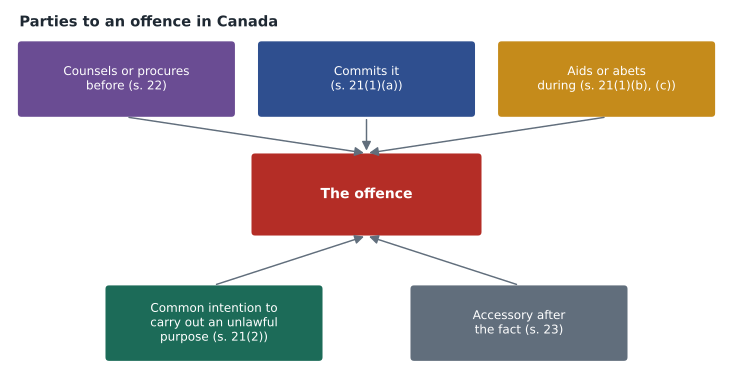
Section 21(1) of the Criminal Code says that everyone is a party to an offence who actually commits it, who does or omits to do anything for the purpose of aiding any person to commit it, or who abets any person in committing it. A party is guilty of the offence itself, not a lesser offence, and can be convicted even if the person who actually committed it is never identified or is acquitted. Aiding means helping, such as driving the getaway car, supplying a tool or acting as a lookout. Abetting means encouraging, instigating or promoting the crime. In R. v. Briscoe (2010), the Supreme Court held that the aider or abettor must intend to assist and must know that the principal intends to commit the crime, though not necessarily the precise details, and that wilful blindness can satisfy the knowledge requirement. In R. v. Thatcher (1987), it held that a jury need not agree whether an accused committed the offence personally or as a party, as long as each juror is satisfied he was one or the other.
Presence at the scene of a crime is not enough. In Dunlop and Sylvester v. The Queen (1979), the Supreme Court held that two men who were present while others committed a gang sexual assault could not be convicted as parties without evidence that they encouraged the principals or did something to facilitate the crime. Presence can be evidence of aiding or abetting when combined with other facts, such as a prior agreement, presence to prevent interference, or a duty to act, but it is not enough by itself. This principle protects bystanders, friends and family members who happen to be nearby, and it means that officers must gather evidence of what each person did and said, not simply who was there.
Section 21(2) extends liability further. When two or more people form an intention in common to carry out an unlawful purpose and to assist each other in it, each of them is a party to any offence committed by one of them in carrying out the common purpose, if each knew or ought to have known that committing that offence would be a probable consequence. If two men agree to rob a store and one of them shoots the clerk, the other may be a party to the shooting. Because murder requires subjective fault, the Supreme Court held in R. v. Logan (1990) that the words or ought to have known cannot be used for murder or attempted murder: the party must have actually foreseen that death was likely.
Counselling and accessories after the fact
Section 22 makes a person who counsels another to commit an offence a party to that offence if it is committed, and to any other offence the counsellor knew or ought to have known was likely to be committed as a result. Counselling includes procuring, soliciting and inciting. If the offence counselled is not committed, the counsellor is still guilty of an offence under section 464, punished as an attempt. In R. v. Hamilton (2005), the Supreme Court held that counselling requires that the accused deliberately encouraged or actively induced the offence, and either intended it to be committed or knowingly counselled it while aware of the unjustified risk that it was likely to be committed. Section 23 deals with help after the crime: an accessory after the fact is a person who, knowing that someone has been a party to an offence, receives, comforts or assists that person for the purpose of enabling him or her to escape. Under section 463, an accessory after the fact is punished more lightly than the principal.
Attempts
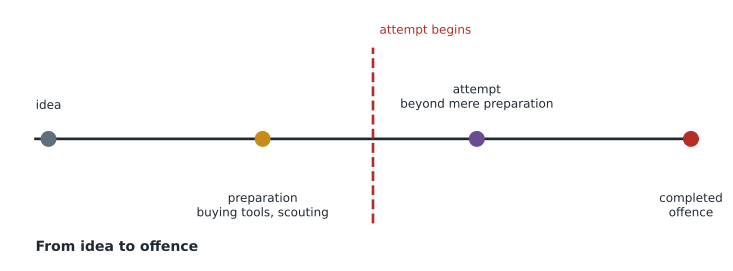
An attempt is an incomplete offence: the person intended to commit a crime and took steps toward it, but did not complete it. Section 24 of the Criminal Code says that everyone who, having an intent to commit an offence, does or omits to do anything for the purpose of carrying out the intention is guilty of an attempt, whether or not it was possible in the circumstances to commit the offence. The hardest question is where preparation ends and an attempt begins. In R. v. Deutsch (1986), the Supreme Court held that there is no single test: the line is drawn by common sense, considering the nature and quality of the act and its relationship to the completed offence, including how close it came in time, place and acts under the accused's control. Buying a balaclava is preparation; standing at a bank teller's window with a gun and a note is an attempt. The intent required is the full intent for the completed offence. In R. v. Ancio (1984), the Court held that attempted murder requires a specific intent to kill, even though murder itself can be committed with lesser forms of intent.
Two features of attempt law often surprise students. First, impossibility is usually no defence. In United States of America v. Dynar (1997), the Supreme Court of Canada held that a man who tried to launder money he believed was drug money was guilty of attempt, even though the money was in fact supplied by police in a sting and was not the proceeds of crime. This is why police stings, in which an officer poses as a child online or a buyer of stolen goods, can lead to attempt convictions. Second, giving up halfway may or may not help. In Canada, once an act goes beyond mere preparation, the attempt is complete, and abandoning it later is no defence, though it may affect sentence.
Conspiracy
Under section 465 of the Criminal Code, a conspiracy is an agreement between two or more people to commit an indictable or summary offence. The agreement itself is the offence; nothing more need be done. Each conspirator must intend to agree and intend to carry out the common object. In R. v. O'Brien (1954), the Supreme Court held that there is no conspiracy where one of only two parties merely pretends to agree, as an undercover officer or informer does, because there is no genuine meeting of minds. And in R. v. Déry (2006), it held that there is no offence of attempting to conspire. Conspiracy is punished in the same way as the offence the conspirators agreed to commit, or in some cases a set maximum. The Code also contains specific offences for participating in the activities of a criminal organization and committing offences for its benefit, in sections 467.11 to 467.13.
Conspiracy cases are built on communications: phone calls, text and encrypted messages, recorded meetings and the testimony of participants who agree to cooperate. They are usually investigated by specialized units with judicial authorizations to intercept communications, and they raise special evidence rules about when one conspirator's words can be used against another. For a patrol officer, the main lessons are to recognize when a call may be part of a larger investigation, to preserve phones and messages lawfully, and to pass information to investigators rather than act alone in a way that could expose an ongoing operation.
The code below applies the rules to the convenience store robbery from the start of the lesson, recording what the evidence showed about each person's role and knowledge. Amara notes that the same five people could face five different outcomes depending on a few facts about what each one knew.
# Who is liable for the store robbery, and how? (Criminal Code ss. 21 to 23, simplified)
people = [
    # name, role, knew of the plan beforehand, helped or encouraged, acted after the crime to help escape
    ("gunman", "took the money at gunpoint", True, True, False),
    ("lookout", "watched the street at the door", True, True, False),
    ("driver", "waited with the engine running", True, True, False),
    ("girlfriend", "told them about one clerk and no camera", True, True, False),
    ("cousin", "hid them and burned their jackets", False, False, True),
    ("friend", "was in the store buying gum, left with them", False, False, False),
]
for name, role, knew, helped, after in people:
    if role.startswith("took"):
        result = "principal: robbery, s. 343"
    elif knew and helped:
        result = "party to robbery: aided or abetted, s. 21(1)"
    elif after:
        result = "accessory after the fact if he knew of the robbery, s. 23"
    else:
        result = "mere presence: no liability without more evidence"
print(f"{name:10s} {role:42s} -> {result}")gunman took the money at gunpoint -> principal: robbery, s. 343 lookout watched the street at the door -> party to robbery: aided or abetted, s. 21(1) driver waited with the engine running -> party to robbery: aided or abetted, s. 21(1) girlfriend told them about one clerk and no camera -> party to robbery: aided or abetted, s. 21(1) cousin hid them and burned their jackets -> accessory after the fact if he knew of the robbery, s. 23 friend was in the store buying gum, left with them -> mere presence: no liability without more evidence
The code simplifies real decisions, but it captures the logic. Every person is assessed separately, and the key facts are what each knew before or during the crime, what each did to help or encourage, and what each did afterward. The friend who happened to be in the store is a witness, not a suspect, unless further evidence shows otherwise. The girlfriend's tip, given before the robbery with knowledge of the plan, makes her an aider; if she had urged them to do it, she would also be a counsellor under section 22.
Worked problem
A sting on a stolen goods ring
Port Ardent's property crime unit sets up an undercover storefront that buys used electronics. Over three months, a man sells the undercover officer eleven laptops, telling him each time that they come from car break-ins his friends do, and asking him to pay more if he can because his friends are splitting the money. Police later arrest the man and two friends. What incomplete or group offences could apply?
Show solution
- Possession of property obtained by crime, section 354, is the main charge for the seller, based on his statements about the source of the laptops.
- The friends who broke into the cars are principals to theft and to the break-ins; if the seller encouraged them to steal more, he may be a party to those thefts as an abettor or counsellor.
- Conspiracy: an agreement among the three to steal and sell laptops is a conspiracy to commit theft, and the undercover officer's pretended participation does not matter because the three genuinely agreed among themselves.
- Evidence: recordings of every transaction, the serial numbers matched to theft reports, and the phone messages among the three, each obtained with the proper legal authority.
Answer: The sting supports charges against all three, each based on separate evidence of what he did and knew. The rules on group and incomplete offences let police act on agreements and encouragement as well as completed thefts.
Common mistakes
MistakeEveryone present at a crime is guilty of it.
InsteadMere presence is not enough; there must be evidence of aiding, encouraging or a shared intent.
MistakeA person who helps only after the crime is guilty of the crime itself.
InsteadHelp after the crime is a separate offence, being an accessory after the fact, punished less severely.
MistakeIf the crime was impossible, there can be no attempt.
InsteadImpossibility is generally no defence; a person who tries to buy what he believes is stolen property can be guilty of attempt.
MistakeAn agreement with an undercover officer is always a conspiracy.
InsteadIn Canada, a genuine agreement between at least two real conspirators is required, so agreeing only with an undercover officer is not a conspiracy.
Summary and key terms
- Section 21 makes those who commit, aid or abet an offence parties to it, guilty of the offence itself.
- Mere presence at a crime is not enough for liability; there must be assistance or encouragement and the required knowledge and intent.
- Counselling (s. 22 and s. 464) and being an accessory after the fact (s. 23) are separate forms of liability.
- An attempt requires the intent for the full offence and an act beyond mere preparation; impossibility is no defence.
- Conspiracy is an agreement between two or more people to commit an offence; the agreement is the crime.
- Each person in a group must be assessed separately, based on evidence of what he or she knew, intended and did.
- Party to an offence
- A person who commits, aids or abets an offence, or forms a common intention leading to it.
- Aiding
- Helping a person commit an offence, with intent to assist and knowledge of the plan.
- Abetting
- Encouraging, instigating or promoting the commission of an offence.
- Counselling
- Procuring, soliciting or inciting another to commit an offence.
- Accessory after the fact
- A person who knowingly helps a party to an offence escape.
- Conspiracy
- An agreement between two or more people to commit an offence.
Practice problems
Work each problem on paper first, then reveal the answer to check.
What must the prosecution prove about an aider's mental state?
Show answer
That the aider intended to assist and knew the principal intended to commit the crime, with wilful blindness sufficient.
Why is mere presence not enough for liability?
Show answer
Because it does not show assistance, encouragement or a shared intent, and the law protects bystanders who happen to be nearby.
What test does Canadian law use to separate preparation from attempt?
Show answer
A common sense assessment of the nature of the act and how close it came to the completed offence, from R. v. Deutsch.
Why can a person caught in a sting be convicted of attempt?
Show answer
Because impossibility is no defence: the person intended the crime and acted on what he believed the circumstances to be.
Lesson quiz · 5 questions
Score 60% or more to complete this lesson.
Create a free account to save your progress, take quizzes and earn a certificate.