
LES-103 · Lesson 7 of 12 · 21 min
Homicide: murder, manslaughter and criminal negligence
▶ Video coming soon A video version of this lesson is on the way.
Professor Desjardins investigated eleven homicides during his years in major crimes, and he tells the class that no two were alike. One was a planned killing over a drug debt. One was a husband who killed his wife after years of abuse that the police had been called about four times. One was a single punch outside a bar, after which a 22-year-old fell, struck his head on the curb and never woke up. One was a contractor who removed a trench support to save time, killing a worker when the wall collapsed. All of them ended a life, and all were homicides in law, but they led to very different charges, from first-degree murder to criminal negligence causing death. The difference lies almost entirely in the mental state of the accused and the circumstances of the killing. This lesson sets out the ladder of homicide offences, which officers must understand from the first minutes at a death scene.
Homicide and culpable homicide
Section 222 of the Criminal Code defines homicide as directly or indirectly causing the death of a human being by any means. Homicide is either culpable, meaning blameworthy and criminal, or not culpable, as in a death caused by a lawful act of self-defence or a pure accident. A person commits culpable homicide when he or she causes the death of a human being by means of an unlawful act, by criminal negligence, by causing the person by threats, fear of violence or deception to do anything that causes death, or by wilfully frightening a child or sick person. Culpable homicide is murder, manslaughter or infanticide. Everything that follows depends on the causation principles of lesson 4: the accused's conduct must be a significant contributing cause of death, and the thin skull rule applies.
Murder
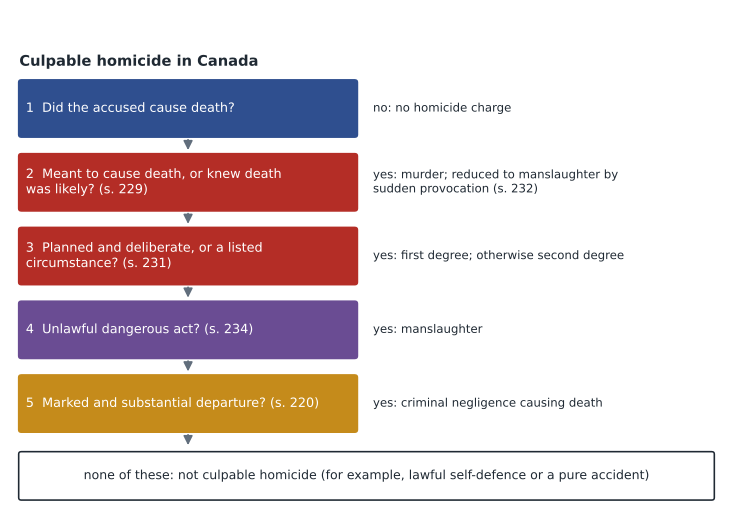
Section 229 sets out the ways of committing murder. Under section 229(a)(i), culpable homicide is murder where the person means to cause death. Under 229(a)(ii), it is murder where the person means to cause bodily harm that he or she knows is likely to cause death and is reckless whether death ensues or not, such as stabbing someone repeatedly in the chest. Section 229(b) covers transferred intent: a person who means to kill one person and by accident or mistake kills another is guilty of murder. Section 229(c) covers a person who, for an unlawful object, does anything that he or she knows is likely to cause death. In R. v. Vaillancourt (1987) and R. v. Martineau (1990), the Supreme Court struck down the old constructive murder provisions that allowed a murder conviction without subjective foresight of death, holding that the Charter requires that a murderer at least know that death was likely. Murder therefore always requires proof that the accused either intended death or knew it was likely.
Murder is either first degree or second degree, and the difference matters for parole: both carry a mandatory life sentence, but first-degree murder carries parole ineligibility for 25 years, while for second-degree murder the judge sets parole ineligibility between 10 and 25 years. Under section 231, murder is first degree when it is planned and deliberate, meaning the result of a considered scheme, carefully thought out, and not impulsive; when the victim is a police officer, correctional officer or similar person acting in the course of duty; when it is committed while committing or attempting certain offences such as sexual assault, kidnapping, forcible confinement or hostage-taking; when it is committed while committing criminal harassment and the accused intended the victim to fear for his or her safety; or when it is connected to terrorism or a criminal organization. In June 2026, Parliament added to this list: the Protecting Victims Act makes murder first degree when it involves coercive control, hate, sexual violence or exploitation, including the killing of women and girls known as femicide, and Bailey's Law makes murder first degree when it is committed within a pattern of coercive or controlling conduct toward an intimate partner. All other murder is second degree. In R. v. Bissonnette (2022), the Supreme Court struck down a provision allowing consecutive 25-year parole ineligibility periods for multiple murders, holding that life with no realistic possibility of parole is cruel and unusual punishment.
Manslaughter and provocation
Manslaughter, under section 234, is culpable homicide that is not murder or infanticide. It carries a maximum of life imprisonment, with no minimum except where a firearm is used, so sentences range widely. There are two main routes to a manslaughter conviction. The first is unlawful act manslaughter: the accused caused death by an unlawful act that was objectively dangerous, meaning that a reasonable person would have foreseen a risk of bodily harm that is neither trivial nor transitory. In R. v. Creighton (1993), the Supreme Court held that foresight of death is not required; foresight of bodily harm is enough. A single punch that causes a fall and a fatal head injury is the classic example. The second route is a murder charge reduced by a partial defence. Section 232 reduces murder to manslaughter where the accused acted in the heat of passion caused by sudden provocation. Since 2015, provocation is limited to conduct of the victim that would constitute an indictable offence punishable by five years or more, such as an assault, and that was sufficient to deprive an ordinary person of the power of self-control, and the accused must have acted on the sudden, before there was time for passion to cool. Provocation does not apply to a killer who is simply angry or humiliated. Bailey's Law of June 2026 also requires courts to consider life imprisonment, with parole ineligibility of 10 to 25 years, for manslaughter of an intimate partner within a pattern of coercive control.
Criminal negligence and other homicides
Criminal negligence causing death, under section 220, carries up to life imprisonment and applies where the accused showed wanton or reckless disregard for the lives or safety of others, a marked and substantial departure from the standard of a reasonable person, as in the trench collapse in Professor Desjardins's case. Section 217.1, added after the Westray mine disaster in Nova Scotia in 1992, imposes a legal duty on everyone who directs how others do work to take reasonable steps to prevent bodily harm, and organizations can be convicted under sections 22.1 and 22.2. Dangerous operation of a conveyance causing death, under section 320.13(3), and impaired operation causing death, under section 320.14(3), carry up to life imprisonment and are the most common homicides arising from driving. Infanticide, under section 233, is a narrow offence that applies when a mother causes the death of her newly born child while her mind is disturbed by the effects of giving birth or of lactation, carrying a maximum of five years.
| Offence and section | Mental element | Sentence |
|---|---|---|
| First-degree murder, ss. 229, 231 | Intent or knowledge that death was likely, plus planning and deliberation or listed circumstances | Life; parole ineligibility 25 years |
| Second-degree murder, s. 229 | Intent or knowledge that death was likely | Life; parole ineligibility 10 to 25 years |
| Manslaughter by unlawful act, s. 234 | Unlawful dangerous act; objective foresight of bodily harm | Up to life; no minimum unless a firearm is used |
| Manslaughter after provocation, ss. 232, 234 | Murder intent, reduced by sudden provocation | Up to life |
| Criminal negligence causing death, s. 220 | Marked and substantial departure; wanton or reckless disregard | Up to life |
The first hour at a death scene
Homicide investigations are run by major crime units, but the first officers at a scene make decisions that can determine the outcome. Their priorities are, in order: preserve life, by giving first aid and calling paramedics even when a person appears dead, unless death is obvious; ensure safety, by locating any suspect and securing weapons; identify and separate witnesses, and note what each says spontaneously; secure the scene with a perimeter larger than seems necessary, a single entry path and a scene log recording everyone who enters; and notify supervisors, investigators and the coroner, who in Ontario has authority over the body and investigates every sudden or unnatural death under the Coroners Act. The officers should not touch, move or clean anything they do not have to, and should record anything they had to disturb to save life.
Many of the facts that separate murder from manslaughter are captured in these first minutes or lost forever. What the suspect says spontaneously, before any questioning, may reveal intent or provocation. Whether the suspect appeared intoxicated affects the analysis of intent, as lesson 11 explains. The position of the body, the location of weapons and the condition of the scene help show whether there was a struggle, whether the killing was sudden or prolonged and whether anyone tried to help. Planning and deliberation is often proved by evidence found later, such as searches, purchases and messages, but the officers who first arrive set the stage by preserving everything. Professor Desjardins says that the best thing a first officer can do is to treat every unexplained death as a homicide until a pathologist says otherwise; it is easy to relax a scene later, but impossible to recover what was lost.
The code below represents the first questions a Crown asks when reviewing a homicide file, in order. Priya notes that it is a decision tree, and that each branch corresponds to a fact that must be proved with evidence.
# Which homicide charge do the facts support? (Criminal Code, simplified)
def charge(f):
    if not f["caused_death"]:
        return "no homicide charge"
    if f["meant_death_or_knew_likely"]:
        if f["sudden_provocation_by_serious_offence"]:
            return "manslaughter (murder reduced by provocation, s. 232)"
        if f["planned_and_deliberate"] or f["listed_circumstance"]:
            return "first-degree murder (ss. 229, 231)"
        return "second-degree murder (s. 229)"
    if f["unlawful_dangerous_act"]:
        return "manslaughter by unlawful act (s. 234)"
    if f["marked_and_substantial_departure"]:
        return "criminal negligence causing death (s. 220)"
    return "not culpable homicide"
base = dict(caused_death=True, meant_death_or_knew_likely=False, sudden_provocation_by_serious_offence=False,
            planned_and_deliberate=False, listed_circumstance=False, unlawful_dangerous_act=False,
            marked_and_substantial_departure=False)
files = {
    "drug debt killing after buying a gun": {"meant_death_or_knew_likely": True, "planned_and_deliberate": True},
    "repeated stabbing in a sudden fight": {"meant_death_or_knew_likely": True},
    "killed during a sexual assault": {"meant_death_or_knew_likely": True, "listed_circumstance": True},
    "single punch, fatal fall on curb": {"unlawful_dangerous_act": True},
    "trench support removed, worker killed": {"marked_and_substantial_departure": True},
    "lawful self-defence": {},
}
for name, facts in files.items():
print(f"{name:40s} -> {charge({**base, **facts})}")drug debt killing after buying a gun -> first-degree murder (ss. 229, 231) repeated stabbing in a sudden fight -> second-degree murder (s. 229) killed during a sexual assault -> first-degree murder (ss. 229, 231) single punch, fatal fall on curb -> manslaughter by unlawful act (s. 234) trench support removed, worker killed -> criminal negligence causing death (s. 220) lawful self-defence -> not culpable homicide
Each line of the output depends on evidence of mental state and circumstances, which is why homicide investigations focus so heavily on what the accused said, did and planned. Compare how the single punch and the trench collapse lead to different charges, though both involve no intent to kill: the punch is an unlawful assault, while the trench collapse is a lawful activity carried out with criminal negligence.
Worked problem
One punch
At 1:50 a.m. outside a waterfront bar, a 22-year-old man argues with another man about a spilled drink. The other man punches him once in the face. He falls backward, strikes his head on the curb and dies in hospital two days later. Witnesses say the puncher had not threatened to kill anyone and looked shocked when the victim did not get up. What charge fits?
Show solution
- Causation: the pathologist confirms death from the head injury suffered in the fall; the punch caused the fall, so the puncher's act is a significant contributing cause of death. The thin skull rule means the hardness of the curb or any fragility of the victim does not matter.
- Intent to kill: a single punch, with no weapon, threats or prior conflict, and shock afterward, does not support an intent to kill or knowledge that death was likely, so murder is not available.
- Unlawful act manslaughter: the punch was an assault, an unlawful act, and a reasonable person would foresee a risk of bodily harm from punching someone in the face, so the Creighton test is met.
- Self-defence: investigators must still ask whether the victim did anything that could support self-defence, such as swinging first, which lesson 11 covers.
Answer: Manslaughter is the appropriate charge. Such cases are prosecuted regularly, and sentences reflect both the tragic result and the absence of intent to kill.
Common mistakes
MistakeEvery killing is murder.
InsteadHomicide is graded by mental state and circumstances; many killings are manslaughter or negligence offences, and some are not crimes at all.
MistakeManslaughter requires that the accused foresaw a risk of death.
InsteadUnlawful act manslaughter requires only objective foresight of bodily harm (R. v. Creighton).
MistakeAnger at an insult is provocation.
InsteadProvocation requires conduct of the victim that is a serious indictable offence and would make an ordinary person lose self-control, with no time to cool.
MistakeIf a person looks dead, first officers need not call paramedics.
InsteadFirst officers preserve life first unless death is obvious, then secure the scene and witnesses.
Summary and key terms
- Culpable homicide is murder, manslaughter or infanticide; causation must be proved.
- Murder requires intent to kill or knowledge that death was likely (s. 229); it is first degree if planned and deliberate or in listed circumstances, now including femicide and killings within coercive control.
- Manslaughter covers unlawful act killings with objective foresight of bodily harm and murders reduced by provocation.
- Criminal negligence causing death and impaired or dangerous driving causing death carry up to life imprisonment.
- First officers at a death scene preserve life, secure the scene and witnesses, and notify investigators and the coroner.
- Evidence of what the accused said, did and planned decides the level of homicide.
- Culpable homicide
- Causing the death of a human being by an unlawful act, criminal negligence or other listed means.
- Planned and deliberate
- The result of a considered scheme carefully thought out, as opposed to an impulsive act.
- Unlawful act manslaughter
- Causing death by an unlawful, objectively dangerous act.
- Provocation
- A partial defence reducing murder to manslaughter when the accused acted on the sudden in response to a serious offence by the victim.
- Criminal negligence
- Wanton or reckless disregard for the lives or safety of others, a marked and substantial departure from reasonable conduct.
- Coroner
- An official who investigates sudden and unnatural deaths and has authority over the body.
Practice problems
Work each problem on paper first, then reveal the answer to check.
What mental state does the Charter require for murder?
Show answer
Subjective foresight of death: intent to kill or knowledge that death was likely.
Give two circumstances that make a killing first-degree murder.
Show answer
Planning and deliberation; the victim was a police officer on duty; murder during a sexual assault or kidnapping; murder involving coercive control.
Why is a fatal single punch usually not murder?
Show answer
Because a single punch without more does not show an intent to kill or knowledge that death was likely; it is usually manslaughter.
What are the first officers' priorities at a death scene?
Show answer
Preserve life, ensure safety, identify and separate witnesses, secure the scene and notify investigators and the coroner.
Lesson quiz · 5 questions
Score 60% or more to complete this lesson.
Create a free account to save your progress, take quizzes and earn a certificate.