
LES-103 · Lesson 12 of 12 · 21 min
Capstone: from facts to charges in a Port Ardent case file
▶ Video coming soon A video version of this lesson is on the way.
The last lesson brings the course together in the way officers actually use criminal law: starting from a messy set of facts and working toward charges that will survive in court. Ms. Liu hands each student a copy of a closed Port Ardent file, with names changed, from a Saturday night in the entertainment district. It contains officers' notes, three witness statements, a booking record, a hospital report, a list of seized property and twenty minutes of video from a bar's cameras. The students' task is the one Ms. Liu performs every week: decide what offences the evidence supports, which charges should be laid, and what is missing. This lesson walks through the method, then the file, and ends with the written product, a charge synopsis like the ones officers submit to the Crown.
How charging decisions are made
In Canada, police lay charges by swearing an information before a justice of the peace under section 504, and the Crown then decides whether the prosecution continues. In British Columbia, Quebec and New Brunswick, Crown counsel approve charges before they are laid; elsewhere, including Ontario, police lay charges and the Crown screens them afterward. Either way, the Crown applies a two-part test: whether there is a reasonable prospect of conviction based on the admissible evidence likely to be available at trial, and whether prosecution is in the public interest. British Columbia uses a slightly higher standard, a substantial likelihood of conviction. The officer's job is to lay charges supported by reasonable grounds and to give the Crown a file that can be assessed against that test. Overcharging, laying the most serious charge the facts could possibly support in order to bargain, is something Crown policies and courts discourage.
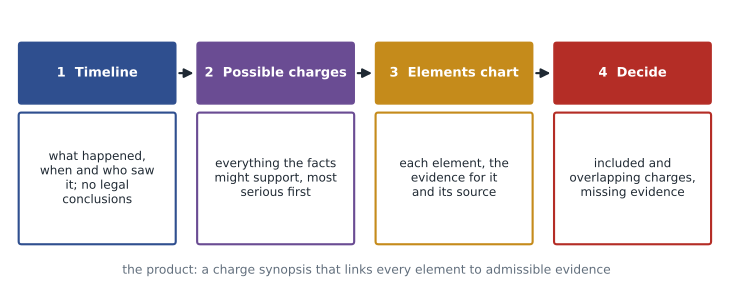
Ms. Liu's method, which the class has practised all term, has four steps. First, write out the facts as a neutral timeline, without legal conclusions. Second, list every offence the facts might support, starting from the most serious. Third, for each offence, write the elements one per line and, beside each, the evidence that proves it and its source. Fourth, decide which charges to lay, considering lesser included offences, overlapping offences and the evidence that is still missing. She says the most common failure is skipping step one and going straight to a charge, because once an officer has decided what the offence is, he or she starts to see only the evidence that fits.
Included and overlapping offences
Two rules shape how many charges to lay. The first is the rule on included offences: under section 662, a count charging an offence includes any offence whose elements are all contained in it, so a charge of aggravated assault includes assault causing bodily harm and assault, and if the Crown fails to prove the aggravating element, the accused can still be convicted of the included offence. Officers do not need to lay every included offence separately. The second is the rule against multiple convictions from R. v. Kienapple (1975): an accused should not be convicted of two offences arising from the same act when the offences have no additional distinguishing element, so a person who steals with violence is convicted of robbery, not of robbery, theft and assault for the same act. Officers can still lay overlapping charges so that the court can convict on whichever is proved, and the Crown and the court sort out Kienapple at the end. The practical rule for officers is the same in both systems: lay the charges the evidence supports, describe the facts that distinguish them, and let the Crown decide the final shape.
The file: Saturday night on Front Street
Here is the neutral timeline the class builds from the file. At 12:52 a.m., a man the file calls R.T. and his friend arrive at a bar on Front Street. Video shows R.T. drinking steadily. At 1:31 a.m., R.T. picks up a phone left on the bar by another customer, the complainant K.M., looks at it and puts it in his pocket. At 1:34 a.m., K.M. notices the phone is missing and asks R.T. if he has it; video shows R.T. shaking his head. At 1:36 a.m., K.M. reaches toward R.T.'s pocket; R.T. pushes him away, picks up a beer bottle and strikes K.M. on the side of the head, then says, according to two witnesses, touch me again and you're dead. K.M. falls, bleeding. R.T. walks out. At 1:41 a.m., Constable Malhotra, responding to the 911 call, stops R.T. a block away. R.T. first gives the name of his brother. A pat-down incident to arrest finds K.M.'s phone and a small bag containing eleven pills later analysed as oxycodone. At the station, R.T.'s real name is confirmed by fingerprints; records show he is on a release order with a condition not to possess controlled substances. The hospital report shows K.M. needed eight stitches and had a mild concussion.
Jesse Morningstar points out that the timeline contains no legal words at all, not assault or theft or threat, only what people did and when. Ms. Liu says that is exactly the point: the timeline is what the evidence shows, and everything else is analysis.
| Possible offence | Key elements | Evidence and source |
|---|---|---|
| Assault with a weapon or causing bodily harm, s. 267 | Assault; with a weapon or causing bodily harm | Video 1:36; two witnesses; bottle seized; hospital report (stitches, concussion) |
| Theft under, s. 334(b) | Taking without colour of right with intent to deprive | Video 1:31; phone found in R.T.'s pocket; K.M. identifies it; denial at 1:34 |
| Robbery, s. 343 | Violence to retain stolen property or overcome resistance | Blow came when K.M. reached for the phone: video 1:36, witnesses |
| Uttering threats, s. 264.1 | Threat to cause death or bodily harm, meant to intimidate | Two witnesses; context of the blow |
| Possession of a Schedule I substance, CDSA s. 4 | Knowledge and control of a controlled substance | Pills found on search incident to arrest; lab analysis |
| Identity fraud or obstruction, ss. 403, 129 | Personating another to avoid arrest, or wilful obstruction | Constable Malhotra's notes at 1:41; fingerprint confirmation |
| Failure to comply with release order, s. 145 | A valid order; knowledge; breach of a condition | Release order or bond record; the pills or the new offenses |
Working through the chart produces several conclusions. The blow with a bottle is an assault with a weapon, and the cut and concussion are bodily harm, so section 267 is supported either way; if the injury were more serious, aggravated assault under section 268 would follow. Because R.T. struck K.M. when K.M. reached for the phone, the violence was used to prevent resistance to the stealing, so robbery under section 343 is also supported, with theft and assault included in it. The words you're dead, said while K.M. lay bleeding, support uttering threats. The pills support possession of a Schedule I substance, though eleven pills alone would not support trafficking. Giving his brother's name to avoid arrest supports identity fraud or obstruction. And possessing the pills breaches the release order. Amara notices that one moment in the timeline, the blow at 1:36, supports four of the charges, and Ms. Liu says that is why the video's exact sequence is the most important evidence in the file.
Linh turns the chart into a short program that checks which elements of each candidate charge have evidence from at least one source, and lists what is still missing. Her version uses the file's facts directly.
# Elements chart for the Front Street file (Criminal Code, simplified)
evidence = {
    "video shows R.T. take phone": True, "phone found on R.T.": True, "K.M. identifies phone": True,
    "video shows blow with bottle": True, "witnesses saw blow": True, "hospital report": True,
    "bottle seized": True, "witnesses heard threat": True, "pills found on search": True,
    "lab confirms oxycodone": False, "notes record false name": True, "fingerprint ID": True,
    "copy of release order": False,
}
charges = {
    "robbery, s. 343": [["video shows R.T. take phone", "phone found on R.T."],
                        ["video shows blow with bottle", "witnesses saw blow"]],
    "assault with a weapon / bodily harm, s. 267": [["video shows blow with bottle", "witnesses saw blow"],
                                                    ["bottle seized", "hospital report"]],
    "uttering threats, s. 264.1": [["witnesses heard threat"]],
    "possession, CDSA s. 4": [["pills found on search"], ["lab confirms oxycodone"]],
    "identity fraud, s. 403": [["notes record false name"], ["fingerprint ID"]],
    "fail to comply, s. 145": [["copy of release order"], ["pills found on search"]],
}
for charge, elements in charges.items():
    missing = [e for e in elements if not any(evidence[s] for s in e)]
    status = "ready" if not missing else "missing: " + "; ".join(" or ".join(m) for m in missing)
print(f"{charge:44s} {status}")robbery, s. 343 ready assault with a weapon / bodily harm, s. 267 ready uttering threats, s. 264.1 ready possession, CDSA s. 4 missing: lab confirms oxycodone identity fraud, s. 403 ready fail to comply, s. 145 missing: copy of release order
The output shows four charges ready and two waiting on documents: the drug possession charge needs the lab analysis, and the breach of the release order needs a copy of the order showing the condition. Neither is unusual. Police often lay a possession charge on reasonable grounds and file the analyst's certificate later, under section 51 of the CDSA, and they obtain release orders from the court registry. The point is that the file tells the officer exactly what to follow up on.
Writing the charge synopsis
The final product is a Crown brief synopsis, usually one or two pages, that tells the story in plain language and connects each charge to the evidence. Professor Desjardins has read thousands of them and says the good ones share these features:
- A one-paragraph summary at the top: who, what, when and where, and the charges recommended.
- A neutral, chronological narrative with times, written in the first person for the officer's own observations and attributed for everything else (witness A states...).
- For each charge, the section, the elements and the evidence that proves each element, including any weaknesses.
- The grounds for each police action: the stop, the detention, the arrest, the search and the seizure of each item.
- Rights advice and any statements made, with times and exact words where possible.
- A list of evidence and witnesses, outstanding items such as the lab analysis or video still to be obtained, and disclosure notes such as body camera footage.
- Victim information, including injuries, the impact of the offence and any concerns about release, and the accused's record and release status.
Priya, reading her draft aloud, realizes she has written that R.T. stole the phone and then assaulted K.M. to keep it, which is a legal conclusion, not a fact. Ms. Liu suggests the factual version: at 1:36 a.m., K.M. reached toward R.T.'s right jacket pocket, where the phone was later found; R.T. pushed K.M.'s arm away, picked up a beer bottle from the bar and struck K.M. on the left side of the head. The legal conclusion goes in the charge analysis, where it can be supported element by element.
What the course has built
Over twelve lessons, the class has moved from the sources of criminal law to the elements of offences, the forms of participation, offences against the person, sexual offences and harassment, property crimes, weapons, drugs and public order, and the defences. Each topic has added to the same skill: reading a provision carefully, breaking it into elements, and matching each element to evidence. That skill will be used in every course that follows, from LES-111 on the Charter and LES-112 on police powers to the investigation courses in second year. Marco says he expected a law course to be about memorizing sections, and that he was surprised how much of it is about thinking clearly under pressure. Professor Desjardins says that is the job.
Worked problem
A second file to try
A 911 caller reports two men fighting in a convenience store parking lot. Officers arrive to find one man, D.W., holding a folding knife, and another, P.N., with a cut on his forearm. P.N. says D.W. tried to rob him of his wallet. D.W. says P.N. owed him money, grabbed him when he asked for it, and that he pulled the knife only to make P.N. let go. The store's camera shows the start of the encounter but not who grabbed whom first. How should an officer approach the file?
Show solution
- Timeline first: record the times, positions and actions shown on video and described by each man and any other witness, without legal labels.
- Possible offences: robbery or attempted robbery, assault with a weapon or causing bodily harm, possession of a weapon for a dangerous purpose, and, for P.N., assault if he grabbed first.
- Elements: for robbery, the officer needs evidence of an intent to steal, so D.W.'s claim of a debt matters, because an honest claim of right to the money can negate the theft element.
- Defences: D.W.'s account raises self-defence; the evidence on who grabbed whom, the timing of the knife and the injuries will decide whether it is credible.
- Missing evidence: other cameras, the store clerk, the knife, photographs of both men's injuries and any messages about the debt.
Answer: The file cannot be resolved at the scene, and the method keeps the officer from choosing a story too early. The charge, if any, will follow from the evidence on how the fight began.
Common mistakes
MistakeCharge the most serious offence possible to give the Crown room to bargain.
InsteadCharge what the evidence supports; overcharging is discouraged and damages credibility.
MistakeLay every included offence as a separate count.
InsteadAn included offence is covered by the main count (s. 662).
MistakeThe synopsis should explain why the accused is guilty.
InsteadThe synopsis states facts neutrally and connects them to elements; conclusions come from the evidence.
MistakeIf the lab report is not back, no drug charge can be laid.
InsteadCharges can be laid on reasonable grounds or probable cause, with the analysis added to the file later.
Summary and key terms
- Police lay charges on reasonable grounds; the Crown continues them if there is a reasonable prospect of conviction and it is in the public interest.
- Ms. Liu's method: neutral timeline, possible offences, elements chart, then charging decisions.
- Included offences (s. 662) and the Kienapple rule shape how many counts to lay.
- One act, such as a blow used to keep stolen property, can support several charges; its timing is critical evidence.
- A charge synopsis tells the story neutrally, links each element to evidence and lists what is missing.
- The core skill of the course is matching each element of an offence to admissible evidence.
- Information
- A sworn document before a justice of the peace that starts a prosecution.
- Reasonable prospect of conviction
- The Crown's evidentiary test for continuing a prosecution.
- Public interest test
- The second part of the Crown's charging standard.
- Included offence
- An offence whose elements are all contained in the offence charged.
- Kienapple rule
- No multiple convictions for the same act without an additional distinguishing element.
- Crown brief
- The package of evidence and synopsis police give the Crown.
Practice problems
Work each problem on paper first, then reveal the answer to check.
Why should the timeline contain no legal conclusions?
Show answer
Because it records what the evidence shows; legal labels applied early can make officers see only the evidence that fits.
In the Front Street file, why is the robbery charge supported?
Show answer
Because R.T. used violence, the blow with the bottle, when K.M. tried to recover the phone, connecting the force to keeping the stolen property.
What does the Kienapple rule prevent?
Show answer
Multiple convictions for the same act when the offences have no additional distinguishing element.
List four things a good charge synopsis includes.
Show answer
A summary, a neutral timeline, elements matched to evidence for each charge, grounds for police actions, statements, an evidence list and outstanding items.
Lesson quiz · 5 questions
Score 60% or more to complete this lesson.
Create a free account to save your progress, take quizzes and earn a certificate.