
JS-290 · Lesson 1 of 12 · 25 min
Choosing the project and users
▶ Video coming soon A video version of this lesson is on the way.
On Tuesday, March 13, 2029, a week after Beatrix Lund retested the fixed plan page on staging and signed up for a practice shift with her screen reader, Mira starts the last course of her program. It is different from every block before it. For two and a half years she has learned one subject at a time, with Gareth or Theo beside her and a small, well-defined exercise at the end. The capstone turns that around. For eleven weeks Mira leads a small team that chooses a real problem, talks to the people who have it, designs and builds a full-stack application, tests it, has it reviewed, deploys it and hands it over. The mentors advise; they do not decide.
The team is Mira and two first-year apprentices who joined Brightwater in January. Odalys Ferreyra came from a college web program and is strongest on the front end. Tavish Mulcahy spent six years in a warehouse before retraining, wrote his first SQL query last autumn and has a habit of asking how a thing will be used before asking how it will be built. Rhea has set the rules: the project must serve the Food Hub or one of its partners, it must be small enough to ship by the end of May, it must reuse what the studio already runs instead of inventing new infrastructure, and everything must happen on staging with invented data until the client signs off.
What a capstone is for
A capstone is not a bigger exercise. Its purpose is to practise the parts of the work that small exercises leave out: choosing what to build, saying no to good ideas, working with people who are not developers, coordinating three people's changes in one code base, and finishing. Gareth tells the team that most projects that fail do not fail because the code is hard. They fail because the team built the wrong thing, built too much of it, or never got it to the point where someone could use it. The capstone is graded the same way a client judges a project: does it solve the problem, does it work, can someone else look after it?
Every earlier course left a piece the capstone will use. JS-101 to JS-130 gave the language and TypeScript. WEB-201 gave the database design method. JS-201 gave the data structures for scheduling problems. JS-210 gave the test tools and CI. JS-220 gave React and the portal's patterns. JS-230 and JS-240 gave the Node service, its API style and its sign-in. JS-250 gave performance budgets and offline support, JS-260 gave the deployment pipeline, and WEB-230 gave the security and accessibility checklist. The team's first decision is which problem deserves all of it.
Finding candidate projects
Mira does not start with an idea. She starts by asking the people who run the Food Hub what is hard. In the first week the team spends an hour each with Lucy, Rosa and Dev, and half an hour with Paul. Tavish asks each of them the same three questions: what takes too long, what goes wrong, and what do you do now when it goes wrong? Odalys takes notes in the words people actually use, not in developer language, because those words will become the labels on screens.
Three candidates come out of the interviews. Lucy wants a way for volunteers to swap shifts with each other without phoning her, since about a third of her calls in a busy week are swap requests. Dev wants online registration for the community kitchen's cooking classes, which are now booked by e-mail and often oversubscribed. Rosa and Lucy together describe the problem that bothers them most: food rescue. Nine local businesses, three grocers, four bakeries and two cafés, give the Food Hub food they cannot sell, such as day-old bread, bruised produce and unsold sandwiches. A volunteer driver collects it and brings it to the warehouse or the kitchen. All of it is arranged by phone calls, text messages and a shared spreadsheet that Lucy updates by hand.
| Candidate | Who asked | Problem today | What it would reuse |
|---|---|---|---|
| Shift swaps | Lucy | About a third of her calls in busy weeks are swap requests | Portal, shifts API, overlap rule from JS-220 |
| Cooking class registration | Dev | E-mail booking, classes oversubscribed, no waiting list | Portal sign-in, payments are out of scope |
| Food rescue pickups | Rosa and Lucy | Phone, texts and a spreadsheet; pickups missed; food thrown away | Partner service patterns, sign-in, mail outbox, pipeline |
Choosing with a weighted matrix
The team could argue for hours, so Mira proposes a weighted decision matrix. They agree the criteria first, before scoring anything, so that nobody can choose criteria to suit a favourite. The criteria are the value to the Food Hub, how well the problem is understood, whether it fits in eleven weeks, how much of the studio's existing work it reuses, and the risk of harm if it goes wrong. Each criterion gets a weight that says how much it matters, and the weights add up to 10. Then each person scores each candidate from 1 to 5 on each criterion, and the team discusses any score where they disagree by more than one point.
// Weighted decision matrix: weights add to 10; scores are 1 (poor) to 5 (good).
const weights = { value: 3, understood: 2, fits: 2, reuse: 2, lowRisk: 1 };
const candidates = {
  'Shift swaps': { value: 3, understood: 4, fits: 4, reuse: 5, lowRisk: 4 },
  'Class registration': { value: 2, understood: 3, fits: 4, reuse: 3, lowRisk: 5 },
  'Food rescue pickups': { value: 5, understood: 4, fits: 3, reuse: 4, lowRisk: 3 },
};

const total = Object.values(weights).reduce((a, b) => a + b, 0);
const results = Object.entries(candidates).map(([name, s]) => {
  const score = Object.entries(weights).reduce((sum, [k, w]) => sum + w * s[k], 0);
  return { name, score, max: total * 5 };
});
results.sort((a, b) => b.score - a.score);
for (const r of results) {
  console.log(`${r.name.padEnd(20)} ${String(r.score).padStart(2)} of ${r.max}`);
}Food rescue pickups 40 of 50 Shift swaps 39 of 50 Class registration 31 of 50
What this code does
Each candidate's score is the sum of weight times score over all five criteria, so a criterion with weight 3 counts three times as much as one with weight 1. The best possible total is 50, which is the weights' sum times the top score of 5. Sorting the results puts the strongest candidate first, but the numbers are a starting point for discussion, not a verdict.
Food rescue comes out ahead, mainly because of its value. Rosa estimates that in 2028 the Food Hub rescued about 41,600 kg of food, and Lucy's spreadsheet records 37 missed pickups out of 1,480 scheduled. A missed pickup usually means the food is thrown away. Shift swaps score well on fit and reuse, and the team writes it down as a strong second choice for a later project. Class registration loses on value, partly because Dev admits the classes fill anyway.
Tavish raises the obvious concern: food rescue scores lowest on fit, because it touches more people than the other two. Mira's answer is that this is exactly why scope will matter, and that the first version will be deliberately small. The team takes the decision to Paul and Lucy on Friday, March 16, with the matrix attached, and they agree.
Who the users are
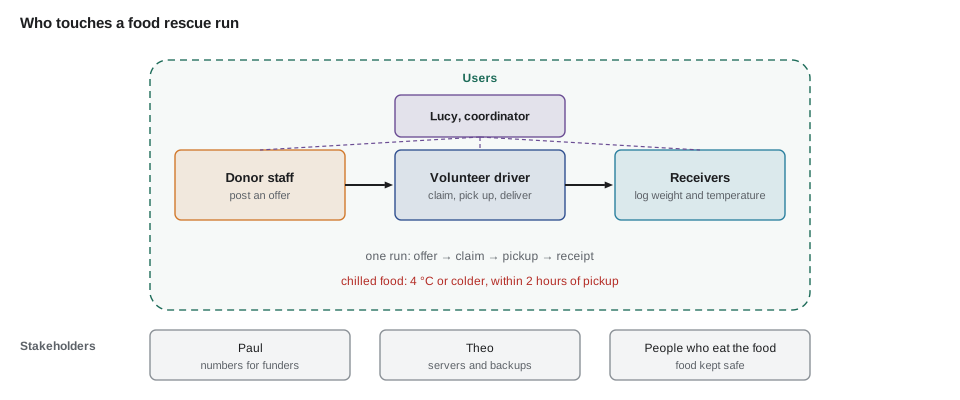
A problem belongs to people, and the next step is to name them. Odalys distinguishes users, who will use the application directly, from stakeholders, who are affected by it or have a say in it without necessarily using it. Mixing the two leads to applications designed for the person who pays rather than the person who taps the screen.
| Group | User or stakeholder | What they need from food rescue |
|---|---|---|
| Donor staff at the nine businesses | User | Say quickly what food is available and when it can be collected, without a phone call |
| Volunteer drivers (about 22 active) | User | See runs near them, claim one, know exactly where to go and whom to ask for |
| Warehouse and kitchen receivers, including Rosa | User | Know what is coming, record what arrived, its weight and, for chilled food, its temperature |
| Lucy, the volunteer coordinator | User | See unclaimed runs early, fill gaps, stop chasing people by phone |
| Paul, the executive director | Stakeholder | Reliable numbers for funders and the board, no new risks |
| Theo, who runs the servers | Stakeholder | A service that fits his hosting, backups and monitoring |
| People who eat the food | Stakeholder | Food that was kept safe on its way |
The last row matters even though those people will never see the application. Rescued food includes sandwiches and dairy that must stay cold. The Food Hub already has a rule, taken from its food safety training: chilled food must arrive at 4 °C or colder, and it must reach the warehouse within two hours of pickup. If the application makes it easier to break that rule, it has made things worse, however tidy its screens are.
Mapping stakeholders by influence and interest
With a list of people, the team needs to decide how much attention each one gets. A common tool is the influence and interest grid. People with high influence and high interest are managed closely: they are consulted on every major decision. People with high influence and low interest are kept satisfied, which usually means short updates and no surprises. People with low influence and high interest are kept informed, and the rest are monitored. The grid is not about who matters as a person; it is about how the team spends its limited meeting time.
// Influence and interest, each 1 (low) to 5 (high); 4 or more counts as high.
const people = [
  { name: 'Lucy', influence: 5, interest: 5 },
  { name: 'Paul', influence: 5, interest: 3 },
  { name: 'Rosa', influence: 3, interest: 5 },
  { name: 'Theo', influence: 4, interest: 4 },
  { name: 'Donor staff', influence: 2, interest: 4 },
  { name: 'Drivers', influence: 2, interest: 5 },
  { name: 'Dev', influence: 2, interest: 2 },
];

function quadrant(p) {
  const hi = (n) => n >= 4;
  if (hi(p.influence) && hi(p.interest)) return 'manage closely';
  if (hi(p.influence)) return 'keep satisfied';
  if (hi(p.interest)) return 'keep informed';
  return 'monitor';
}

const groups = {};
for (const p of people) (groups[quadrant(p)] ??= []).push(p.name);
for (const q of ['manage closely', 'keep satisfied', 'keep informed', 'monitor']) {
  console.log(`${q.padEnd(15)} ${(groups[q] ?? []).join(', ')}`);
}manage closely Lucy, Theo keep satisfied Paul keep informed Rosa, Donor staff, Drivers monitor Dev
What this code does
Each person gets an influence and an interest score, and a score of 4 or more counts as high. The quadrant function checks the combinations in order, so someone high on both is managed closely before any other rule is tried. Grouping the names by quadrant gives the team a plan for who gets weekly demos and who gets a short monthly note.
The grid shows something the team had not noticed. Rosa's influence is lower than Lucy's only because Lucy runs the volunteers, but Rosa's kitchen receives half the rescued food, so she must be consulted on anything about receiving. Mira moves her into the weekly demo list anyway. A tool like this is a prompt for judgment, not a replacement for it.
The problem statement
Before any feature is discussed, the team writes a problem statement: one short paragraph that says who has the problem, what it is, why it matters, and how anyone will know it has been solved. It is the paragraph they will reread whenever a new idea threatens the schedule. Odalys drafts it and the team cuts it twice.
Their final version reads: *Donors, drivers and receivers arrange about thirty food rescue pickups a week by phone and a shared spreadsheet that only Lucy updates. Pickups are missed or found too late to cover, chilled food is sometimes collected without a cooler, and the Food Hub cannot report reliably how much food it rescues. Rescue Runs will let donors post available food, let drivers claim and complete runs, and let receivers record what arrived, so that fewer pickups are missed, chilled food is handled safely, and Lucy spends less time on the phone.*
Measuring success
A goal without a measure is a wish, so the team agrees how they will know the application helped. They choose measures they can get from the application itself and compare with the baseline in Lucy's spreadsheet. Each has a target for the first three months of real use, which will begin after the course ends.
// Baseline from Lucy's 2028 spreadsheet and targets for the first three months of use.
const baseline = { scheduled: 1480, missed: 37, foundLate: 112, chilledNoCooler: 9 };
const rate = (n, d) => Math.round((n / d) * 1000) / 10;

const measures = [
  ['Missed pickups', rate(baseline.missed, baseline.scheduled), 1.5],
  ['Runs covered with under 2 hours notice', rate(baseline.foundLate, baseline.scheduled), 4.0],
  ['Chilled runs without a cooler', rate(baseline.chilledNoCooler, baseline.scheduled), 0.0],
];
console.log('Measure'.padEnd(40), 'Now', ' Target', '(in 100 runs)');
for (const [name, now, target] of measures) {
  console.log(name.padEnd(40), String(now).padStart(3), String(target).padStart(7));
}Measure Now Target (in 100 runs) Missed pickups 2.5 1.5 Runs covered with under 2 hours notice 7.6 4 Chilled runs without a cooler 0.6 0
What this code does
Each measure is a count divided by the 1,480 scheduled pickups, rounded to one decimal place and shown as a number in each 100 runs. The rounding multiplies by 1,000, rounds, then divides by 10, which keeps one decimal without the surprises of formatting functions. Writing the baseline next to the target makes it obvious how big an improvement the team is promising.
Lucy adds a measure the team had not thought of: the number of phone calls she makes about rescue in a week. She has kept a tally for two weeks and averages 41. Her target is under 15. It is not something the application can count, so she will keep counting it herself.
Constraints and ground rules
The team also writes down what they may not do, because constraints are as much a part of the project as features. Rhea's rules become the first entries in the project's decision log.
- The project runs from Tuesday, March 13 to Thursday, May 31, 2029, with demo day on May 31 and a retrospective on Friday, June 1.
- It reuses the studio's stack: React and Vite in the food-hub repository, a Node service beside Theo's PHP application, Theo's managed PostgreSQL, the mail outbox and the JS-260 pipeline.
- All development and testing use invented data on staging. Real donors' and drivers' details are entered only after Paul signs off, and only for a pilot.
- Sign-in is reused, not reinvented: no new password scheme and no new kind of session.
- Accessibility target WCAG 2.2 AA from the start, with Beatrix invited to test before demo day.
- Theo has the final say on anything that changes his servers or his database.
Gareth adds one rule of his own: every Tuesday the team shows something that works, however small, to at least one person who will use it. A team that demonstrates weekly cannot drift for long.
Worked problem
Weighing a fourth criterion
After the matrix, Paul asks whether the team considered how many people each project would help each week. The team adds a criterion "reach" with weight 2 and reduces "value" from 3 to 2, so the weights still add to 10. They score reach as 5 for shift swaps, 2 for class registration and 3 for food rescue. Using the scores from the matrix, what are the new totals?
Show solution
- Shift swaps: value 2 × 3 = 6, understood 2 × 4 = 8, fits 2 × 4 = 8, reuse 2 × 5 = 10, low risk 1 × 4 = 4, reach 2 × 5 = 10; total 46.
- Class registration: 2 × 2 = 4, 2 × 3 = 6, 2 × 4 = 8, 2 × 3 = 6, 1 × 5 = 5, 2 × 2 = 4; total 33.
- Food rescue: 2 × 5 = 10, 2 × 4 = 8, 2 × 3 = 6, 2 × 4 = 8, 1 × 3 = 3, 2 × 3 = 6; total 41.
- The weights now add to 2 + 2 + 2 + 2 + 1 + 2 = 11, not 10, so the best possible total is 11 × 5 = 55; the team forgot to take a point from somewhere else.
Answer: With the extra criterion, shift swaps lead with 46 to food rescue's 41, but the weights now add to 11. The team rebalances to 10 and keeps food rescue, and records why, which is the real value of the exercise: the choice is explained, not just made.
Common mistakes
MistakeStarting with a favourite idea and looking for reasons to build it.
InsteadInterview the people with the problem, list candidates, and agree criteria before scoring them.
MistakeTreating the person who pays as the main user.
InsteadSeparate users, who use the application, from stakeholders, who are affected by it.
MistakeWriting success as "the app works".
InsteadChoose measures with a baseline and a target, such as missed pickups in each 100 runs.
MistakeIgnoring people who never see the screens.
InsteadInclude stakeholders such as the people who eat rescued food, and design rules that protect them.
MistakeLeaving constraints unwritten.
InsteadRecord time limits, reuse rules, data rules and decision rights at the start.
Summary and key terms
- A capstone practises choosing, scoping, coordinating and finishing a real project.
- Candidate projects come from interviews with the people who have the problem.
- A weighted decision matrix with criteria agreed in advance makes the choice explainable.
- Users use the application; stakeholders are affected by it or have a say in it.
- An influence and interest grid helps decide how much attention each group gets, but judgment still overrides it.
- A problem statement says who has the problem, what it is, why it matters and how success will be known.
- Success measures need a baseline and a target.
- Constraints and decision rights are written down at the start.
- Capstone
- A final project that brings together a whole program's skills on a real problem.
- Weighted decision matrix
- A table that scores options against agreed criteria, each multiplied by a weight.
- User
- A person who uses the application directly.
- Stakeholder
- A person or group affected by the application or with a say in it.
- Influence and interest grid
- A way of placing stakeholders by how much they can affect the project and how much they care about it.
- Problem statement
- A short paragraph naming who has a problem, what it is, why it matters and how success will be measured.
- Baseline
- The value of a measure before a change, used to judge the change.
- Food rescue
- Collecting surplus food from businesses so it can be used instead of thrown away.
Practice problems
Work each problem on paper first, then reveal the answer to check.
Why agree the criteria before scoring the candidates?
Show answer
So that nobody can choose criteria that favour the option they already prefer.
What is the difference between a user and a stakeholder?
Show answer
A user uses the application directly; a stakeholder is affected by it or has a say without necessarily using it.
Why does the team record a baseline?
Show answer
Without the value before the change, nobody can tell whether the application improved anything.
Why is food safety part of the project even though eaters never use the app?
Show answer
The app must not make it easier to break the cold-food rule, because harm to eaters would outweigh any convenience.
Try it yourself
Weighted score
Complete weightedScore(weights, scores). Both are objects with the same keys.
Return the sum of each weight times its score. If a key in weights is missing from scores, treat its score as 0.
function weightedScore(weights, scores) {
  return 0;
}

const w = { value: 3, fits: 2, reuse: 2, risk: 1 };
console.log(weightedScore(w, { value: 5, fits: 3, reuse: 4, risk: 3 }));
console.log(weightedScore(w, { value: 2, fits: 4 }));
Try it yourself
Stakeholder quadrants
Complete quadrant(influence, interest). Each argument is 1 to 5, and 4 or more counts as high.
Return manage closely, keep satisfied, keep informed or monitor, using the grid from the lesson.
function quadrant(influence, interest) {
  return 'monitor';
}

console.log(quadrant(5, 5));
console.log(quadrant(4, 2));
console.log(quadrant(2, 5));
console.log(quadrant(3, 3));
Lesson quiz · 5 questions
Score 60% or more to complete this lesson.
Create a free account to save your progress, take quizzes and earn a certificate.