
ITIL-141 · Lesson 9 of 12 · 30 min
Supplier management I: strategy, selection and contracts
Larchmont Technology Services cannot deliver a single business service on its own. The shipment portal runs in a public cloud. The distribution centres connect through a carrier's network. The warehouse management system is licensed from a software vendor, which also provides support. Security monitoring is outsourced to a managed security provider. Laptops come from a hardware reseller with a repair contract. When any of these suppliers fails, Larchmont's customers feel it. Supplier management is the practice that makes sure suppliers, and their performance, support the services LTS promises.
ITIL-130 lesson 11 introduced partners and suppliers in the value system: sourcing models, classifying suppliers by risk and value, service integration and management (SIAM) layers and exit planning. This lesson and the next look at supplier management as a practice. This lesson covers its purpose and activities, supplier strategy, selection and due diligence, contract design, commercial models and key clauses, and the legal and procurement context. Lesson 10 covers performance, risk and multi-supplier management.
Purpose of supplier management
In plain words, the purpose of the supplier management practice is to ensure that the organization's suppliers and their performances are managed appropriately to support the seamless provision of quality products and services. This includes creating closer, more collaborative relationships with key suppliers to uncover and realize new value and reduce the risk of failure. The words seamless and collaborative are important. Users should not be able to see where one supplier's responsibility ends and another's begins. And for key suppliers, the aim is not only to police a contract but to work together to improve.
Supplier management is a general management practice in ITIL 4. Published summaries of ITIL (Version 5), checked in October 2026, keep supplier management in the general management group.
Activities of the practice
ITIL describes the key activities of supplier management as: creating a single point of visibility and control to ensure consistency; maintaining a supplier strategy, policy and contract management information; negotiating and agreeing contracts and arrangements; managing relationships and contracts with internal and external suppliers; and managing supplier performance. The first activity is often overlooked. In many organizations, contracts are signed by different departments, stored in different places and managed by nobody in particular. A single supplier and contract register, with owners for each supplier, is the foundation of everything else.
| Activity | What it involves | Larchmont example |
|---|---|---|
| Single point of visibility | One register of suppliers, contracts, owners and key dates | 84 IT suppliers recorded with owner, spend, criticality and renewal dates |
| Strategy, policy and information | Sourcing direction, rules for buying, contract records | Policy: critical suppliers need security review and exit plans |
| Negotiate and agree | Select suppliers, agree terms | Renegotiate the network carrier contract before renewal |
| Manage relationships and contracts | Day-to-day contact, change control, disputes | Monthly operational meetings with the managed security provider |
| Manage performance | Measure, review and improve supplier delivery | Quarterly scorecards for critical suppliers (lesson 10) |
Supplier strategy
A supplier strategy sets the direction for how the organization uses suppliers. It draws on the organization's overall strategy and the sourcing factors discussed in ITIL-130: which capabilities are core and should stay in-house, which are better sourced, how much dependence on any one supplier is acceptable, what the organization's approach is to cloud, and how suppliers should support goals such as security, accessibility, sustainability and local economic benefit. The strategy guides decisions about individual contracts so they add up to a coherent whole.
For Larchmont, the supplier strategy might say: keep warehouse process knowledge and integration skills in-house; use public cloud for customer-facing services; avoid single-supplier dependence for network connectivity at the largest distribution centres; prefer suppliers with independent security assurance; and include environmental criteria in hardware purchasing.
Segmenting suppliers
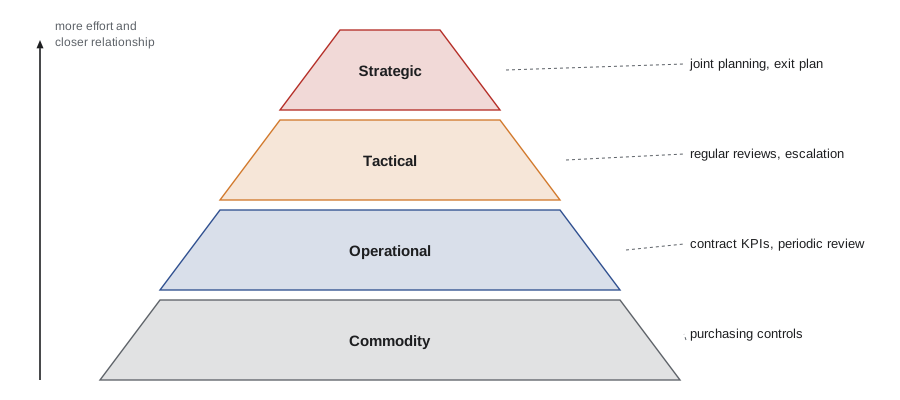
Not every supplier deserves the same attention. ITIL-130 introduced the purchasing portfolio matrix, which classifies suppliers by business impact and supply risk. Supplier management uses segmentation to decide how much effort to spend on each supplier. A common segmentation uses three or four tiers: strategic suppliers, whose failure would seriously harm critical services and with whom the organization seeks partnership; tactical suppliers, important but replaceable with some effort; operational suppliers, providing standard products or services; and commodity suppliers, easily replaced and managed mainly through purchasing.
| Tier | Typical characteristics | Management approach | Larchmont examples |
|---|---|---|---|
| Strategic | Critical to key services, hard to replace | Executive sponsor, joint planning, quarterly business reviews, exit plan | Cloud provider, warehouse management system vendor |
| Tactical | Important, replaceable with effort | Regular performance reviews, defined escalation | Network carrier, managed security provider |
| Operational | Standard services with alternatives | Contract KPIs, periodic review | Laptop repair, printer maintenance |
| Commodity | Easily replaced, low risk | Purchasing controls, catalogue buying | Cables, accessories, consumables |
Selecting suppliers
Supplier selection should be structured and fair. A typical process starts by defining requirements: what is needed, the service levels, security and privacy requirements, integration needs and constraints. The organization may issue a request for information (RFI) to learn about the market, then a request for proposal (RFP) asking suppliers to describe how they would meet the requirements and at what price. Proposals are evaluated against criteria defined and weighted before proposals arrive, to avoid bias. Shortlisted suppliers may give demonstrations, provide references and answer due diligence questions. The organization then negotiates with the preferred supplier.
Price matters, but rarely alone. Criteria usually include functional fit, service levels, security and privacy, financial stability, references and track record, implementation approach, support model, exit arrangements and total cost over the contract life.
Worked problem
Weighted evaluation of proposals
LTS is choosing a managed security provider. Criteria and weights are: capability 30 %, security assurance 20 %, service levels and support 20 %, price 20 % and exit and data return 10 %. Three proposals are scored out of 10. Provider P: 8, 9, 7, 6, 8. Provider Q: 9, 7, 8, 8, 5. Provider R: 7, 8, 9, 9, 7. Which scores highest?
Show solution
- P: 0.3 × 8 + 0.2 × 9 + 0.2 × 7 + 0.2 × 6 + 0.1 × 8 = 2.4 + 1.8 + 1.4 + 1.2 + 0.8 = 7.6.
- Q: 2.7 + 1.4 + 1.6 + 1.6 + 0.5 = 7.8.
- R: 2.1 + 1.6 + 1.8 + 1.8 + 0.7 = 8.0.
Answer: Provider R scores highest at 8.0. The scores are close, so due diligence, references and sensitivity to the weights should be checked before deciding.
# Weighted proposal evaluation with a sensitivity check on the weights
criteria = ["capability", "assurance", "service", "price", "exit"]
weights = [0.30, 0.20, 0.20, 0.20, 0.10]
scores = {"P": [8, 9, 7, 6, 8], "Q": [9, 7, 8, 8, 5], "R": [7, 8, 9, 9, 7]}

def total(w):
    return {s: sum(a * b for a, b in zip(w, v)) for s, v in scores.items()}

base = total(weights)
print("base weights:", {k: round(v, 2) for k, v in sorted(base.items(), key=lambda x: -x[1])})
# Shift 10 points of weight from price to each other criterion in turn and see if the winner changes
for i, c in enumerate(criteria):
    if c == "price":
        continue
    w = weights[:]
    w[3] -= 0.10
    w[i] += 0.10
    t = total(w)
    winner = max(t, key=t.get)
print(f"price -10 pts, {c:<10} +10 pts: winner {winner} " + " ".join(f"{k}={v:.2f}" for k, v in sorted(t.items())))base weights: {'R': 8.0, 'Q': 7.8, 'P': 7.6}
price -10 pts, capability +10 pts: winner Q P=7.80 Q=7.90 R=7.80
price -10 pts, assurance +10 pts: winner P P=7.90 Q=7.70 R=7.90
price -10 pts, service +10 pts: winner R P=7.70 Q=7.80 R=8.00
price -10 pts, exit +10 pts: winner P P=7.80 Q=7.50 R=7.80The sensitivity check shows whether the decision depends heavily on a particular weighting. Here it does: shifting just 10 points of weight away from price changes the winner in three of the four cases. If moving a small amount of weight from price to capability changes the winner, the evaluation team should discuss which criterion truly matters more before committing to a multi-year contract.
Due diligence
Due diligence checks that a supplier is what it claims to be and can be trusted with the organization's services and data. It typically covers financial health, ownership, legal and regulatory history, security controls, privacy practices, business continuity and disaster recovery arrangements, subcontractors (sometimes called fourth parties), insurance, and references from comparable customers. For suppliers that will handle sensitive data or support critical services, independent assurance reports such as SOC 2 or ISO/IEC 27001 certification are commonly requested. Lesson 10 explains these reports.
Contract structure
A contract for IT services usually has a master agreement containing the legal terms and several schedules or exhibits covering the service description, service levels and KPIs, pricing, security and data protection, governance and reporting, change control, transition in and transition out. Keeping the service and commercial details in schedules makes them easier to update through a contract change process without renegotiating the legal terms.
| Contract component | Contents |
|---|---|
| Master agreement | Legal terms: definitions, term, liability, indemnities, confidentiality, intellectual property, termination, dispute resolution |
| Service description | What the supplier provides, in scope and out of scope, responsibilities on both sides |
| Service levels and KPIs | Measurable targets, measurement method, reporting, service credits |
| Pricing | Charging model, rates, volumes, indexation, invoicing |
| Security and data protection | Controls, certifications, breach notification, data location, audit rights |
| Governance | Meetings, roles, reporting, escalation path |
| Change control | How contract and service changes are requested, assessed and agreed |
| Transition and exit | Onboarding steps, knowledge transfer, data return, assistance at the end of the contract |
Commercial models
How a supplier is paid shapes how it behaves. In a fixed-price model, the supplier delivers a defined scope for an agreed price, which gives the customer cost certainty but transfers risk to the supplier, who will price that risk in and resist scope changes. In a time and materials model, the customer pays for effort used, which is flexible but gives the supplier little incentive to be efficient. In a consumption or unit-based model, common in cloud services, the customer pays per unit used, such as per user, per virtual machine hour or per transaction, which aligns cost with use but can surprise the customer when volumes grow. In an outcome-based model, payment depends partly on achieving business outcomes, which aligns incentives strongly but requires outcomes the supplier can influence and both sides can measure.
| Model | Customer benefit | Customer risk | Good fit |
|---|---|---|---|
| Fixed price | Cost certainty | Risk premium, rigid scope | Well-defined projects |
| Time and materials | Flexibility | Little efficiency incentive, cost overruns | Uncertain or evolving work |
| Consumption or unit-based | Pay for what you use | Costs grow with volume, hard to forecast | Cloud services, per-user software |
| Outcome-based | Strong alignment with results | Hard to define and measure outcomes fairly | Mature relationships with measurable outcomes |
Worked problem
Consumption pricing forecast
The shipment portal's hosting costs $0.012 per thousand requests plus $2,400 a month for reserved capacity. Requests are 210 million a month and expected to grow 4 % a month during the next six months. Estimate the month-six bill.
Show solution
- Month-six requests = 210 million × 1.04^6 ≈ 210 × 1.2653 ≈ 265.7 million.
- Usage charge = 265,700 thousand × 0.012 ≈ $3,188.
- Total = 3,188 + 2,400 ≈ $5,588.
Answer: About $5,590 in month six, compared with about $4,920 now. Consumption models need forecasts and budget alerts, covered under FinOps in lesson 5.
Key clauses for service managers
Service managers do not draft contracts, but they should know which clauses affect service delivery and make sure those clauses work in practice. Service levels and credits must be measurable and aligned with the SLAs they underpin. Notification clauses should require suppliers to report incidents, security breaches and planned changes promptly. Audit and information rights let the customer verify controls. Subcontracting clauses control whether the supplier can pass work to others. Data clauses specify where data is stored, how it is protected and how it is returned or destroyed. Termination and exit clauses set out the circumstances for ending the contract and the help the supplier must give in transferring services. Step-in rights, more common in large outsourcing deals, allow the customer to take over a failing service temporarily.
A recurring gap is the mismatch between contract terms and operational reality. A contract might promise a four-hour response for critical incidents, but if the supplier's support line is not integrated with LTS's incident management and nobody knows the escalation route, the clause is worth little at 02:00.
Procurement and legal context
In Canada, public-sector buyers must follow procurement rules that promote fair, open and transparent competition. Federal departments buy through Public Services and Procurement Canada (PSPC) and must respect trade agreements such as the Canadian Free Trade Agreement, CUSMA and the Canada–EU CETA where they apply. Provincial and municipal bodies follow their own rules and agreements. Private-sector organizations have more freedom but often adopt similar practices. On privacy, PIPEDA's accountability principle makes an organization responsible for personal information it transfers to a supplier for processing, which it must protect through contractual or other means; Quebec's Law 25 adds requirements such as privacy impact assessments before transferring personal information outside Quebec. Federally regulated financial institutions must also meet OSFI Guideline B-10 on third-party risk management, covered in lesson 10.
Legal advice is needed for contract drafting and regulatory interpretation. The service manager's job is to make sure the operational realities of a service are reflected in the contract and that the contract is then managed actively.
Managing the contract lifecycle
Contracts have lifecycles: drafting, signature, onboarding, operation, renewal or renegotiation, and termination. Missing a renewal date can lock an organization into another year on poor terms, because many contracts renew automatically unless notice is given months in advance. A contract register with alerts for notice deadlines is a simple but valuable tool.
# Contract register: flag notice deadlines falling in the next 120 days
from datetime import date, timedelta
today = date(2026, 10, 1)
contracts = [
    # supplier, tier, end date, notice period (days), auto-renews
    ("Network carrier", "tactical", date(2027, 3, 31), 90, True),
    ("Managed security provider", "tactical", date(2027, 1, 31), 60, True),
    ("WMS vendor support", "strategic", date(2027, 6, 30), 180, False),
    ("Laptop repair", "operational", date(2026, 12, 31), 30, True),
    ("Cloud commitment", "strategic", date(2027, 9, 30), 0, False),
    ("Printer maintenance", "operational", date(2027, 2, 28), 60, True),
]
print(f"{'supplier':<28}{'tier':<12}{'notice by':<12}{'days left':>9}  action")
for name, tier, end, notice, auto in sorted(contracts, key=lambda c: c[2] - timedelta(days=c[3])):
    deadline = end - timedelta(days=notice)
    left = (deadline - today).days
    flag = "DECIDE NOW" if 0 <= left <= 120 else ("passed" if left < 0 else "")
    renew = "auto-renews" if auto else "expires"
print(f"{name:<28}{tier:<12}{deadline.isoformat():<12}{left:>9} {renew} {flag}")supplier tier notice by days left action Laptop repair operational 2026-12-01 61 auto-renews DECIDE NOW Managed security provider tactical 2026-12-02 62 auto-renews DECIDE NOW Printer maintenance operational 2026-12-30 90 auto-renews DECIDE NOW Network carrier tactical 2026-12-31 91 auto-renews DECIDE NOW WMS vendor support strategic 2027-01-01 92 expires DECIDE NOW Cloud commitment strategic 2027-09-30 364 expires
Common mistakes
MistakeLetting each department sign and store its own IT contracts.
InsteadCreate a single point of visibility with a supplier and contract register and named owners.
MistakeSelecting suppliers mainly on price.
InsteadUse weighted criteria defined before proposals arrive, including security, service, exit and total cost.
MistakeTreating all suppliers the same.
InsteadSegment suppliers and match management effort to their importance and risk.
MistakeSigning contracts whose service levels do not support the SLA.
InsteadAlign underpinning contract targets and measures with customer commitments.
MistakeMissing renewal notice deadlines.
InsteadTrack notice periods and start renewal decisions well before they fall due.
Summary and key terms
- Supplier management ensures suppliers and their performance are managed to support seamless provision of quality products and services.
- Its activities include a single point of visibility, strategy and policy, negotiation, relationship and contract management, and performance management.
- A supplier strategy sets direction; segmentation matches management effort to importance.
- Selection uses defined requirements, weighted criteria and due diligence; sensitivity checks test close decisions.
- Contracts combine a master agreement with schedules for service, levels, pricing, security, governance, change and exit.
- Fixed-price, time and materials, consumption and outcome-based models shift risk and incentives differently.
- Procurement rules, privacy accountability and sector regulation shape supplier contracts; renewal dates need active tracking.
- Supplier management
- The practice of managing suppliers and their performance to support seamless provision of products and services.
- Supplier strategy
- The direction for how the organization uses suppliers to meet its goals.
- Supplier segmentation
- Grouping suppliers into tiers that determine how they are managed.
- Request for proposal
- A formal invitation for suppliers to propose how they would meet requirements and at what price.
- Due diligence
- Checks that a supplier is capable, stable and trustworthy before contracting.
- Master agreement
- The core legal contract to which service and commercial schedules are attached.
- Outcome-based contract
- A contract in which payment depends partly on achieving business outcomes.
- Consumption pricing
- Charging per unit of service used.
- Step-in rights
- Contract rights allowing the customer to take over a failing service temporarily.
- Fourth party
- A subcontractor of a supplier.
Practice problems
Work each problem on paper first, then reveal the answer to check.
State the purpose of supplier management in plain words.
Show answer
To ensure suppliers and their performance are managed appropriately to support seamless provision of quality products and services.
Why is a single point of visibility important?
Show answer
Without one register of suppliers, contracts and owners, contracts are scattered and nobody manages them consistently.
Name the four supplier tiers described in this lesson.
Show answer
Strategic, tactical, operational and commodity.
Why should evaluation criteria be weighted before proposals arrive?
Show answer
To avoid bias towards a favoured proposal.
A proposal scores 9, 6 and 8 on criteria weighted 50 %, 30 % and 20 %. What is its weighted score?
Show answer
4.5 + 1.8 + 1.6 = 7.9.
List four things due diligence covers.
Show answer
Any four of: financial health, ownership, legal history, security, privacy, continuity, subcontractors, insurance, references.
Give one benefit and one risk of a time and materials model for the customer.
Show answer
Benefit: flexibility. Risk: little incentive for supplier efficiency and possible cost overruns.
What do exit clauses typically cover?
Show answer
Circumstances for ending the contract, knowledge transfer, data return and supplier assistance during transition.
A contract ends on 30 June with a 120-day notice period. By when must notice be given?
Show answer
By 2 March in a non-leap year, since 30 June minus 120 days is 2 March.
Why might a four-hour response clause be worth little in practice?
Show answer
If the supplier's support is not integrated with incident management and escalation routes are unknown.
Lesson quiz · 5 questions
Score 60% or more to complete this lesson.
Create a free account to save your progress, take quizzes and earn a certificate.