
ITIL-141 · Lesson 10 of 12 · 30 min
Supplier management II: performance, risk and multi-supplier services
A signed contract is a promise; supplier management turns it into delivery. This lesson covers how to measure and review supplier performance with scorecards, how to improve it, how to assess and manage supplier risk, what independent assurance reports such as SOC 2 do and do not tell you, how regulation shapes third-party risk management, and how to make several suppliers work as one service through service integration and management (SIAM). ITIL-130 lesson 11 introduced the SIAM layers and concentration risk; here we focus on how they work day to day.
Measuring supplier performance
Supplier performance is measured against the service levels and KPIs in the contract, supplemented by the organization's own experience. Contract measures typically include availability, response and resolution times, delivery dates, defect rates and reporting timeliness. Experience measures capture what the contract may miss: how easy the supplier is to work with, how quickly they escalate, how honest their reporting is, whether they propose improvements and how their staff behave in a crisis.
Organizations should not rely solely on the supplier's own reports. Where possible, LTS measures critical supplier services independently, for example with synthetic transactions through the network carrier's links and its own monitoring of cloud services. When the supplier's report and the organization's measurements disagree, the difference must be investigated before the review, not argued about during it.
| Measure type | Examples | Source |
|---|---|---|
| Contract service levels | Availability, incident response, resolution, delivery on time | Supplier reports, checked against own monitoring |
| Quality | Failed changes, repeat incidents, defect rates | Incident, problem and change records |
| Responsiveness | Time to escalate, time to answer queries | Ticket timestamps, meeting actions |
| Relationship and behaviour | Transparency, cooperation, proactive improvement ideas | Survey of internal stakeholders who work with the supplier |
| Commercial | Invoice accuracy, cost against budget | Finance and contract records |
| Security and compliance | Patching, audit findings, breach notifications | Assurance reports, security reviews |
Supplier scorecards
A supplier scorecard brings these measures together for review. Each measure is scored against its target, often on a simple scale or as a percentage, and weighted according to its importance. Scorecards make trends visible, allow fair comparison over time and give structure to review meetings. They should be shared with suppliers in advance; a scorecard that surprises a supplier in a meeting damages trust.
# Quarterly supplier scorecards: weighted score and trend for each supplier (invented data)
weights = {"service levels": 0.35, "quality": 0.20, "responsiveness": 0.15,
           "relationship": 0.15, "security": 0.15}
# scores out of 100 for the last three quarters
data = {
    "Network carrier": {"service levels": [92, 88, 81], "quality": [85, 80, 74], "responsiveness": [70, 68, 60],
                        "relationship": [75, 72, 65], "security": [88, 88, 86]},
    "Managed security": {"service levels": [84, 88, 91], "quality": [80, 83, 87], "responsiveness": [90, 92, 93],
                         "relationship": [82, 85, 88], "security": [95, 95, 96]},
    "Laptop repair":    {"service levels": [78, 79, 77], "quality": [82, 80, 81], "responsiveness": [75, 74, 76],
                         "relationship": [80, 80, 79], "security": [70, 72, 71]},
}
for sup, m in data.items():
    q = [sum(weights[k] * m[k][i] for k in weights) for i in range(3)]
    trend = q[2] - q[0]
    status = "improvement plan" if q[2] < 75 or trend < -5 else ("watch" if trend < 0 else "good")
print(f"{sup:<18} Q1 {q[0]:5.1f} Q2 {q[1]:5.1f} Q3 {q[2]:5.1f} trend {trend:+5.1f} -> {status}")Network carrier Q1 84.1 Q2 81.0 Q3 74.8 trend -9.3 -> improvement plan Managed security Q1 85.5 Q2 88.2 Q3 90.8 trend +5.3 -> good Laptop repair Q1 77.5 Q2 77.5 Q3 77.0 trend -0.4 -> watch
The network carrier's weighted score has fallen by more than nine points over three quarters, with service levels, quality and responsiveness all declining. Even though its latest score is only just below 75, the trend alone justifies a supplier improvement plan. The managed security provider is improving steadily; the laptop repair supplier is stable but its security score deserves a closer look.
Supplier reviews and improvement
Reviews happen at different levels. Operational reviews, often monthly, look at incidents, requests, changes and service levels. Tactical reviews, often quarterly, look at scorecards, trends, risks, improvement plans and contract issues. Strategic reviews, often annual for strategic suppliers, look at the relationship as a whole: shared goals, roadmaps, innovation and the future of the contract. The level of formality should match the supplier tier.
When performance falls short, a supplier improvement plan sets out the problem, causes, actions, owners, dates and measures, much like the service improvement plan in lesson 3. Most performance problems are resolved through such plans and honest conversation. Contractual remedies, such as service credits, withholding payment or ultimately termination, are tools of last resort, because they damage the relationship and rarely improve the service quickly. For strategic suppliers especially, the aim is joint improvement: both sides may need to change, for example by sharing better forecasts or simplifying handoffs.
Worked problem
A supplier improvement plan
The network carrier's mean time to restore circuit faults has grown from 3.1 to 5.4 hours over three quarters, against a target of 4 hours. What should the improvement plan contain?
Show solution
- Problem and evidence: restore time trend, affected sites, impact on warehouse operations.
- Causes: joint analysis finds that field technicians are dispatched only after a remote test that takes up to 90 minutes, and that LTS often reports faults without circuit IDs.
- Actions: the carrier dispatches in parallel with remote testing for priority sites; LTS adds circuit IDs to the CMDB and to its monitoring alerts; both sides agree a joint escalation contact.
- Measures and dates: restore time under 4 hours for two consecutive months by the end of the next quarter, reviewed monthly.
Answer: A joint plan with actions on both sides, owners, dates and measures, reviewed until the target is met.
Supplier risk
Every supplier introduces risk. Risks include service failure, financial failure of the supplier, security breaches, privacy violations, regulatory non-compliance, concentration on one supplier, geopolitical events affecting supply, loss of key supplier staff, fourth-party failures and lock-in that makes exit difficult. Supplier risk management identifies these risks for each supplier, assesses their likelihood and impact, and decides how to treat them: accept, reduce, transfer through contracts or insurance, or avoid by not using the supplier.
A common technique is to tier suppliers by inherent risk before contracting, based on the criticality of the services they support and the sensitivity of the data they handle, and then to set the depth of due diligence and monitoring by tier. Residual risk, the risk remaining after controls, is then reviewed periodically.
# Inherent supplier risk tiering from criticality, data sensitivity and substitutability
suppliers = [
    # name, service criticality (1-5), data sensitivity (1-5), difficulty to replace (1-5)
    ("Cloud provider", 5, 4, 5),
    ("WMS vendor", 5, 3, 5),
    ("Managed security provider", 4, 5, 3),
    ("Network carrier", 5, 2, 3),
    ("Payroll SaaS", 3, 5, 3),
    ("Laptop repair", 2, 3, 1),
    ("Printer maintenance", 2, 1, 1),
]

def tier(c, d, r):
    score = 0.4 * c + 0.35 * d + 0.25 * r
    if score >= 4.0 or (c == 5 and r == 5):
        return score, "tier 1: deep due diligence, annual assurance review, exit plan"
    if score >= 3.0:
        return score, "tier 2: standard due diligence, assurance every 2 years"
    return score, "tier 3: light checks at contract and renewal"

for name, c, d, r in sorted(suppliers, key=lambda s: -(0.4 * s[1] + 0.35 * s[2] + 0.25 * s[3])):
    s, t = tier(c, d, r)
print(f"{name:<26} score {s:4.2f} {t}")Cloud provider score 4.65 tier 1: deep due diligence, annual assurance review, exit plan WMS vendor score 4.30 tier 1: deep due diligence, annual assurance review, exit plan Managed security provider score 4.10 tier 1: deep due diligence, annual assurance review, exit plan Payroll SaaS score 3.70 tier 2: standard due diligence, assurance every 2 years Network carrier score 3.45 tier 2: standard due diligence, assurance every 2 years Laptop repair score 2.10 tier 3: light checks at contract and renewal Printer maintenance score 1.40 tier 3: light checks at contract and renewal
Independent assurance reports
Organizations cannot audit every supplier themselves, so they rely on independent assurance. A SOC 2 report, prepared by an independent auditor under standards set by the AICPA, describes a service organization's controls relevant to security, availability, processing integrity, confidentiality and privacy. A Type I report assesses whether controls are suitably designed at a point in time; a Type II report also tests whether they operated effectively over a period, usually six to twelve months, and is far more useful. SOC 1 reports cover controls relevant to customers' financial reporting. In Canada, the equivalent assurance standards are issued under CPA Canada's handbook, and many Canadian organizations accept SOC reports as well. ISO/IEC 27001 certification shows that an organization operates an information security management system audited by a certification body.
These reports are valuable but must be read, not just collected. Reviewers should check the scope (does it cover the services and locations used?), the period, any exceptions found by the auditor, the complementary user entity controls the customer must operate itself, and the carve-outs for subservice organizations such as the supplier's own cloud provider. A SOC 2 report that excludes the very data centre hosting your service gives little assurance about it.
| What to check in a SOC 2 report | Why it matters |
|---|---|
| Type I or Type II | Type II shows controls operated over time, not just designed |
| Scope and period | Must cover the services, systems and locations you use, recently |
| Exceptions | Control failures found by the auditor need follow-up with the supplier |
| Complementary user entity controls | Controls you must operate, such as reviewing user access |
| Subservice organizations | Fourth parties carved out of the report need their own assurance |
| Auditor's opinion | A qualified opinion signals significant problems |
Regulation of third-party risk
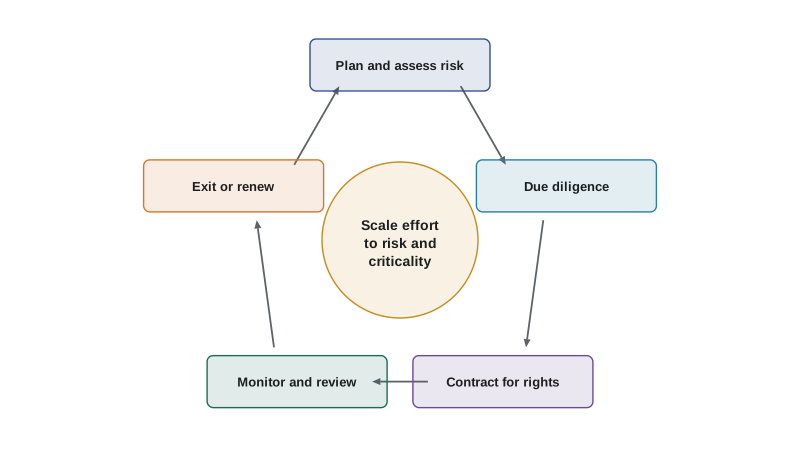
Regulators increasingly expect organizations to manage third-party risk formally. For federally regulated financial institutions, OSFI Guideline B-10, Third-Party Risk Management, published in April 2023 and effective from May 2024, expects institutions to identify and assess risks before entering arrangements, apply more scrutiny to higher-risk and critical arrangements, include specific provisions in contracts such as audit and information rights and breach notification, monitor arrangements continuously, plan for exit and consider concentration risk across the institution. Guideline B-13 on technology and cyber risk applies alongside it. For cloud services used by the federal government, the Canadian Centre for Cyber Security assesses cloud providers' security controls, and departments must apply the Government of Canada cloud guardrails. Other sectors face their own expectations, such as provincial health privacy laws for suppliers handling health information.
These rules differ in detail, but they share a common shape: know your suppliers, assess risk before contracting, contract for the rights you need, monitor continuously, plan for exit and watch concentration. That shape is good practice for any organization, regulated or not.
Concentration and fourth-party risk
Concentration risk arises when many critical services depend on one supplier, or when many suppliers depend on the same fourth party. ITIL-130 discussed concentration at the level of the value system. In supplier management, the practical task is to map dependencies: which critical services rely on which suppliers, and which suppliers rely on the same underlying providers. A CMDB that records supplier relationships, as described in lesson 4, makes this much easier. Larchmont discovered, for example, that its managed security provider, its payroll software and its shipment portal all ran in the same cloud region, so a regional outage would affect all three at once.
Multi-supplier services and SIAM in practice
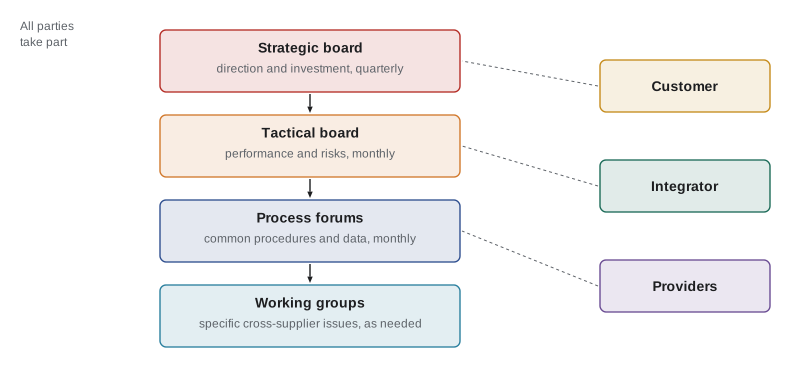
When a service depends on several suppliers, someone must make them work together. ITIL-130 described the SIAM layers: the customer organization, the service integrator and the service providers. In daily operation, SIAM relies on a governance structure of boards and forums. Strategic boards, with executives from the customer, integrator and key providers, set direction. Tactical boards review performance, risks and improvements across suppliers. Operational forums, often called process forums or working groups, bring practitioners from all suppliers together around a process such as incident or change management, so that procedures, tools and data work across organizational boundaries.
The integrator, whether an internal team or an external company, owns end-to-end service levels, coordinates cross-supplier incidents and changes, maintains a shared service management toolset or integrations between suppliers' tools, produces end-to-end reporting and leads collaborative improvement. Contracts with providers should include collaboration obligations: taking part in forums, sharing data, following common processes and accepting the integrator's coordination role even though the integrator is not a party to each provider's contract.
| SIAM structure | Who takes part | Typical frequency | Purpose |
|---|---|---|---|
| Strategic board | Customer executives, integrator lead, key provider executives | Quarterly or twice yearly | Direction, investment, relationship health |
| Tactical board | Service managers from all parties | Monthly | Performance, risks, cross-supplier improvements |
| Process forum | Practitioners for one process from all parties | Monthly or as needed | Common procedures, tools and data |
| Working group | Specialists for a specific issue | Temporary | Solve a defined cross-supplier problem |
Worked problem
A cross-supplier incident
Shipment bookings fail intermittently. The cloud provider says its platform is healthy, the network carrier says its links are fine and the portal vendor says its application has no errors. How should a SIAM approach handle this?
Show solution
- The integrator owns the incident end to end and opens a joint bridge with all three suppliers.
- Shared monitoring data, including LTS's synthetic transactions, is examined together rather than each supplier checking only its own component.
- The joint analysis finds that a load balancer timeout configured by the cloud team is shorter than the portal's slowest search, causing failures only under load.
- A change is coordinated across the cloud team and the portal vendor, and a problem record captures the need for end-to-end timeout standards.
Answer: The integrator prevents finger-pointing by owning the outcome, sharing data and coordinating analysis and changes across suppliers.
Exit and transition
Every contract ends eventually. ITIL-130 introduced exit planning; supplier management keeps exit plans current for strategic and tactical suppliers. A practical exit plan lists the services and data to be transferred, the knowledge and documentation needed, the assistance the supplier must provide, the timeline, the costs and the risks, and identifies alternative suppliers or an in-house option. It should be tested in part, for example by checking that data can actually be exported in a usable format.
Measuring the practice
Measures for supplier management include the share of suppliers with a named owner and current contract record; the share of critical suppliers with current scorecards, risk assessments, assurance reviews and exit plans; supplier performance trends; the number of renewal deadlines missed; savings achieved through negotiation; and stakeholder satisfaction with supplier-delivered services.
Common mistakes
MistakeRelying only on suppliers' own performance reports.
InsteadMeasure critical supplier services independently where possible and reconcile differences before reviews.
MistakeUsing service credits as the main improvement tool.
InsteadUse joint improvement plans and honest conversation; keep contractual remedies as a last resort.
MistakeFiling SOC 2 reports without reading them.
InsteadCheck type, scope, period, exceptions, user entity controls and carve-outs.
MistakeAssessing each supplier's risk in isolation.
InsteadMap dependencies to find concentration and fourth-party risks.
MistakeExpecting suppliers to cooperate without contractual obligations.
InsteadInclude collaboration duties and recognition of the integrator's role in provider contracts.
Summary and key terms
- Supplier performance combines contract service levels with quality, responsiveness, relationship, commercial and security measures.
- Weighted scorecards shared in advance make trends visible and structure reviews.
- Reviews run at operational, tactical and strategic levels; improvement plans fix most problems.
- Supplier risk is tiered by criticality, data sensitivity and substitutability, and treated proportionately.
- SOC 2 Type II reports and ISO/IEC 27001 certification provide assurance but must be read critically.
- Third-party risk regulations share a lifecycle shape: assess, contract for rights, monitor, plan exit and watch concentration.
- SIAM governance boards and forums, led by an integrator, make multiple suppliers work as one service.
- Supplier scorecard
- A weighted set of measures used to assess and review a supplier's performance.
- Supplier improvement plan
- Agreed actions with owners, dates and measures to improve a supplier's performance.
- Inherent risk
- Risk before controls are applied.
- Residual risk
- Risk remaining after controls are applied.
- SOC 2 report
- An independent auditor's report on a service organization's controls relevant to security and related criteria.
- Type II report
- An assurance report that tests whether controls operated effectively over a period.
- Complementary user entity controls
- Controls a customer must operate for a supplier's controls to be effective.
- Concentration risk
- Risk from heavy dependence on one supplier or a shared underlying provider.
- Service integrator
- The party that coordinates multiple service providers to deliver end-to-end services.
- Process forum
- A SIAM group bringing practitioners from all parties together around one process.
Practice problems
Work each problem on paper first, then reveal the answer to check.
Why should critical supplier services be measured independently?
Show answer
To verify supplier reports and detect problems the supplier might not report.
Name four types of supplier performance measure.
Show answer
Any four of: contract service levels, quality, responsiveness, relationship, commercial, security and compliance.
A supplier scores 80, 70 and 90 on measures weighted 50 %, 30 % and 20 %. What is its score?
Show answer
40 + 21 + 18 = 79.
Why should scorecards be shared with suppliers in advance?
Show answer
So reviews focus on discussion and actions, and suppliers are not surprised, which protects trust.
Why are contractual remedies a last resort?
Show answer
They damage relationships and rarely improve service quickly.
What is the difference between SOC 2 Type I and Type II?
Show answer
Type I assesses control design at a point in time; Type II also tests operating effectiveness over a period.
What is a subservice organization carve-out?
Show answer
Exclusion of a supplier's own providers from the report's scope, requiring separate assurance.
Describe the common shape of third-party risk regulations.
Show answer
Assess risk before contracting, contract for needed rights, monitor continuously, plan exit and manage concentration.
What does a SIAM process forum do?
Show answer
Brings practitioners from all parties together to align procedures, tools and data for one process.
How does a service integrator prevent finger-pointing in cross-supplier incidents?
Show answer
By owning the incident end to end, sharing data and coordinating joint analysis and changes.
Lesson quiz · 5 questions
Score 60% or more to complete this lesson.
Create a free account to save your progress, take quizzes and earn a certificate.