
ITIL-141 · Lesson 11 of 12 · 27 min
Information security management for service managers
Every practice in this course touches information security. Configuration and asset data show what must be protected. Releases and deployments can introduce vulnerabilities or close them. Suppliers handle sensitive data. Service levels include availability, which is one of the three classic goals of security. Continual improvement must include security improvements. This lesson explains information security management at the level the ITIL Foundation exam expects and that every service manager needs: its purpose, the core concepts, the balance between prevention, detection and correction, how security is woven into other practices, and how it is measured. The CISSP courses, CISSP-113 to CISSP-116, cover security in much greater depth.
Purpose of information security management
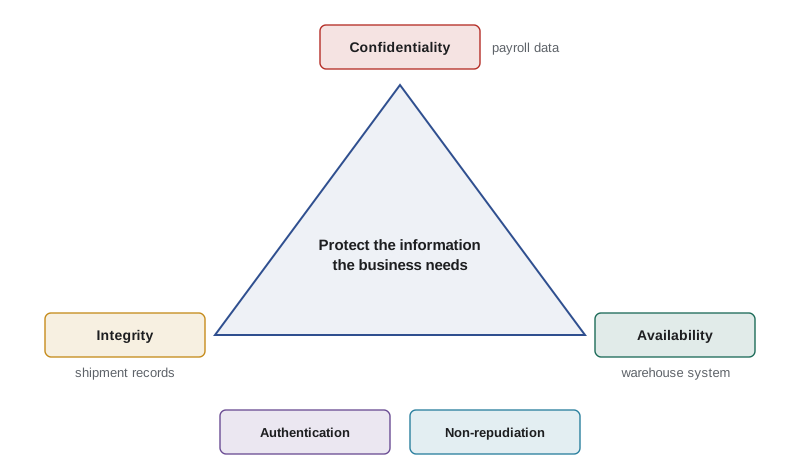
In plain words, the purpose of the information security management practice is to protect the information needed by the organization to conduct its business. This includes understanding and managing risks to the confidentiality, integrity and availability of information, as well as other aspects of information security such as authentication (ensuring someone is who they claim to be) and non-repudiation (ensuring that someone cannot deny that they took an action). The purpose is framed around the business: information is protected because the organization needs it, and the level of protection should match the value and risk involved.
In ITIL 4, information security management is a general management practice. Published summaries of ITIL (Version 5), checked in October 2026, list it in the product and service management group instead, reflecting how closely security is now built into the design and operation of products and services. Its core purpose is described in similar terms.
Confidentiality, integrity and availability
The three classic properties of information security are often called the CIA triad. Confidentiality means information is accessible only to those authorized to see it. Integrity means information is accurate and complete and is changed only in authorized ways. Availability means information and systems are accessible to authorized users when needed. Different information needs different emphasis. Larchmont's payroll data demands strong confidentiality; its shipment records demand integrity, because a wrong delivery address costs money; and its warehouse management system demands availability, because every hour of downtime stops trucks.
| Property | Meaning | Threat example | Typical controls |
|---|---|---|---|
| Confidentiality | Only authorized people can access information | Payroll file emailed to the wrong recipient | Access control, encryption, data loss prevention |
| Integrity | Information is accurate and changed only in authorized ways | Unauthorized change to carrier rates | Change control, logging, checksums, segregation of duties |
| Availability | Information and systems are accessible when needed | Ransomware encrypts warehouse servers | Backups, redundancy, patching, incident response |
| Authentication | Users and systems are who they claim to be | Stolen password used to sign in | Multi-factor authentication, strong identity management |
| Non-repudiation | Actions cannot be credibly denied | Dispute over who approved a payment | Audit logs, digital signatures |
Balancing prevention, detection and correction
ITIL emphasizes that information security management must balance three kinds of activity. Prevention stops security incidents from happening, for example through access controls, patching and staff training. Detection finds incidents quickly when prevention fails, for example through monitoring, logging and alerts. Correction recovers from incidents and limits damage, for example through incident response, backups and restoration. No organization can prevent everything, so investment only in prevention leaves it blind and slow when something does go wrong.
Security also has to be balanced against other goals. Controls that are too strict make work so hard that people find workarounds, such as writing passwords down or using personal file-sharing services. ITIL encourages organizations to design controls that are proportionate to risk and that support, rather than obstruct, the work. The guiding principle "keep it simple and practical" applies directly.
| Activity | Goal | Examples at Larchmont |
|---|---|---|
| Prevention | Stop incidents occurring | Multi-factor authentication, patching within agreed times, least-privilege access, staff awareness |
| Detection | Find incidents quickly | Managed security monitoring, log alerts, user reports of phishing |
| Correction | Recover and limit damage | Security incident response plan, tested backups, isolation of infected devices |
Policies, risk and controls
Information security management is usually anchored in an information security policy approved by senior leadership, supported by more specific policies and standards, such as acceptable use, access control, cryptography, supplier security and incident response. Policies express what the organization intends; controls are the measures that put policy into effect.
Controls are chosen through risk assessment. A risk is a possible event that could cause harm or loss. Risk assessment identifies assets and threats, estimates the likelihood and impact of each risk, and compares the result with the organization's risk appetite. Risks above appetite are treated: reduced through controls, transferred through insurance or contracts, avoided by stopping an activity, or accepted with management approval. Controls can be classified by what they do, such as preventive, detective or corrective, and by their nature, such as technical (encryption), administrative (policies and training) or physical (locks and badges).
# A simple risk register: score likelihood x impact and compare with risk appetite
risks = [
    # risk, likelihood (1-5), impact (1-5), control in place
    ("Phishing leads to account takeover", 4, 4, "MFA for all staff"),
    ("Ransomware on warehouse servers", 3, 5, "EDR, offline backups"),
    ("Supplier breach exposes customer data", 2, 4, "Contract clauses, SOC 2 review"),
    ("Lost unencrypted laptop", 2, 3, "Full-disk encryption"),
    ("Unauthorized change to carrier rates", 2, 4, "Change control, logging"),
    ("Server room power failure", 1, 5, "UPS and generator"),
]
appetite = 10      # scores above this need treatment beyond current controls
print(f"{'risk':<40}{'L':>3}{'I':>3}{'score':>7}  decision")
for r, l, i, ctrl in sorted(risks, key=lambda x: -x[1] * x[2]):
    s = l * i
    decision = "treat further" if s > appetite else "accept and monitor"
print(f"{r:<40}{l:>3}{i:>3}{s:>7} {decision} [{ctrl}]")risk L I score decision Phishing leads to account takeover 4 4 16 treat further [MFA for all staff] Ransomware on warehouse servers 3 5 15 treat further [EDR, offline backups] Supplier breach exposes customer data 2 4 8 accept and monitor [Contract clauses, SOC 2 review] Unauthorized change to carrier rates 2 4 8 accept and monitor [Change control, logging] Lost unencrypted laptop 2 3 6 accept and monitor [Full-disk encryption] Server room power failure 1 5 5 accept and monitor [UPS and generator]
The scores here are residual risks after current controls. Two risks remain above the appetite even with controls in place, which tells leadership where further investment or acceptance decisions are needed. Real risk assessments use clearer definitions for each score, and many organizations use frameworks such as ISO/IEC 27005 or NIST guidance to structure them.
Security in the other practices
Information security management cannot succeed as a separate function that reviews everything at the end. It works by building security into other practices. The table below shows how it connects with the practices in this course and in ITIL-140.
| Practice | Security contribution |
|---|---|
| Service level management | Availability and security targets in SLAs; security reporting to customers |
| Service configuration management | Knowing which CIs hold sensitive data and which are vulnerable |
| IT asset management | Complete inventory of hardware and software; secure disposal |
| Release and deployment management | Security testing in pipelines; secure configuration baselines |
| Supplier management | Due diligence, security clauses, assurance reports, breach notification |
| Relationship management | Understanding stakeholders' security and privacy expectations |
| Continual improvement | Lessons from security incidents and audits enter the register |
| Change enablement | Security review of high-risk changes; detecting unauthorized changes |
| Incident management | Recognizing security incidents and handing them to the security response process |
| Service desk | First reports of phishing and suspicious activity; identity checks before resets |
ITIL-140 lesson 1 explained that the word incident means something different in security: a security incident under NIST SP 800-61 Revision 3, published in April 2025, is an occurrence that jeopardizes the confidentiality, integrity or availability of information or systems, or violates security policies. The service desk and incident management must recognize such events and pass them to the security incident response process, which has its own procedures for evidence, containment and notification.
Identity and access
Access management, a practice in its own right in some frameworks and part of information security management in ITIL 4, ensures that people have the access they need and no more. Key ideas are least privilege, giving each user only the access required for their role; segregation of duties, ensuring no single person controls all steps of a sensitive process; joiner, mover and leaver processes that grant, change and remove access promptly as people's roles change; and periodic access reviews in which managers confirm that their staff's access is still appropriate. Multi-factor authentication, which requires something you know plus something you have or are, is now a baseline control for remote access and privileged accounts.
Worked problem
An access review finding
A quarterly review of 2,400 user accounts finds 61 accounts belonging to people who left more than 30 days ago and 140 accounts with access to finance systems beyond their role. What do these findings suggest, and what should happen?
Show solution
- Leaver accounts: 61 ÷ 2,400 ≈ 2.5 % of accounts should have been disabled; the leaver process is not reliably triggered.
- Excess access: 140 accounts suggest that movers keep old access when changing roles.
- Actions: disable leaver accounts immediately, remove excess access after manager confirmation, and fix the causes, for example by connecting the HR system to the identity directory so leavers and movers trigger access changes automatically.
Answer: Both findings point to process gaps. Correct the accounts now, then fix the joiner, mover and leaver processes so the problem does not recur, and record the improvement in the register.
Frameworks and standards
Several frameworks help organizations structure information security. ISO/IEC 27001 specifies requirements for an information security management system, and ISO/IEC 27002 provides a catalogue of controls; the current editions date from 2022. The NIST Cybersecurity Framework 2.0, released in February 2024, organizes security outcomes into six functions: govern, identify, protect, detect, respond and recover. The CIS Critical Security Controls give a prioritized list of practical safeguards, starting with inventories of assets and software. ITIL does not replace these frameworks; it shows how security fits into the service value system and works alongside the other practices.
| Framework | What it provides | Typical use |
|---|---|---|
| ISO/IEC 27001:2022 | Requirements for an information security management system | Certification, structured security programme |
| ISO/IEC 27002:2022 | Catalogue of security controls with guidance | Selecting and implementing controls |
| NIST Cybersecurity Framework 2.0 | Six functions of security outcomes | Assessing and communicating security posture |
| CIS Critical Security Controls | Prioritized practical safeguards | Planning improvements for smaller teams |
Privacy and legal obligations
Information security supports privacy. In Canada, PIPEDA requires organizations to protect personal information with security safeguards appropriate to its sensitivity and to report breaches of security safeguards that create a real risk of significant harm to the Privacy Commissioner and to affected individuals. Quebec's Law 25 adds obligations such as confidentiality incident registers and privacy impact assessments. Provincial laws cover the public sector and health information. Bill C-8 received royal assent in June 2026, enacting the Critical Cyber Systems Protection Act for designated operators in federally regulated sectors such as telecommunications, banking, energy and transport; its obligations take effect as operators are designated and regulations are made, so check the current status. ITIL-140 lesson 4 mapped breach reporting obligations in more detail.
Service managers do not need to be privacy lawyers, but they need to know which services handle personal information, who is responsible for privacy decisions and how to escalate potential breaches quickly.
Culture and awareness
Most security incidents involve human actions: clicking a phishing link, misconfiguring a cloud storage bucket, reusing a password or sending data to the wrong person. Technology controls help, but people remain the first line of defence. Effective awareness programmes are short, frequent, relevant to people's actual work and free of blame. Encouraging staff to report suspicious emails, and thanking them when they do, turns every employee into a sensor. Punishing people who report their own mistakes teaches everyone to hide them.
Measuring information security
Measures for information security management include the share of critical vulnerabilities patched within agreed times; the share of accounts with multi-factor authentication; access review completion and findings; phishing report rates and simulated phishing click rates; time to detect and contain security incidents; audit findings closed on time; and the share of critical suppliers with current security assurance. As with service levels, distributions matter more than averages: a mean patch time of ten days can hide a few critical systems left unpatched for months.
# Patch compliance: share of critical vulnerabilities fixed within target, and the slowest cases
import random, statistics
random.seed(1141)
target_days = 14
# days to patch for 300 critical findings: most quick, a long tail of hard-to-patch systems
days = [round(random.expovariate(1 / 6)) for _ in range(270)] + [random.randint(30, 120) for _ in range(30)]
within = sum(1 for d in days if d <= target_days) / len(days) * 100
q = statistics.quantiles(days, n=20)
print(f"findings: {len(days)}   mean days to patch: {statistics.mean(days):.1f}   median: {statistics.median(days):.0f}")
print(f"within {target_days} days: {within:.1f} %")
print(f"90th percentile: {q[17]:.0f} days   95th percentile: {q[18]:.0f} days   max: {max(days)} days")
print("over 60 days:", sum(1 for d in days if d > 60), "findings need risk acceptance or a fix plan")findings: 300 mean days to patch: 13.4 median: 6 within 14 days: 82.0 % 90th percentile: 31 days 95th percentile: 73 days max: 119 days over 60 days: 22 findings need risk acceptance or a fix plan
The mean looks reasonable, but the tail tells a different story: a group of findings has stayed open for months. Those are often the systems that are hardest to patch, such as legacy warehouse controllers, and they need specific plans, compensating controls or formal risk acceptance by the right level of management.
Common mistakes
MistakeTreating security as a separate team's job.
InsteadBuild security into every practice, from asset management to release and supplier management.
MistakeInvesting only in prevention.
InsteadBalance prevention, detection and correction.
MistakeMaking controls so strict that people bypass them.
InsteadDesign proportionate controls that support the work.
MistakeReporting only average patch times.
InsteadReport distributions and tails, and act on long-open critical findings.
MistakeBlaming people who report security mistakes.
InsteadThank reporters and fix the conditions that led to the mistake.
Summary and key terms
- Information security management protects the information the organization needs to conduct its business.
- It manages risks to confidentiality, integrity and availability, plus authentication and non-repudiation.
- A balanced approach combines prevention, detection and correction with proportionate controls.
- Policies set intent, risk assessment prioritizes, and controls put policy into effect.
- Security is built into every practice; security incidents are handed to a dedicated response process.
- Least privilege, segregation of duties, joiner, mover and leaver processes and MFA underpin access control.
- Frameworks such as ISO/IEC 27001, NIST CSF 2.0 and the CIS Controls complement ITIL; Version 5 summaries move the practice into product and service management.
- Information security management
- The practice of protecting the information needed by the organization to conduct its business.
- Confidentiality
- Information is accessible only to those authorized to see it.
- Integrity
- Information is accurate and complete and changed only in authorized ways.
- Availability
- Information and systems are accessible to authorized users when needed.
- Authentication
- Verifying that a user or system is who or what it claims to be.
- Non-repudiation
- Assurance that someone cannot credibly deny an action they took.
- Risk appetite
- The amount of risk an organization is willing to accept in pursuit of its goals.
- Least privilege
- Giving each user only the access needed for their role.
- Segregation of duties
- Ensuring no single person controls all steps of a sensitive process.
- Multi-factor authentication
- Authentication requiring two or more different kinds of evidence.
Practice problems
Work each problem on paper first, then reveal the answer to check.
State the purpose of information security management in plain words.
Show answer
To protect the information needed by the organization to conduct its business.
Define confidentiality, integrity and availability.
Show answer
Only authorized access; accurate and authorized changes only; accessible when needed.
Why must security balance prevention, detection and correction?
Show answer
Prevention cannot stop everything, so incidents must be found quickly and recovered from.
A risk has likelihood 3 and impact 4, and appetite is 10. What should happen?
Show answer
Score 12 exceeds appetite, so the risk needs further treatment or formal acceptance.
Give one way release management contributes to security.
Show answer
Security testing in pipelines or secure configuration baselines.
What should incident management do with a security incident?
Show answer
Recognize it and hand it to the security incident response process.
What is least privilege?
Show answer
Giving each user only the access needed for their role.
Name the six functions of NIST CSF 2.0.
Show answer
Govern, identify, protect, detect, respond and recover.
Why can a mean patch time mislead?
Show answer
It can hide a tail of critical findings left open for months.
In which group do Version 5 summaries place information security management?
Show answer
Product and service management, having been a general management practice in ITIL 4.
Lesson quiz · 5 questions
Score 60% or more to complete this lesson.
Create a free account to save your progress, take quizzes and earn a certificate.