
IRW-210 · Lesson 11 of 12 · 25 min
Erection sequence and coordination
▶ Video coming soon A video version of this lesson is on the way.
A week before the Linwood steel arrived, Carla Duquette sat in the general contractor's site trailer with the superintendent, Bettina Ogle of Tallcorn Builders, the fabricator's project manager on speakerphone, and a printed copy of Crossbeam's erection plan. They went through it line by line: where the crane would set up, where the trucks would turn, where each load would be shaken out, which bay would go up first, when the concrete crew could start on the apparatus bay slab and when the roofer could get on. Bettina had one change: the fire department, whose old station stayed in service next door until the new one opened, wanted the north driveway kept open for its own trucks every afternoon after three. Carla moved two deliveries to the morning and the shakeout area to the south. "Every hour we spend in this trailer," she told Shay later, "is a day we do not lose in the field."
This lesson explains how an erection sequence is planned, what the erector needs from the general contractor before steel can go up, how deliveries, shakeout and crane time are organized, and how the steel crew works with the other trades on a site.
The erection plan
Every Crossbeam job starts with a written erection plan. On a simple job it may be a few pages; on a complex one it is a thick document with drawings by the erection engineer. Whatever its size, it covers the same things.
- The site: access roads, crane positions, delivery and shakeout areas, overhead power lines and other hazards, and the controlled areas around the work.
- The sequence: the order in which bays and tiers will be erected, starting with the parts that make the frame stable.
- Stability: the bracing, guying and temporary supports, and the conditions for removing them (lesson 9).
- Lifting: the crane, its set-up, the heaviest and critical lifts and the rigging plans (IRW-120).
- Fall protection and rescue: the anchors, the systems and the rescue plan (IRW-110).
- Bolting and inspection: the methods, the pre-installation verification and the hold points for inspection.
- Coordination: what the erector needs from others, and what others may do in the erector's areas.
Ontario's construction regulation and the Occupational Health and Safety Act make the constructor, usually the general contractor, responsible for the project as a whole, and the employer, here Crossbeam, responsible for its own workers and work. The erection plan is Crossbeam's way of showing how it will meet its duties and fit into the constructor's site.
What the erector needs before steel goes up
Before erection can start, the general contractor and the other parties have to provide several things. In Ontario they are partly set by the regulation and partly by contract and good practice, and Crossbeam lists them in its plan and asks for them in writing.
- Written confirmation that the concrete in the footings, piers and walls has reached enough strength to carry the steel. Crossbeam asks for confirmation that the concrete has reached at least 75 in 100 of its specified strength, or that the engineer has confirmed it is strong enough.
- Written notice of any anchor rod repairs, replacements or modifications, and the engineer's approval of them (lesson 3).
- Access roads into and through the site that can carry the cranes, trucks and other equipment, and a firm, graded and drained area for the crane and for storing steel.
- Information on overhead and underground hazards near the work: power lines, buried utilities and anything that could undermine the crane set-up.
- Control of the areas below and around the work, so that other trades are not working under the steel as it goes up.
Worked problem
Is the concrete strong enough?
The footings and piers at Linwood are specified at 25 MPa. Field-cured cylinders broken at seven days averaged 19.6 MPa. Has the concrete reached 75 in 100 of its specified strength?
Show solution
- Needed = 0.75 × 25 = 18.75 MPa.
- Measured = 19.6 MPa.
- 19.6 is more than 18.75.
Answer: Yes. With the written confirmation from the general contractor and the anchor rod survey done, the columns can be set. If the cylinders had come in low, the steel would wait for the next set of breaks or for the engineer's decision.
Planning the sequence
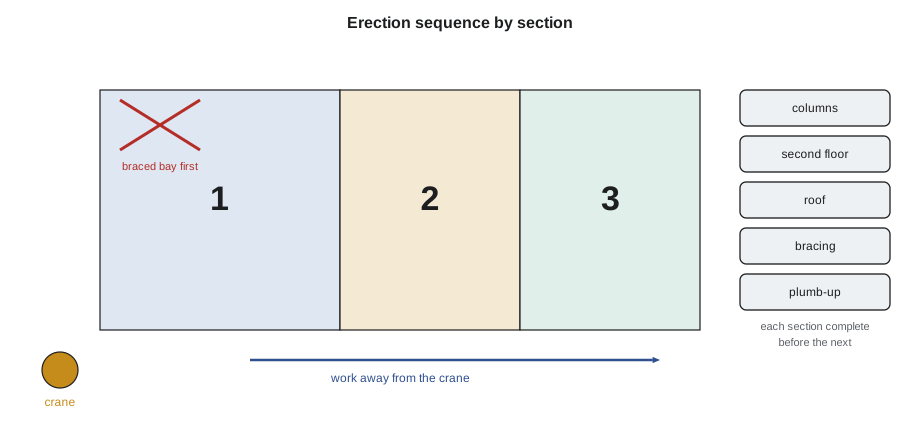
The order of erection is chosen to keep the frame stable and to use the crane efficiently. A few principles guide almost every sequence.
- Start at a stable point. The first bay to go up is a braced bay or a moment frame, or one that can be guyed easily, so that everything after it can be tied back to it.
- Work away from the crane, or in an order the crane can reach, so that the crane is never lifting over steel already standing more than it has to.
- Complete a section before moving on. Columns, beams, bracing and plumb-up for one area are finished before the next area is started, so that no part of the frame is left half-built and unstable.
- Keep tiers together. On a multi-storey frame, one tier is erected, plumbed and bolted before the next tier is set on it.
- Leave room for the next trade. The deck crew follows the steel, and the concrete crew follows the deck, so the sequence gives each of them a finished area to start on.
Deliveries and shakeout
Steel arrives on trucks in loads the fabricator assembles from the erection sequence, so that the pieces needed first come first. Each load has a load list showing every piece mark, its weight and its sequence. The erector checks every load against its list when it arrives, before the truck leaves, and reports missing or damaged pieces at once.
Shakeout is unloading and sorting the steel on the ground near where it will be lifted, with the pieces blocked off the ground, marks out and in the order they will be needed (lesson 1). A good shakeout lets the crane pick each piece without digging for it. On a tight site, steel may be lifted straight off the truck to its place, which saves space but needs the deliveries timed to the crane's work.
Worked problem
How many truckloads?
The Linwood steel weighs about 62 t. A flatbed can carry about 18 t of steel on this route. How many loads will the fabricator send?
Show solution
- 62 ÷ 18 = 3.4.
- Rounded up: 4 loads.
Answer: At least four loads, and in practice often more, because long or bulky pieces fill a truck before its weight limit, and loads are built to match the sequence rather than to fill every truck. Carla asked for five loads, one per sequence step, delivered on the mornings they were needed.
Crane time
The crane is usually the most expensive item on an erection job, and its time is planned carefully. Each pick takes time to rig, lift, swing, land, connect and release, and the time per piece depends on its size, the distance and the connection. A foreperson estimates crane days from the piece count and an average cycle time based on experience.
Worked problem
Estimating crane days
Linwood has 116 pieces. From past jobs of similar size, Carla expects an average of about 26 minutes per pick, including rigging and connecting, and about 8 hours of crane time a day. How many crane days does that suggest for setting the steel?
Show solution
- Picks per day = 8 × 60 ÷ 26 = 480 ÷ 26 = 18.5, so about 18.
- Crane days = 116 ÷ 18 = 6.4.
- Rounded up: 7 days.
Answer: About seven crane days for setting, not counting plumb-up and bolting, which go on behind the connectors. Carla booked the crane for eight days to allow for weather. As lesson 12 shows, a windy Thursday made that day of spare time useful.
Working with other trades
A steel erector rarely has a site to itself. Concrete crews may be finishing foundations as the steel starts; electricians and plumbers want to start their rough-in as soon as there is a floor; roofers and deck crews follow the steel; and the general contractor's own crews are moving material. Coordination keeps them from getting in each other's way and, more importantly, keeps them from working under the steel as it goes up.
- Controlled areas. The area below the connectors and the crane's load path is closed to other trades while steel is being lifted (IRW-110 and IRW-120). The erector marks it and the general contractor enforces it.
- Released areas. When an area is erected, plumbed, bolted and inspected, the erector releases it to the next trade, often in writing, so that everyone knows which parts of the frame are finished and safe to work on and under.
- Daily coordination. A short meeting or call each morning between the foreperson and the superintendent covers what will be lifted that day, which areas are closed and what the other trades need.
- Changes. If the sequence has to change because of weather, a late delivery or a problem on the site, the change is discussed and agreed before it is made.
Records
The foreperson keeps a daily report: crew, hours, crane hours, weather, pieces set, areas plumbed and bolted, inspections, deliveries, problems and anything unusual. The reports, with the plumb readings, the bolting records and the inspection reports, form the record of how the frame was built. They are what the foreperson relies on when a question comes up months later, and they are the first thing a general contractor or an engineer asks for when something goes wrong.
Planning around the site
Every site has its own constraints, and good sequence planning starts with them. A downtown site may have no room for a shakeout, so steel is lifted straight from the trucks, and deliveries are timed to the hour. A site beside a busy road may need lane closures and traffic control for the crane and the deliveries. A site with overhead power lines may limit where the crane can set up and which pieces it can reach (IRW-120). A site next to an occupied building, like Linwood beside the working fire station, may need to keep driveways, exits or parking clear at certain times. These constraints shape the sequence as much as the structure does.
Ground conditions matter too. The crane needs firm, level, drained ground or crane mats on a prepared pad, and the delivery trucks need roads that will not rut or soften in the rain. A wet week can turn a good laydown area into mud, and steel stored in mud is steel that has to be cleaned before it is erected. The general contractor provides the site, but the erector's foreperson is the one who has to tell the superintendent, early, what the steel crew needs.
The steel crew's place in the schedule
Steel erection is usually on the critical path of a building job: the trades that follow, deck, concrete, mechanical, electrical, roofing and cladding, cannot start until the steel is up and released. A day lost in the steel is often a day lost for the whole job. That pressure is real, and it is the reason good forepersons are firm about the things that must not be rushed: the anchor rod survey, the stability sequence, the wind limits, plumb-up and bolting. A frame put up a day early and then found out of plumb or unsafe costs far more than the day.
Coordination also runs the other way. The steel crew depends on others: the concrete crew for foundations at strength and rods in the right place, the fabricator for the right pieces on the right trucks, the crane company for a crane on the right day, and the general contractor for a workable site. When any of them is late or wrong, the foreperson's daily report and the early warning to the superintendent are what keep the problem from growing.
Changes during the job
No job goes exactly to plan. A delivery arrives late, a piece is wrong, the wind blows or an RFI holds up a column. When that happens, the foreperson looks first at stability: can the sequence change without leaving part of the frame unstable? If the answer is not obvious, the erection engineer is asked before anything is moved. Then the foreperson tells the superintendent what has changed and what it means for the other trades. At Linwood, the half-day wait for column C-4 was absorbed because nothing else depended on it until Tuesday, and Carla knew that only because she had planned the sequence in detail.
Common mistakes
MistakeStarting erection without the written concrete strength confirmation.
InsteadGet it in writing before the first column is set.
MistakeStarting erection at the far end of the building because the trucks parked there.
InsteadStart at a stable, braced point and follow the plan's sequence.
MistakeLetting a truck leave before its load is checked.
InsteadCheck every piece against the load list while the driver is there.
MistakeAllowing other trades to work under the steel being lifted.
InsteadKeep controlled areas closed and release finished areas in writing.
MistakeChanging the sequence on the fly.
InsteadAgree changes with the general contractor and the erection engineer first.
Summary and key terms
- The erection plan covers the site, sequence, stability, lifting, fall protection, bolting and coordination.
- Before erection, the erector needs written confirmation of concrete strength and anchor rod repairs, a workable site and control of the area below.
- Sequences start at a stable point, work away from the crane and complete each section before moving on.
- Loads are checked against their lists, and shakeout sorts steel in the order it will be needed.
- Crane days are estimated from the piece count and an average cycle time.
- Other trades stay out of controlled areas, and finished areas are released in writing.
- Erection plan
- The erector's written plan for erecting the steel safely.
- Sequence
- The order in which parts of the frame are erected.
- Shakeout
- Unloading and sorting steel on site in the order it will be needed.
- Load list
- The list of pieces on a delivery.
- Constructor
- In Ontario, the person who undertakes the project and has overall responsibility for it.
- Released area
- An area handed over to the next trade as finished and safe.
- Daily report
- The foreperson's record of each day's work.
Practice problems
Work each problem on paper first, then reveal the answer to check.
Concrete is specified at 30 MPa. What is 75 in 100 of that?
Show answer
22.5 MPa.
A job has 90 pieces and the crew averages 20 picks a day. How many days?
Show answer
90 ÷ 20 = 4.5, so 5 days.
Where should erection start?
Show answer
At a braced bay or other stable point.
Why check each load before the truck leaves?
Show answer
So missing or damaged pieces can be reported at once.
What is a released area?
Show answer
An area handed to the next trade as finished and safe.
Lesson quiz · 5 questions
Score 60% or more to complete this lesson.
Create a free account to save your progress, take quizzes and earn a certificate.