
HSE-406 · Lesson 7 of 12 · 21 min
Orientation and site rules
On the first morning of last August's shutdown, contractor orientation at Harrowgate Foods Ltd. consisted of a security guard handing each worker a copy of the two-page rules sheet and a sign-in book. On the busiest morning, sixty-two workers arrived in the first hour. Most signed the book without reading the sheet. Several crews started work before their supervisor had arrived. When the ammonia detector in the engine room briefly alarmed during a test on day four, a group of roofers on the north roof did not know what the sound meant, and nobody had told them where to go. They kept working.
Orientation is the stage where the knowledge the host gathered in planning reaches the people doing the work. Contractor workers cannot follow rules they have never heard, avoid hazards they do not know about or evacuate to a muster point they have never been shown. This lesson covers how Harrowgate Foods Ltd. rebuilt its orientation and site rules, and how it checks that every worker on site has been through them.
Layers of orientation
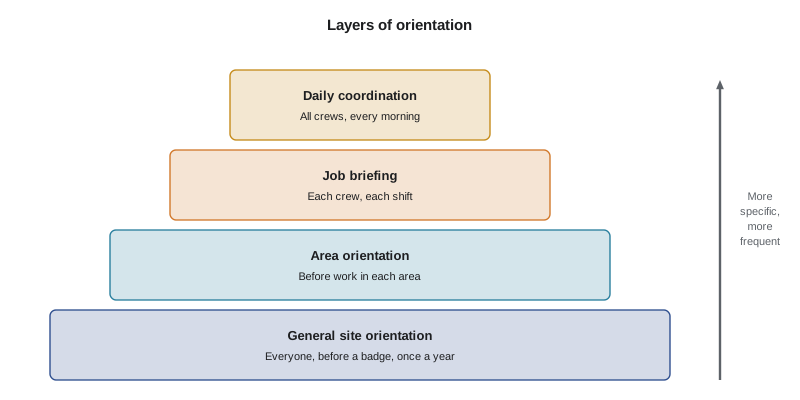
A single orientation session cannot cover everything a contractor worker needs to know, because what they need depends on where they will work and what they will do. Harrowgate Foods Ltd. now uses four layers, each building on the one before:
- General site orientation covers what everyone on site must know: the site's main hazards, emergency alarms and evacuation, site rules, food safety rules, reporting and the right to stop work. Every contractor worker completes it before receiving a badge, and repeats it each year.
- Area orientation covers the hazards and rules of the specific area where the worker will be: the engine room, the bakery hall, the roof. It is given by the area owner or a designated person, at the area, before work starts there.
- Job briefing covers the specific task: the work plan, the permits, the hazards and controls for that day. It is given by the contractor's own supervisor at the start of each shift, with the host's permit issuer present for high-risk work.
- Daily coordination covers how the day's work fits together: which crews are where, which areas are isolated, what has changed since yesterday. Lesson 10 covers it in detail.
What general site orientation covers
Elena Novak rebuilt the general orientation around one question: what does a contractor worker need to know to stay safe, keep others safe and not put the food at risk, on any part of this site? The answer filled a forty-minute session with these topics:
- The site and its hazards. A plan of the site showing the production areas, the engine room, the boiler room, the docks and traffic routes, with the main hazards of each: ammonia, moving equipment and automatic starts, forklifts and trucks, hot surfaces, steam, flour dust, slippery floors and cold rooms.
- Emergencies. What each alarm sounds like, including the ammonia alarm and the fire alarm, what to do for each, where the muster points are, how to report an emergency and how the plant accounts for everyone, including contractors.
- Site rules. The rules that apply everywhere, described below.
- Food safety. Hygiene and product protection rules that apply in production areas.
- Permits. Which kinds of work need a permit, and that no such work starts without one.
- Reporting. How to report injuries, near misses, hazards and spills, and the requirement to report immediately.
- Stopping work and refusing unsafe work. That any worker, employee or contractor, can stop work they believe is unsafe, and that contractor workers also have the right to refuse unsafe work under the law, without reprisal.
- Who to ask. The job owner, the area owner, the contractor's own supervisor and the health and safety team, with phone numbers on the back of the badge.
The food safety rules surprised some contractors. Food plants have rules that would not exist at a factory making steel parts: no glass or brittle plastic in production areas, hairnets and beard covers, no jewellery, no food or drink outside break rooms, hand washing on entry, controls on tools and parts so that nothing is left behind in a product zone, and allergen controls that keep certain ingredients away from certain lines. Aisha Rahman, the quality manager, joined the redesign and added a short section explaining why the rules exist. Contractors who understand that a lost screw could end up in a frozen meal, or that a smear of nut paste on a tool could cause a severe allergic reaction in a customer, follow the rules much more reliably than those who are simply told to.
Site rules
The 2014 rules sheet listed forty-one rules in small type, from parking to radios. Nobody could remember them, and nobody tried. Elena replaced it with two parts. The first is a set of nine life-saving rules, covering the activities most likely to cause serious injury or death at the plant. Breaking one leads to removal from site. The second is a list of general site rules, such as speed limits, smoking areas and housekeeping, which are enforced in the normal way.
- Never start hot work, confined space entry, line breaking or work at height without a valid permit.
- Always apply your own lock before working on equipment, and never remove anyone else's lock.
- Never enter the engine room or a process area without area orientation and the area owner's knowledge.
- Always use fall protection where required.
- Never bypass or disable a guard, interlock, alarm or detector.
- Always keep clear of forklift and truck routes unless you have a spotter or a barrier.
- Never work while impaired by alcohol, drugs or fatigue.
- Always evacuate immediately when an alarm sounds, and report to your muster point.
- Always report injuries, incidents and near misses immediately.
Life-saving rules work only if they are few, clear and enforced consistently for everyone, employees and contractors alike. Elena insisted that the same nine rules applied to Harrowgate Foods Ltd.'s own workers, and that the consequences were the same. A contractor who sees a plant mechanic break a lockout rule without consequence will not take the rule seriously.
Making orientation work
Delivering orientation is easy. Making sure it is understood is harder. Harrowgate Foods Ltd. made several changes to the way orientation is delivered:
- Before arrival. The general orientation is available online, so contractor workers can complete it before they arrive and the gate is not overwhelmed on the first morning. A short in-person session at the plant then covers the site walk, the muster points and questions.
- Checking understanding. Each worker completes a ten-question check at the end of the general orientation, with any wrong answers explained in person before a badge is issued.
- Language and literacy. The orientation uses plain language, photos and short videos, and is available in the languages most often spoken by contractor crews. Supervisors are asked in advance whether any worker needs an interpreter.
- New and young workers. Workers new to the trade or under twenty-five are identified on the roster and paired with an experienced worker from their own crew.
- Showing, not telling. The ammonia and fire alarms are played during the session, and every worker walks to their muster point on their first day.
The roster and the badge
A key failure last August was that nobody knew exactly who was on site. The sign-in book recorded names, but not employers, areas or whether the person had been oriented, and many workers did not sign out. During the ammonia alarm, the plant could not have accounted for the contractors even if it had tried.
The new program uses a roster for every contractor firm, submitted before the work starts and updated as workers are added. A worker can be badged only when they appear on an approved roster, have completed general orientation and have the training the job requires. Badges show the worker's name, employer, photo, the areas they are oriented for and an expiry date. Workers badge in and out at the gate, and the headcount by area is available to the emergency coordinator at all times.
# Check the gate roster on the first morning of the shutdown
roster = [
    # name, firm, general orientation done, area orientations, required training held
    ("C. Rafuse",  "Coastal",  True,  ["bakery"],      True),
    ("J. MacLeod", "Bayview",  True,  ["bakery", "freezer"], True),
    ("T. Byers",   "Bayview",  True,  [],              True),
    ("P. Comeau",  "AirPro",   False, ["bakery"],      True),
    ("D. Hines",   "Northline", True, ["engine room"], False),
]
assignments = {"C. Rafuse": "bakery", "J. MacLeod": "freezer", "T. Byers": "freezer",
               "P. Comeau": "bakery", "D. Hines": "engine room"}
for name, firm, general, areas, trained in roster:
    area = assignments[name]
    problems = []
    if not general: problems.append("no general orientation")
    if area not in areas: problems.append(f"not oriented for {area}")
    if not trained: problems.append("training record missing")
print(f"{name:<11} {firm:<9} {'BADGE' if not problems else 'HOLD: ' + '; '.join(problems)}")C. Rafuse Coastal BADGE J. MacLeod Bayview BADGE T. Byers Bayview HOLD: not oriented for freezer P. Comeau AirPro HOLD: no general orientation D. Hines Northline HOLD: training record missing
On the first morning of the new shutdown, the gate check held eleven workers out of 138. Most were fixed within an hour: an area orientation that had not been recorded, a training certificate left in a truck. Two workers were sent home because their firms could not show the confined space training their job required. Jen MacLeod said the hour was well spent. 'Last year we found out who was missing things after something went wrong.'
Worked problem
Orienting the night sanitation crew
Show solution
- The contract sanitation crew cleans the bakery hall every night under Dev Sandhu, the plant's night sanitation supervisor. Crew members turn over often, and new workers had sometimes started with no orientation beyond a walk-through.
- Under the new program, the sanitation firm is treated as a resident contractor. Every new crew member completes general orientation and bakery area orientation before their first shift, and the firm sends Dev an updated roster each week.
- Because the sanitation crew uses chemicals and works on equipment that must be locked out, its job briefing each night covers the lockout points, the chemicals for that night and any maintenance work going on nearby.
- Sanitation crew members now attend the plant's monthly safety meeting for the night shift, and their incidents are included in the plant's monthly safety report.
Answer: Resident contractors are oriented and included like employees, because they are on site every night and face the same hazards.
Visitors who do work
One gap the old program had never addressed was visitors who do work: equipment suppliers' technicians, consultants taking measurements, auditors and inspectors who walk the floor. They were signed in as visitors, escorted loosely and given no orientation. The new program draws a clear line. A visitor who only observes, escorted at all times, receives a short visitor briefing covering emergencies and food safety rules. Anyone who does any work, including adjusting equipment, taking samples on the line or commissioning a machine, is a contractor and goes through the full process for the work's risk level. The mixer supplier's commissioning technician, who arrived in the second week to start the new mixer, was the first to go through it, and was surprised to find he needed a lockout lock of his own.
Keeping orientation current
Orientation goes stale quickly. The plant changes: new equipment arrives, an area is rearranged, a muster point moves because of construction, the alarm system is upgraded. Each change that affects what a contractor worker needs to know must reach the orientation material, or the material becomes a description of a site that no longer exists. Harrowgate Foods Ltd. ties orientation updates to its management of change process. When a change review finds that evacuation routes, alarms, area hazards or site rules are affected, updating the orientation and the relevant area hazard sheet becomes one of the actions that must be closed before the change is complete.
Elena also asks for feedback. The last question in the orientation check asks each worker what was unclear or missing, and contractor supervisors are asked the same question at close-out. In the first year, the most common answers were requests for a clearer map of the forklift routes and for photographs of the muster points as seen from the roof. Both were added within a month. The joint occupational health and safety committee reviews the orientation once a year and walks the site with the material in hand, checking that what it says matches what workers will find.
Common mistakes
MistakeHanding out a rules sheet at the gate as orientation.
InsteadDeliver layered orientation and check that it was understood.
MistakeListing dozens of rules nobody can remember.
InsteadUse a short set of life-saving rules, enforced the same way for employees and contractors.
MistakeSkipping area orientation because the worker completed general orientation.
InsteadOrient workers to each area's specific hazards before they work there.
MistakeNot knowing who is on site.
InsteadUse rosters, badges and badge in and out so everyone can be accounted for.
MistakeTreating technicians who do work as visitors.
InsteadPut anyone who does work through the contractor process.
Summary and key terms
- Orientation brings the host's knowledge of its site to the people doing the work.
- It is layered: general site orientation, area orientation, job briefing and daily coordination.
- General orientation covers site hazards, emergencies, site rules, food safety, permits, reporting and stopping work.
- A short set of life-saving rules, applied to everyone, works better than a long rule list.
- Orientation must be checked for understanding and adapted for language, literacy and new workers.
- Rosters, badges and gate checks make sure only oriented, trained workers are on site and everyone can be accounted for.
- General site orientation
- Orientation every contractor worker completes before receiving a badge, covering what everyone on site must know.
- Area orientation
- Orientation to the specific hazards and rules of the area where a worker will be.
- Job briefing
- A briefing at the start of each shift on the day's task, permits, hazards and controls.
- Life-saving rules
- A short set of rules covering the activities most likely to cause serious injury, with removal from site for breaking them.
- Roster
- A contractor's list of workers approved for the job, checked before badges are issued.
Practice problems
Work each problem on paper first, then reveal the answer to check.
What happened on the north roof during the ammonia alarm test last year?
Show answer
The roofers did not know what the alarm meant or where to go, and kept working.
Name the four layers of orientation.
Show answer
General site orientation, area orientation, job briefing and daily coordination.
Why did the quality manager add explanations to the food safety rules?
Show answer
Contractors who understand why the rules exist follow them more reliably.
Why must the life-saving rules apply equally to employees?
Show answer
Contractors will not take a rule seriously if they see employees break it without consequence.
When is a visitor treated as a contractor?
Show answer
When the person does any work, such as adjusting equipment, taking line samples or commissioning a machine.
Lesson quiz · 5 questions
Score 60% or more to complete this lesson.
Create a free account to save your progress, take quizzes and earn a certificate.