
HSE-406 · Lesson 6 of 12 · 21 min
Contract terms, insurance and workers' compensation
Kevin Doucette had been the purchasing manager at Harrowgate Foods Ltd. for nine years, and he knew the company's contract templates well. When Elena Novak asked him what the standard contract said about safety, he found one clause: 'The Contractor shall comply with all applicable laws, regulations and the Owner's site rules.' The site rules were the two-page sheet from 2014. Nothing in the contract said who would supervise the work, what the contractor must tell the plant, whether it could use subcontractors, what happened if it broke the rules or how the plant could stop the work.
A contract cannot remove a legal duty, as Lesson 2 explained. What it can do is make each party's role, obligations and expectations clear, give the host practical tools to enforce its requirements, and make sure the money follows safety rather than working against it. This lesson covers the safety terms that belong in a contractor agreement, and the insurance and workers' compensation documents that go with it.
The structure of contractor agreements
Harrowgate Foods Ltd. uses two kinds of agreement. A master service agreement is signed once with a contractor that does repeated work, such as the sanitation contractor, the forklift service firm or the refrigeration contractor on call. It sets the general terms, including safety, for every job. Each job is then ordered by a purchase order or work order that refers to the master agreement and adds the job's scope. For one-off projects, such as the freezer installation, a project contract includes the general terms and the scope in one document.
Either way, the safety requirements sit in three places. The general terms set out the obligations that apply to all work. A contractor safety requirements document, attached to every agreement, sets out the site's rules and the requirements for each risk level. And the scope of work, from Lesson 4, sets out the hazards and controls for the particular job. Kevin and Elena rewrote all three, and Aisha Grant reviewed the result.
Safety terms that belong in the contract
Elena's list of terms came partly from the gaps that last August had revealed and partly from comparing the contracts of two larger food companies that Kevin knew. The final general terms include these obligations for the contractor:
- Compliance: comply with the law, the contractor safety requirements and the scope's safety requirements, and make sure its workers and subcontractors do too.
- Supervision: name a competent supervisor for the job, present on site whenever its workers are working, with authority to stop work.
- Competent workers: use only workers trained and, where required, certified for the work, and provide proof on request.
- Subcontractors: use only subcontractors named in its bid and approved in writing by the host, and pass the same safety obligations down to them in its own subcontracts.
- Hazard information: tell the host about any hazards its work will create, any hazardous products it will bring on site, and any hazards it discovers.
- Permits and coordination: obtain the permits the work needs before starting and attend coordination meetings.
- Hours and fitness: keep workers' hours within the limits set in the scope, and keep workers who are impaired for any reason off the site.
- Incident reporting: report every injury, near miss, spill, fire and property damage to the host immediately and in writing within twenty-four hours, and cooperate with investigations.
- Records and audits: keep records of training, inspections and incidents for the job, and allow the host to audit the work and those records.
- Corrective action: correct unsafe conditions and practices when asked, within the time the host sets.
The general terms also give the host rights. The host may stop any work it believes is unsafe, without liability for the delay. It may require the removal from site of any worker who breaks a safety rule. It may withhold payment for work not done safely. And it may terminate the contract for serious or repeated safety breaches. Several of these were already implied in law or practice, but writing them down meant that neither a job owner nor a contractor could be surprised by them.
Making the money work for safety
Contract payment terms can quietly undermine safety. A fixed-price contract with heavy penalties for late completion encourages a contractor to cut corners when the schedule slips. Elena did not want to remove completion incentives altogether, since the shutdown really did need to finish on time. But she and Kevin made three changes.
First, any delay caused by a host stop-work order for a genuine safety reason, or by the host's own failure to provide isolations, permits or access on time, extends the completion date without penalty. Second, safety costs, such as fire watches, scaffolding, rescue standby and gas testing, are priced as separate items in the bid rather than buried in the lump sum, so that the cheapest bid is not simply the one that left them out. Third, the contractor's safety performance rating, from Lesson 11, is recorded at close-out and used in future selection, so that a firm that worked safely has a better chance of being invited back.
Kevin added one more change himself. Bids are now compared on a common basis that includes the safety items, and a bid that prices them far below the others is queried. A fire watch costs what a worker's time costs. A bid that prices two weeks of fire watches at a few hundred dollars has either misunderstood the job or does not intend to provide them.
Insurance
Insurance protects the parties against the financial consequences of injury and damage. It is not safety, and a contractor with excellent insurance can still hurt people. But a contractor without proper insurance can leave the host exposed to claims it should never have had to face, so insurance checks are a basic part of the documents stage. Harrowgate Foods Ltd. requires contractors to carry:
- Commercial general liability insurance, covering injury to third parties and damage to their property, with a limit set by risk level, and with Harrowgate Foods Ltd. named as an additional insured for liability arising from the contractor's work.
- Automobile liability insurance for vehicles used on site and on the roads.
- Professional liability insurance for contractors providing design, engineering or consulting services.
- Pollution liability insurance for contractors whose work could cause a release, such as ammonia work or tank cleaning.
- Workers' compensation coverage for their own workers, covered below.
Insurance terms and indemnity clauses are matters for lawyers and insurance advisors, not safety managers, and the right limits depend on the job and the company. Aisha Grant set Harrowgate Foods Ltd.'s limits with the company's insurance broker. Elena's interest was simpler: that every contractor on site had the coverage the contract required, and that it was in force on the days the contractor worked. Certificates of insurance are evidence that a policy existed when the certificate was issued. They do not change the policy, and they can expire or be cancelled. The program therefore records each policy's expiry date and asks for renewals before they lapse.
Workers' compensation
Workers' compensation in Nova Scotia is a no-fault system run by the Workers' Compensation Board of Nova Scotia (WCB). Employers in covered industries with the required number of workers must register and pay assessments, and in return their workers receive compensation for work injuries and are generally barred from suing their employer or other covered employers for those injuries. Some small firms and owner-operators are not required to register, but can choose optional coverage. A host that hires a firm without coverage may end up responsible for that firm's unpaid assessments.
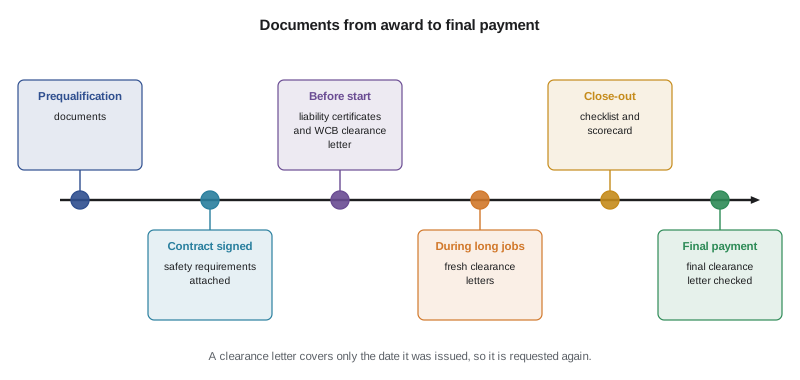
For that reason, Harrowgate Foods Ltd. asks for a WCB clearance letter showing the firm is in good standing at three points: before the contract is signed, before the contractor starts work and before final payment. For long jobs and master service agreements, it asks for a fresh letter at regular intervals while work continues. A clearance letter is a statement that the firm is registered and its account is in good standing on the date the letter is issued. It does not cover later periods, which is why it is requested again before payment.
# Which contractor documents expire before or during the shutdown?
from datetime import date
shutdown_start, shutdown_end = date(2027, 8, 3), date(2027, 8, 16)
docs = [
    ("Bayview Mechanical", "liability certificate", date(2028, 3, 31)),
    ("Bayview Mechanical", "comp clearance",        date(2027, 8, 10)),
    ("Northline Refrig.",  "liability certificate", date(2027, 7, 15)),
    ("Northline Refrig.",  "comp clearance",        date(2027, 9, 30)),
    ("Coastal Fab & Weld", "comp clearance",        date(2027, 8, 20)),
    ("AirPro Duct",        "pollution liability",   date(2027, 8, 5)),
]
for firm, doc, expires in docs:
    if expires < shutdown_start:
        status = "EXPIRED before start"
    elif expires <= shutdown_end:
        status = "expires during shutdown"
    else:
        continue
print(f"{firm:<20} {doc:<22} {expires} {status}")Bayview Mechanical comp clearance 2027-08-10 expires during shutdown Northline Refrig. liability certificate 2027-07-15 EXPIRED before start AirPro Duct pollution liability 2027-08-05 expires during shutdown
Kevin's team runs a check like this each week from June. It lists every document that will expire before or during the shutdown, so that renewals can be requested in time. In the first run, eleven documents across eight firms needed attention, including one liability certificate that had already expired. Without the check, those firms would have been stopped at the gate on the first morning of the shutdown, or worse, allowed in without anyone noticing.
Worked problem
Flowing safety obligations down to a subcontractor
Show solution
- Bayview's bid for the freezer installation named Coastal Fab and Weld for the steelwork, as the new rules required. Coastal was prequalified for low- and medium-risk work with conditions, including a new hot work procedure.
- Bayview's contract with Harrowgate Foods Ltd. required it to pass the same safety obligations down to Coastal, so Bayview attached Harrowgate Foods Ltd.'s contractor safety requirements to its subcontract with Coastal.
- Coastal provided its own liability certificate and WCB clearance letter to Bayview, and Bayview forwarded copies to the plant before Coastal's crew was oriented.
- When a Coastal welder later skipped a gas test at the start of a hot work shift, the plant's right to remove workers applied to him because it had been flowed down, and Bayview, as the party that hired Coastal, handled the discipline.
Answer: Flow-down terms made the host's requirements reach a firm it had no contract with, and gave both the host and the prime contractor a clear basis for acting.
Contracts as communication
Aisha's advice to the team was that the best contract is one both parties understand before they sign. Long contracts full of terms nobody reads protect no one. The contractor safety requirements document was rewritten in plain language, with a one-page summary at the front, and Kevin's team now walks every high-risk contractor through it at a pre-award meeting attended by the job owner, the contractor's site supervisor and someone from Elena's team. The meeting covers the scope, the site hazards, the permits needed, the coordination arrangements and the reporting rules. Jen MacLeod said afterwards that it was the first time a client had explained its rules before the work rather than after something went wrong.
Owner-operators and very small firms
Very small contractors raise particular questions. A self-employed electrician working alone may not be required to register with the WCB, and may have no written safety program at all. Harrowgate Foods Ltd. does not exclude such firms, because some of its most skilled trades come from them. Instead, the contract for an owner-operator includes a short declaration: whether the person has optional WCB coverage, whether anyone else will come to site with them, and confirmation that they have read the contractor safety requirements. If the owner-operator later brings a helper, the helper's coverage and orientation must be in place before the helper starts. The job owner checks this at the gate, not after the fact.
The same declaration helps with a common problem at shutdowns: contractors who bring extra workers on the busiest days. Each additional worker must be added to the contractor's roster, oriented and covered before being badged. Kevin's team found that simply asking for the roster in advance, and making clear that unlisted workers would be turned away, cut the number of surprise arrivals sharply.
Common mistakes
MistakeRelying on a single clause requiring compliance with all laws.
InsteadSet out supervision, subcontracting, reporting, permits, audits and the host's rights in the contract.
MistakeBurying safety costs in a lump-sum price.
InsteadPrice safety items separately and query bids that price them far too low.
MistakePenalizing all delay, including delay from safety stops.
InsteadExtend the completion date for genuine safety stops and host-caused delays.
MistakeTreating a certificate of insurance as permanent proof of coverage.
InsteadTrack expiry dates and ask for renewals before they lapse.
MistakeChecking workers' compensation status only once.
InsteadAsk for clearance letters before start, during long jobs and before final payment.
Summary and key terms
- Contracts cannot remove legal duties but can clarify roles, give the host enforcement tools and align payment with safety.
- Safety terms cover compliance, supervision, competence, subcontractors, hazard information, permits, hours, reporting, audits and corrective action.
- The host should reserve the rights to stop work, remove workers, withhold payment and terminate for safety breaches.
- Safety costs should be priced separately, and safety stops should not trigger delay penalties.
- Insurance is checked for type, limits, additional insured status and expiry; certificates are evidence, not the policy.
- WCB clearance letters are requested before start, during long jobs and before final payment.
- Master service agreement
- A contract signed once that sets the general terms for repeated work ordered later.
- Flow-down clause
- A term requiring a contractor to pass the host's obligations down to its subcontractors.
- Additional insured
- A party added to another party's liability policy for liability arising from that party's work.
- WCB clearance letter
- A WCB statement that a firm is registered and in good standing on the date issued.
- Stop-work right
- The host's contractual right to halt any work it believes is unsafe.
Practice problems
Work each problem on paper first, then reveal the answer to check.
Where do safety requirements sit in a contractor agreement at the plant?
Show answer
In the general terms, the attached contractor safety requirements document and the scope of work.
Name four rights the host reserves in the general terms.
Show answer
Stop work, remove workers, withhold payment for unsafe work and terminate for serious or repeated breaches.
Why are safety items priced separately in bids?
Show answer
So the cheapest bid is not simply the one that left them out, and low prices for them can be queried.
When does the plant ask for WCB clearance letters?
Show answer
Before signing, before start, regularly during long jobs and before final payment.
How did the host's requirements reach Coastal, which had no contract with the host?
Show answer
Through flow-down terms in Bayview's subcontract.
Lesson quiz · 5 questions
Score 60% or more to complete this lesson.
Create a free account to save your progress, take quizzes and earn a certificate.