
HSE-406 · Lesson 12 of 12 · 18 min
Learning from contractor incidents and a capstone shutdown plan
Last August's fire was investigated, after a fashion. Bayview wrote a one-page report that blamed Coastal's welder for not getting a permit and Coastal's apprentice for leaving the fire watch early. Coastal disciplined both. The plant filed the report and paid for the clean-up. Nobody asked why the plant had no way of knowing Coastal was on site, why the permit pad sat in the maintenance office or why a sixteen-hour shift seemed normal. The engine room near miss was never investigated at all, because nobody was hurt and both companies thought the other had made the mistake.
This final lesson covers how hosts and contractors learn from incidents together, so that the lessons reach the host's systems as well as the contractor's workers. It then brings the whole course together in a capstone: the plan Elena Novak and her colleagues at Harrowgate Foods Ltd. built for the next August shutdown at the Truro plant.
Why contractor incidents are often investigated badly
Contractor incidents are among the hardest to investigate well, for reasons that follow directly from the risks described in Lesson 1. Several employers are involved, and each has a reason to see the cause in someone else's actions. The contractor's workers may fear losing their jobs, or their firm losing the contract, if they speak openly. The contractor may leave the site before the investigation is finished. Records are held by different firms. And the easiest explanation, a contractor worker who broke a rule, usually stops the investigation before it reaches the host's own systems. HSE-403 covers investigation methods in detail. This section covers what is different when contractors are involved.
Reporting contractor incidents
In Nova Scotia, serious injuries, deaths and certain dangerous occurrences must be reported to the Department promptly, and the scene must not be disturbed except to protect people or property. The injured worker's employer must also report the injury to the WCB. When a contractor's worker is hurt on the host's site, more than one party may have a reporting duty. Harrowgate Foods Ltd.'s contracts now require the contractor to tell the host immediately, and the host and contractor agree, at the pre-award meeting, who will make each report and how each will confirm the other has done so.
Whatever the legal reporting duties, the host needs to know about every contractor incident and near miss on its site, because that is the only way it can learn from them. The new contracts require immediate notice of every injury, near miss, fire, spill and property damage, and a written report within twenty-four hours. The plant enters every report into its own incident system, flagged as a contractor event, so that contractor incidents are counted and analysed alongside the plant's own.
Investigating together
For any serious contractor incident, Harrowgate Foods Ltd. now runs a joint investigation. The team includes someone from Elena's team, the job owner or area owner, the contractor's supervisor or safety lead, and a worker representative, who may be from the plant's joint occupational health and safety committee or from the contractor's crew. For the most serious incidents, a member of the plant's leadership team sponsors the investigation and receives its findings. The investigation follows four principles:
- Look at every employer's systems. The investigation asks what each party's systems allowed or encouraged, including the host's planning, selection, orientation, permits, coordination and oversight. A finding that stops at a contractor worker's error is treated as incomplete.
- Protect the people who speak. Contractor workers are told, and the contractor confirms in writing, that what they say will be used to prevent recurrence, not to discipline them, except in cases of deliberate, reckless violation. Without that assurance, the most important witnesses say nothing useful.
- Keep the contractor involved until the end. The contract requires the contractor to cooperate and make its people and records available, even after its work on site has finished.
- Share the findings. Findings and actions are shared with the contractor's management, and lessons relevant to other contractors are shared with them too.
Elena reopened last August's fire using these principles, a year after the event. The new investigation found eleven contributing factors. Only two involved Coastal's workers directly. The rest were in the systems around them: no requirement to name subcontractors, no gate control on who entered, a permit system that contractors did not know about, no coordination between trades in the same space, hours of work with no limit, a fire watch role with no defined duration or training, and a scope that did not mention the flour dust or the sanitation crew. Every one of those factors had become part of the new program. Coastal's owner, who took part in the reinvestigation, said it was the first time a client had asked what had gone wrong on its own side.
Learning across contractors
One contractor's incident often holds a lesson for others. Harrowgate Foods Ltd. now shares contractor lessons in three ways. A short incident summary, written without names or blame, is sent to every contractor approved for similar work within a week of any serious incident or significant near miss. Every daily coordination meeting during a shutdown starts with one lesson from the previous day. And twice a year, the plant holds a contractor safety forum, a half-day meeting with the supervisors and safety leads of its main contractors, to review incidents and near misses, audit trends, scorecard results and program changes, and to hear contractors' own ideas.
The first forum, held in March, was attended by fourteen firms. Its most useful outcome was a request from three contractors for the plant to share its area hazard sheets with them before bidding, not just at award, so that their prices could reflect the real conditions. Kevin Doucette added the sheets to every request for quotation the following week.
Capstone: the shutdown plan
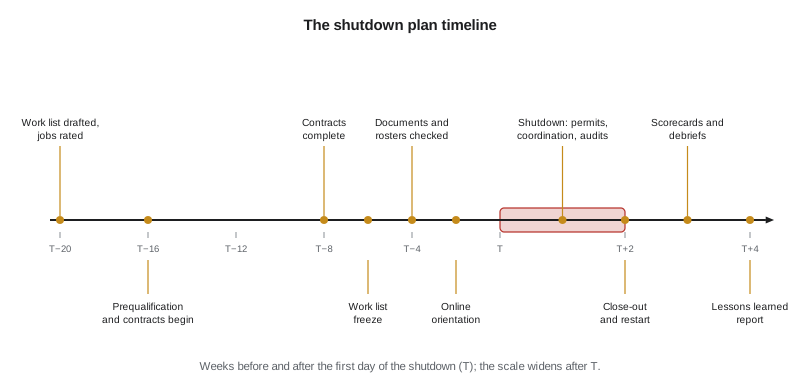
The shutdown plan brings together everything in this course. Elena wrote it as a single document, approved by Marcus Bell and Rachel Okoye in March, that every job owner, area owner, issuer and contractor supervisor received. Its sections follow the lifecycle, and each points back to the lesson where the method is explained.
- Objectives and limits. No serious injuries, fires or releases; no contractor worker on site without orientation; every high-risk job audited as planned; restart on schedule without product contamination. Shifts limited to twelve hours and seven consecutive days.
- Work list and risk ratings. Forty-three jobs, each scoped with the new template and rated: seventeen high, fifteen medium, eleven low (Lesson 4).
- Contractors and documents. Twenty-one prime contractors and fourteen named subcontractors, all prequalified for their work and risk level, with document expiry checked weekly from June (Lessons 5 and 6).
- Contracts. New general terms and contractor safety requirements for all firms, pre-award meetings for every high-risk job and flow-down to every subcontractor (Lesson 6).
- Orientation and access. Online general orientation completed before arrival, site walk and muster on day one, area orientation before work in each area, rosters and badges for every worker (Lesson 7).
- Permits. Twelve trained issuers on the day shift and four at night, a permit board in the control room, shared isolation plans and group lockboxes for every job involving plant equipment (Lesson 8).
- Coordination. Daily coordination meeting at 6:30, area notices, named owners for all shared equipment, chain depth limited to two tiers below the prime (Lesson 10).
- Oversight. A field audit plan by risk and contractor history, three released supervisors and an outside consultant as auditors, a night shutdown coordinator and a daily summary report (Lesson 9).
- Emergency response. Updated muster plan and headcount from the gate system, radios for every contractor supervisor, rescue standby for confined spaces and work at height, fire protection impairments scheduled and the fire department told, and an unannounced drill in the first week.
- Close-out and restart. Joint close-out checklist with tool counts and quality release, restart plan and restart briefings for every shift (Lesson 11).
- Evaluation and learning. Scorecards within a week of close-out, debriefs with every high-risk contractor, a lessons learned report within four weeks, and the next contractor safety forum in the autumn (Lessons 11 and 12).
Checking the plan for conflicts
The last check before the work list was frozen was a conflict review. Elena's team put every planned permit into a simple table, by area, level and time window, and checked for combinations that the plan did not allow: hot work in the same area as a line break or a confined space entry, any work directly above other work, or two hot work jobs in the same area at once.
# Check planned permits for conflicts before the work list is frozen
plan = [
    # job, area, level, day, start hour, end hour, permit types
    ("Bracket relocation", "bakery hall",  "high", 3, 22, 30, {"hot work", "height"}),
    ("Duct entry 1",       "bakery hall",  "high", 3, 20, 24, {"confined space"}),
    ("Header line break",  "engine room",  "floor", 4, 7, 15, {"line break", "isolation"}),
    ("Roof N membrane",    "roof north",   "roof", 4, 7, 19, {"height", "hot work"}),
    ("Compressor wiring",  "engine room",  "floor", 4, 13, 19, {"isolation"}),
    ("Freezer drive lift", "freezer hall", "high", 5, 8, 12, {"lift"}),
    ("Panel install",      "freezer hall", "floor", 5, 9, 17, {"height"}),
]
BAD_PAIRS = [({"hot work"}, {"confined space"}), ({"hot work"}, {"line break"}), ({"lift"}, set())]
def overlap(a, b):
    return a[3] == b[3] and a[4] < b[5] and b[4] < a[5]
def bad(a, b):
    for x, y in BAD_PAIRS:
        if (x <= a[6] and (not y or y & b[6])) or (x <= b[6] and (not y or y & a[6])):
            return True
    return False
from itertools import combinations
for a, b in combinations(plan, 2):
    if a[1] == b[1] and overlap(a, b) and bad(a, b):
print(f"CONFLICT day {a[3]} {a[1]}: {a[0]} vs {b[0]}")CONFLICT day 3 bakery hall: Bracket relocation vs Duct entry 1 CONFLICT day 5 freezer hall: Freezer drive lift vs Panel install
The check found two conflicts. The bracket relocation's hot work overlapped the first duct entry in the bakery hall on the third night, so the duct entry was moved to start after the hot work and its fire watch had finished. The freezer drive lift overlapped the panel installation in the freezer hall, and the lift would pass over the panel crew's work area, so the panel crew was scheduled to start after the lift. Neither conflict was hard to fix. Both would have been found on the day by the coordination meeting or the permit board, but finding them in March meant no crew had to wait and nobody was tempted to work around the plan.
How the next shutdown went
The next August shutdown ran for its planned fourteen days, finished on schedule and restarted without a product hold. There were 152 contractor workers on site at the peak, from thirty-five firms. Contractor hours were recorded at 10,450. Contractor workers were involved in three recorded incidents, against seven the year before; two were recordable injuries, a hand laceration and a back strain, and thirty-one near misses were reported, against two. Field audits averaged 84 percent, and the plan's audits were completed as scheduled. Four life-saving rule stops were made, two of them by plant operators. Three workers were removed from site.
Elena's lessons learned report did not claim success. The near miss count rose because reporting had improved, not because the site was more dangerous. Two recordable injuries in fourteen days was still too many. Close-out and housekeeping remained the weakest area. But the report could show, for the first time, what had happened to contractor workers on the Truro site, what the plant had done about it and what it would change next time. Rachel Okoye presented the report to the board in October. Her summary was one line: 'We now know who is on our site, what they are doing and whether they are doing it safely, and they know the same about us.'
Common mistakes
MistakeStopping an investigation at a contractor worker's rule breach.
InsteadLook at every employer's systems, including the host's planning, permits, coordination and oversight.
MistakeLeaving reporting duties unclear between host and contractor.
InsteadAgree in advance who reports what, and confirm it is done.
MistakeLetting the contractor leave before the investigation is finished.
InsteadRequire cooperation and access to people and records after the work ends.
MistakeKeeping one contractor's lessons inside that contractor.
InsteadShare summaries, start coordination meetings with a lesson and hold contractor safety forums.
MistakeTreating a rise in near-miss reports as a failure.
InsteadRead it alongside audit results and serious incidents; better reporting is progress.
Summary and key terms
- Contractor incidents are hard to investigate because several employers are involved and the easiest explanation stops at a worker's error.
- Reporting duties can fall on more than one party, so host and contractor agree in advance who reports to the Department and the WCB.
- Joint investigations look at every employer's systems, protect the people who speak and share findings.
- Lessons are shared through incident summaries, daily coordination meetings and contractor safety forums.
- A shutdown plan brings the whole lifecycle together, from scoping and prequalification to close-out and learning.
- Checking the plan for permit conflicts before work begins removes problems that would otherwise surface under time pressure.
- Joint investigation
- An investigation of a contractor incident led together by the host and the contractor, with a worker representative.
- Contractor safety forum
- A regular meeting of the host and its main contractors to review incidents, trends and program changes.
- Shutdown plan
- A single document setting out how every stage of contractor management will be carried out for a shutdown.
- Conflict review
- A check of planned permits for combinations of work that must not happen in the same place at the same time.
- Lessons learned report
- A report after a shutdown or major job recording what happened and what will change.
Practice problems
Work each problem on paper first, then reveal the answer to check.
What was wrong with Bayview's original report on the fire?
Show answer
It blamed two Coastal workers and stopped there, without looking at the host's systems.
Name four of the eleven contributing factors found in the reinvestigation.
Show answer
Any four of: no requirement to name subcontractors, no gate control, permit system unknown to contractors, no coordination, unlimited hours, undefined fire watch role, scope missing flour dust and sanitation crew.
Why are contractor workers given assurance about what they say in investigations?
Show answer
Without it, the most important witnesses say nothing useful.
Which two conflicts did the plan check find?
Show answer
Hot work overlapping a duct entry in the bakery hall, and the freezer drive lift overlapping the panel installation.
Why did Elena not treat the rise in near misses as bad news?
Show answer
It reflected better reporting, not a more dangerous site.
Lesson quiz · 5 questions
Score 60% or more to complete this lesson.
Create a free account to save your progress, take quizzes and earn a certificate.