
HSE-406 · Lesson 10 of 12 · 21 min
Managing subcontractors and multi-employer coordination
When Elena Novak drew the contracting chain for last August's shutdown, it took up a whole whiteboard. Harrowgate Foods Ltd. had hired twenty-six firms directly. Those firms had hired at least eleven more. Two of the subcontractors had hired subcontractors of their own: an insulation installer working for the refrigeration contractor's panel supplier, and a crane firm hired by the steel fabricator to lift the new freezer's drive unit. Nobody at the plant had a complete list. Coastal Fab and Weld, whose welder started the fire, was a first-tier subcontractor: hired by Bayview, which was itself hired by the plant.
Contracting chains are normal and often necessary. Specialist work is done by specialist firms, and a prime contractor that manages the specialists can save the host a great deal of effort. But each tier in the chain adds distance between the host and the people doing the work, and each handoff is a place where information can be lost. This lesson covers how the host manages subcontractors it did not hire, and how it coordinates many employers working on one site at one time.
The contracting chain
The firm the host hires directly is called the prime contractor, or simply the contractor, for that job. Firms the prime contractor hires are first-tier subcontractors; firms they hire are second-tier, and so on. Every firm in the chain is an employer with full duties for its own workers, as Lesson 2 explained. The host has a contract only with the prime contractor, so its influence over lower tiers flows through the contracts the prime contractor writes.
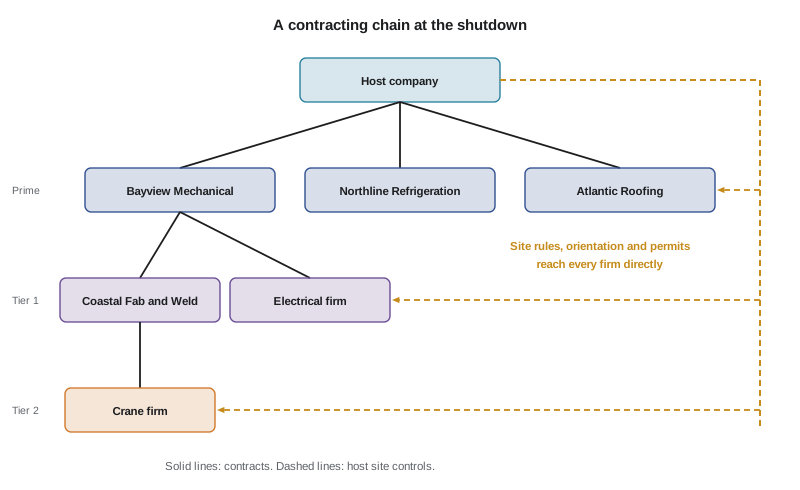
Two things in the figure are worth noticing. First, the contracts follow the chain: the host can require Bayview to pass on obligations, and Bayview must require Coastal to pass them on again. Second, the host's site controls do not follow the chain. Every worker from every firm goes through the host's gate, the host's orientation and the host's permit system. That direct line is what makes it possible to manage a long chain at all.
Rules for subcontracting
Harrowgate Foods Ltd.'s new contractor standard sets rules for subcontracting on any medium- or high-risk job:
- Name them in the bid. Every subcontractor the bidder intends to use must be named in the bid, with the work it will do, so that it can be prequalified before award.
- Prequalify them. Each named subcontractor must be prequalified for its part of the work at the right risk level, as Lesson 5 described.
- No surprise additions. No subcontractor may be added after award without the host's written approval, which requires prequalification first.
- Limit the depth. For high-risk work, the chain may go no more than two tiers below the prime contractor without the plant manager's approval.
- Flow the obligations down. The prime contractor must pass the host's contractor safety requirements down to every subcontractor, and require them to pass them on.
- Keep the prime responsible. The prime contractor remains responsible for coordinating and supervising its subcontractors' work, and must attend coordination meetings for them or make sure they attend.
The rule limiting depth was the most debated. Bayview argued that some specialist work, such as crane lifts, often comes three tiers down because of the way equipment suppliers subcontract installation. The compromise was the plant manager's approval for deeper chains, with a condition that the deeper firm's supervisor attend the daily coordination meeting in person. In practice, Marcus Bell approved two such cases for the new shutdown, and both went smoothly.
The prime contractor's role
A prime contractor that manages its subcontractors well takes a great deal of work off the host. It plans and sequences their work, briefs them, checks their documents and supervises them on site. Jen MacLeod's approach at Bayview was to treat each subcontractor crew as part of her own: subcontractor workers attended her morning briefing, used her permit requests and reported to her lead hands. Coastal's welder, who last year had started work without anyone knowing he was there, this year signed in with Bayview's crew and worked under a Bayview lead hand's direction.
Where a shutdown or installation is large enough to be a construction project, the party in overall charge of the project may be the constructor under the Nova Scotia Act, with additional duties to coordinate the project and ensure compliance. The host's lawyer and safety advisor should decide early whether that applies and who the constructor will be, and the contract should say so. HSE-375 covers the constructor's duties.
Coordinating many employers
Even with good subcontract management, the host still has to coordinate across chains. Bayview's crew, Northline's crew, the roofers and the duct cleaners did not answer to each other, but their work overlapped in time and space. Coordination is the host's job because only the host sees the whole site. Harrowgate Foods Ltd. uses four tools.
- The shutdown schedule shows every job by area and shift, as Lesson 4 described. It is the starting point for spotting overlaps.
- The daily coordination meeting, held each morning at 6:30 in the shutdown control room, brings together the supervisor of every contractor crew working that day, the area owners, the permit issuers and a member of Elena's team. It lasts twenty minutes. Each supervisor says where the crew will work, what it will do and what it needs from others. Overlaps and conflicts are resolved on the spot.
- The permit board shows all open permits on a plan of the plant, so that issuers can see conflicts before signing new permits, as Lesson 8 described.
- Area notices are posted at the entrance to each area each morning, listing the crews working there, their supervisors' phone numbers and the permits in force.
The daily coordination meeting was Jen MacLeod's suggestion after last year's fire, and it became the most valued part of the new program. The meeting found an average of three conflicts a day during the shutdown: two crews planning to use the same scissor lift, a roof crew planning to work above the line break on the ammonia header, an electrical isolation that would have cut power to the duct cleaners' ventilation fans. None was difficult to solve once it was seen.
# Find area overlaps between crews from different employers, by shift
plan = [
    # crew, employer, area, shift, activity
    ("Freezer A",  "Bayview",   "freezer hall", "day",   "rigging"),
    ("Steel 1",    "Coastal",   "bakery hall",  "night", "hot work"),
    ("Panels",     "Insulpro",  "freezer hall", "day",   "panel install"),
    ("Valve stn",  "Northline", "engine room",  "day",   "line break"),
    ("Roof N",     "Atlantic",  "roof north",   "day",   "membrane"),
    ("Ducts",      "AirPro",    "bakery hall",  "night", "confined space"),
    ("Sanitation", "CleanCo",   "bakery hall",  "night", "chemical clean"),
]
from itertools import combinations
for a, b in combinations(plan, 2):
    if a[2] == b[2] and a[3] == b[3] and a[1] != b[1]:
print(f"{a[2]:<12} {a[3]:<5} {a[0]} ({a[1]}, {a[4]}) <-> {b[0]} ({b[1]}, {b[4]})")freezer hall day Freezer A (Bayview, rigging) <-> Panels (Insulpro, panel install) bakery hall night Steel 1 (Coastal, hot work) <-> Ducts (AirPro, confined space) bakery hall night Steel 1 (Coastal, hot work) <-> Sanitation (CleanCo, chemical clean) bakery hall night Ducts (AirPro, confined space) <-> Sanitation (CleanCo, chemical clean)
The overlaps the script finds are not necessarily dangerous, but each one must be looked at. Three different employers planned to work in the bakery hall on the same night: Coastal's hot work, AirPro's duct entries and the sanitation crew's chemical cleaning. That combination prompted the coordination meeting to move the sanitation crew's cleaning on two of those nights and to sequence the hot work and the duct entries so they never ran at the same time.
Sharing hazard information between employers
Coordination also means making sure each employer knows about the hazards the others create. A cleaning chemical used by one crew can produce vapours that affect another. A welding crew's sparks can reach another crew's materials. A crane lift creates a hazard zone for everyone below it. Each employer must tell the others, through the host, what hazards its work will create and what products it is bringing on site.
At Harrowgate Foods Ltd., every contractor submits a list of the hazardous products it will bring on site, with safety data sheets, before it starts. The list goes on the area notice, and the safety data sheets are kept in the shutdown control room where anyone can see them. This meets the host's duty under section 14 to share health and safety information between employers, and it lets each crew know what the others are using.
Shared equipment and shared facilities
Some of the hardest coordination problems involve things several employers use: scaffolds, aerial work platforms, cranes, temporary power, washrooms, laydown areas. When everyone uses a scaffold, who inspects it, who tags it and who fixes it if it is damaged? Harrowgate Foods Ltd.'s rule is that every piece of shared equipment has a single owner named in the coordination plan. The scaffold contractor owns the scaffolds and inspects and tags them each day before use. The plant owns temporary power. Bayview owns the crane lift plan for the freezer drive. Any crew that finds a problem with shared equipment reports it to the owner and stops using it until it is fixed.
Worked problem
A scaffold shared by three crews
Show solution
- A scaffold built along the freezer hall wall was used by Bayview's pipefitters, the insulation crew and the electricians. On the third day, the insulation crew removed a section of guardrail to lift panels onto the platform and did not replace it.
- Next morning, an electrician noticed the missing guardrail before climbing. Under the old arrangements, he might have climbed anyway, assuming someone else was responsible.
- Under the new rule, he reported the missing guardrail to the scaffold contractor, the named owner, and the scaffold was tagged out of use. The scaffold contractor replaced the guardrail within an hour and retagged it.
- At the next coordination meeting, the insulation crew's supervisor agreed a procedure with the scaffold contractor for lifting panels using a removable gate instead of removing guardrail.
Answer: A named owner for shared equipment meant the problem had a clear route to being fixed, and the coordination meeting stopped it happening again.
Temporary workers within contractor crews
Contractors sometimes fill gaps in their crews with workers from staffing agencies, especially at peak times such as shutdowns. Those workers are another tier in the chain, and they are often the least experienced and least known. Harrowgate Foods Ltd. requires contractors to identify agency workers on their rosters, to confirm that they have the training their tasks need and to give them the same supervision as their own workers. They go through the same orientation and badging as everyone else. On the busiest day of the new shutdown, fourteen of the 152 contractor workers on site were agency workers, and all of them were known by name before they arrived.
Communication across employers during an emergency
Coordination matters most when something goes wrong. In an emergency, a site with twenty employers on it can easily end up with twenty different responses: one crew evacuates, another keeps working, a third tries to fight a fire it does not understand. Harrowgate Foods Ltd.'s emergency plan for the shutdown made three changes to deal with this. Every contractor supervisor carries a plant radio on the shutdown channel, so that an alarm or an instruction from the emergency coordinator reaches every crew at once. Every crew has an assigned muster point, shown on the area notice, and the supervisor is responsible for reporting the crew's headcount at muster against the gate records. And no contractor crew may respond to an ammonia release or a fire beyond raising the alarm and evacuating, unless it has been specifically assigned and trained for that role in the plan.
The plan was tested on the third day of the shutdown with an unannounced ammonia alarm drill. All 147 contractor workers on site at the time reached their muster points within seven minutes, and the headcount matched the gate records except for two workers who had badged out earlier without telling their supervisor. Last year, the same alarm had left a roofing crew working on the roof because nobody had told them what it meant.
Common mistakes
MistakeAssuming the host only needs to manage the firms it hires directly.
InsteadKnow every tier, and apply site rules, orientation and permits to every worker directly.
MistakeAllowing subcontractors to be added after award without approval.
InsteadRequire subcontractors to be named, prequalified and approved in writing.
MistakeLeaving each contractor to coordinate with the others informally.
InsteadHold a daily coordination meeting run by the host with every crew's supervisor.
MistakeLetting everyone use shared equipment without a named owner.
InsteadName one owner for each scaffold, platform, crane or temporary system.
MistakeKeeping each crew's hazardous products to itself.
InsteadCollect product lists and safety data sheets and share them across employers.
Summary and key terms
- Contracting chains are normal, but each tier adds distance and a place where information can be lost.
- Contracts run down the chain, while site rules, orientation and permits reach every worker directly.
- Subcontractors must be named, prequalified, approved and bound by flow-down terms, with limits on chain depth for high-risk work.
- The prime contractor coordinates and supervises its subcontractors, and the host coordinates across chains.
- The daily coordination meeting, schedule, permit board and area notices are the host's main coordination tools.
- Hazard information is shared between employers, shared equipment has one owner, and agency workers in contractor crews are known by name.
- Prime contractor
- The firm the host hires directly for a job, which may hire subcontractors.
- Contracting chain
- The sequence of contracts from the host through prime contractors to each tier of subcontractors.
- Tier
- A level in the contracting chain, counted down from the prime contractor.
- Daily coordination meeting
- A short morning meeting of every crew supervisor, area owner and permit issuer to resolve conflicts.
- Equipment owner
- The single party named as responsible for inspecting and maintaining a piece of shared equipment.
Practice problems
Work each problem on paper first, then reveal the answer to check.
On which tier was Coastal Fab and Weld last year?
Show answer
The first subcontractor tier below Bayview, which was the prime contractor hired by the plant.
What two things must happen before a subcontractor can be added after award?
Show answer
Prequalification and the host's written approval.
Why does the host run coordination rather than the contractors?
Show answer
Only the host sees the whole site.
Which three employers planned to work in the bakery hall on the same night?
Show answer
Coastal (hot work), AirPro (duct entry) and the sanitation contractor (chemical cleaning).
What should a worker do if shared equipment is damaged?
Show answer
Report it to the named owner and stop using it until it is fixed.
Lesson quiz · 5 questions
Score 60% or more to complete this lesson.
Create a free account to save your progress, take quizzes and earn a certificate.