
HSE-391 · Lesson 9 of 12 · 26 min
Bariatric patients
▶ Video coming soon A video version of this lesson is on the way.
Earlier lessons mentioned bariatric equipment several times and then moved on. This lesson comes back to it. Patients and residents with severe obesity are a growing share of the people that hospitals, long-term care homes and home care teams look after, and they are among the hardest people to move safely. The weights involved are far beyond what any team of workers can lift by hand. Body shape changes how slings fit and how a patient sits and lies. Ordinary beds, chairs, commodes and lifts may not be rated for them at all. And the patients themselves often arrive expecting to be treated badly, because many have been.
At Northbridge, about one acute admission in twenty-five now weighs more than 135 kg (300 lb), and Maple Court has four residents over 160 kg (350 lb). Two of last year's ten lost-time patient handling injuries involved bariatric patients, although they make up only a small share of moves. This lesson covers what bariatric means for patient handling, the equipment and space needed, how to plan before the patient arrives, the special tasks such as moving a limb or the abdomen, and how to keep the patient's dignity at the centre of the work.
What bariatric means for handling
In medicine, obesity is usually classified using the body mass index (BMI), the weight in kilograms divided by the square of the height in metres. A BMI of 30 or more is classed as obesity, and 40 or more as severe obesity. For patient handling, however, BMI is less useful than two simpler facts: how much the patient weighs, and how that weight is distributed. Equipment is rated by weight, not BMI, and a tall, muscular patient and a short patient with a large abdomen may weigh the same but need different slings, chairs and methods.
Northbridge's policy uses a practical definition: a patient is managed as bariatric for handling when they weigh more than 135 kg (300 lb), or when their size or shape means that standard equipment does not fit, whatever their weight. A patient of 120 kg (265 lb) whose hips are wider than a standard wheelchair is bariatric for handling purposes.
Body shape matters in several ways:
- Width. A wide patient may not fit between the side rails of a standard bed, on a standard stretcher or imaging table, or through a standard door in a wheelchair.
- Weight distribution. Patients whose weight is mostly in the abdomen and hips (sometimes called an apple shape) have a centre of gravity further forward, which affects how they sit, stand and balance in a sit-to-stand aid. Patients whose weight is mostly in the hips and thighs (a pear shape) may need a wider sling seat and thigh sections.
- The panniculus. A large fold of abdominal skin and fat, called a panniculus or apron, can hang over the thighs or to the knees. It can weigh 20 kg (44 lb) or more, makes skin care and positioning difficult, and must be supported during some moves.
- Breathing. Many patients with severe obesity become short of breath lying flat, so moves that need the bed flat must be short and planned, and the head of the bed raised as soon as possible.
- Skin. Skin folds trap moisture and are easily damaged by friction and shear, so dragging is even more harmful than for other patients.
The weights involved
The guideline from Lesson 1 is that one worker should not lift more than about 16 kg (35 lb) of a patient's weight, even in good conditions. For bariatric patients, even single body parts exceed this. A leg makes up roughly a sixth of total body weight, and the share is often higher in severe obesity, so holding up the leg of a 180 kg (400 lb) patient for a dressing change means holding about 30 kg (66 lb).
Grace uses a script to show staff what common tasks mean in weight for bariatric patients. The body segment shares are typical textbook values for adults and are only approximate for any one person.
# Approximate weight of body segments for patients of different sizes.
# Segment shares are typical adult values (whole leg about 16%, arm about 5%).
segments = {"one whole leg": 0.16, "one arm": 0.05, "head and neck": 0.08}
GUIDE_KG = 16          # guideline limit for one worker, ideal conditions

for patient_kg in (70, 135, 180, 230):
    print(f"patient {patient_kg} kg")
    for name, share in segments.items():
        w = patient_kg * share
        flag = "  over guideline" if w > GUIDE_KG else ""
        print(f"   {name:14} {w:5.1f} kg{flag}")

# A two-person manual boost of a 180 kg patient on a cotton sheet
mu, g = 0.45, 9.81
each = mu * 180 * g / 2 / g
print(f"\nboosting 180 kg on a cotton sheet: about {each:.0f} kg-force per worker")patient 70 kg one whole leg 11.2 kg one arm 3.5 kg head and neck 5.6 kg patient 135 kg one whole leg 21.6 kg over guideline one arm 6.8 kg head and neck 10.8 kg patient 180 kg one whole leg 28.8 kg over guideline one arm 9.0 kg head and neck 14.4 kg patient 230 kg one whole leg 36.8 kg over guideline one arm 11.5 kg head and neck 18.4 kg over guideline boosting 180 kg on a cotton sheet: about 40 kg-force per worker
Holding a leg of an average patient is a small task. For a 180 kg patient it is nearly twice the guideline, and for a 230 kg (500 lb) patient nearly two and a half times. The last line shows why manual boosting is out of the question: even two workers pulling on an ordinary sheet would each need to apply a force equal to lifting about 40 kg (90 lb). Every routine move, not just transfers, has to be done with equipment.
Equipment for bariatric care
Every piece of handling equipment has a safe working load, the maximum weight it is designed to carry, marked on its label. Using equipment beyond its rating risks collapse, tipping or a broken sling, and the consequences of a failure with a heavy patient are severe. A typical standard ceiling lift motor is rated around 200 to 250 kg (440 to 550 lb), while bariatric models go to 360 kg (800 lb) or more. Standard floor lifts are often rated around 180 to 200 kg (400 to 440 lb).
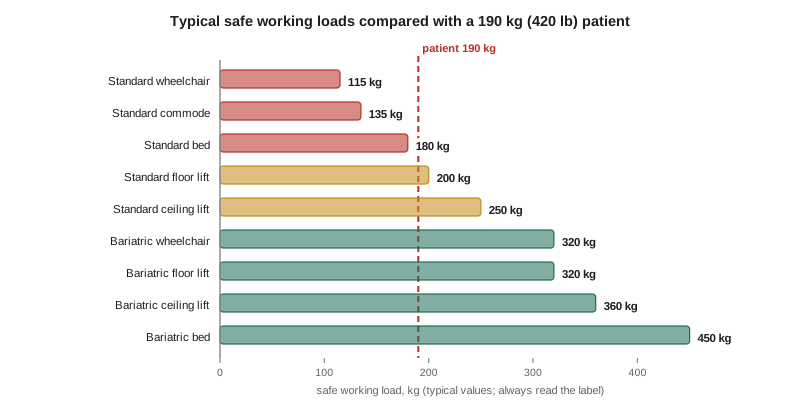
The bariatric equipment that a hospital or care home needs usually includes:
- Beds. Bariatric beds are wider, often adjustable from about 900 to 1,200 mm (36 to 48 in), with a higher safe working load, a powered drive or a bed mover for transport, and controls that let the bed tilt into a chair position so the patient can sit up without being lifted.
- Mattresses. Pressure-redistributing mattresses rated for the patient's weight, often with a turning-assist function that inflates one side to help staff turn the patient.
- Lifts and slings. Ceiling or floor lifts with a bariatric rating, wider spreader bars, and slings of the right size and rating. A sling has its own safe working load, separate from the lift, and the lower of the two is the limit.
- Seating. Bariatric wheelchairs, chairs and commodes, wide enough and rated high enough, with arms that drop away so the patient can be transferred sideways.
- Lateral transfer and repositioning devices. Air-assisted devices rated for the weight, and extra-wide slide sheets.
- Bathroom fixtures. Wall-hung toilets in hospitals are often rated for around 130 to 225 kg (300 to 500 lb) depending on the model; a floor-mounted toilet or a toilet support frame, a bariatric commode over the toilet, or a bariatric shower chair may be needed.
- Walking aids. Bariatric walkers, a walking sling on a ceiling lift for early mobility, and wider canes and crutches.
Northbridge keeps most of this equipment in a bariatric equipment pool managed by biomedical engineering and the patient flow office. Some items, such as beds, are rented from a supplier when the pool is in use. Like other medical devices, bariatric lifts and beds sold in Canada must be licensed by Health Canada, and the manufacturer's instructions set the rated load and the inspection schedule.
Space
Bariatric equipment is bigger than standard equipment, and the people using it need more room. A bariatric bed with a floor lift beside it and two or three staff around it needs much more floor space than an ordinary room provides. Without space, staff twist, reach and squeeze into corners, and the equipment cannot be positioned properly.
Design guidance for new hospitals, such as the CSA Z8000 standard in Canada and the FGI guidelines in the United States, calls for some patient rooms designed for bariatric care, with wider doors, more clear floor space around the bed, a ceiling lift and a bathroom large enough for a bariatric commode and two staff. When Northbridge renovated 4 West, two rooms were built this way: rooms 401 and 402 have doors about 1,500 mm (60 in) wide, a ceiling lift that covers the bed and the bathroom, and a floor-mounted toilet.
Space also matters along the route the patient takes. Doors into imaging rooms, the width of corridor corners, the weight rating of elevators and the size of the morgue are all part of bariatric planning. Kevin Tran knows that one of the two older elevators in the east wing is too small for a bariatric bed with a mover, and the transfer request form now asks for the bed type so that porters are sent to the right elevator.
Planning before the patient arrives
Most bariatric handling problems happen in the first hours of an admission, when a heavy patient arrives on a unit that has not prepared. The patient is moved onto an ordinary bed because the bariatric bed is still on its way, staff improvise with too few people and the wrong sling, and someone gets hurt. Northbridge's bariatric admission procedure moves the planning earlier:
- Flag. When a patient over 135 kg (300 lb) or wider than standard equipment is expected, from the emergency department, a transfer from another hospital or a planned surgery, the referring area flags it to the receiving unit and patient flow.
- Assess. The nurse does a mobility assessment (Lesson 3) as early as possible, including weight, width, shape, how much the patient can help, breathing and skin.
- Assemble. The unit requests equipment from the pool before the patient arrives: bed, mattress, lift and sized slings, chair, commode, walker and lateral transfer device. A checklist ensures nothing is missed.
- Room. The patient goes to a bariatric room if one is free. If not, the charge nurse checks that the room chosen has enough space, a ceiling lift with an adequate rating or room for a floor lift, and a usable bathroom.
- Staff. The plan says how many staff each task needs. Repositioning and transfers of a bariatric patient often need three or four people even with equipment, one to run the lift and others to guide limbs, manage lines and support the patient.
- Communicate. The plan is recorded on the bedside sign and in the care plan, and shared with imaging, physiotherapy, porters and the night shift.
The same planning applies at Maple Court before a bariatric resident moves in, and in home care before the first visit (Lesson 10).
Special tasks
Some tasks are much harder with bariatric patients and need specific methods.
- Holding limbs. For wound care, catheter insertion, dressing changes and washing, a leg or the abdomen may need to be held up for several minutes. Limb-lifting slings on the ceiling lift, which wrap around the leg and hang from the spreader bar, do this instead of a worker. Never ask a colleague to hold a heavy leg for a long procedure.
- Lifting the panniculus. A panniculus sling or holder lifts the abdominal apron so that skin under it can be cleaned and dried and wounds dressed. Staff must not lift a heavy panniculus by hand.
- Turning. A turning-assist mattress, a repositioning sling on a ceiling lift or a slide sheet with enough staff turns the patient. Turning a bariatric patient by pulling on the draw sheet is not allowed.
- Sitting up and standing. A bed with a chair position lets the patient sit up with little help. Many bariatric patients can stand with a bariatric sit-to-stand aid or a walking sling on the ceiling lift, which keeps them mobile and reduces later handling.
- Getting up after a fall. A fall is especially hazardous. The patient is assessed on the floor, kept warm and comfortable, and raised with a bariatric floor lift or an inflatable lifting device rated for the weight. Lesson 8's methods apply, but the rating of every piece of equipment must be checked first.
Dignity and respect
People with severe obesity often face stigma in health care: equipment that does not fit, comments about their weight, being weighed in public, staff who sigh or joke when they are moved, and an assumption that their illness is their own fault. Many delay seeking care because of this. Stigma is harmful for patients, and it is also a safety problem for staff. A patient who feels humiliated may refuse equipment, try to move alone and fall, or become anxious and less able to help.
Northbridge's bariatric training includes the patient's side of the experience. Staff are taught to:
- Use neutral language. Say a larger bed or a wider chair, not a fat bed or a heavy chair, and never discuss the patient's weight within their hearing except as part of care.
- Weigh in private, using a bed scale, a lift scale or a bariatric chair scale, not a public scale in the corridor.
- Have equipment ready before the patient arrives, so the patient does not wait on a stretcher while staff hunt for a bed that fits.
- Explain each move, ask what has worked for the patient before, and involve them in the plan. Many bariatric patients know exactly which slings and methods work for them.
- Refuse to joke. A remark about weight during a transfer is unprofessional, and colleagues are expected to speak up.
Worked problem
A bariatric admission to 4 West at night
At 2200, the emergency department calls 4 West: a 62-year-old woman with pneumonia, weight about 205 kg (450 lb), is being admitted. She is short of breath lying flat and can stand briefly with help. Room 402 is free. The night shift has three nurses and two personal support workers for 32 patients. What should Amira, the charge nurse tonight, check and arrange before the patient comes up?
Show solution
- Weight against ratings. At 205 kg, the patient is over the rating of a standard bed (about 180 kg), standard floor lifts (about 200 kg) and most standard slings, commodes and wheelchairs. Everything must be bariatric. The ceiling lift in room 402 is rated 360 kg, which is enough, but Amira checks that a bariatric sling of the right size is on the unit, and its own rating.
- Equipment. She calls patient flow for a bariatric bed with a turning-assist mattress and a bariatric commode from the pool. The patient will be moved from the emergency department stretcher with an air-assisted device rated for her weight, so Amira asks the emergency department to send it with her.
- Space and route. Room 402 has the wide door and the ceiling lift. Kevin's colleague on nights is told to use the west elevator, which is large enough for a bariatric stretcher.
- Staff. The transfer onto the bed needs at least three staff even with the air-assisted device, plus the porter. Amira plans the move for when she and both personal support workers are free, and asks the emergency department to wait until the bed has been delivered rather than send the patient early.
- Breathing and dignity. The patient will be kept flat for as short a time as possible and the head of the bed raised straight after the transfer. Amira asks staff to weigh her using the bed scale and to explain each step.
- Plan. Amira records the mobility assessment, the equipment and the number of staff for each task on the bedside sign, so the day shift starts with a plan rather than a problem.
Answer: Check her weight against every item's rating, get a bariatric bed, mattress, commode, sling and air-assisted device to room 402 before she arrives, plan the route, schedule the transfer when three staff and the porter are free, and record the plan at the bedside.
Common mistakes
MistakeChecking only the lift rating.
InsteadCheck every item the patient will use: lift, sling, bed, chair, commode, toilet and transfer device. The lowest rating is the limit.
MistakeMoving the patient onto a standard bed until the bariatric bed arrives.
InsteadHave the equipment in place first; ask the sending area to wait if necessary.
MistakeAsking a colleague to hold a heavy leg during a dressing change.
InsteadUse a limb-lifting sling on the ceiling lift.
MistakeUsing BMI alone to decide whether a patient needs bariatric equipment.
InsteadUse weight, width and shape; a patient who does not fit standard equipment is bariatric for handling.
MistakeWeighing the patient on a public scale in the corridor.
InsteadWeigh privately with a bed, lift or bariatric chair scale.
Summary and key terms
- For handling, a patient is bariatric when their weight or size exceeds what standard equipment can safely handle, not just above a BMI number.
- Even single limbs of bariatric patients weigh more than the one-worker guideline, so every move, not only transfers, needs equipment.
- Every item has a safe working load; the lift, sling, bed, chair, commode, toilet and transfer device must all be rated above the patient's weight.
- Bariatric care needs more space: wide doors, clear floor space around the bed, a ceiling lift and a large bathroom, and a route through the building that fits.
- Planning before arrival, with flagging, assessment, equipment, room, staff and communication, prevents most first-day problems.
- Limb slings, panniculus holders, turning-assist mattresses and beds with a chair position replace manual holding and lifting.
- Respect and dignity are part of safe handling: patients who feel humiliated are less able and less willing to work with staff.
- Bariatric
- Relating to the care of people with severe obesity; for handling, a patient whose size or weight exceeds standard equipment.
- Safe working load
- The maximum weight a piece of equipment is designed to carry, marked on its label.
- Panniculus
- A large apron of abdominal skin and fat that hangs down over the thighs.
- Limb-lifting sling
- A sling that wraps around a limb and hangs from the lift, holding it up for care.
- Turning-assist mattress
- A mattress that inflates one side to help staff turn a patient.
- Bariatric equipment pool
- A shared stock of bariatric equipment that units request when they need it.
Practice problems
Work each problem on paper first, then reveal the answer to check.
Why is BMI alone not enough to decide on bariatric equipment?
Show answer
Equipment is rated by weight and size, and two patients with the same BMI can differ greatly in weight, width and shape.
About how much does one leg of a 180 kg (400 lb) patient weigh?
Show answer
About 29 kg (64 lb), roughly a sixth of body weight and well over the one-worker guideline.
A ceiling lift is rated 360 kg and the sling 250 kg. What is the limit for this combination?
Show answer
250 kg, the lower of the two ratings.
Name four items to request before a bariatric patient arrives.
Show answer
Any four of: bed, mattress, lift and slings, chair, commode, walker, lateral transfer device.
How should a heavy leg be held up for a long dressing change?
Show answer
With a limb-lifting sling on the ceiling lift, not by a worker.
Give two ways to protect a bariatric patient's dignity during care.
Show answer
Any two of: weigh privately, use neutral language, have equipment ready before arrival, explain each move and involve the patient, and do not joke about weight.
Lesson quiz · 5 questions
Score 60% or more to complete this lesson.
Create a free account to save your progress, take quizzes and earn a certificate.