
HSE-391 · Lesson 2 of 12 · 22 min
Policies, laws and standards for patient handling
▶ Video coming soon A video version of this lesson is on the way.
Lesson 1 showed why manual patient handling injures workers. This lesson looks at the rules that apply to it: the general duties in health and safety law, the specific laws and regulations that some jurisdictions have added, the standards and guidelines that describe good practice, and the hospital's own policy. HSE-390 Lesson 2 covered the general structure of healthcare safety law at Northbridge. Here the focus narrows to moving and handling people.
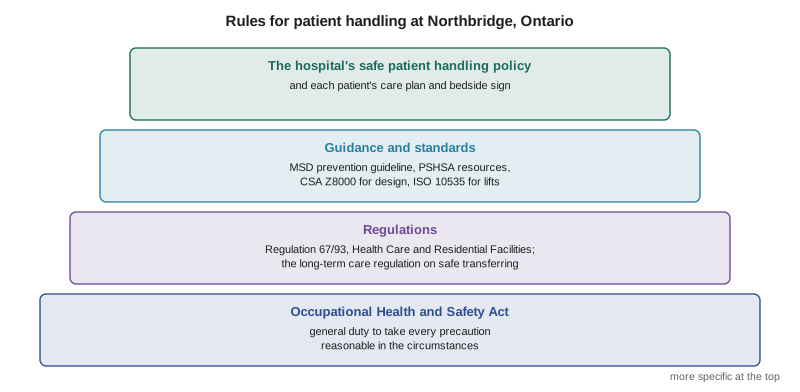
The short version for Ontario is that there is no regulation written only for patient handling, but the general duties of the Act, the requirements of the health care regulation and the long-term care rules together add up to a clear obligation: the hospital must assess the risk, provide the equipment and training to control it, and make sure staff use them.
The general duty
Ontario's Occupational Health and Safety Act does not mention patients, lifts or slings. It does not need to. Section 25 requires every employer to take every precaution reasonable in the circumstances for the protection of a worker, to provide information, instruction and supervision, and to provide and maintain equipment in good condition. Section 27 makes supervisors responsible for ensuring that workers use the equipment and follow the procedures the employer requires. When the risk of a task is as well known as manual patient lifting, an inspector will expect a hospital to show that it has assessed the risk and controlled it, and a hospital that relies only on lifting technique will struggle to show that it took every reasonable precaution.
Workers have duties too. Section 28 requires them to use the equipment and protective devices the employer requires and to report hazards and defects to their supervisor. A personal support worker who knows that the care plan calls for a ceiling lift and moves the resident by hand to save time is not following the Act, and a supervisor who knows it is happening and does nothing is not either.
Laws written for patient handling
Ontario has two more specific sets of rules that apply at Northbridge:
- Regulation 67/93, Health Care and Residential Facilities, requires the hospital to develop, establish and put into effect written measures and procedures for the health and safety of workers, in consultation with the joint health and safety committee, to review them at least once a year, and to train workers in them. The hazards these measures and procedures must deal with include moving and handling patients and residents, so the hospital's safe patient handling policy is one of them.
- The general regulation under the Fixing Long-Term Care Act, 2021 requires every long-term care home to ensure that staff use safe transferring and positioning devices or techniques when helping residents, and to train staff in them. This rule is written for resident safety, but it protects staff too, and long-term care inspectors check it.
Other provinces have their own rules. British Columbia's OHS Regulation has a section on the risk of musculoskeletal injury that requires employers to identify, assess and control the risk, with worker involvement and training, and WorkSafeBC treats patient handling as one of its main targets in healthcare. Manitoba's Workplace Safety and Health Regulation has a similar part on musculoskeletal injuries, and Alberta's OHS Code has a part on lifting and handling loads that requires employers to provide appropriate equipment where it is reasonably practicable. The details differ, but the direction is the same everywhere: assess, provide equipment, train and involve workers.
Guidelines and standards
Laws say what must be achieved. Guidelines and standards describe how good programs achieve it, and inspectors, accreditors, courts and arbitrators often use them as the measure of what is reasonable.
- The MSD Prevention Guideline for Ontario, published by the province's health and safety system, describes how to recognize, assess and control the risk of musculoskeletal disorders, with a toolbox of assessment methods. It is the reference point an Ontario inspector is likely to use.
- The Public Services Health and Safety Association (PSHSA) publishes patient handling resources for Ontario hospitals and long-term care homes, including program templates, mobility assessment tools and audit forms.
- CSA Z8000, the Canadian standard for planning, designing and building health care facilities, includes provisions for patient lifts, such as the space around beds and the structure needed for ceiling track.
- ISO 10535 is the international standard for hoists used to transfer people. Manufacturers design and test their lifts and slings to it, and it sets out the information they must give users.
- Health Canada licenses lifts and slings as medical devices and publishes recalls and safety alerts about them.
Collective agreements also matter. The agreements between Northbridge and its nursing and service unions include health and safety articles that require equipment and training, give the joint health and safety committee a role in choosing equipment, and set out how disputes about staffing and workload are raised. Many nurses' unions have campaigned for no-manual-lift programs for years.
Refusing an unsafe lift
What can a worker do when asked to lift a patient by hand in a situation they believe is dangerous? Under section 43 of the Act, workers in Ontario have the right to refuse unsafe work. In hospitals, long-term care homes and some other settings, the right is limited: a worker cannot refuse when the circumstances are inherent in the work or normal working conditions, or when the refusal would directly endanger the life, health or safety of another person. A broken ceiling lift is not an inherent danger of nursing, and moving a resident who is not in distress can usually wait the few minutes it takes to fetch another lift. In practice, the right to refuse is a last resort. Most unsafe lifts are prevented much earlier, by raising the problem with the charge nurse or supervisor, who must then find a safe way to do the task.
There is one firm exception to waiting. If a patient is in immediate danger, for example sliding out of a chair or in a fire, staff act to protect the patient. Even then, the safest action is usually to lower the patient to the floor in a controlled way and get equipment, not to lift. Lesson 8 covers this.
Northbridge's policy, before and after
When Grace started as coordinator, she found that Northbridge's policy was a three-page document called Lifts and Transfers, last revised in 2019. It said that staff should use mechanical lifts "when appropriate", that lift training was part of orientation, and that equipment problems should be reported to maintenance. It did not say who decided what was appropriate, how patients were assessed, how often training was repeated, who was responsible for slings, or how the program was measured. Most staff had never read it.
Grace did a gap analysis, comparing the policy with the elements that a strong program needs. She kept the results in a short script so she could rerun it as the policy improved.
# Gap analysis of the Lifts and Transfers policy (2019)
# 2 = fully in place, 1 = partly, 0 = missing
elements = {
    "Clear goal: minimize manual lifting":          1,
    "Leadership responsibility named":              0,
    "Committee with frontline workers":             0,
    "Patient mobility assessment tool":             0,
    "Assessment linked to equipment choice":        0,
    "Enough equipment on every unit":               1,
    "Slings: supply, laundry, inspection":          0,
    "Equipment maintenance and charging":           1,
    "Training at hire and at least yearly":         1,
    "Unit peer leaders or champions":               0,
    "Injury and near-miss data reviewed":           1,
    "Design review for new or renovated space":     0,
    "Return to work after injury":                  1,
    "Annual evaluation and policy review":          0,
}
score = sum(elements.values())
print(f"score {score} of {2 * len(elements)}  ({score / (2 * len(elements)):.0%})")
print("missing:")
for name, v in elements.items():
    if v == 0:
print(" -", name)score 6 of 28 (21%) missing: - Leadership responsibility named - Committee with frontline workers - Patient mobility assessment tool - Assessment linked to equipment choice - Slings: supply, laundry, inspection - Unit peer leaders or champions - Design review for new or renovated space - Annual evaluation and policy review
A score below a third told Grace that the hospital had equipment and good intentions but not a program. The missing elements were mostly about organization: who decides, who checks, who is responsible. Over the next months, Grace and the JHSC rewrote the policy as a Safe Patient Handling and Mobility policy. Its key points, which the rest of this course explains, are:
- Goal: manual lifting of all or most of a patient's weight is eliminated wherever equipment can do the job, and staff are expected to use the equipment the assessment calls for.
- Assessment: every patient and resident has a mobility assessment on admission, at least every shift in acute care and whenever their condition changes, using a standard tool (Lesson 3).
- Care plan: the result is recorded in the chart and on a sign at the bedside, so everyone moving the patient knows the method.
- Equipment: each unit has the lifts, slings, sit-to-stand aids and friction-reducing devices its patients need, stored close to where they are used, charged and maintained (Lessons 4 to 7 and 11).
- Training: hands-on training at hire, yearly refreshers and training whenever new equipment arrives, with checks of competence on the unit.
- Peer leaders: trained staff on every unit and shift who coach colleagues and report problems.
- Data: injury and near-miss reports, equipment problems and audit results reviewed by the committee every quarter.
- Design: every new or renovated space is reviewed for lift coverage and room space.
- Review: the program is evaluated and the policy reviewed every year.
Worked problem
Lina and the broken lift
At 0700, Lina finds that the ceiling lift in a Birch resident's room will not move. The resident, who is fully dependent and weighs about 80 kg (175 lb), needs to get up for breakfast and a medical appointment at 0900. A colleague suggests that the two of them lift her to the chair by hand, as they did years ago. What should Lina do?
Show solution
- The resident's care plan calls for a ceiling or floor lift, so a manual lift would mean each worker holding about 40 kg (88 lb), far over the guideline. It would also be against the hospital's policy and the long-term care rules on safe transferring.
- The resident is not in danger, so there is time to find another way. Lina tags the lift as out of service, reports it to maintenance and the charge nurse, and fetches the floor lift and a compatible sling from the Birch equipment room.
- If the floor lift were in use, the charge nurse would borrow one from Cedar or rearrange the morning so the resident gets up later. Missing breakfast in the dining room is a much smaller harm than a dropped resident or an injured worker.
- Lina records the problem on the equipment log, and the JHSC sees it at its next review. If lifts are often broken or unavailable, that is a system problem that the program must fix.
Answer: Do not lift by hand. Tag and report the broken lift, use the floor lift or another unit's lift, and adjust the schedule if needed; the resident is not in danger, so there is time to do it safely.
Common mistakes
MistakeAssuming there are no rules because Ontario has no patient handling regulation.
InsteadThe general duties of the Act, Regulation 67/93 and the long-term care rules together require assessment, equipment, training and use.
MistakeWriting a policy that says to use lifts "when appropriate".
InsteadSay who decides, how patients are assessed, what equipment each result calls for, and how the program is checked.
MistakeTreating the right to refuse as the main protection against unsafe lifts.
InsteadMost unsafe lifts should be stopped much earlier, by reporting problems and having equipment and staff available.
MistakeLeaving frontline workers out of the program.
InsteadInvolve the JHSC and the people who do the moves in assessment, equipment choice and evaluation.
MistakeWriting the policy and never reviewing it.
InsteadEvaluate the program and review the policy at least once a year.
Summary and key terms
- Ontario has no patient handling regulation, but the Act's general duties require every reasonable precaution, and a known risk must be assessed and controlled.
- Regulation 67/93 requires written measures and procedures, developed with the JHSC, reviewed yearly and taught to workers; the long-term care regulation requires safe transferring devices or techniques.
- Other provinces, such as British Columbia and Manitoba, have regulations on musculoskeletal injury risk.
- Guidance such as the MSD Prevention Guideline, PSHSA resources, CSA Z8000 and ISO 10535 describe good practice.
- Workers must use the equipment and methods required, and supervisors must make sure they do.
- The right to refuse is a last resort; a broken lift is a reason to fetch another one, not to lift by hand.
- A strong policy names who decides, how patients are assessed, what equipment is used, how staff are trained and how the program is measured.
- General duty
- The employer's duty under section 25 of the Act to take every precaution reasonable in the circumstances.
- Safe patient handling policy
- A written policy that sets out how a facility minimizes manual lifting through assessment, equipment, training and evaluation.
- Gap analysis
- A comparison of what is in place with what a good program needs, to find what is missing.
- ISO 10535
- The international standard for hoists used to transfer people, including their slings.
- Peer leader
- A trained frontline worker who coaches colleagues on safe patient handling and reports problems.
Practice problems
Work each problem on paper first, then reveal the answer to check.
Which part of Ontario law requires written measures and procedures for patient handling in a hospital?
Show answer
Regulation 67/93, Health Care and Residential Facilities.
What does the long-term care regulation require about transfers?
Show answer
That staff use safe transferring and positioning devices or techniques when helping residents, with training.
Name three elements that Northbridge's 2019 policy was missing.
Show answer
Any three of: a named leader, a committee with frontline workers, a mobility assessment tool, a link from assessment to equipment, sling management, peer leaders, design review and annual evaluation.
A ceiling lift is broken and a resident needs to get up. Is this a reason to lift by hand?
Show answer
No. Tag and report the lift, use another lift, and adjust the schedule if needed.
Why do guidelines and standards matter if they are not law?
Show answer
Inspectors, accreditors, courts and arbitrators use them as the measure of what is reasonable and good practice.
When may staff act without equipment to protect a patient?
Show answer
When the patient is in immediate danger; even then, lowering the patient in a controlled way is usually safer than lifting.
Lesson quiz · 5 questions
Score 60% or more to complete this lesson.
Create a free account to save your progress, take quizzes and earn a certificate.