
HSE-391 · Lesson 12 of 12 · 25 min
Capstone: building a safe patient handling program
▶ Video coming soon A video version of this lesson is on the way.
This last lesson puts the course together. A safe patient handling program is not a lift, a policy or a training day. It is a system in which every patient is assessed, the assessment points to a method, the equipment for that method is there and working, staff know how to use it and are expected to, and someone checks the results and fixes what is not working. Lesson 2 listed the elements of such a program and showed how far Northbridge's old policy fell short. Lessons 3 to 11 covered each element in turn.
The capstone follows Grace and the 3 East team through a year of building the program on one unit. 3 East is a 30-bed surgical unit with a steady flow of patients who are mobile before surgery, dependent for a day or two afterwards, and then quickly mobile again. Lesson 11's availability audit found it was the weakest of the three units checked. By the end of the lesson you should be able to plan the same work for a unit, a long-term care home area or a home care team of your own.
The program cycle
Grace uses a simple cycle to plan the work. The steps are the same as in any occupational health and safety program, and they match the elements in Lesson 2.
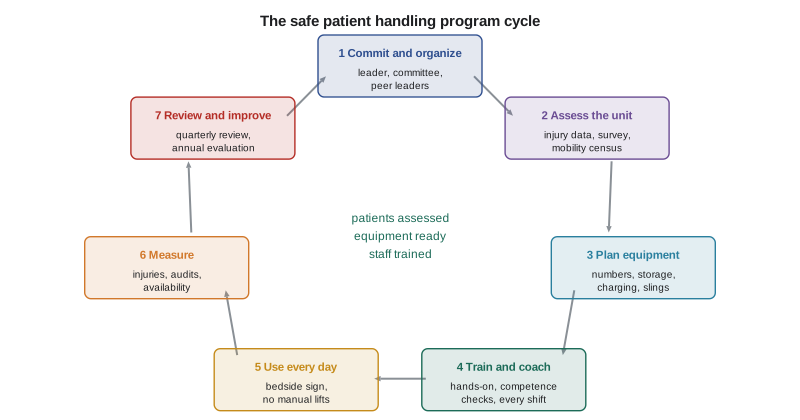
Step 1: commit and organize
A program needs people who are responsible for it. On 3 East, Grace started by agreeing on roles with Sarah MacLeod's counterpart, the 3 East unit manager, and the director of surgery:
- A leader. The unit manager is accountable for the program on 3 East, including equipment, training time and follow-up. Grace, as the hospital's safe patient handling coordinator, provides expertise and data.
- A working group. The unit's working group reports to the JHSC and its patient handling working group. It has two nurses, two personal support workers, a physiotherapist, a porter, the unit's educator and the manager. Half its members do the moves every day.
- Peer leaders. Six staff, at least one on every shift and rotation, are trained as peer leaders. They coach colleagues at the bedside, run the routine equipment inspections and are the first contact when something goes wrong.
- Time. Peer leaders get two hours a month away from patient care for program work, and the working group meets monthly for the first six months.
Commitment also means saying out loud what the program expects. The director of surgery and the manager told staff at the launch meeting that manual lifting of all or most of a patient's weight would no longer be accepted on 3 East, that equipment would be provided to make that possible, and that no one would be blamed for taking the time to use it.
Step 2: assess the unit
Before buying anything, the working group collected four kinds of information.
- Injury and near-miss data. Over the previous two years, 3 East had 14 patient handling injury reports, 5 WSIB claims and 3 lost-time cases. Most were during repositioning in bed and the first time a patient got up after surgery.
- A staff survey. Staff were asked which tasks they found hardest, how often they lifted by hand and why, and what got in the way of using equipment. The top answers were that the lift was too far away and often flat, that there were not enough slings, and that there was no time.
- A patient mobility census. For two weeks, nurses recorded each patient's mobility level at the start of every day shift, using the assessment tool from Lesson 3.
- A walk-through. Grace and a peer leader looked at every room, bathroom and storage area, measured clear floor space and doorways, and checked whether ceiling track could be installed.
Step 3: plan equipment and space
The mobility census told the group how many patients at each level the unit usually had, and so how much equipment it needed. Grace turned the census into equipment numbers with a short script, using the planning ratios from Lesson 11.
import math
# 3 East patient mobility census: patients at each level at the start of day shift
# (level 1 = fully dependent ... level 4 = independent), 14 days
census = {
    1: [3, 4, 2, 3, 5, 4, 3, 2, 3, 4, 3, 5, 4, 3],
    2: [5, 6, 5, 7, 6, 5, 6, 5, 6, 7, 5, 6, 6, 5],
    3: [9, 8, 10, 8, 9, 10, 9, 9, 8, 9, 10, 8, 9, 9],
    4: [11, 10, 11, 10, 9, 10, 11, 12, 11, 9, 10, 10, 10, 11],
}
peak = {lvl: max(days) for lvl, days in census.items()}
avg = {lvl: sum(days) / len(days) for lvl, days in census.items()}
for lvl in census:
    print(f"level {lvl}: average {avg[lvl]:4.1f}, peak {peak[lvl]}")

# plan for the peak, using ratios of about 1 device per 8 patients who need it
floor_lifts = max(2, math.ceil(peak[1] / 8))         # at least 2: one each end
standing_aids = max(1, math.ceil(peak[2] / 8))
slings = 2 * (peak[1] + peak[2])                      # two per patient: one in use, one in laundry
slide_sheets = peak[1] + peak[2] + peak[3]            # one stays with each patient who needs it
print(f"\nfloor lifts {floor_lifts}, sit-to-stand aids {standing_aids}, "
f"slings {slings}, slide sheets {slide_sheets}")level 1: average 3.4, peak 5 level 2: average 5.7, peak 7 level 3: average 8.9, peak 10 level 4: average 10.4, peak 12 floor lifts 2, sit-to-stand aids 1, slings 24, slide sheets 22
On a typical day, about nine patients on 3 East needed a full lift or a standing aid, rising to twelve at peak. The unit had one floor lift and no sit-to-stand aid. The plan added a second floor lift, a sit-to-stand aid, a full stock of slings in each size, and slide sheets for every patient who needed repositioning. The working group also asked for ceiling lifts in the four rooms nearest the nursing station, where the sickest post-operative patients are placed, which biomedical engineering and facilities confirmed could be installed.
Space and storage followed Lesson 11: two equipment alcoves with chargers, one at each end of the corridor, made from a former linen room and an unused nourishment room. Sling hooks were labelled by size. Every room got a hook for a slide sheet at the head of the bed.
The working group also wrote down how the method for each patient would be communicated: the mobility level and method on a sign at the head of the bed and in the care plan, updated at every reassessment, and a line on the shift huddle sheet for any patient whose level had changed.
Step 4: train and coach
Training on 3 East was built around the equipment the unit actually had and the patients it actually saw.
- Every staff member who moves patients, including porters, physiotherapists and float staff, attended a two-hour hands-on session before the launch, practising each move on each device with a partner as the patient.
- Training covered the mobility assessment, the care plan sign, pre-use checks, sling selection and fit, each device, falls and controlled lowering, and what to do when equipment fails.
- Each person's competence was checked on the unit by a peer leader within a month, using a short checklist, rather than assumed from attendance.
- New staff are trained during orientation and checked before they work alone. Everyone has a yearly refresher, and new equipment always comes with training.
Coaching matters more than the classroom. Peer leaders spent the first weeks after the launch on the floor, helping colleagues with their first uses of the new equipment, answering questions on night shift and spotting problems early. When staff saw a respected colleague use a lift for a boost that they would once have done by hand, the habit started to change.
Step 5: use every day
The program only works if it changes what happens at the bedside, every shift. The 3 East routine became:
- Assess every patient on admission, every day shift and whenever their condition changes, especially after surgery and before the first time up.
- Put the mobility level and method on the bedside sign and say it at the shift huddle.
- Bring the equipment to the bedside before the move, check it, and use it, even when it seems quicker not to.
- Report any problem with equipment, any move done by hand and any near miss, so the working group can see what is getting in the way.
The charge nurse checks bedside signs on rounds, and peer leaders do short observation audits each month, watching a sample of moves and noting whether the method matched the plan.
Step 6: measure
The working group measured both the process (whether the program was being followed) and the outcomes (whether injuries fell).
- Process measures: the share of patients with a current mobility assessment and bedside sign, the share of observed moves that used the planned method, availability audit times (Lesson 11), slings at par level, and equipment repair times.
- Outcome measures: patient handling injury reports, WSIB claims, lost-time cases and lost days, staff survey results, and patient outcomes such as falls and pressure injuries, which a good program also tends to reduce.
Grace compared the year before the program with the first full year after it. Because the number of hours worked changes from year to year, she used rates per 100 full-time equivalents (FTE), as in HSE-390.
# 3 East: patient handling injuries, year before and first year after the program
before = {"reports": 8, "claims": 3, "lost_time": 2, "lost_days": 61, "fte": 46.0}
after  = {"reports": 6, "claims": 1, "lost_time": 0, "lost_days": 0,  "fte": 47.5}

def per_100_fte(n, fte):
    return 100 * n / fte

for key in ("reports", "claims", "lost_time"):
    b = per_100_fte(before[key], before["fte"])
    a = per_100_fte(after[key], after["fte"])
    print(f"{key:10} {b:5.1f} -> {a:5.1f} per 100 FTE")
print(f"lost days {before['lost_days']} -> {after['lost_days']}")

# process measures from monthly audits in the first year (share of checks passed)
process = {"current assessment and sign": [0.62, 0.78, 0.86, 0.91],
           "observed moves used planned method": [0.55, 0.71, 0.83, 0.88],
           "lift at bedside within 2 minutes": [0.33, 0.67, 0.83, 0.92]}
for name, q in process.items():
print(f"{name:35} " + " ".join(f"Q{i + 1} {v:.0%}" for i, v in enumerate(q)))reports 17.4 -> 12.6 per 100 FTE claims 6.5 -> 2.1 per 100 FTE lost_time 4.3 -> 0.0 per 100 FTE lost days 61 -> 0 current assessment and sign Q1 62% Q2 78% Q3 86% Q4 91% observed moves used planned method Q1 55% Q2 71% Q3 83% Q4 88% lift at bedside within 2 minutes Q1 33% Q2 67% Q3 83% Q4 92%
The results were encouraging but needed careful reading. Lost-time cases fell from two to none and WSIB claims from three to one, a real improvement in the most serious outcomes. Injury reports fell only a little, from 8 to 6, and Grace was glad of that: part of the program was to encourage reporting of strains and near misses before they became injuries, so a steady number of reports with fewer serious cases is what a working program often looks like. The numbers on one unit are also small, so a single bad week can change them. The process measures showed steady improvement every quarter, which gave the working group more confidence that the outcome changes were not just chance.
Step 7: review and improve
Every quarter, the working group reviews the data and reports to the JHSC and its patient handling working group, and once a year the whole program is evaluated and the policy reviewed. On 3 East, the first annual review found three problems still to fix:
- The night shift's audit scores lagged behind days, because two of the six peer leaders worked days only. A night peer leader was added.
- Patients going home were still being helped into cars by hand at the front entrance. A swivel cushion and a transfer board were added to the discharge cart, with a short training session for staff and volunteers.
- Two of the four ceiling lifts had been installed, but the other two were delayed by funding. The committee put them first on the next capital budget.
Grace then re-ran the gap analysis from Lesson 2, this time for the hospital program as a whole. The score had risen from 6 of 28 to 23 of 28. The elements still only partly in place were design review for renovated space, equipment maintenance in home care, and return to work after injury, which became the priorities for the next year.
Keeping it going
Many programs start well and fade. Equipment wears out and is not replaced, peer leaders move on, new managers arrive who were not there at the launch, and old habits return when the unit is busy. The programs that last share some features:
- They are built into normal work: the assessment is in the chart, the sign is part of the bed, equipment checks are part of the shift, and the budget includes slings and batteries every year.
- They have a named owner at every level, from the unit peer leader to a senior leader.
- They keep measuring and reporting results, so that leaders see the value and staff see that their reports lead to action.
- They involve frontline workers in every decision, from choosing equipment to writing procedures.
- They link safe patient handling with patient goals such as early mobility, fall prevention and skin care, so that it is seen as good care, not an extra.
Worked problem
Planning a program for Cedar at Maple Court
After the 3 East results, Maple Court's manager asks Lina and a colleague to help plan the next year's work for Cedar, a home area of 24 residents. Cedar has ceiling lifts in 10 rooms, one floor lift, one sit-to-stand aid and a sling stock that no one has counted. Last year it had 9 handling injury reports, 4 WSIB claims and 2 lost-time cases, mostly during repositioning in bed and toileting at night. Use the program cycle to sketch the plan.
Show solution
- Commit and organize. The manager is the accountable leader. The Cedar working group includes Lina and other personal support workers, a nurse, a physiotherapist and a family council member. Two peer leaders are chosen for nights, where most injuries happened.
- Assess. Review the injury reports, survey staff, do a two-week mobility census of residents including their status at night, and walk through rooms and bathrooms.
- Plan equipment and space. If the census shows most residents need full lifts, the priority is ceiling lifts in the remaining 14 rooms. Meanwhile, add a second floor lift for nights, count slings, bring stock to two per resident who needs one, and set up a charging alcove.
- Train and coach. Hands-on training for all Cedar staff including float and agency staff, with competence checks and night coaching by the peer leaders.
- Use every day. Mobility status on the care plan and at the bedside, updated when residents change; equipment used for every repositioning and night toileting task.
- Measure, review, improve. Monthly process audits, availability audits on nights, quarterly injury review, and an annual evaluation reported to the committee.
Answer: Follow the cycle: name a leader, working group and night peer leaders; assess with injury data, a survey and a mobility census; fill the ceiling lift gap and fix slings and charging; train and coach; use the plan every shift; measure, review and improve.
Common mistakes
MistakeStarting a program by buying equipment.
InsteadStart with leadership and an assessment of the unit, then plan equipment from patients' needs.
MistakeTraining staff once in a classroom and assuming competence.
InsteadTrain hands-on with the unit's own equipment, check competence on the unit and coach at the bedside.
MistakeJudging success only by the number of injury reports.
InsteadUse process measures and serious outcomes such as lost time, and expect reporting of minor problems to continue.
MistakeTreating the launch as the finish line.
InsteadReview quarterly, evaluate yearly, and keep budgeting for equipment, slings and peer leaders.
MistakeLeaving night shift out of the plan.
InsteadHave peer leaders, audits and equipment checks on every shift.
Summary and key terms
- A safe patient handling program links assessment, method, equipment, training, daily use, measurement and review into one system.
- It starts with commitment: an accountable leader, a working group with frontline staff, peer leaders on every shift, and time to do the work.
- An assessment of injury data, staff views, patient mobility and spaces shows what the unit needs before anything is bought.
- A mobility census turns into equipment numbers, planned for the peak, with storage, charging and slings.
- Hands-on training, competence checks and bedside coaching by peer leaders change daily habits.
- Process measures and outcome measures together show whether the program is working; small numbers need careful reading.
- Programs last when they are built into normal work, owned at every level, measured, and linked to patient care goals.
- Safe patient handling program
- An organized system to eliminate manual lifting through assessment, equipment, training, use and review.
- Peer leader
- A trained staff member who coaches colleagues and supports the program on their unit and shift.
- Mobility census
- A count of patients at each mobility level over a period, used to plan equipment.
- Process measure
- A measure of whether the program is being carried out, such as assessments done or methods followed.
- Outcome measure
- A measure of results, such as injuries, lost time or patient falls.
- Annual evaluation
- A yearly review of the whole program and its policy.
Practice problems
Work each problem on paper first, then reveal the answer to check.
List the seven steps of the program cycle used on 3 East.
Show answer
Commit and organize, assess the unit, plan equipment and space, train and coach, use every day, measure, review and improve.
What four kinds of information did the 3 East working group collect before buying equipment?
Show answer
Injury and near-miss data, a staff survey, a patient mobility census and a walk-through of rooms and storage.
Why did Grace plan equipment for the peak census rather than the average?
Show answer
So equipment is available on the busiest days, when shortages push staff into manual lifting.
Why is a steady number of injury reports with fewer lost-time cases a reasonable result?
Show answer
The program encourages reporting of minor strains and near misses, while serious injuries are the outcomes it most aims to prevent.
Give two process measures and two outcome measures.
Show answer
Process: assessments current, planned method used, availability times, slings at par. Outcome: injury reports, claims, lost-time cases, lost days, patient falls.
Name three features of programs that last.
Show answer
Any three of: built into normal work, named owners at every level, ongoing measurement and reporting, frontline involvement, links to patient care goals.
Lesson quiz · 5 questions
Score 60% or more to complete this lesson.
Create a free account to save your progress, take quizzes and earn a certificate.