
HSE-391 · Lesson 1 of 12 · 29 min
Why patient handling injures workers
▶ Video coming soon A video version of this lesson is on the way.
Moving people is the core physical work of healthcare. Every day at Northbridge Community Hospital, staff help patients sit up, roll over, slide up the bed, move from bed to chair, get on and off the toilet, climb into a bath, transfer to a stretcher and stand up after a fall. Most of these moves are routine. Done by hand, many of them are also among the most dangerous things anyone does at work, and they injure more healthcare workers than any other task.
This course is about doing that work without injuring the people who do it. It follows the same hospital, long-term care wing and home care team as HSE-390 Healthcare Workplace Safety Essentials, and it assumes you have taken HSE-107, which covers lifting, carrying and the general causes of strain injuries. This first lesson explains why patient handling is so hard on the body, why the traditional answer of better lifting technique does not work, and what the numbers at Northbridge show. The rest of the course covers the law, assessing patients, the equipment, special situations such as falls, bariatric care and home care, and finally how to build a program that changes the numbers.
Patient handling at Northbridge
Patient handling means any task in which a worker moves, supports or holds all or part of a person's body. It includes lifting and lowering, transferring from one surface to another, repositioning in bed or in a chair, turning, holding a limb during a procedure, helping someone walk, and catching or lowering someone who is falling. The term covers residents in long-term care and clients at home as well as patients in hospital, and this course uses all three words.
At Northbridge, patient handling happens everywhere:
- On 4 West, the 32-bed medical unit, many patients are older, unwell and weak. A typical day shift includes about 40 repositioning moves, 30 transfers in and out of bed and a dozen trips to the bathroom that need help. Twenty of the 32 rooms have ceiling lifts; the rest rely on two floor lifts and a sit-to-stand aid that are shared with 3 East.
- At Maple Court, the 96-bed long-term care wing, most residents need help with every transfer, many of them several times a day, and many live with dementia. Lina Santos and her colleagues on the Birch home area may help with 150 moves in a day shift. Sixty of the 96 rooms have ceiling lifts.
- In the emergency department, patients arrive on ambulance stretchers and must be moved to the department's own stretchers, sometimes when they are unconscious, in pain or agitated.
- Porters such as Kevin Tran move patients between beds, stretchers and wheelchairs for imaging, surgery and transfers between units, and push heavy beds through the building.
- In imaging, technologists move patients onto and off scanning tables that cannot be lowered or widened.
- Nadia Rahman and the Northbridge Home Care team help clients in homes that were never designed for care: narrow bathrooms, soft low beds, stairs and no lift.
This course introduces one new person. Grace Liu is a physiotherapist who has worked at Northbridge for nine years. Last spring she was given a new half-time role as the hospital's safe patient handling coordinator, reporting to Joanne Pelletier in the Occupational Health and Safety office. Her job is to turn a scattered collection of lifts, policies and training sessions into a program that actually lowers injuries, and her work runs through the whole course.
What the injury data show
HSE-390 showed that patient and resident handling is the largest single cause of injury at Northbridge. The detail is worth a second look. Last year there were 52 reports of injuries during patient handling, 15 of which became WSIB claims and 10 of which led to time off work. Those 10 cases cost the hospital about 410 days of lost work and a much larger amount in replacement staff, overtime and claim costs.
| Where it happened | Reports | WSIB claims | Lost-time claims |
|---|---|---|---|
| Maple Court (long-term care) | 22 | 6 | 5 |
| 4 West and 3 East (inpatient units) | 14 | 4 | 3 |
| Emergency department | 4 | 1 | 0 |
| Intensive care unit | 3 | 1 | 0 |
| Portering and imaging | 4 | 2 | 1 |
| Home care | 5 | 1 | 1 |
| Totals | 52 | 15 | 10 |
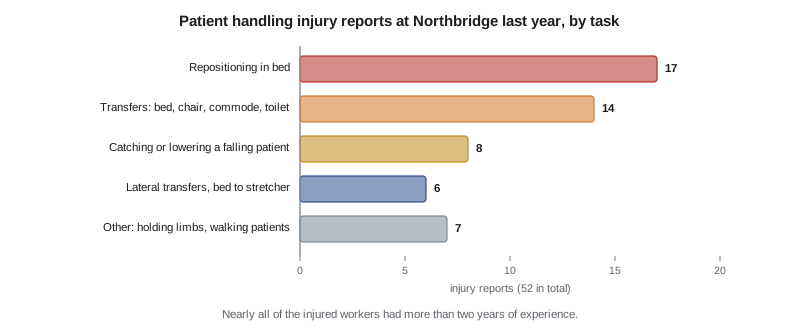
Three things stand out. First, the long-term care wing produces the most injuries, even though it has fewer beds than the acute hospital. That matches the provincial and national picture: residential care has some of the highest injury rates in any sector, because residents need the most help with the most moves. Second, the injuries cluster in a small number of tasks. When Grace sorted the 52 reports by task, repositioning in bed (sliding a patient up the bed, turning and boosting) came first with 17, followed by transfers between bed, chair, commode and toilet with 14, catching or lowering a falling patient with 8, lateral transfers between bed and stretcher with 6, and other tasks such as holding limbs and helping patients walk with 7. Third, almost all of the injured workers were experienced. These were not new staff who did not know how to lift.
The pattern is the same across the country. In Ontario's health care sector in 2025, musculoskeletal injuries from handling clients caused 2,044 lost-time injuries, on top of more than 2,300 other musculoskeletal injuries and about 2,100 from falls. personal support workers, nurses and porters are the occupations most affected, and long-term care homes have lost-time injury rates more than three times those of hospitals.
Why moving people is so hard on the body
A person is the most awkward load anyone is asked to lift. HSE-107 explained the three main causes of strain injury: force, awkward posture and repetition. Patient handling combines all three, and adds problems of its own.
- Heavy loads. An adult patient may weigh 50 kg (110 lb) or 150 kg (330 lb), and the worker usually cannot choose. Even a single leg of a 110 kg (240 lb) patient weighs about 17 kg (38 lb).
- Loads held far from the body. A box can be pulled close to the chest; a patient in bed is across the mattress, and the worker must reach. Every extra bit of reach multiplies the load on the lower back.
- Bent and twisted postures. Beds that are too low, chairs and toilets in tight spaces, and patients who are on the far side of the bed force workers to bend, twist and reach at the same time.
- No handles. People have no good places to grip. Workers grab under arms, hold belts and clothing, or hook their hands under knees and shoulders, which pulls the load further away.
- Shifting weight. A patient may help at the start of a move and then go limp, push the wrong way, grab the worker's neck, or start to fall. The worker reacts with a sudden jerk, the moment when many injuries happen.
- Repetition. Even moderate loads, lifted many times a shift for years, cause tiny damage to the discs and muscles of the back and shoulders that adds up faster than the body can repair it.
- Pressure of time and care. Staff move patients who need help now, when the lift is down the hall and the second person is busy. Lesson 1 of HSE-390 called this the patient-first trap.
The result is that a single patient handling task can load the lower back of the worker far beyond what the spine can tolerate, and the many smaller tasks of each shift build up the damage in between. Most patient handling injuries are not caused by one dramatic lift. They are the last straw on a back that has been loaded thousands of times before.
The 35-pound guideline
For lifting boxes, the NIOSH lifting equation (Lesson 8 of HSE-390) gives a recommended weight limit for a task, which can be as high as 23 kg (51 lb) in ideal conditions. NIOSH's own researchers concluded that the equation was never designed for people, because patients are not rigid and cannot be held close to the body. In 2007, Thomas Waters of NIOSH applied the equation to patient handling under the best conditions it could describe: a patient who is cooperative and not combative, a slow and smooth lift, hands close to the body and no twisting. The result was a limit of about 16 kg (35 lb) for one worker. Above that, the guideline says, a worker should use assistive equipment rather than lift by hand.
The 35-pound figure is a ceiling for good conditions, not a target. Conditions that are common in healthcare make the safe limit lower still:
- lifting with the arms extended, for example reaching across a bed;
- lifting near the floor, or while kneeling or sitting;
- twisting or lifting a load that is off to one side;
- lifting with one hand, or in a cramped space such as a bathroom;
- lifting a patient who might move suddenly, resist or fall;
- lifting late in a long shift, when the body is tired.
The guideline has a simple and uncomfortable meaning. Very few complete patient lifts by hand are safe. Lifting a whole adult, even with two or three people, means each worker carries more than 16 kg (35 lb), because the load is never shared evenly and the people on the sides of the bed are reaching. Holding a leg for wound care or putting on compression stockings can exceed the limit for a heavier patient. Grace uses a short script to show staff what the guideline means for the moves they do every day.
# Share of the patient's weight each worker holds, compared with the
# 16 kg (35 lb) guideline for one worker in good conditions.
LIMIT_KG = 16

def leg_weight(body_kg):
    # one whole leg is about 16 per 100 of body weight
    return body_kg * 0.16

tasks = [
    # (task, patient kg, share of weight lifted, workers)
    ("Hold one leg for wound care", 110, 0.16, 1),
    ("Hold one leg for wound care", 70, 0.16, 1),
    ("Bed to chair, patient bears half", 82, 0.50, 2),
    ("Lift dependent patient up the bed", 91, 0.90, 4),
    ("Lift dependent patient up the bed", 91, 0.90, 2),
    ("Lift fallen resident from floor", 75, 1.00, 3),
]

for task, kg, share, n in tasks:
    each = kg * share / n
    flag = "OVER" if each > LIMIT_KG else "ok"
    print(f"{task:35} {kg:3} kg  {n} worker(s): {each:5.1f} kg each  {flag}")

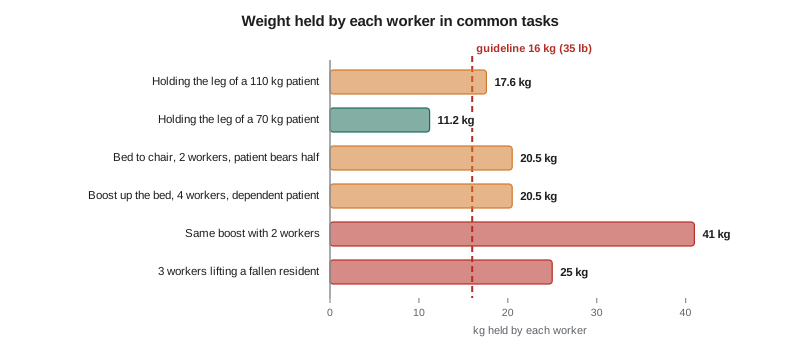
print("\nleg of a 110 kg patient:", round(leg_weight(110), 1), "kg")Hold one leg for wound care 110 kg 1 worker(s): 17.6 kg each OVER Hold one leg for wound care 70 kg 1 worker(s): 11.2 kg each ok Bed to chair, patient bears half 82 kg 2 worker(s): 20.5 kg each OVER Lift dependent patient up the bed 91 kg 4 worker(s): 20.5 kg each OVER Lift dependent patient up the bed 91 kg 2 worker(s): 41.0 kg each OVER Lift fallen resident from floor 75 kg 3 worker(s): 25.0 kg each OVER leg of a 110 kg patient: 17.6 kg
The numbers are generous to the workers, because they assume the load is shared evenly. In real moves, the worker at the heavier end, the shorter worker or the one who is reaching furthest carries more. Even so, five of the six tasks are over the guideline, including the four-person lift up the bed that many units still do. Only the leg of a lighter patient is under it, and only just.
Why lifting technique is not the answer
For decades, the main answer to patient handling injuries was training in body mechanics: bend the knees, keep the back straight, hold the load close, use the legs, do not twist. These are good habits, and HSE-107 teaches them for general lifting. For patient handling, however, research over many years has found that training in lifting technique on its own does not reduce injuries. There are several reasons.
- The load is too heavy. No technique makes a 90 kg (200 lb) person safe to lift by hand. Good posture lowers the load on the spine a little; it does not bring it under the limit.
- The environment makes good technique impossible. A worker cannot keep the load close and the back straight while reaching across a bed, kneeling beside a fallen resident or twisting in a bathroom.
- Patients move. A technique learned with a cooperative partner in a classroom falls apart when the patient grabs, pushes or slumps.
- People revert under pressure. When time is short and the patient needs help now, workers fall back on the habits of their whole career.
- Back belts do not help either. Studies have not shown that back belts prevent back injuries in healthcare or elsewhere, and they may give a false sense of protection.
This does not mean training is useless. It means training in technique is not enough. What works, as the rest of this course shows, is to remove most manual lifting altogether by using mechanical lifts and other equipment, to assess every patient so the right equipment is used, and to build a program that makes the equipment available, maintained and expected. Training then teaches staff how to use the equipment well, which is a much more useful thing to train.
A word on 'lift teams'
Some hospitals have tried teams of specially trained staff who do all the heavy lifts. Lift teams can reduce injuries among nurses, but if the team lifts by hand, its own members are injured instead. Modern programs use lift teams, where they exist, as equipment experts who help with the hardest moves, not as people who lift by hand with more skill than others.
Patients benefit too
Safe patient handling is not only about workers. The same equipment and methods that protect staff also make care safer and more comfortable for patients:
- Fewer falls during transfers. A patient in a lift sling or on a sit-to-stand aid is much less likely to slip to the floor than one held under the arms.
- Less skin damage. Dragging a patient up the bed causes friction and shear that can tear fragile skin and lead to pressure injuries. Slide sheets and lifts prevent this.
- Less pain and fear. Patients who are pulled under the arms often report pain in the shoulders, and frail patients are frightened of being dropped. Many feel more secure in a well-fitted sling.
- More mobility. Equipment such as sit-to-stand aids and walking slings lets staff get patients up and moving sooner and more often, which helps prevent the weakness, blood clots, pneumonia and confusion that come with long bed rest.
- More dignity. Being moved smoothly by one or two staff with a lift can be less undignified than being hauled by four people.
This matters for the success of a program. Staff are far more willing to use equipment when they see that it is good for their patients, and families accept it more readily when it is explained as part of good care.
Who is at risk
Anyone who moves patients can be hurt, but some groups carry more risk:
- personal support workers and nursing staff in long-term care, who do the most moves with the most dependent residents.
- Nurses and personal support workers on medical, surgical and rehabilitation units, especially at night when there are fewer staff.
- Porters, who move patients between many surfaces in a shift and push heavy beds.
- Physiotherapists and occupational therapists, who help patients stand and walk and may be tempted to catch them when they fall.
- Imaging, emergency and operating room staff, who do many lateral transfers onto narrow tables and stretchers.
- Home care staff, who work alone in homes with no equipment and no help.
- Workers who are new to the job, returning from an injury, pregnant or working long hours, and older workers whose spines have already taken years of load.
The cost of a back injury
One of last year's lost-time cases shows what a patient handling injury costs. Ji-ho, a personal support worker in the Oak home area at Maple Court, was helping a colleague move a resident up the bed by hand at the end of a night shift, because the ceiling lift in that room had a flat battery. The resident pushed against the bed rail, and Ji-ho felt a sharp pain in her lower back. She was off work for 11 weeks, then on modified duties for another 6. She still cannot do some transfers and is worried that she will never return to full duties.
For the hospital, the claim cost was only part of the bill. Replacement staff were paid overtime for most of Ji-ho's shifts, the WSIB premium rose with the claim experience, and the Oak home area was short-staffed on several nights, which made the next injury more likely. For Ji-ho, the costs were pain, lost income on top of the benefits, months of physiotherapy, and fear of the work she had done for 14 years. Back injuries also tend to recur: a worker who has had one is much more likely to have another.
Worked problem
Reading an injury report
Grace receives this report from 3 East: "Two staff were helping a post-operative patient (about 95 kg) from the bed to a chair using a gait belt. The patient's knees buckled halfway through the pivot. RPN held the belt and lowered him towards the chair but felt a pull in her right shoulder. Patient not injured." What does the report tell her, and what questions should she ask?
Show solution
- The task was a standing transfer from bed to chair, one of the highest-risk categories at Northbridge. The patient was heavy and recently operated on, so his strength and balance were uncertain.
- The equipment was a gait belt, which is a handle for steadying a patient who can stand and walk, not a lifting device. When the patient's knees buckled, the gait belt became a lifting strap and the worker took most of his weight.
- Questions for the unit: Was the patient's mobility assessed before the transfer, and what did the care plan say? Was a sit-to-stand aid or floor lift available, charged and nearby? Did staff know which equipment the assessment called for? How often do similar transfers happen on the unit?
- The fix is unlikely to be more training in how to hold a gait belt. It is far more likely to be an assessment before every first transfer after surgery, a clear link from the assessment to the equipment, and enough sit-to-stand aids on the unit that using one is the easiest choice.
Answer: A standing transfer of a heavy post-operative patient was done with a gait belt instead of a mechanical aid; Grace should look at the assessment, the equipment available and the care plan, not just the worker's technique.
Common mistakes
MistakeBelieving that good lifting technique makes manual patient lifting safe.
InsteadTechnique helps a little, but most whole-body patient lifts exceed safe limits however they are done. Use equipment.
MistakeThinking that more people make a manual lift safe.
InsteadLoads are never shared evenly, and extra people mean more reaching and twisting. Four people lifting a patient up the bed are still each over the guideline.
MistakeBlaming injuries on careless or new workers.
InsteadMost patient handling injuries happen to experienced staff doing routine tasks. The causes are the load, the environment and the system.
MistakeTreating the 35-pound guideline as a safe target.
InsteadIt is a ceiling for ideal conditions. Reaching, twisting, kneeling or an unpredictable patient makes the safe load lower.
MistakeRelying on back belts.
InsteadThey have not been shown to prevent back injuries and can give false confidence.
Summary and key terms
- Patient handling is any task in which a worker moves, supports or holds all or part of a person, and it is the largest single cause of injury in healthcare.
- At Northbridge, 52 patient handling injuries last year led to 15 claims and 10 lost-time cases, with long-term care the most affected.
- Repositioning in bed and transfers between surfaces cause the most injuries, followed by falls and lateral transfers.
- People are heavy, awkward, held far from the body, move unpredictably and are moved many times a shift.
- NIOSH research suggests a limit of about 16 kg (35 lb) for one worker in good conditions; most manual patient lifts exceed it.
- Training in lifting technique alone does not reduce injuries; equipment, assessment and a program do.
- Safe patient handling also reduces falls, skin damage and pain for patients and helps them get moving sooner.
- Patient handling
- Any task in which a worker lifts, lowers, transfers, repositions, supports or holds all or part of a person.
- Musculoskeletal injury
- An injury to the muscles, tendons, ligaments, joints, discs or nerves, such as a back strain or a shoulder tear.
- 35-pound guideline
- The NIOSH recommendation that one worker should not lift more than about 16 kg (35 lb) of a patient by hand even in good conditions.
- Body mechanics
- Postures and movements, such as bending the knees and keeping the load close, intended to reduce strain during lifting.
- Safe patient handling coordinator
- The person responsible for running a hospital's safe patient handling program.
Practice problems
Work each problem on paper first, then reveal the answer to check.
Name four features of patient handling that make it harder on the body than lifting a box.
Show answer
Any four of: heavy loads, loads held far from the body, bent and twisted postures, no handles, shifting weight, repetition and time pressure.
Two workers move an 80 kg patient who bears half her own weight. If they share evenly, how much does each hold, and is it over the guideline?
Show answer
20 kg each (80 times 0.5 divided by 2), which is over the 16 kg (35 lb) guideline.
Why does training in lifting technique alone not prevent patient handling injuries?
Show answer
The loads are too heavy, the environment prevents good posture, patients move unpredictably, and workers revert to old habits under pressure.
Which task caused the most patient handling injuries at Northbridge last year?
Show answer
Repositioning in bed, with 17 of the 52 reports.
Give three ways safe patient handling benefits patients.
Show answer
Any three of: fewer falls during transfers, less skin damage, less pain and fear, more mobility and more dignity.
What was wrong with using a gait belt for the 3 East transfer?
Show answer
A gait belt steadies a patient who can stand; when the patient's knees buckled it became a lifting strap and the worker took his weight.
Lesson quiz · 5 questions
Score 60% or more to complete this lesson.
Create a free account to save your progress, take quizzes and earn a certificate.