
HSE-390 · Lesson 7 of 12 · 23 min
Shift work, fatigue and long hours
▶ Video coming soon A video version of this lesson is on the way.
Hospitals and care homes never close. Someone has to be awake at four in the morning to answer a call bell, give a medication, settle a resident who is frightened, clean up after an emergency case and run the lab tests that come in overnight. Shift work is part of the job for most healthcare workers, and so are long shifts, rotating schedules, overtime and, for some, a second job. This lesson looks at fatigue as a hazard in its own right: what it does, how schedules create it, what the law says about hours, and what workers and managers can do about it.
What fatigue does
Fatigue is more than feeling tired. It is a state in which the brain and body cannot work at their normal level because of lack of sleep, long periods awake, or working at a time of day when the body expects to be asleep. A fatigued worker:
- notices less and reacts more slowly;
- makes more mistakes in calculations, checks and handovers;
- finds it harder to stay patient and calm with a difficult patient or colleague;
- is more likely to take shortcuts, skip protective equipment and lift without help;
- is more likely to have a needlestick, a fall or a back injury;
- is at much higher risk of falling asleep at the wheel on the drive home.
Research on sleep loss has found that being awake for about 17 to 19 hours affects performance about as much as a blood alcohol level near the legal limit for driving, and being awake for 24 hours affects it more. A nurse who wakes at 0600, works a 12-hour day shift, stays four hours late and then drives home has been awake for about 17 hours. Over years, shift work and short sleep are also linked to poorer heart and metabolic health, digestive problems, mood problems and some cancers, and night shift work has been classified by the International Agency for Research on Cancer as probably carcinogenic to humans.
The body clock
The body runs on a roughly 24-hour clock, the circadian rhythm, that makes people alert in the day and sleepy at night, whatever their schedule. Alertness falls to its lowest point between about 0200 and 0600, with a smaller dip in the early afternoon. Night workers are therefore working through the body's low point, and then trying to sleep in the day when the body clock is pushing them awake. Most people never fully adjust to nights, even after years.
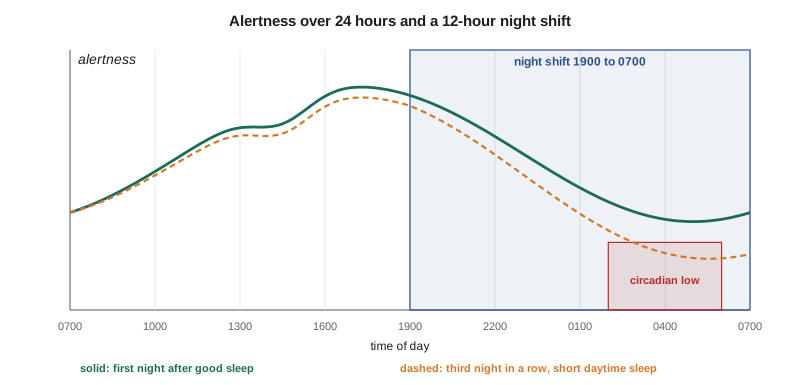
Two things make fatigue worse. Sleep debt builds up over several shifts when daytime sleep is short, which is why the third or fourth night in a row is harder than the first. And time on task matters: the last few hours of a 12-hour shift, especially a night shift, are when errors and injuries cluster. Amira notices it herself: between 0400 and 0600 she double-checks everything and avoids starting any task she would rather do with a second person.
Shifts and schedules in healthcare
Most nurses at Northbridge work 12-hour shifts, either days (0700 to 1900) or nights (1900 to 0700), on a rotation that mixes the two. Many support staff work 8-hour shifts. personal support workers at Maple Court work 7.5 or 8 hours. Overtime is common, especially when someone calls in sick and the unit cannot find a replacement. And some staff, especially part-time personal support workers, work at more than one employer to make up full-time hours.
Twelve-hour shifts are popular because they mean fewer days at work, fewer handovers and longer stretches off. But they also mean long periods awake, and they leave little room for overtime before hours become dangerous. A 4-hour overtime after a 12-hour shift is a 16-hour day.
Research and guidance on shift scheduling point to a few practical rules:
- Rotate forward, from days to evenings to nights, rather than backward, because it is easier for the body to shift later than earlier.
- Limit consecutive night shifts, usually to three or four 12-hour nights.
- Leave at least 11 hours between the end of one shift and the start of the next, and avoid quick returns such as a night shift ending at 0700 followed by a day shift the next morning.
- Give at least two full days off after a block of nights.
- Limit consecutive 12-hour shifts and total weekly hours, including overtime and second jobs.
- Build in breaks, and make sure staff actually take them.
Scoring a schedule
Sarah checks the 4 West schedule for fatigue risks before it is posted. She uses a short script that applies the scheduling rules to each worker's planned shifts, including any overtime already booked.
# Fatigue check on a 4-week schedule. Each day: "D" day 0700-1900, "N" night 1900-0700,
# "D16" day with 4 h overtime (0700-2300), "-" off.
def shifts(pattern):
    out = []
    for day, code in enumerate(pattern):
        if code == "D":   out.append((day * 24 + 7, day * 24 + 19))
        if code == "D16": out.append((day * 24 + 7, day * 24 + 23))
        if code == "N":   out.append((day * 24 + 19, day * 24 + 31))
    return out

def check(name, pattern):
    s = shifts(pattern)
    flags = []
    for (a1, b1), (a2, b2) in zip(s, s[1:]):
        if a2 - b1 < 11:
            flags.append(f"rest of only {a2 - b1} h before day {a2 // 24 + 1}")
    run = best = 0
    for code in pattern:
        run = run + 1 if code == "N" else 0
        best = max(best, run)
    if best > 3:
        flags.append(f"{best} nights in a row")
    for a, b in s:
        if b - a > 13:
            flags.append(f"{b - a} h shift on day {a // 24 + 1}")
    for w in range(4):
        hours = sum(min(b, (w + 1) * 168) - max(a, w * 168) for a, b in s
                    if a < (w + 1) * 168 and b > w * 168)
        if hours > 60:
            flags.append(f"{hours} h in week {w + 1}")
    for i, code in enumerate(pattern[:-2]):
        if code == "N" and pattern[i + 1] == "-" and pattern[i + 2].startswith("D"):
            flags.append(f"nights to days with one day off, day {i + 3}")
    print(f"{name}: {len(flags)} flags")
    for f in flags:
        print("   -", f)

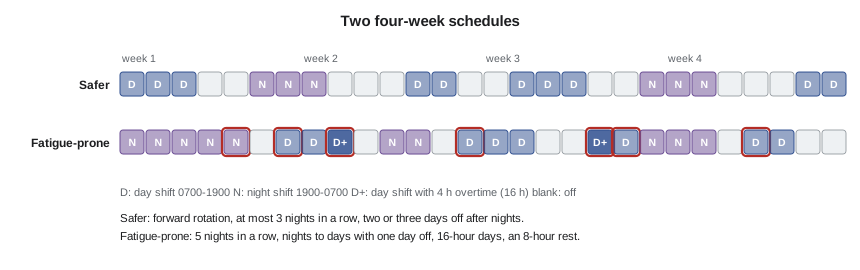
safer = ["D","D","D","-","-","N","N","N","-","-","-","D","D","-",
         "-","D","D","D","-","-","N","N","N","-","-","-","D","D"]
risky = ["N","N","N","N","N","-","D","D","D16","-","N","N","-","D",
         "D","D","-","-","D16","D","N","N","N","-","D","D","-","-"]
check("schedule A", safer)
check("schedule B", risky)schedule A: 0 flags schedule B: 9 flags - rest of only 8 h before day 20 - 5 nights in a row - 16 h shift on day 9 - 16 h shift on day 19 - 72 h in week 1 - 64 h in week 2 - nights to days with one day off, day 7 - nights to days with one day off, day 14 - nights to days with one day off, day 25
Schedule A produces no flags. Schedule B produces several: five nights in a row, three backward switches from nights to days with only one day off, an 8-hour rest after an overtime day, two 16-hour days, and two weeks above 60 hours. None of these is unusual in a short-staffed unit, and each one on its own might be manageable. Together they add up to a worker who will be driving home exhausted several times a month. Sarah uses the check to rebuild schedules before they are posted and to decide which overtime requests to approve.
What the law says about hours
Ontario's Employment Standards Act sets general limits on hours of work: usually no more than 8 hours a day (or the regular working day if longer) and 48 hours a week, at least 11 consecutive hours off each day, at least 8 hours off between shifts, and a 30-minute eating period after no more than 5 hours of work. Employers and workers can agree in writing to work more, and in unionized hospitals the collective agreement often sets the schedule rules in detail. The Act also allows hours to be exceeded in emergencies, to carry out urgent work, and to ensure the continued delivery of essential services, which is why hospitals can keep staff past the end of a shift when no replacement is available. These limits are about employment standards rather than safety, but they are the closest thing to a legal hours limit for most healthcare workers.
Beyond hours law, the general duty in the Occupational Health and Safety Act (OHSA) to take every precaution reasonable in the circumstances applies to fatigue. An employer that knows staff are regularly working 16-hour days and driving home asleep at the wheel has a hazard to deal with like any other.
For supervisors: approving overtime
When the unit is short, it is tempting to ask the person who always says yes. Before you do, ask how many hours they have worked this week, when their last shift ended, whether they work anywhere else, and how they will get home. Keep a simple rule, such as no shift longer than 16 hours and no one working beyond 60 hours in a week, and stick to it even when it means calling in agency staff or closing a bed. A nurse who stays for a second shift as a favour is not doing the patients a favour in the last four hours of it.
What workers can do
Schedules are set by employers, but workers have some control over how fatigued they become. The habits that help most are:
- Protect your sleep. Aim for seven to nine hours in each 24. After a night shift, sleep in a dark, quiet, cool room, with the phone silenced, and tell family and friends when you are sleeping.
- Use an anchor. Keeping a few hours of sleep at the same time every day, whether you are on days or nights, can help the body clock cope with rotation.
- Nap before a first night shift, and on breaks where the hospital allows it. A short nap of 20 to 30 minutes improves alertness without leaving you groggy.
- Use caffeine early in the shift, not in the last few hours, so it does not stop you sleeping afterwards.
- Eat light meals at night and drink water.
- Take your breaks, away from the unit if you can.
- Plan the trip home. If you are too tired to drive safely, nap first, call someone, take a taxi or transit, or share a ride. Northbridge's rest room for staff after long shifts is there for this purpose.
- Be honest about second jobs, and include them when you think about how many hours you are working.
Fatigue in home care
Nadia's fatigue risks are different. Her shifts are usually 8 hours, but much of the day is spent driving between clients, often in bad weather, and visits run late when a client is unwell. The end of a long home care day is a drive home on rural roads in the dark. Northbridge Home Care schedules no more than seven visits a day for nurses, plans routes to cut driving, and tells staff to stop and rest if they feel drowsy at the wheel. HSE-352 Working Alone and Late-Night Safety covers the wider hazards of working alone.
Managing fatigue as a hazard
Some hospitals now manage fatigue the way they manage other hazards: assessing it, setting limits, monitoring hours and investigating incidents where fatigue may have played a part. Northbridge's fatigue policy, written with the joint health and safety committee, includes a maximum of 16 consecutive hours of work, at least 10 hours off after an overtime shift, a schedule check before posting, a quiet room for rest after a long shift, and an option for a worker to say they are too tired to stay without being treated as unreliable. Injury investigations now ask what time the injury happened and how long the worker had been on duty.
Worked problem
Amira and the extra shift
It is 1830 on a Saturday. Amira has worked 0700 to 1900 and is due back at 0700 on Sunday. A night nurse has called in sick and the charge nurse asks whether Amira can stay until 2300 to cover the first part of the night. Amira slept six hours last night and has a 35-minute drive home. What are the fatigue risks, and what are the options?
Show solution
- If she stays until 2300, she will have been awake for about 17 hours when she drives home, and will have about 8 hours between the end of the shift and the start of the next one, which leaves time for perhaps five or six hours of sleep.
- Her Sunday shift would then start with a sleep debt, and its last hours, Sunday evening, would be the riskiest of the weekend.
- Options for the charge nurse: call staff who are off and rested before asking someone already on shift, ask the float pool or an agency, ask another nurse who started later, or split the four hours between two staff.
- If Amira does stay, the unit should move her Sunday start to 1100 or give her the rest room overnight and a lighter assignment on Sunday morning, and she should not drive home if she feels drowsy.
- Amira says no, and the charge nurse calls a casual nurse who is off. Under the unit's fatigue policy, saying no is a legitimate answer, not a black mark.
Answer: Staying would mean about 17 hours awake before driving and a short rest before the next shift; the unit should look for a rested replacement first, and adjust the next shift if she stays.
Common mistakes
MistakeThinking you get used to night shifts after a few years.
InsteadMost people never fully adjust; plan sleep and limit consecutive nights.
MistakeUsing caffeine in the last hours of a night shift.
InsteadUse it early in the shift so it does not stop you sleeping afterwards.
MistakeAsking the same willing person to stay every time.
InsteadCheck hours, rest and the trip home before approving overtime, and keep a hard limit.
MistakeDriving home when you are struggling to stay awake.
InsteadNap, call someone, take a taxi or share a ride.
MistakeIgnoring second jobs when counting hours.
InsteadFatigue comes from total hours awake and working, not just the hours at one employer.
Summary and key terms
- Fatigue slows reactions, causes errors and shortcuts, increases injuries and makes the drive home dangerous.
- About 17 to 19 hours awake affects performance about as much as a blood alcohol level near the driving limit.
- Alertness is lowest between about 0200 and 0600; the last hours of a night shift are the riskiest.
- Safer schedules rotate forward, limit consecutive nights, leave at least 11 hours between shifts and give days off after nights.
- Ontario's Employment Standards Act sets general hour limits, with exceptions for essential services and emergencies.
- Supervisors should check hours, rest and the trip home before approving overtime.
- Workers can protect sleep, nap, time caffeine, take breaks and plan the trip home.
- Fatigue
- A state of reduced mental and physical performance caused by lack of sleep, long hours awake or working against the body clock.
- Circadian rhythm
- The body's roughly 24-hour clock that controls sleepiness and alertness.
- Sleep debt
- The build-up of missed sleep over several days.
- Forward rotation
- A schedule that moves from day to evening to night shifts rather than the reverse.
- Quick return
- A short gap between two shifts, usually less than 11 hours.
Practice problems
Work each problem on paper first, then reveal the answer to check.
Between which hours is alertness usually lowest?
Show answer
Between about 0200 and 0600.
Why is the third or fourth night shift in a row harder than the first?
Show answer
Sleep debt builds up because daytime sleep is shorter and poorer.
Name three rules for safer shift schedules.
Show answer
Any three of: rotate forward, limit consecutive nights, at least 11 hours between shifts, two days off after nights, limit consecutive 12-hour shifts and weekly hours, build in breaks.
What did the schedule check flag in schedule B?
Show answer
Five nights in a row, backward switches from nights to days, a short rest after overtime, 16-hour days and weeks above 60 hours.
What should a supervisor ask before approving overtime?
Show answer
How many hours the worker has done this week, when their last shift ended, whether they work elsewhere and how they will get home.
Give three things a worker can do to reduce fatigue.
Show answer
Any three of: protect sleep in a dark quiet room, keep an anchor sleep, nap before nights or on breaks, use caffeine early, take breaks, plan the trip home.
Lesson quiz · 5 questions
Score 60% or more to complete this lesson.
Create a free account to save your progress, take quizzes and earn a certificate.