
HSE-390 · Lesson 3 of 12 · 22 min
Hazard assessment on a care unit
▶ Video coming soon A video version of this lesson is on the way.
Lessons 1 and 2 described the hazards of healthcare and who is responsible for them. This lesson is about the practical work of finding hazards on a care unit, deciding how serious they are and choosing what to do. HSE-103 Hazard Recognition and Risk Assessment teaches the general method in depth. Here the same method is applied to a place where the hazards move: a patient's condition changes overnight, a visitor brings in a space heater, a new admission arrives with an infection, and the unit that was calm at noon is chaotic by four.
How hazards are found on a unit
Hazards on a care unit come to light in four main ways, and a good unit uses all of them.
- Inspections. A worker member of the joint health and safety committee inspects part of the hospital every month, and many units add their own short walk each week or each shift. Inspections are good at finding fixed hazards: a blocked exit, a cracked floor tile, a full sharps container, a lift with an overdue service sticker.
- Reports from staff. Hazard reports, near-miss reports and injury reports are the richest source, because staff see the unit at every hour. Lesson 11 covers reporting.
- Assessments of tasks. A job hazard analysis breaks a task such as bathing a resident or cleaning an isolation room into steps and looks at the hazards of each. Ergonomic assessments, violence risk assessments and chemical assessments are special kinds of task assessment.
- Assessments at the bedside. Before every interaction with a patient, a trained worker makes a quick judgment about the risks of this patient, this task and this environment, at this moment. In Ontario this is often called a point-of-care risk assessment.
The first three are done by people with time to think. The fourth is done in seconds, many times a shift, by the person about to do the work. It is the one that catches the hazards that appeared in the last hour, and it depends on training, habit and the information on the care plan and the door.
A quick check at the bedside
Amira's habit at the door of every room takes about five seconds. She looks and asks herself:
- The patient: How are they today? Confused, agitated, in pain, drowsy, newly admitted? Is there a flag for violence, falls or infection? Can they help with a move?
- The task: What am I about to do, and does it need a lift, a second person or protective equipment?
- The room: Is the floor dry and clear? Is the bed at the right height with the brakes on? Is the lift charged and the sling the right size? Is there a clear way out?
- Me: Am I rushed, tired or alone? Is help nearby if I need it?
If the answer to any question changes the plan, she changes it: she fetches a second person, puts on a gown, moves the commode out of the way, or waits five minutes for a patient who is agitated to settle. These are small decisions, but they are where most injuries are either prevented or not.
Rating how serious a hazard is
Not every hazard deserves the same response. A full sharps container and a loose handle on a linen cart are both hazards, but one could expose a worker to a bloodborne infection today and the other is an annoyance. A simple way to rank hazards is to rate two things on a scale of 1 to 5 and multiply them.
- Likelihood: how likely is it that someone will be hurt in the next year if nothing changes? 1 means rare, 5 means almost certain.
- Severity: if someone is hurt, how badly? 1 means first aid only, 2 a minor injury with some medical care, 3 lost time from work, 4 a serious or permanent injury, 5 a death or a life-changing injury or infection.
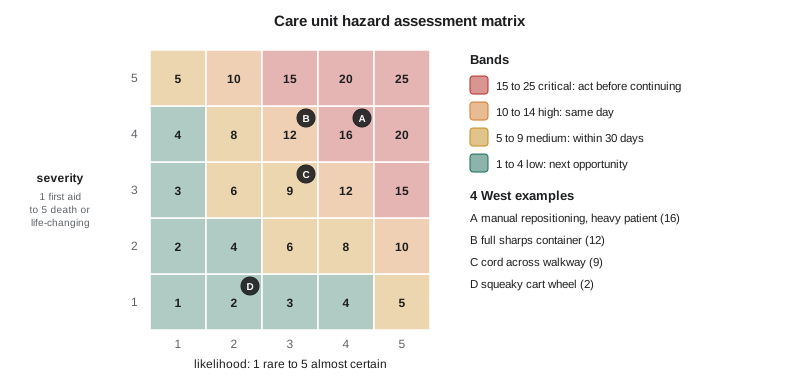
The score tells you how fast to act. Northbridge uses four bands: 15 to 25 is critical and needs action before the task continues; 10 to 14 is high and needs a fix the same day or a temporary control right away; 5 to 9 is medium and goes on a work order or action plan within 30 days; 1 to 4 is low and can be dealt with at the next opportunity. The bands are a guide, not a rule. A hazard that could kill someone gets attention even if it is unlikely.
Sarah and Amira used the matrix after the last monthly inspection of 4 West. Amira keeps the list in a short script so that she can sort it by score and print it for the unit huddle.
# 4 West inspection findings: likelihood (1-5) x severity (1-5)
findings = [
    ("Room 412: ceiling lift out of order, staff repositioning by hand", 4, 4),
    ("Med room: sharps container above fill line", 3, 4),
    ("Room 418: oxygen tubing and bed cord across walkway", 3, 3),
    ("Isolation cart outside 406: no N95 in size small", 3, 4),
    ("Clean utility: boxes stacked above shoulder height", 3, 2),
    ("Med cart: wheel squeaks", 2, 1),
    ("Corridor: hand gel dispenser drips onto floor", 4, 3),
    ("Room 409: patient flagged for violence, no care plan in chart", 4, 4),
]

def band(score):
    if score >= 15: return "CRITICAL - act before continuing"
    if score >= 10: return "HIGH - same day"
    if score >= 5:  return "MEDIUM - within 30 days"
    return "LOW - next opportunity"

scored = sorted(((l * s, l, s, what) for what, l, s in findings), reverse=True)
for score, l, s, what in scored:
    print(f"{score:2} (L{l} x S{s})  {band(score):33} {what}")

counts = {}
for score, *_ in scored:
    counts[band(score).split()[0]] = counts.get(band(score).split()[0], 0) + 1
print("\nby band:", counts)16 (L4 x S4) CRITICAL - act before continuing Room 412: ceiling lift out of order, staff repositioning by hand
16 (L4 x S4) CRITICAL - act before continuing Room 409: patient flagged for violence, no care plan in chart
12 (L4 x S3) HIGH - same day Corridor: hand gel dispenser drips onto floor
12 (L3 x S4) HIGH - same day Med room: sharps container above fill line
12 (L3 x S4) HIGH - same day Isolation cart outside 406: no N95 in size small
9 (L3 x S3) MEDIUM - within 30 days Room 418: oxygen tubing and bed cord across walkway
6 (L3 x S2) MEDIUM - within 30 days Clean utility: boxes stacked above shoulder height
2 (L2 x S1) LOW - next opportunity Med cart: wheel squeaks
by band: {'CRITICAL': 2, 'HIGH': 3, 'MEDIUM': 2, 'LOW': 1}Two items come out as critical: the broken lift, which Lesson 1 already met, and a patient with a violence flag and no care plan. The flag tells staff that something has happened before, but without the plan they do not know what triggers this patient, what has worked and what has not. Sarah calls the charge nurse and the patient's nurse together that afternoon to write it. The full sharps container, the missing N95 size and the dripping gel dispenser are high and are fixed the same day. The squeaky wheel goes on a work order.
Choosing controls
Once a hazard is found and rated, the hierarchy of controls guides what to do about it. HSE-103 explains it in detail. In healthcare it looks like this:
- Elimination removes the hazard. Examples: getting rid of a disinfectant the hospital no longer needs, removing a broken piece of equipment from the unit, stopping the practice of manual lifting altogether.
- Substitution replaces the hazard with something less dangerous. Examples: safety-engineered needles instead of conventional ones, a less irritating disinfectant, latex-free gloves, a lighter bed.
- Engineering controls separate people from the hazard. Examples: ceiling lifts in every room, needleless IV connectors, biological safety cabinets and fume hoods, negative pressure isolation rooms, closed system drug transfer devices, staff alarms, a locked door between the public area and the nursing station, non-slip flooring.
- Administrative controls change the way work is done. Examples: procedures, training, care plans, violence flags, staffing levels, scheduling, signs, inspections and limiting who may do a task.
- Personal protective equipment protects the worker's body. Examples: gloves, gowns, masks, N95 respirators, eye protection, lead aprons, slip-resistant shoes.
Healthcare leans heavily on the bottom two levels, because they are quick and familiar, and on the work of individual staff to make up for what is missing. A unit that has run out of lifts trains staff in body mechanics; a unit with frequent violence puts up signs asking visitors to be respectful. Both help a little. A lift in every room and enough staff to use it help far more. Whenever you are choosing controls, look for one higher up the list and use the lower levels as well, not instead.
Assessing a task: bathing at Maple Court
The tub room on the Birch home area at Maple Court produced four injury reports last year: two back strains, a slip and a scratch from a resident who became frightened in the water. Joanne, Lina and the Birch charge nurse carried out a job hazard analysis of the task, breaking it into steps.
| Step | Hazards | Score before | Controls added | Score after |
|---|---|---|---|---|
| Bring resident to the tub room | Pushing a heavy shower chair; resident anxious about the unfamiliar room | 3 x 2 = 6 | Lighter shower trolley; same staff member every bath day where possible | 2 x 2 = 4 |
| Transfer to the bath lift | Lifting and twisting; resident may resist | 4 x 4 = 16 | Ceiling lift over the tub; two staff for residents who resist; care plan notes on approach | 2 x 3 = 6 |
| Bathing | Bending over the tub; wet floor; resident may hit or grab | 4 x 3 = 12 | Height-adjustable tub; non-slip mat; warm room; explain each step; offer a towel to hold | 2 x 3 = 6 |
| Transfer out and dry | Wet resident is slippery; lifting | 4 x 4 = 16 | Ceiling lift; warm towels ready; bed-height dressing table | 2 x 3 = 6 |
| Clean the tub | Disinfectant splashes; kneeling | 3 x 2 = 6 | Long-handled brush; goggles and gloves; ready-to-use product instead of mixing | 2 x 1 = 2 |
The analysis found that the two transfers carried most of the risk, which is why the biggest change was an engineering control: a ceiling lift track over the tub. It also found that bathing itself was a trigger for one resident's fear, which is not a building problem but a care problem, and the controls for it were in the care plan. Healthcare hazard assessment often works like that. The hazards to workers and the needs of patients are tied together, and the best controls usually improve both.
For supervisors: assessments that change things
A hazard assessment is only as good as what happens afterwards. Before you file one, check that each high or critical item has an owner, a date and a way of knowing it is done. Share the results with the staff who took part, and with the staff on the other shifts who did not. And repeat the assessment when something changes: a new patient population, a new piece of equipment, a renovation, a change in staffing, or an injury that the assessment did not predict.
Worked problem
A new admission to room 409
At 1500 on a Thursday, a patient is admitted to room 409 from the emergency department with pneumonia, a history of alcohol withdrawal and a note that he struck a paramedic during transport. He weighs about 120 kg (265 lb) and needs help to stand. Amira is assigned to him. How should the unit assess and control the hazards before and during his first evening?
Show solution
- Amira reads the emergency department notes and the transfer report and checks the chart for a violence flag. There is none yet, because the incident happened before he reached the hospital. She tells Sarah, who arranges for a flag and a care plan to be started.
- The likely hazards are violence (likelihood 4, severity 4: score 16, critical), patient handling (likelihood 4, severity 3: score 12, high) and respiratory infection (likelihood 3, severity 3: score 9, medium, controlled by droplet precautions while the cause is confirmed).
- Critical hazards need controls before care continues. The team agrees that two staff will enter together for care, that staff will carry their personal alarms, that the room will be kept clear of objects that could be thrown, and that the security team will be told. The physician reviews his withdrawal treatment.
- For handling, the patient is assessed with the unit's mobility tool and a ceiling lift with a large sling is used for transfers. A sit-to-stand aid is not used until his strength and cooperation have been assessed.
- Amira does her bedside check at every entry, because the hazards will change as his withdrawal progresses. The plan is reviewed at the 1900 shift change.
Answer: Identify violence, handling and infection hazards, rate them, put critical controls in place before care continues, and reassess at every entry and every shift change.
Common mistakes
MistakeTreating a hazard assessment as a one-time form.
InsteadReassess whenever something changes, and at every patient interaction in a quick form.
MistakeRelying on training and signs when a better control is possible.
InsteadLook for elimination, substitution and engineering controls first; use procedures and PPE as well, not instead.
MistakeFlagging a patient for violence without a care plan.
InsteadA flag says there is a risk; the care plan tells staff what to do about it.
MistakeRating every hazard the same way.
InsteadUse likelihood times severity to decide what to fix first and how fast.
MistakeKeeping assessment results in the manager's office.
InsteadShare them with every shift, and give each action an owner and a date.
Summary and key terms
- Hazards on a care unit are found by inspections, staff reports, task assessments and a quick check at the bedside.
- The bedside check looks at the patient, the task, the room and the worker, every time.
- Rating likelihood and severity from 1 to 5 and multiplying gives a score and a response time.
- The hierarchy of controls runs from elimination and substitution through engineering and administrative controls to PPE.
- Healthcare leans heavily on procedures, training and PPE; engineering controls such as lifts are more reliable.
- Task assessments often show that hazards to workers and the needs of patients are tied together.
- Assessments must lead to actions with owners and dates, and must be repeated when things change.
- Point-of-care risk assessment
- A quick assessment of the risks of a specific patient, task and environment made by a worker before each interaction.
- Job hazard analysis
- A method of breaking a task into steps and identifying the hazards and controls for each step.
- Risk score
- Likelihood times severity, each rated from 1 to 5.
- Hierarchy of controls
- The ranking of controls from most effective (elimination) to least effective (personal protective equipment).
- Engineering control
- A change to equipment or the workplace that separates people from a hazard.
Practice problems
Work each problem on paper first, then reveal the answer to check.
Name the four ways hazards are found on a care unit.
Show answer
Inspections, staff reports, task assessments and the quick check at the bedside.
What four things does the bedside check look at?
Show answer
The patient, the task, the room and the worker.
A hazard has likelihood 3 and severity 5. What is its score and band?
Show answer
15, which is critical.
Give an engineering control for patient handling and one for violence.
Show answer
Ceiling lifts for handling; staff alarms, a locked door at the nursing station or a room cleared of throwable objects for violence.
Why did the tub room assessment add a ceiling lift?
Show answer
The two transfers carried most of the risk, and an engineering control removes the manual lifting.
When should a task assessment be repeated?
Show answer
When something changes: new patients, equipment, renovations, staffing or an injury the assessment did not predict.
Lesson quiz · 5 questions
Score 60% or more to complete this lesson.
Create a free account to save your progress, take quizzes and earn a certificate.