
HSE-390 · Lesson 2 of 12 · 22 min
Law, standards and responsibilities in healthcare
▶ Video coming soon A video version of this lesson is on the way.
Lesson 1 showed how often healthcare workers are hurt. This lesson is about who is responsible for preventing it and what the law requires. HSE-101 covered the general rights and duties that apply in every workplace, so this lesson concentrates on what is different in healthcare: the healthcare-specific rules, the limits on refusing unsafe work when patients depend on you, the accreditation standards that hospitals must meet, and the way the duties of a hospital, a unit manager and a frontline worker fit together.
The law that applies in Ontario
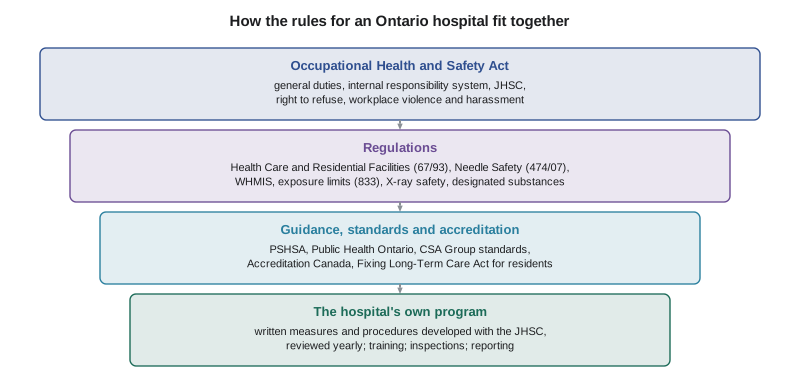
Healthcare workplaces in Ontario are covered by the Occupational Health and Safety Act (OHSA) like any other workplace. Northbridge Community Hospital, Maple Court and Northbridge Home Care are all covered, and so is every worker in them, from the chief executive to a student on placement who is paid. The Act sets out the general duties of employers, supervisors and workers, the internal responsibility system, the joint health and safety committee, the right to refuse unsafe work and the powers of inspectors.
Under the Act sit regulations. The one written specifically for healthcare is Ontario Regulation 67/93, Health Care and Residential Facilities. It applies to hospitals, long-term care homes, psychiatric facilities, laboratories, ambulance services and other health care and residential facilities. Other regulations apply as well, including the WHMIS regulation, the occupational exposure limits in Regulation 833, the designated substances regulation, the X-ray safety regulation, and the Needle Safety regulation (Regulation 474/07), which requires safety-engineered needles in hospitals and many other healthcare settings.
What Regulation 67/93 requires
The heart of Regulation 67/93 is a simple idea. The employer must develop, establish and put into effect written measures and procedures for the health and safety of workers, in consultation with the joint health and safety committee or health and safety representative. The measures and procedures must deal with the hazards of the particular workplace, including safe work practices, safe working conditions, hygiene, the control of infections, immunization, the use of disinfectants and the handling of soiled linen, sharp objects and waste. They must be reviewed and revised at least once a year, and the employer must train workers in the measures and procedures that are relevant to their work, again in consultation with the committee.
The regulation then adds specific requirements, such as the duty to provide and train workers in personal protective equipment (section 10), rules for confined spaces, and requirements for antineoplastic (anti-cancer) drugs (section 97). In practice, an inspector visiting Northbridge will ask to see the written measures and procedures for each hazard, evidence that the joint health and safety committee was consulted, the date of the last annual review and training records.
Ontario's the Occupational Health and Safety Act (OHSA) also has a part on workplace violence and harassment, added in 2010, that matters greatly in healthcare. Every employer must have a workplace violence policy and program, assess the risk of violence and reassess it as often as necessary, and provide workers with information, including personal information, about a person with a history of violent behaviour if the worker can be expected to meet that person in their work and the history creates a risk of physical injury. That last rule is the legal basis for the flagging of patients with a history of violence, covered in HSE-393.
The internal responsibility system
Ontario's law is built on the internal responsibility system: everyone in the workplace has a duty for safety in proportion to their authority and ability, and problems are solved first inside the workplace rather than by an inspector. In a hospital, the parts fit together like this:
| Who | Main duties | At Northbridge |
|---|---|---|
| Employer (the hospital) | Take every precaution reasonable in the circumstances; provide equipment, information, instruction and supervision; written measures and procedures; violence program; appoint competent supervisors | Board of directors and senior leadership; Joanne's Occupational Health and Safety office runs the program |
| Supervisor | Know the hazards and tell workers about them; make sure workers follow procedures and use equipment; take every reasonable precaution | Unit managers such as Sarah, charge nurses, department leads |
| Worker | Work safely; use the equipment and protective gear provided; report hazards, contraventions and injuries; do not remove safety devices | Amira, Lina, Kevin, Marta, Daniel, Priya, Nadia |
| JHSC | Inspect monthly; identify hazards; make written recommendations; be consulted on measures, procedures and training; take part in work refusals and investigations | Tom (worker co-chair), Amira and 12 other members |
| the Ministry of Labour | Inspect, investigate, order, prosecute | Visits after complaints, critical injuries and as part of healthcare inspection campaigns |
A joint health and safety committee is required in Ontario at any workplace that regularly employs 20 or more workers, and at least two of its members, one representing workers and one representing management, must be certified. At Northbridge the committee has 14 members. A worker member inspects part of the workplace every month so that the whole hospital is inspected at least once a year. When the committee makes a written recommendation, the employer must respond in writing within 21 days, either with a plan and timetable or with reasons for not accepting it.
Refusing unsafe work when patients depend on you
The right to refuse unsafe work applies to healthcare workers, but with an important limit. For people employed in hospitals, long-term care homes, psychiatric institutions, rehabilitation facilities, laboratories and ambulance services, among others, the right does not apply when the danger is inherent in the work or a normal condition of employment, or when the refusal would directly endanger the life, health or safety of another person. A nurse cannot walk away from a patient in the middle of a resuscitation because the patient might have an infection, and a personal support worker cannot refuse to help a resident who has fallen.
This limit is narrower than it sounds. It does not mean that anything goes in healthcare. A danger is not inherent in the work just because it is common: a broken lift, a missing sharps container, an untested N95 respirator or a patient known to be violent with no plan in place are hazards that should not be there. Workers in these situations can still raise the concern, ask for help, refuse once the patient is safe, and call the Ministry of Labour. And the employer's duty to take every precaution reasonable in the circumstances is not reduced at all.
For supervisors: when a worker says no
When a nurse or a personal support worker tells you a task is unsafe, the useful question is not whether they have the legal right to refuse. It is what has made them unsafe and how quickly you can fix it. Get the patient safe first, together. Then look at the hazard with the worker and, if the concern is not resolved, bring in a worker member of the JHSC and Joanne. Write down what happened. A manager who argues about the law in the moment teaches the whole unit not to raise concerns, and the next one may not be raised until somebody is hurt.
Accreditation and guidance
Most Canadian hospitals and many long-term care homes are accredited by Accreditation Canada, whose standards include worker safety, workplace violence prevention, infection prevention and control and medical device reprocessing. Accreditation is not law, but surveyors look closely at whether a hospital's safety program actually works. Much of the practical guidance used in Ontario comes from the Public Services Health and Safety Association (PSHSA), the province's health and safety association for the sector, from Public Health Ontario on infection control, and from CSA Group standards on topics such as ventilation in healthcare facilities and psychological health and safety. Long-term care homes are also covered by the Fixing Long-Term Care Act, 2021, which deals mainly with residents' care but affects staffing, training and the handling of residents' responsive behaviours.
None of these sources replace each other. The law sets the minimum. Accreditation checks whether the hospital is managing safety well. Guidance shows how. And the hospital's own program is where all of it turns into what happens on 4 West at three in the morning.
Workers' compensation
Almost all healthcare employers in Ontario are covered by the Workplace Safety and Insurance Board (WSIB). A worker hurt at work is entitled to health care benefits and, if they lose time, wage replacement, whether or not anyone was at fault. In return, the worker cannot sue the employer. The employer must report the injury to the WSIB, and Lesson 11 covers how and when.
Worked problem
A recommendation about the ceiling lift
After the nine-day ceiling lift outage in room 412 described in Lesson 1, the joint health and safety committee sends a written recommendation to the hospital's vice-president of operations: every ceiling lift outage longer than 24 hours must trigger a portable lift being placed on the unit, and the Occupational Health and Safety office must be notified automatically. What must the hospital do, and what should the committee do next?
Show solution
- Under the Occupational Health and Safety Act (OHSA), the employer must respond in writing within 21 days. The response must either accept the recommendation with a timetable for putting it in place, or explain why it does not accept it.
- The vice-president meets Tom and Joanne. The hospital accepts the recommendation and adds a change to the maintenance work order system so that any lift work order flags the Occupational Health and Safety office. It gives a date six weeks away.
- The hospital also updates the written measures and procedures for patient handling under Regulation 67/93, which it develops in consultation with the committee, to include the new rule.
- The committee records the response in its minutes and checks at the six-week mark that the work order change is live. A worker member tests it by asking maintenance to log a dummy work order.
Answer: Respond in writing within 21 days with a plan or reasons, update the written measures and procedures with the committee, and let the committee verify the change.
What the law looks like on a unit
Most frontline staff will never read the Act or the regulations, and they do not need to. What they need is to recognize the places where the law shows up in their day, so they know what to expect and what to ask for when it is missing. On 4 West, those places are easy to list:
- The written procedures for lifts, sharps, isolation, spills and violence, in a binder at the nursing station and on the intranet, each with a review date less than a year old.
- The joint health and safety committee board by the staff room, with the names and photos of the members, the minutes of the last meeting and the date of the last inspection.
- The workplace violence policy, and the flag on the chart and the door of any patient with a history of violent behaviour, with the care plan that goes with it.
- Training records: lift training, N95 fit testing, WHMIS, violence prevention and the unit orientation, each with a date.
- The safety-engineered needles in every supply cart, which the Needle Safety regulation requires.
- The injury and incident reporting form, and a manager who signs off reports within a day or two.
If any of these is missing or out of date, that is worth raising with the unit manager or a committee member. None of it needs a lawyer to understand. A procedure that is five years old, a committee board with last year's minutes or a lift training record that ends in 2022 are all signs that the system is not working as the law intends.
Common mistakes
MistakeBelieving healthcare workers have no right to refuse unsafe work.
InsteadThe right is limited when the danger is inherent or a refusal would endanger a patient, but it still exists, and the employer's duties are not reduced.
MistakeTreating accreditation as the same thing as the law.
InsteadThe law sets the minimum; accreditation checks how well safety is managed.
MistakeWriting procedures without the committee.
InsteadRegulation 67/93 requires measures, procedures and training to be developed in consultation with the joint health and safety committee.
MistakeAssuming a common danger is an inherent one.
InsteadA broken lift or a missing violence plan is a hazard that should not be there, however common it is.
MistakeLeaving safety to the Occupational Health and Safety office.
InsteadEvery supervisor and worker has duties; the office supports them.
Summary and key terms
- Ontario healthcare workplaces are covered by the OHSA and by Regulation 67/93, Health Care and Residential Facilities, plus other regulations such as Needle Safety and WHMIS.
- Regulation 67/93 requires written measures and procedures, developed with the JHSC, reviewed at least once a year, with training.
- Employers must assess the risk of violence and tell workers about people with a history of violent behaviour they may meet.
- The right to refuse is limited in healthcare when a refusal would endanger a patient, but hazards that should not be there can still be raised and fixed.
- Accreditation Canada, PSHSA, Public Health Ontario and CSA standards add guidance and checks on top of the law.
- Responsibility is shared: the hospital, supervisors, workers and the committee each have a part.
- Internal responsibility system
- The principle that everyone in a workplace shares responsibility for safety in proportion to their authority and ability.
- Measures and procedures
- The written safety rules a healthcare employer must develop with the JHSC under Regulation 67/93.
- General Duty Clause
- Section 5(a)(1) of the OSH Act, requiring employers to keep the workplace free of recognized serious hazards.
- Accreditation
- An independent review of whether a healthcare organization meets a set of quality and safety standards.
- Competent supervisor
- A supervisor who knows the work, the hazards and the law well enough to direct work safely.
Practice problems
Work each problem on paper first, then reveal the answer to check.
What does Regulation 67/93 require an employer to do with its measures and procedures?
Show answer
Develop them in writing with the JHSC, put them into effect, review them at least once a year and train workers in them.
When is the right to refuse limited for hospital workers?
Show answer
When the danger is inherent in the work or a normal condition of employment, or when the refusal would directly endanger another person.
What information about violent patients must an Ontario employer give workers?
Show answer
Information, including personal information, about a person with a history of violent behaviour whom the worker can be expected to meet, if the history creates a risk of physical injury.
Name two sources of guidance or standards beyond the law.
Show answer
Any two of: Accreditation Canada, PSHSA, Public Health Ontario, CSA Group standards.
Why is a broken lift not an inherent danger of healthcare work?
Show answer
It is a hazard that should not be there and can be fixed; it is not part of the nature of the work.
What should a supervisor do first when a worker says a task is unsafe?
Show answer
Make the patient safe together, then look at the hazard with the worker and fix it, bringing in the committee and the safety office if needed.
Lesson quiz · 5 questions
Score 60% or more to complete this lesson.
Create a free account to save your progress, take quizzes and earn a certificate.