
HSE-390 · Lesson 1 of 12 · 25 min
Why healthcare work is hazardous
▶ Video coming soon A video version of this lesson is on the way.
Hospitals and care homes exist to make people well, so it can be a surprise to learn that they are among the most dangerous places to work. Nurses, personal support workers, porters, housekeepers, lab staff and the many others who keep a hospital running are hurt at work more often than people in construction or manufacturing. Most of these injuries are not dramatic. They are back and shoulder strains from moving patients, bites and punches from confused or distressed patients, falls on wet floors, needlesticks, splashes of disinfectant, and the slow damage of years of night shifts and long hours. This course is about those hazards and about the rules, habits and systems that keep healthcare workers safe.
This first lesson sets the scene. It introduces the hospital and the people who appear throughout the course and in the five healthcare courses that follow it, explains why healthcare work is hazardous, sorts the hazards into groups, and looks at what the injury numbers show. It assumes you have taken HSE-101 Workplace Safety Orientation, so it does not repeat the basics of rights, duties and reporting. It builds on them for a healthcare setting.
Meet Northbridge Community Hospital
The course follows Northbridge Community Hospital, an invented hospital in Northbridge, Ontario, a city of about 68,000 people with farm country and small towns around it. The hospital has three parts that work very differently:
- The acute hospital has 214 beds: an emergency department with 26 stretchers and about 38,000 visits a year, a 10-bed intensive care unit, medical and surgical units, a 16-bed inpatient mental health unit, a birthing unit, six operating rooms, diagnostic imaging, a core laboratory, a pharmacy, an in-house laundry, food services, medical device reprocessing and a maintenance shop.
- Maple Court is the hospital's 96-bed long-term care wing, licensed as a long-term care home and connected to the main building by a corridor. Its residents live in four home areas of 24, named Birch, Cedar, Oak and Willow. Many residents live with dementia.
- Northbridge Home Care is a team of 42 nurses, personal support workers and therapists who visit about 310 clients in their homes across the city and the rural area around it.
About 1,480 people work for the hospital, which is about 1,260 full-time equivalents. Together they worked about 2.52 million hours last year. Most of them are not clinical staff in the narrow sense: for every nurse there are personal support workers, clerks, cooks, housekeepers, porters, technicians, trades workers and managers, and every one of them faces hazards that are particular to healthcare.
The people in this course
You will meet these people in every lesson, and again in HSE-391 to HSE-395:
- Amira Haddad, a registered nurse with eleven years on 4 West, a 32-bed medical unit. She works a rotation of 12-hour days and nights and is a worker member of the JHSC.
- Lina Santos, a personal support worker on the Birch home area at Maple Court, where she helps residents with bathing, dressing, eating and moving.
- Kevin Tran, a porter who moves patients on stretchers and in wheelchairs, as well as specimens, equipment and supplies, all over the building.
- Marta Kowalski, an environmental services worker who cleans 4 West and the emergency department and takes shifts in the laundry.
- Daniel Okafor, a medical laboratory technologist in the core laboratory, who also covers early-morning blood collection on the units.
- Priya Shah, a pharmacy technician who prepares sterile and hazardous medications in the pharmacy's clean rooms.
- Sarah MacLeod, the unit manager of 4 West, responsible for about 70 staff across all shifts.
- Tom Bergstrom, a maintenance electrician and the worker co-chair of the JHSC.
- Joanne Pelletier, the hospital's occupational health and safety manager, who runs the Occupational Health and Safety office, tracks injuries and advises managers.
- Nadia Rahman, a registered nurse with Northbridge Home Care, who drives about 180 kilometres a week to see clients.
Only Joanne is a safety specialist. Everyone else does safety work as part of a job that is mainly about something else, and this course is written for them.
Why healthcare is different
Many hazards in a hospital are found in other workplaces too: wet floors, chemicals, heavy loads, machines and night work. What makes healthcare different is the way they combine, and a few features that shape the rest of the course.
- The work is done on people. Patients and residents are heavy, unpredictable and often unable to help. They cannot be put down, stacked or left halfway through a move, and their weight is not spread evenly the way a box's is.
- Patients and residents may be ill, in pain, frightened, confused or intoxicated. Some will hit, kick, bite or grab, usually without intending to hurt anyone. Violence from patients is a common cause of lost-time injury in healthcare, and much of it is never reported.
- Workers are exposed to infection as part of the job: blood and body fluids, respiratory infections, contaminated sharps and surfaces.
- The care never stops. Hospitals and care homes run 24 hours a day, every day, so shift work, nights, long shifts and overtime are normal, and fatigue is a hazard in its own right.
- There is a strong culture of putting the patient first. That is the right instinct, but it leads workers to lift a falling patient alone, skip a step to save time, stay late without a break, or decide that being hit is part of the job.
- The workplace is crowded and changes from minute to minute. A patient room can hold a bed, a lift, an IV pole, a commode, a visitor and three staff, with cords on the floor and fluids on the bed.
- Healthcare workers often work alone: a personal support worker in a resident's room at night, a home care nurse in a client's home, a porter in a basement corridor.
For supervisors: the patient-first trap
If you manage a unit, you will rarely see staff take risks for their own convenience. You will see them take risks for patients. The answer is not to tell them to care less, but to make the safe way the fast way: lifts that are charged and close by, enough staff at the times when patients are moved, a clear rule that nobody catches a falling patient, and a reaction to reports that makes people glad they filed one. A unit's safety culture is mostly decided by what its manager does when the unit is busy.
The main groups of hazards
It helps to sort healthcare hazards into groups. Every lesson in this course deals with at least one of them, and the five courses that follow take the biggest ones in depth.
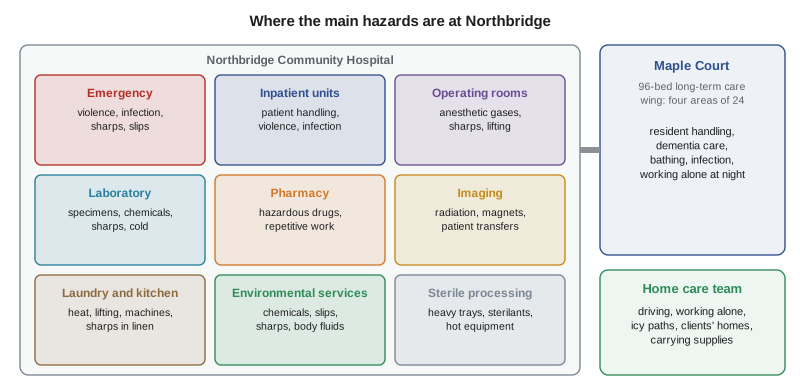
- Patient and resident handling: lifting, transferring and repositioning people, the largest single cause of musculoskeletal injury in healthcare. HSE-391 covers it in depth.
- Workplace violence: physical assault, threats, verbal abuse and harassment, mostly from patients, residents and visitors. HSE-393 covers it.
- Biological hazards: infections spread by blood, contact, droplets and the air. Lesson 5 introduces them; HSE-245 and HSE-392 go further.
- Chemical hazards: disinfectants, sterilants, hazardous drugs, anesthetic gases, laboratory chemicals and more. Lesson 6 introduces them; HSE-394 goes further.
- Physical hazards: slips, trips and falls, sharp objects, heat in kitchens and laundries, noise, electricity, machines and radiation.
- Ergonomic hazards outside patient care: pushing beds and carts, cleaning, laundry, lab and computer work, and the repetitive work of support departments.
- Psychosocial hazards: fatigue, shift work, heavy workload, moral distress, grief and burnout, and harassment from colleagues.
- Emergencies: fires, floods, power failures, outbreaks and mass casualty events, where staff must keep caring for people who cannot leave on their own. HSE-395 covers them.
Real incidents usually involve several groups at once. When a resident with dementia grabs Lina's arm during a transfer and she twists to keep him from falling, that is patient handling, violence and a fall hazard in the same two seconds. Good controls deal with all three: a mechanical lift, two staff, a care plan that tells staff how this resident responds to touch, and a clear rule about not catching a falling person.
What the numbers show
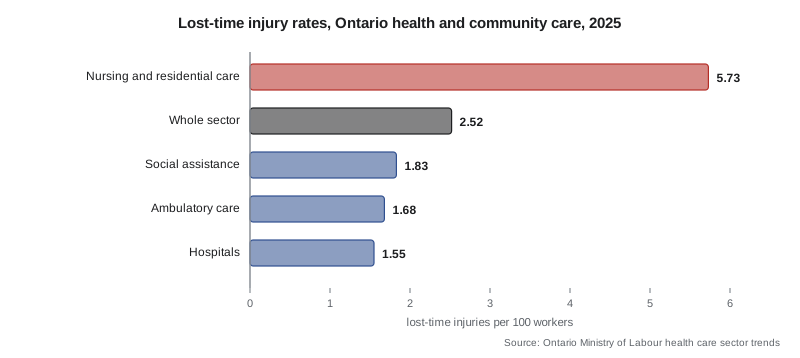
Ontario's Ministry of Labour publishes injury trends for the health and community care sector, which employed about 1,041,400 people in 2025. That year the sector had 15,953 lost-time injuries, a rate of about 2.52 for every 100 workers. Leaving aside exposure claims, the largest causes were musculoskeletal disorders not related to client handling (2,313), falls (2,136), musculoskeletal injuries from client handling (2,044) and workplace violence (1,963). Violence claims were more than one and a half times their 2021 level. Rates varied widely by type of workplace: nursing and residential care had about 5.73 lost-time injuries per 100 workers, far above ambulatory care (about 1.68) and hospitals (about 1.55).
Across Canada, the Association of Workers' Compensation Boards of Canada counted 274,022 accepted lost-time claims in 2023, and health care and social assistance accounts for more of them than any other industry group in recent years. Long-term care stands out in almost every province.
These figures count only injuries that reached a compensation claim or an injury log. They miss the bruise from a resident's kick that nobody wrote down, the strained back that was treated with a weekend's rest, and the needlestick that was not reported because the worker was busy and the patient seemed low risk. Healthcare workers under-report more than most, and Lesson 11 looks at why.
Northbridge's own numbers
Joanne keeps a summary of every injury and exposure report filed at Northbridge. Last year the Occupational Health and Safety office received 241 reports, and 38 near-miss reports. The table shows how they broke down.
| Cause | Reports | WSIB claims | Lost-time claims |
|---|---|---|---|
| Patient and resident handling | 52 | 15 | 10 |
| Violence and aggression | 47 | 12 | 7 |
| Slips, trips and falls | 39 | 10 | 6 |
| Other lifting, pushing and repetitive work | 31 | 8 | 4 |
| Sharps injuries and splashes | 28 | 19 | 0 |
| Struck by or against objects | 17 | 3 | 2 |
| Chemical exposure | 11 | 2 | 1 |
| Infection exposure | 9 | 1 | 0 |
| Other | 7 | 2 | 1 |
| Total | 241 | 72 | 31 |
Three things stand out. Patient handling, violence and slips together account for more than half of all reports and three-quarters of lost-time claims, so a hospital that controls those three has dealt with most of its problem. Sharps injuries produce many claims but almost no lost time, because the worker needs testing and follow-up, not time off; the harm is the anxiety of waiting for results and the small chance of infection. And the 38 near-miss reports are far too few for a hospital this size. Joanne would expect many times that number if people reported everything they saw.
Measuring injury rates
Comparing one hospital's injury count with another's is meaningless unless you allow for size. The standard way is a rate: the number of cases for every 100 full-time workers in a year. Because a full-time worker works about 2,000 hours a year, 100 full-time workers work about 200,000 hours, so the rate is the number of cases times 200,000, divided by the hours actually worked. Joanne uses a short script to calculate Northbridge's rates and compare them with the published figures.
# Injury rates for Northbridge Community Hospital, last year.
hours_worked = 2_520_000      # all staff, all shifts
cases = {"all claims or recordable cases": 72, "lost-time or days-away cases": 31}
benchmarks = {"Ontario health care LTI rate, 2025": 2.52,
              "BLS hospitals injury rate, 2024": 4.7,
              "BLS nursing and residential care, 2024": 4.6}

for name, n in cases.items():
    rate = n * 200_000 / hours_worked
    print(f"{name:32} {n:3}  rate per 100 FTE = {rate:.2f}")

print()
for name, value in benchmarks.items():
    print(f"benchmark: {name:40} {value:.2f}")

# What would it take to reach a lost-time rate of 1.5?
target = 1.5
allowed = target * hours_worked / 200_000
print(f"\nLost-time cases allowed at a rate of {target}: {allowed:.0f} (now 31)")all claims or recordable cases 72 rate per 100 FTE = 5.71 lost-time or days-away cases 31 rate per 100 FTE = 2.46 benchmark: Ontario health care LTI rate, 2025 2.52 benchmark: BLS hospitals injury rate, 2024 4.70 benchmark: BLS nursing and residential care, 2024 4.60 Lost-time cases allowed at a rate of 1.5: 19 (now 31)
Northbridge's lost-time rate of about 2.46 is close to the Ontario sector average of 2.52, which sounds reassuring until you remember that the average includes many workplaces with very low rates. For a hospital with a long-term care wing, the comparison is not with an office but with the safest hospitals in its peer group. Getting to 1.5 would mean about 12 fewer lost-time injuries a year, which is roughly the number caused by patient handling and violence on two units.
Rates are useful for trends and comparisons, but they are slow. A unit with 70 staff might have two or three lost-time injuries a year, so one bad month can double its rate and one lucky year can halve it. That is why the rest of this course puts so much weight on leading indicators: inspections done, hazards fixed, training completed, lifts used, near misses reported.
Worked problem
A bad week on 4 West
In one week on 4 West, a patient with delirium scratches Amira's forearm, Kevin strains his shoulder pushing a bariatric bed whose brake was partly on, Marta slips on a puddle of hand sanitizer gel near a dispenser, and a personal support worker from the float pool reports that the ceiling lift in room 412 has been out of order for nine days. Sort the events into hazard groups and decide which one Sarah should treat as most urgent.
Show solution
- The scratch is workplace violence, and possibly a biological hazard if the skin was broken. Kevin's strain is an ergonomic hazard outside patient care. Marta's slip is a physical hazard. The broken lift is a patient handling hazard and a failure of an engineering control.
- The three injuries have happened and must be reported, treated and investigated. The broken lift has not hurt anyone yet, but every day it stays broken, staff in room 412 either use a portable lift from down the hall, which takes time they often do not have, or lift the patient by hand.
- The lift is the most urgent because it is a hazard that is still present and affects every transfer in that room, several times a day. Sarah escalates the repair, arranges for a portable lift to be parked outside the room until it is fixed, and asks Joanne why a nine-day outage did not trigger an alert.
- The bed brake and the leaking sanitizer dispenser go on work orders the same day. The delirium is added to the patient's care plan so staff know to approach from the front and explain each step.
Answer: Violence, ergonomic, physical and patient handling hazards. The broken ceiling lift is most urgent because the hazard is ongoing; the others need reports, repairs and care-plan changes.
Common mistakes
MistakeThinking hospitals are safe workplaces because they are full of medical help.
InsteadHealthcare has some of the highest injury rates of any sector; medical help nearby does not prevent injury.
MistakeTreating being hit, scratched or grabbed by a patient as part of the job.
InsteadViolence from patients is a hazard to be assessed and controlled, and every incident should be reported.
MistakeComparing injury counts between units of different sizes.
InsteadUse rates per 100 full-time workers, and look at trends over several years.
MistakeSeeing only clinical staff as at risk.
InsteadPorters, housekeepers, laundry, kitchen, lab, pharmacy and maintenance staff face serious healthcare hazards too.
MistakeWaiting for an injury before acting on a broken lift or a leaking dispenser.
InsteadFix hazards that are still present first; they will keep producing injuries until they are gone.
Summary and key terms
- Healthcare workers are injured more often than workers in most other sectors, mainly by patient handling, violence and slips.
- Healthcare is different because the work is done on people, care never stops, infection is part of the job and the patient-first culture leads workers to accept risks.
- Hazards can be grouped as patient handling, violence, biological, chemical, physical, ergonomic, psychosocial and emergencies.
- Long-term care has particularly high injury rates.
- Injury rates allow fair comparisons: cases times 200,000 divided by hours worked.
- Injury figures undercount, especially for violence, minor strains and sharps injuries.
- Hazards that are still present, such as a broken lift, should be fixed before the reports of injuries that have already happened are filed away.
- Hazard
- Anything that could cause injury or illness.
- Lost-time injury
- A work injury that keeps the worker off work beyond the day it happened.
- Injury rate
- The number of cases for every 100 full-time workers in a year: cases times 200,000 divided by hours worked.
- Near miss
- An event that could have caused an injury but did not.
- Leading indicator
- A measure of safety activity, such as inspections or hazards fixed, that changes before injuries do.
- Musculoskeletal disorder
- An injury to muscles, tendons, ligaments, joints or nerves, often from lifting, pushing or repetitive work.
Practice problems
Work each problem on paper first, then reveal the answer to check.
Name three features that make healthcare different from most other workplaces.
Show answer
Any three of: the work is done on people, patients may be violent without intending harm, infection is part of the job, care never stops, the patient-first culture, crowded and changing workspaces, frequent working alone.
Which three causes produce most lost-time injuries at Northbridge?
Show answer
Patient and resident handling, violence and aggression, and slips, trips and falls.
A unit had 4 lost-time injuries in 140,000 hours worked. What is its rate?
Show answer
4 times 200,000 divided by 140,000, which is about 5.7 per 100 full-time workers.
Why do sharps injuries produce many claims or recordable cases but little lost time?
Show answer
The worker needs testing and follow-up but can usually keep working; the harm is anxiety and the chance of infection.
Why is a low number of near-miss reports a bad sign?
Show answer
Near misses are far more common than injuries, so few reports means people are not reporting what they see.
Which part of the healthcare sector has the highest injury rates?
Show answer
Long-term care, or nursing and residential care.
Lesson quiz · 5 questions
Score 60% or more to complete this lesson.
Create a free account to save your progress, take quizzes and earn a certificate.