
HSE-380 · Lesson 6 of 12 · 16 min
Wet and greasy floors
▶ Video coming soon A video version of this lesson is on the way.
Restaurant floors are wet and greasy by nature. Water splashes from the dish pit and the prep sinks, ice melts under the ice machine, oil drifts from the fryers as an invisible film, and food drops everywhere during the rush. People walk fast on these floors carrying hot pans, knives and racks of glassware. Slips and falls are one of the leading causes of serious injury in food service, and a fall while carrying something hot or sharp can turn a bruise into a burn or a deep cut. Kofi's broken wrist was Juniper Street's most serious injury of the year. HSE-106 covers slips, trips and falls in general; this lesson applies those ideas to the kitchen, the bar and the patio.
Why kitchen floors are slippery
A slip happens when the friction between the shoe and the floor is too low for the way a person is walking. Anything that comes between the sole and the floor lowers that friction. In a kitchen the main culprits are:
- Water from dish machines, sprayers, sinks, mopping and melted ice.
- Grease and oil. Cooking vapour carries a fine film of grease that settles on the floor around the hot line, and drips from fryers, oil changes and grease bins add more.
- Food: lettuce leaves, onion skins, fries, sauces and batters, which are often worse than water because they roll or smear.
- Soap film left behind when floors are mopped with too much detergent and not rinsed.
- Worn floors and mats. Quarry tile and sealed concrete lose their texture over years of scrubbing, and rubber mats wear smooth.
- Changes in surface, such as going from a dry dining room floor to a wet kitchen tile, or from a dry tile to a polished floor.
Trips are the other half of the problem: mat edges that curl, hoses across walkways, cases left on the floor during a delivery, a missing drain cover, a step down into the walk-in. Many falls in restaurants are a mixture of the two, such as tripping on a curled mat edge into a puddle.
Kofi's fall
Kofi slipped in the dish pit late on a busy Friday while carrying a rack of clean glasses to the bar. The investigation found four things. The rubber mat in front of the dish machine was worn smooth and no longer drained. The floor drain under the pre-rinse sink was half blocked with food scraps, so water pooled around it. A film of grease had built up because the dish pit floor was mopped only at closing. And Kofi was walking fast because the bar had run out of glasses. Each of those causes had a fix, and none of them was telling Kofi to be careful.
- The dish pit mats were replaced with new drainage mats with raised, open-grid surfaces and bevelled edges, and a schedule was set to lift, wash and check them daily.
- The drain basket was added to the closing checklist, and a strainer was fitted to the pre-rinse sink.
- The dish pit floor is now squeegeed to the drain after each rush, with a full degrease at closing.
- The bar got a second set of glasses so the dish pit is not racing to keep up on Friday nights.
BC's regulation requires floors and other walking surfaces to be kept free of slipping and tripping hazards, and requires housekeeping that keeps floors clear. Ontario's Regulation 851 and Alberta's OHS Code have similar rules for floors, and all three require hazards to be identified and controlled.
Floors and friction
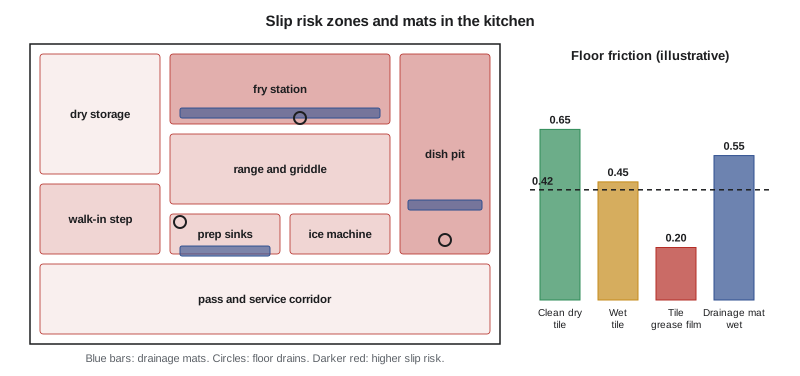
Floor safety is partly about the floor itself. Restaurant kitchens usually have quarry tile, textured porcelain tile or sealed concrete, chosen to resist heat, water and cleaning. A textured floor keeps its grip better when wet, and floors are tested by measuring their coefficient of friction, a number that compares the force needed to slide a shoe across the floor with the weight on it. Higher numbers mean more grip. A common North American tile standard, ANSI A326.3, uses a wet dynamic coefficient of friction of 0.42 as the minimum for level indoor floors that are walked on when wet, and kitchens are usually given more grip than that. A greasy film can cut the friction of any floor dramatically, which is why cleaning matters as much as the tile.
Mats
Mats help in the right places and cause trips in the wrong ones. Kitchens use two main types.
- Drainage mats have holes or an open grid that let water and food fall through, keeping feet above the wet surface. They belong in the dish pit, in front of the fryers and at prep sinks. They must be lifted and washed regularly, because food trapped under them becomes a slippery layer of its own.
- Anti-fatigue mats have a solid cushioned surface for standing at prep tables, the expo window and the bar. Lesson 8 covers standing and fatigue. They do not belong in wet areas, where they become slick.
Every mat must lie flat, with bevelled edges and no curling corners, and be replaced when it is torn or worn smooth. Mats should not overlap, and they should not be placed where carts must roll over them unless they are designed for that. A mat that moves underfoot is worse than no mat.
Shoes
Slip-resistant shoes are one of the most effective controls in a restaurant. Their soft rubber soles and small, closely spaced tread channels push water and grease away from the contact patch, much as tire treads do on a wet road. Juniper requires closed, slip-resistant shoes for everyone who works in the kitchen, the bar or the dish pit, and runs a payroll purchase program with a supplier so new hires can get a pair before their first shift. The rule applies to servers too, who cross the kitchen floor dozens of times a shift.
- Look for a label saying the shoe has been tested for slip resistance, and for soles with many small channels rather than large lugs.
- Replace shoes when the tread wears down, usually every six to twelve months for full-time kitchen work.
- Clean the soles regularly; tread packed with grease loses its grip.
- Closed toes and heels also protect against spills of hot liquids and dropped knives, which is why open shoes are never allowed in the kitchen.
Cleaning floors without making them worse
Mopping can create a slip hazard as easily as it removes one. Juniper's floor cleaning routine follows a few principles.
- Clean spills right away rather than at the end of the shift. During service, the person who sees a spill owns it until it is cleaned or handed to someone who will.
- Use the right product at the right dilution. A kitchen floor degreaser breaks down the grease film; too much detergent leaves its own slippery film. Lesson 9 covers chemical dilution.
- Work in sections, mopping backward to an exit so nobody walks across the wet floor, and put out wet floor signs before you start.
- Use a squeegee to push water to the floor drain and a dry mop to finish.
- Rinse after degreasing where the product's directions say to, and let the floor dry before service resumes.
- Keep drain covers and baskets in place and clean. A missing drain cover is both a trip hazard and an ankle injury waiting to happen.
The spill response steps
- Stop. Stand by the spill or block it so nobody walks through it.
- Signal. Put out a wet floor sign or call for one, and tell the people working nearby.
- Clean. Pick up solids first, then soak up liquids with a mop or absorbent, and use the right cleaner for grease.
- Dry. Finish with a dry mop or towel until the floor is truly dry.
- Check. Look for the source. A dripping ice machine, a leaking dish machine or a cracked bus tub will make the same spill again.
Tracking spills and floor checks
Aisha added a simple log to the dish pit whiteboard after Kofi's fall: each time someone finds a spill or wet area during service, they write the time found, the time cleaned and the place. After a month she ran the numbers to see where spills cluster and how long they sit.
# One month of spill reports from an invented restaurant (minutes after opening).
log = [  # (place, found, cleaned)
    ("dish pit", 310, 312), ("ice machine", 95, 140), ("fry station", 420, 423),
    ("dish pit", 530, 536), ("bar", 600, 602), ("ice machine", 210, 265),
    ("service door", 455, 470), ("dish pit", 640, 641), ("prep sink", 180, 186),
    ("ice machine", 330, 390), ("fry station", 505, 507), ("bar", 655, 661),
]
from collections import defaultdict
by_place = defaultdict(list)
for place, found, cleaned in log:
    by_place[place].append(cleaned - found)
print(f"{'place':14s} count  avg min  longest")
for place, waits in sorted(by_place.items(), key=lambda kv: -len(kv[1])):
    print(f"{place:14s} {len(waits):5d} {sum(waits)/len(waits):8.1f} {max(waits):8d}")
slow = [p for p, w in by_place.items() if max(w) > 15]
print("Places with a spill left more than 15 minutes:", ", ".join(sorted(slow)))place count avg min longest dish pit 3 3.0 6 ice machine 3 53.3 60 fry station 2 2.5 3 bar 2 4.0 6 service door 1 15.0 15 prep sink 1 6.0 6 Places with a spill left more than 15 minutes: ice machine
The numbers told a clear story. Spills in the dish pit and at the fryers were found and cleaned within minutes because people work there all the time. The ice machine in the back corridor was the problem: three spills sat for 45 to 60 minutes because nobody works near it during service. The cause turned out to be a drain line that had slipped out of its floor sink. The fix was a plumber's visit and a drip tray, plus a check of the corridor on the shift lead's hourly walk.
The bar, the patio and the service corridor
- Behind the bar, melted ice, spilled drinks and broken glass make the floor as hazardous as the dish pit. Bartenders need drainage mats and the same slip-resistant shoes as cooks, and the ice well must not overflow onto the floor.
- The swinging doors between the kitchen and the dining room are a collision point. Juniper's doors are marked in and out, each has a window at eye height, and staff call door as they push through.
- The patio gets wet with rain and from hosing down, and its pavers can be slick with spilled drinks. Servers carry trays across it, so it is squeegeed after rain and checked before service.
- The short flight of stairs from the kitchen to the basement storage room has handrails on both sides, non-slip nosings and good lighting, and nobody carries a load that blocks their view of the steps.
For supervisors: floors on your shift
- Walk the kitchen at least once an hour during service and look down: under the ice machine, at the dish pit, at the fryers and at the service doors.
- Check that every new hire has slip-resistant shoes before their first shift, and do not let anyone work the kitchen without them.
- Replace worn mats and missing drain covers immediately; they are cheap compared with one fall.
- Staff the dish pit for the rush. A dishwasher who falls behind starts running, and a backed-up pit spills onto the floor.
- Investigate every slip, even when nobody is hurt, by looking for the source of the water or grease.
Summary and key terms
- Water, grease, food, soap film and worn surfaces lower friction between shoe and floor and cause most kitchen slips.
- Drainage mats belong in wet areas, anti-fatigue mats at dry standing stations, and every mat must lie flat with bevelled edges.
- Slip-resistant shoes with fine tread channels are one of the most effective controls and should be required for everyone working in the kitchen, dish pit and bar.
- Clean spills immediately with the stop, signal, clean, dry and check steps, and fix the source of repeat spills.
- Degrease floors with the right product and dilution, squeegee to drains and keep drain covers in place.
- Coefficient of friction
- A number comparing the force needed to slide a shoe across a floor with the weight on it; higher means more grip.
- Drainage mat
- A mat with holes or an open grid that lets water and food fall through, used in wet areas.
- Anti-fatigue mat
- A cushioned mat for dry standing stations that reduces strain from standing for long periods.
- Floor sink
- A recessed drain in a kitchen floor that receives drain lines from equipment such as ice machines.
- Slip-resistant shoe
- A shoe with a soft rubber sole and tread designed to keep grip on wet and greasy floors.
Common mistakes
MistakePut a wet floor sign on the spill and come back to it after the rush.
InsteadA sign warns people but does not remove the hazard; clean the spill right away or hand it to someone who will.
MistakeMore soap in the mop bucket gets the floor cleaner.
InsteadExcess detergent leaves a slippery film; use the product at its labelled dilution and rinse when directed.
MistakeAny rubber-soled shoe is slip-resistant.
InsteadSlip resistance depends on the sole compound and tread design; look for shoes tested and sold as slip-resistant.
Practice problems
Work each problem on paper first, then reveal the answer to check.
The same corner of the bar is wet at the start of every shift. What should the bartender do beyond mopping it?
Show answer
Look for the source, such as a leaking ice well, glass washer or drain line, and report it for repair.
Why are drainage mats not used at the prep tables?
Show answer
The prep tables are dry standing stations where a cushioned anti-fatigue mat is better; drainage mats belong where water collects.
List the five spill response steps.
Show answer
Stop, signal, clean, dry and check.
Lesson quiz · 5 questions
Score 60% or more to complete this lesson.
Create a free account to save your progress, take quizzes and earn a certificate.