
HSE-380 · Lesson 10 of 12 · 16 min
Dish pits, garbage and grease handling
▶ Video coming soon A video version of this lesson is on the way.
The dish pit is the hardest-working corner of most restaurants and often the least noticed. It is hot, wet, loud and fast, and it is where many first jobs in food service begin. Dishwashers handle every hazard from the rest of the kitchen at second hand: knives left in bus tubs, broken glass, hot water and steam, chemicals, heavy racks and greasy floors. The back lane, where garbage, recycling and used oil go, adds lifting, sharp waste, the cardboard baler and the grease system. At Juniper Street, Kofi's fall in the dish pit was the year's most serious injury, and Ethan, at 15, works there on weekends. This lesson covers both areas.
The Juniper dish pit
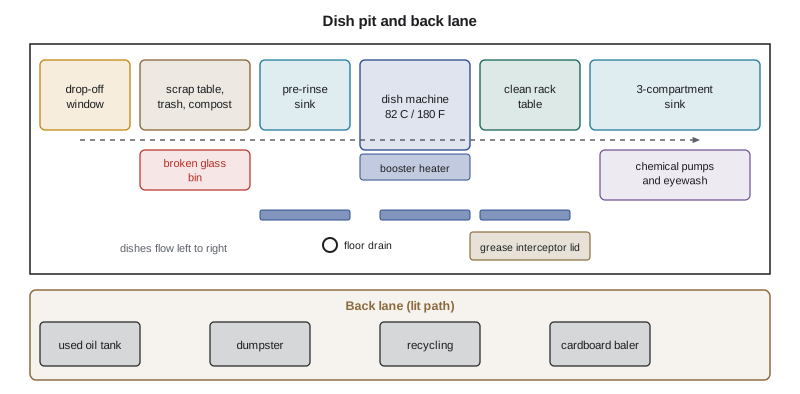
Juniper's dish pit sits between the hot line and the back door. Dirty dishes arrive from the dining room through a drop-off window onto a scrap table, where they are scraped into a trash bin and a compost bin and racked. The pre-rinse sprayer hangs over a deep sink beside the scrap table. A door-type high-temperature dish machine washes each rack in about a minute and finishes with a final rinse at 82 °C (180 °F), heated by a booster heater under the machine. A three-compartment sink handles pots and pans. Chemical pumps on the wall feed detergent and rinse aid to the machine from closed containers on a low shelf, and the eyewash station is on the wall beside them.
Scraping, sorting and sharps
The first hazard in the dish pit is what arrives in the bus tubs. Knives, broken glass, skewers, toothpicks and the occasional fork with a bent tine come mixed in with food scraps and napkins. Most dishwasher cuts happen at the scrap table or when reaching into a sink of water.
- Servers and bussers sort as they clear. Knives and steak knives go in a separate bus tub insert, glasses go in glass racks, not stacked inside each other, and nothing sharp goes in with the food scraps.
- Dishwashers scrape with a rubber scraper or the sprayer, not their fingers, and look before they reach.
- Broken glass goes straight into the marked broken glass bin, never the garbage bag. If a glass breaks in a sink of water, drain the sink first and remove the pieces with tongs or a gloved hand.
- Cracked or chipped glasses and plates are pulled out of service before they break in someone's hand.
- Cooks wash their own knives at the knife tray, as Lesson 3 explained.
Hot water and steam
The final rinse of a high-temperature dish machine is hot enough to cause a deep burn in under a second, and the machine releases a cloud of steam each time the door opens. Pots coming off the line are often still hot, and the water in the three-compartment sink's wash basin is kept hot for cleaning.
- Let the cycle finish and wait a few seconds before opening the door, then raise it and step back to let the steam rise.
- Use the rack handles, not bare hands, to pull racks out, and let clean racks air-dry for a minute before touching the plates.
- Wear water-resistant gloves for long sessions at the sink, and long sleeves or arm guards for pot washing.
- Point the pre-rinse sprayer down into the sink, never at people, and turn it off when not in use.
- Report a dish machine that leaks steam or water around the door, or a booster heater that trips, for repair.
Wet floors, electricity and noise
Lesson 6 covered floors: drainage mats, squeegees to the drain, clean drain baskets and slip-resistant shoes are essential in the dish pit, where water is always on the floor. Water and electricity also meet here. The dish machine, booster heater and any plug-in equipment near the sinks must be on circuits protected by ground fault circuit interrupters, cords must not lie in water, and anyone who sees sparks, smells burning or feels a tingle from equipment stops using it and reports it. HSE-382 covers electrical safety in wet kitchens. Dish pits are also noisy. Raising voices to call over the machine all night is tiring, and a busy pit can be loud enough that hearing protection is worth considering; a simple sound level check answers the question.
Chemicals in the dish pit
The dish machine's detergent is a strong alkali and its rinse aid an eye irritant, and both are pumped from closed containers. The main exposure comes when containers are changed or when pump lines leak. Lesson 9 covered labelling, storage and eyewash. In the dish pit, the rules are short: only trained adults change containers, wearing goggles and gloves; delimer, which is an acid, is used only as the machine's maker directs and never in the same session as bleach; and the eyewash is kept clear and tested weekly.
At 15, Ethan works in the dish pit as light work under BC's rules, with Kofi or another adult 19 or older supervising directly. He loads and unloads racks, scrapes and sorts, and stocks clean dishes. He does not change chemical containers, use the delimer or drain cleaner, or work on the dish machine.
Garbage and recycling
Taking out the trash is one of the most common closing jobs, and one that causes a steady stream of injuries: back strains from heavy bags, cuts from glass and metal poking through bags, slips on wet ground, and falls in poorly lit lanes.
- Fill bags only to a weight one person can carry comfortably, and use a wheeled bin to move them to the dumpster.
- Never push trash down with your hands or feet; sharp objects may be inside.
- Carry bags away from your body, not slung over the shoulder.
- Use the dumpster's side door if it has one, rather than lifting bags over a high rim.
- Keep the back lane well lit and the path to the dumpster clear of pallets and ice.
- If you find a used needle or other sharp object in the lane, do not pick it up with your hands. Tell a supervisor, who uses tongs and the sharps container kept by the back door.
- At closing, take garbage out in pairs or let a coworker know, and keep the back door locked behind you. HSE-352 covers working alone and late-night safety.
The cardboard baler
Juniper's vertical baler compresses flattened cardboard into bales for recycling. A baler is a powerful press, and people have been crushed or killed reaching into balers while they run or while clearing jams. The baler at Juniper has an interlocked gate that stops the ram when it opens, and it is used only by trained adults.
BC's regulation requires guarding and lockout for machines like balers, as Lesson 4 explained. Juniper's house rule keeps everyone under 18 off the baler entirely. Before clearing a jam or tying off a bale, the operator switches off, locks out the baler's disconnect and tests it.
Used cooking oil
Lesson 5 covered draining and filtering fryer oil. The rest of its journey goes through the back door. Juniper drains used oil into a covered oil caddy, lets it cool, and pushes the caddy to an outdoor used oil tank, where a recycling company collects it. The hazards are burns from oil that is still hot, slips on oil spilled along the route, and strains from pouring the caddy into the tank. Juniper's caddy has a pump that transfers oil into the tank without lifting, the route is kept clear and is cleaned with degreaser if anything spills, and the tank lid is kept closed.
Grease interceptors
Fats, oils and grease washed down kitchen drains cool, harden and block sewers, which is why restaurants are required to have a grease interceptor, also called a grease trap. Juniper's interceptor sits under the floor beside the dish pit. Wastewater from the sinks and floor drains flows through it slowly, so grease floats to the top and solids sink to the bottom while cleaner water flows on to the sewer.
Local sewer rules, such as the regional district's sewer use rules in the Victoria area, require restaurants to maintain their interceptors and keep records of cleaning. A common rule of thumb is to pump the interceptor before grease and solids together fill about a quarter of its depth. Juniper has a contractor pump it out every three months and checks the levels monthly between pumpings.
Grease interceptors are a safety hazard as well as an environmental one. Their contents produce hydrogen sulphide and other gases as they decompose, and the gas can collect under the lid. Large in-ground interceptors are confined spaces, which only trained and equipped contractors may enter. Kitchen staff at Juniper never open the interceptor beyond lifting the inspection cap to read the level with a measuring stick, and they never lean over the open lid or put their head inside. A rotten egg smell around the lid is a reason to stop and call the contractor.
Aisha's monthly readings let her predict when the next pumping should really happen rather than relying on the calendar alone.
# Grease interceptor level log (invented): when do grease plus solids reach 25%?
depth_cm = 120                  # liquid depth of the interceptor
readings = [  # (days since last pumping, grease layer cm, solids layer cm)
    (0, 0, 0), (30, 7, 4), (60, 15, 8),
]
limit = 0.25 * depth_cm
(d0, g0, s0), (d1, g1, s1) = readings[0], readings[-1]
rate = ((g1 + s1) - (g0 + s0)) / (d1 - d0)     # cm per day
for day, g, s in readings:
    print(f"day {day:3d}: grease {g:2d} cm + solids {s:2d} cm = {100 * (g + s) / depth_cm:4.1f}% of depth")
days_to_limit = (limit - (g1 + s1)) / rate
print(f"Build-up rate: {rate:.2f} cm per day")
print(f"25% reached about day {d1 + days_to_limit:.0f}; schedule pumping before then")day 0: grease 0 cm + solids 0 cm = 0.0% of depth day 30: grease 7 cm + solids 4 cm = 9.2% of depth day 60: grease 15 cm + solids 8 cm = 19.2% of depth Build-up rate: 0.38 cm per day 25% reached about day 78; schedule pumping before then
The readings show the interceptor filling a little faster than the three-month schedule assumes, mostly because of the busy patio season. Aisha moved the summer pumping a few weeks earlier, which prevents a backup into the dish pit floor drains, the kind of event that floods a floor with greasy water in the middle of service. The best way to slow the build-up is to keep grease out of the drains in the first place: scrape plates into the bins, wipe greasy pans with a paper towel before washing, and never pour oil or grease down a sink.
For supervisors: the dish pit and the back lane
- Staff the dish pit for the rush, and remember that a backed-up pit leads to running, spills and broken glass.
- Check the broken glass bin, knife inserts and sharps container weekly, and replace them before they are full.
- Test GFCI outlets near the sinks monthly with their test button.
- Keep the back lane lit and clear, and walk it at closing.
- Keep the interceptor and oil collection records, and know the contractor's emergency number.
Summary and key terms
- Dishwashers face cuts from knives and glass in bus tubs, burns from rinse water and steam, chemicals, heavy racks and wet floors.
- Sort at the table, scrape with tools, keep broken glass in its own bin, and drain a sink before reaching in after a breakage.
- Open dish machine doors after the cycle ends and step back from the steam; keep electrical equipment near water on GFCI-protected circuits.
- Garbage, the baler and used oil each have their own controls: lighter bags and wheeled bins, interlocks and lockout with no under-18 operators, and covered caddies with pumps.
- Grease interceptors must be pumped before grease and solids fill about a quarter of their depth, and only trained contractors open or enter them.
- Dish pit
- The area of a kitchen where dishes, glasses, pots and utensils are scraped, washed and sanitized.
- Booster heater
- A heater that raises the dish machine rinse water to sanitizing temperature.
- Grease interceptor
- A tank that separates fats, oils and grease from kitchen wastewater before it enters the sewer.
- Ground fault circuit interrupter
- A device that cuts power in a fraction of a second when current leaks to ground, such as through water or a person.
- Baler
- A machine that compresses cardboard or other recyclables into bales.
Common mistakes
MistakeA glass broke in the sink, so reach in carefully and feel for the pieces.
InsteadDrain the sink first, then remove the pieces with tongs or a gloved hand.
MistakePushing the trash down in the bag makes room for more.
InsteadHidden sharps can cut through the bag; tie off the bag and start a new one.
MistakeHot water dissolves grease, so it is fine to pour oil down the sink with hot water.
InsteadGrease cools and hardens in the interceptor and sewer; scrape and wipe grease into the bins instead.
Practice problems
Work each problem on paper first, then reveal the answer to check.
Why are knives collected in a separate insert when tables are cleared?
Show answer
So dishwashers do not reach into a tub of scraps and napkins and find a knife with their fingers.
Kofi notices a rotten egg smell by the grease interceptor lid. What should he do?
Show answer
Keep away from the open lid, ventilate if possible, keep others away and call the contractor; the smell can mean hydrogen sulphide.
The baler jams with the gate closed. What must the operator do before reaching in?
Show answer
Switch it off, lock out the disconnect with a personal lock and test that it will not start.
Lesson quiz · 5 questions
Score 60% or more to complete this lesson.
Create a free account to save your progress, take quizzes and earn a certificate.