
HSE-380 · Lesson 5 of 12 · 16 min
Burns: fryers, ovens, steam and hot liquids
▶ Video coming soon A video version of this lesson is on the way.
Burns are the second most common kitchen injury after cuts, and they are among the most painful. Most are small: a forearm brushed against an oven rack, a finger on a hot pan handle. But hot oil, steam and boiling liquids can cause deep burns over large areas in seconds, and those burns need hospital care and leave scars. At Juniper Street, the first-aid log showed 11 minor burns in a year, and Ben's fryer burn kept him off work for three days. This lesson covers how kitchen burns happen and how to prevent them. Kitchen fires, gas appliances and hood systems are covered in HSE-382.
Where the heat is
Juniper's hot line holds most of the restaurant's burn hazards in one row under the hood.
- Two floor fryers, each holding about 18 kg (40 lb) of oil at 175 °C (350 °F).
- A six-burner range with an oven below, used for sauté pans, stockpots and sauces.
- A flat-top griddle, a charbroiler and a salamander broiler mounted above the range.
- A combi oven that cooks with dry heat, steam or both, and releases a cloud of steam when its door opens.
- A 38 L (10 gal) tilting steam kettle for stocks and soups.
- Around the line: sheet pans and cast iron straight from the oven, hot plates under the heat lamps at the pass, the dish machine's 82 °C (180 °F) final rinse, and the bar's coffee machine and hot water tap.
How burns happen
A burn's severity depends on how hot the source is and how long it touches the skin. Very hot sources, like frying oil, burn instantly. Water just below boiling causes a deep burn in about a second. Even water from a hot tap can scald in a few minutes. The common ways kitchen workers get burned follow from that.
- Spattering oil: wet or frozen food dropped into a fryer, or water splashed into hot oil.
- Contact with hot surfaces: oven racks, sheet pans, pan handles, griddle edges and the inside of the oven door.
- Steam: opening a combi oven, steamer or dish machine door with your face over it, lifting a lid so it opens on your side, or a wet towel turning to steam against a hot pan.
- Spills and splashes of hot liquids: carrying full stockpots, draining pasta, tilting the kettle, or a collision in a crowded aisle.
- Oil handling: filtering, draining and carrying used fryer oil, which stays hot enough to burn for hours.
- Hot plates: servers grabbing a plate that sat under the salamander or heat lamp.
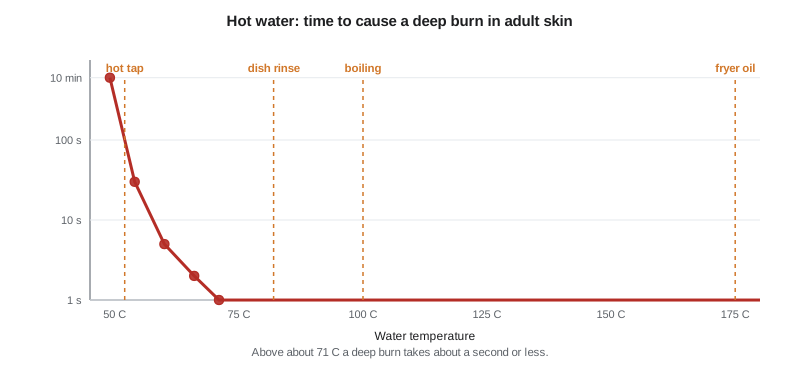
The shape of this curve is the most important fact in this lesson. A few degrees make a huge difference near the bottom, and everything on the line is far past the point where a burn is instant. There is no time to react to a splash of fryer oil or boiling stock; prevention has to happen before the splash.
# Approximate time for hot water to cause a deep burn in adult skin.
# Points are commonly cited estimates from burn research; times are rounded.
points = [(49, 600), (54, 30), (60, 5), (66, 2), (71, 1)]  # (deg C, seconds)
import math

def time_to_burn(t):
    if t <= points[0][0]:
        return None                      # below about 49 C: long exposure only
    if t >= points[-1][0]:
        return 1.0                       # about one second or less
    for (t1, s1), (t2, s2) in zip(points, points[1:]):
        if t1 <= t <= t2:
            f = (t - t1) / (t2 - t1)     # interpolate on a log scale
            return math.exp(math.log(s1) + f * (math.log(s2) - math.log(s1)))

for label, t in [("hand sink", 43), ("hot tap", 52), ("bain-marie", 63),
                 ("coffee", 70), ("dish rinse", 82), ("boiling stock", 100)]:
    s = time_to_burn(t)
print(f"{label:14s} {t:3d} C ->", "long exposure only" if s is None else f"about {s:.0f} s")hand sink 43 C -> long exposure only hot tap 52 C -> about 99 s bain-marie 63 C -> about 3 s coffee 70 C -> about 1 s dish rinse 82 C -> about 1 s boiling stock 100 C -> about 1 s
Fryer safety
Deep fryers cause the worst burns in most kitchens, because frying oil is far hotter than boiling water, it sticks to skin, and water hitting it turns to steam instantly. One gram of water becomes well over a thousand times its volume in steam, so a little ice on a basket of fries is enough to throw oil out of the fryer. Ben's burn happened exactly this way.
- Shake ice crystals and water off frozen food over the drip station before frying, and dry wet food such as battered fish on a rack.
- Fill baskets no more than half full, and lower them slowly. Never drop food into the oil by hand.
- Keep the oil at the fill line. Overfilled fryers boil over when food goes in, and low oil overheats.
- Keep water, ice, drinks and wet towels away from the fryer. Never put out an oil fire with water; HSE-382 covers fryer fires and the Class K extinguisher.
- Stand back from the fryer and face it, not sideways, when lowering and lifting baskets, and hang baskets on the hooks to drain rather than shaking them over the oil.
- Never lean over a fryer to reach something behind it. Keep the area around the fryer clear of things people reach for.
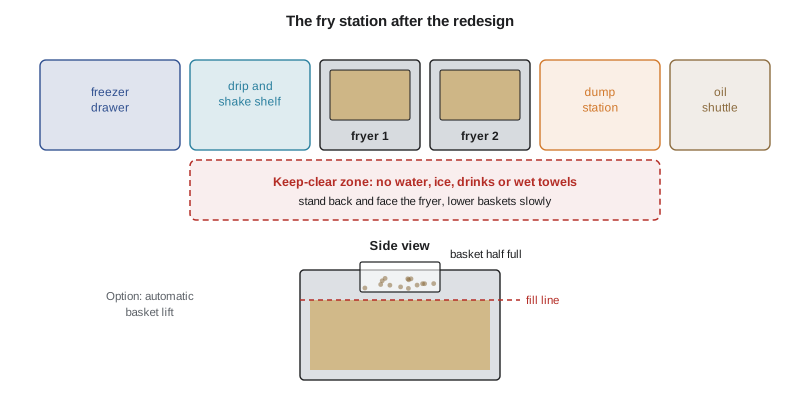
After Ben's injury, the committee redesigned the fry station. A drip shelf with a perforated pan now sits between the freezer drawer and the fryers so frozen product can be shaken before it goes in. The ice bin that had stood beside the fryer moved to the other end of the line. Elena approved the purchase of automatic basket lifts for the next fryer replacement, which will also let younger workers use the fryer where the law allows it.
BC's young worker rules do not single out fryers, but a fryer is equipment that can seriously harm a 14- or 15-year-old, so Juniper treats it as outside light work. Maya and Noah may work the fryer after training.
Handling and changing fryer oil
Oil is filtered daily and changed every few days at Juniper, and both jobs are burn hazards. Hot oil keeps its heat for a long time; a full fryer can stay hot enough to cause a deep burn for hours after it is switched off.
- Use the fryer's built-in filtration system, following the maker's steps, wearing heat-resistant gloves, a face shield and a long-sleeved jacket or apron.
- Drain used oil into a covered oil shuttle or caddy designed for hot oil, never into an open pot or bucket, and push the caddy rather than carrying oil.
- Let oil cool to a safe temperature before carrying it any distance, and take the caddy straight out to the used oil tank by a clear route.
- Never drain oil into a floor drain or sink, which is a burn hazard and blocks the grease system covered in Lesson 10.
- Make sure the drain valve is fully closed before refilling, and refill with cool oil before heating.
Ranges, ovens, griddles and broilers
- Turn pot and pan handles in, away from the edge of the range, so nobody knocks them.
- Use dry oven cloths or mitts. A wet towel conducts heat straight to the hand and turns to steam against a hot pan.
- Pull oven racks out with a mitt before reaching in, and keep forearms covered when working in deep ovens.
- Announce hot pans. Hot behind is part of the kitchen language, and anything that has been in the oven is treated as hot until proven otherwise.
- Keep sleeves and towels away from burners and the salamander, and keep the salamander's plate at a safe height so cooks do not reach up into the heat.
- Put a hot pan straight onto the range, a trivet or a marked hot spot, never on a prep table where someone might grab it.
Steam, kettles and hot liquids
Steam burns are deceptive because steam is invisible near its source and the burn often happens on the face, wrists and forearms.
- Open combi oven, steamer and dish machine doors slowly and stand to the side, letting the steam escape before reaching in.
- Lift pot lids away from you, so the lid shields your face and arm from the steam.
- Fill stockpots in place on the range with a hose or pitcher, not at the sink, and ladle them out before moving them. Lesson 8 covers moving heavy pots.
- Tilt the steam kettle slowly with the pan or container secured below, and keep feet and hands out of the pour path.
- Pour hot liquids away from your body and below waist height, and never carry hot liquids through a crowded aisle during service.
- Heat liquids in the microwave in short bursts and stir them; liquids can superheat and erupt when disturbed.
Hot plates and service
Servers are burned by plates that sat under the heat lamp or came straight from the salamander. The cook calls hot plate when setting it in the window, the server uses a service towel, and plates that went under the broiler go out on an underliner. Coffee pots and teapots are carried upright, poured at the table carefully and never passed over a guest. HSE-383 covers the front of house in more depth.
Protective clothing
Cooks' clothing is partly about protection. A double-breasted jacket with long sleeves protects the chest and arms from spatter, and its cotton does not melt onto skin the way some synthetic fabrics do. Aprons protect the body during oil handling. Closed, slip-resistant shoes protect feet from spills; Lesson 6 covers footwear. Heat-resistant gloves, long mitts and face shields are personal protective equipment for specific tasks such as oil filtration and handling large hot pans, and HSE-104 covers how to select them.
First aid for burns
Every second counts with a burn. The first-aid steps are simple and should be posted at the hot line.
- Cool the burn immediately with cool running water for about 20 minutes. Do not use ice, butter or ointments.
- Remove rings, watches and tight clothing near the burn before swelling starts, unless they are stuck to the skin.
- Cover the burn loosely with a clean, non-stick dressing or clean plastic wrap.
- Get medical care for burns larger than the injured person's palm, deep burns that look white, leathery or charred, burns to the face, hands, feet, genitals or major joints, chemical and electrical burns, and any burn with blisters that break.
- Call emergency services for large or deep burns, burns to the airway or any burn with signs of shock.
Ben's first aid was handled well: Hana put his arm under the prep sink's cool water within seconds and kept it there while Aisha called his ride to the clinic. Cooling for the full time limits how deep a burn goes. HSE-110 covers burns and first aid more fully.
For supervisors: preventing burns on the line
- Set the line so cooks do not reach over fryers, open flames or hot surfaces to get to things they use often.
- Keep enough dry oven cloths and mitts at every station, and replace any that are thin, torn or greasy.
- Schedule oil filtration and changes for when the fryer can cool, and train every cook who will do them.
- Watch the end of the night. Burns spike during closing cleaning when people are tired and equipment is still hot.
- Investigate every burn in the first-aid log. Most have a fixable cause, as Ben's did.
Summary and key terms
- Burn severity depends on temperature and contact time; almost every liquid and surface on the hot line burns instantly.
- Fryer burns come mostly from water and ice hitting hot oil; shake and dry food, fill baskets half full and lower them slowly.
- Hot oil stays dangerous for hours; filter and drain it with the right equipment and protective gear and push it in a covered caddy.
- Open steam equipment slowly and stand aside, lift lids away from you, use dry cloths, and call out hot pans and plates.
- Cool a burn with running water for about 20 minutes and get medical care for large, deep or sensitive-area burns.
- Superficial burn
- A burn to the outer layer of skin that is red and painful without blisters.
- Partial-thickness burn
- A deeper burn that blisters and damages part of the skin layer below the surface.
- Full-thickness burn
- A burn through the whole skin that may look white, leathery or charred and needs medical care.
- Oil shuttle
- A covered, wheeled container designed to drain and transport hot fryer oil.
- Superheating
- Heating a liquid above its boiling point without bubbles, so it can erupt suddenly when moved.
Common mistakes
MistakeA damp towel is fine for grabbing a hot pan.
InsteadWet cloth conducts heat and turns to steam; use dry cloths or mitts.
MistakePut ice on a burn to stop the pain.
InsteadUse cool running water for about 20 minutes; ice can damage the skin further.
MistakeOnce the fryer is switched off, the oil is safe to carry.
InsteadFryer oil stays hot enough to burn for hours; let it cool and move it in a covered caddy.
Practice problems
Work each problem on paper first, then reveal the answer to check.
Why did Ben’s basket of frozen fries make the oil spatter?
Show answer
Ice on the fries turned to steam instantly in the hot oil, expanding to many times its volume and throwing oil out of the fryer.
A cook needs to check a tray in the combi oven during steam mode. How should the door be opened?
Show answer
Slowly, standing to the side, letting the steam escape before reaching in.
A server burns two fingers on a plate. What first aid comes first?
Show answer
Cool the fingers under cool running water for about 20 minutes and remove any rings.
Lesson quiz · 5 questions
Score 60% or more to complete this lesson.
Create a free account to save your progress, take quizzes and earn a certificate.