
HSE-380 · Lesson 4 of 12 · 17 min
Slicers, mixers, grinders and other kitchen machines
▶ Video coming soon A video version of this lesson is on the way.
Knife cuts are common but usually small. Machine injuries are less common and far worse. A meat slicer blade can take off a fingertip in an instant, a floor mixer can break an arm that is caught by the beater, and a meat grinder can pull a hand into its feed screw. These injuries happen most often during cleaning, clearing a jam or reaching in to scrape down a bowl, when people assume the machine is safe because it is not making food. This lesson covers the machines in Juniper Street's prep area, the guards that protect people from them, and how to make each one safe before cleaning or clearing it.
Juniper's prep machines
- A 30 cm (12 in) gravity-feed meat slicer, used for deli meats, cheese, onions and potatoes.
- A floor mixer with a 19 L (5 gal) bowl and dough hook, whip and paddle attachments, used for pizza dough, bread and batters.
- A meat grinder attachment that fits the mixer hub, used for burger blends.
- A countertop food processor and a high-speed blender for sauces and soups, plus a hand-held immersion blender.
- A vacuum packing machine, an electric can opener and a countertop dough sheeter that is no longer used and has been tagged out of service.
Each machine has a different hazard point, but the same three questions apply to all of them: where are the moving parts that can cut, crush or catch, what keeps a hand away from them during use, and how is the power removed before anyone reaches in?
How the guards work
A guard is a physical barrier that keeps body parts out of the danger zone. Kitchen machines come from the maker with guards designed for normal use, and removing, bending or bypassing a guard is one of the most dangerous things anyone in a kitchen can do.
- Slicer: a ring guard covers the edge of the round blade except where food meets it. The gauge plate in front of the blade controls slice thickness and, when closed to zero, covers the edge. A product pusher or pusher arm on the carriage holds food against the blade so hands stay behind the carriage. Some slicers have an interlock that stops the motor if the blade cover is removed.
- Floor mixer: a bowl guard, usually a wire cage or a solid shield around the top of the bowl, is interlocked so the mixer will not run when the guard is open or the bowl is lowered. The speed must only be changed when the mixer is stopped on gear-driven models.
- Grinder: the feed throat is too small for a hand, and a stomper or pusher is used to feed meat into it. The cutting plate and knife are held by a threaded ring that must never be loosened while the motor can run.
- Food processors and blenders: an interlocked lid prevents the blade from turning when the lid is off, and the blade keeps spinning briefly after the motor is switched off.
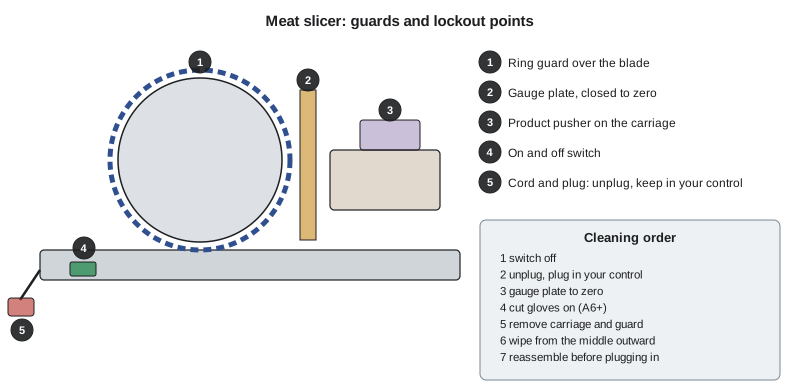
BC's Occupational Health and Safety Regulation, Part 12, requires machines to have safeguards that prevent access to hazardous moving parts, and requires those safeguards to be kept in place and in good repair. Ontario's Regulation 851 and Alberta's OHS Code have similar guarding requirements. A guard that is damaged or missing makes the machine unfit for use until it is repaired.
Slicer safety
The meat slicer is the most dangerous machine in most restaurant kitchens. Its blade is large, extremely sharp and turns fast, and the most dangerous moment is cleaning, when the guard and carriage come off and the cleaner's hands are next to an exposed edge.
- Only trained adults use, clean or adjust the slicer at Juniper, and the slicer carries a label saying so.
- Before slicing, check that the ring guard, pusher and gauge plate are in place and the blade is not damaged, and that the slicer sits square on a stable surface.
- Use the pusher arm or the carriage handle, never your hands, to push food against the blade, and stop slicing when the piece gets small rather than reaching closer.
- Turn the slicer off and close the gauge plate to zero whenever you walk away from it, even for a moment.
- Never reach over or behind the blade while it is turning, and never try to catch a slice falling off the far side.
Cleaning follows a fixed order every time: switch off, unplug and keep the plug in your control, close the gauge plate to zero, put on cut-resistant gloves, then remove the carriage and the guard according to the maker's instructions. Wipe the blade from the centre outward, never along the edge, using a long-handled brush or a folded cloth, and clean and sanitize every part. Reassemble the guard and carriage fully before plugging the slicer in again. The slicer should be cleaned at least every four hours during continuous use, which is a food safety requirement covered in HSE-381, so cleaning happens several times a day.
Mixers, grinders and processors
- Mixers. Lower the bowl and switch off before adding ingredients, scraping the bowl or changing attachments. Never put a hand, spatula or spoon into a running bowl; the beater can snap a spatula or pull an arm in. Tie back long hair, remove dangling jewellery and keep apron strings and sleeves away from the beater. Changing speeds while running can strip the gears on gear-driven models, and a stripped gear can let the beater move unexpectedly.
- Grinders. Feed meat with the stomper only. When the grinder jams, switch off and unplug before taking off the ring to clear it. Never push meat into the throat with fingers, even with the motor off; it can restart if someone else switches it on.
- Food processors and blenders. Wait until the blade has stopped before opening the lid, and lift the blade out by its hub, not its edge. Never put fingers into a blender jar to free a stuck blade; switch off, unplug and use a spatula.
- Immersion blenders. Keep the blade fully under the surface of the liquid to avoid splashing hot soup, unplug before cleaning the blade, and never touch the blade guard while the trigger can be pressed.
- Vacuum packers and can openers. Keep fingers clear of the sealing bar and the cutting wheel, and unplug before cleaning.
Lockout: removing the energy before reaching in
Many machine injuries happen when someone reaches into a machine they thought was off, or when a second person switches it on without knowing someone has a hand inside. Lockout is the procedure that prevents this: the energy source is isolated, and the person doing the work controls it so nobody else can restore it.
BC's regulation, Part 10, requires machinery to be locked out before maintenance, cleaning or clearing a jam if unexpected start-up or movement could injure a worker. Each worker applies their own personal lock to the energy-isolating device, and the machine is tested to make sure it cannot start. For equipment powered by a cord and plug, unplugging the machine and keeping the plug under the exclusive control of the worker doing the work is an accepted way of controlling the hazardous energy, but only when the plug stays where the worker can see and reach it. Hard-wired equipment, such as some floor mixers, dish machines and walk-in compressors, needs a lock on the disconnect switch or the breaker.
At Juniper, the slicer, processor, blender, immersion blender, vacuum packer and can opener are cord-and-plug machines, and the rule is: unplug and keep the plug in your hand, in your pocket or in a plug lockout box you hold the key to. The floor mixer and the dish machine are hard-wired, so Tomás, Aisha and Kofi each have a personal padlock and a lockout tag. Before anyone reaches into the mixer guard area to work on it, they switch it off, open the disconnect beside it, apply their lock and tag, and press the start button to check that the mixer will not run. Only then do they begin.
The tested-dead step is the one people skip, and it is the one that catches mistakes such as locking the wrong disconnect. After the work is done, the worker removes the tools, replaces every guard, tells the people nearby, removes their own lock and restarts the machine. Nobody removes another person's lock.
Machines and young workers
BC law limits what 14- and 15-year-olds can do with equipment, as Lesson 2 explained, and Juniper's house rule keeps everyone under 18 off the slicer, the floor mixer, the grinder and the baler. The program below shows how a kitchen manager can turn the house rule and the training records into a simple permission list.
# Who may run each machine at Juniper (house rule: under 18 barred from the listed machines).
RESTRICTED_UNDER_18 = {"slicer", "floor mixer", "grinder", "baler"}
workers = {  # name: (age, set of machines trained on)
    "Luis": (41, {"slicer", "floor mixer", "grinder", "processor"}),
    "Hana": (29, {"slicer", "processor"}),
    "Noah": (17, {"processor", "fryer", "slicer"}),
    "Maya": (16, {"processor"}),
    "Ethan": (15, set()),
}
machines = ["slicer", "floor mixer", "grinder", "processor", "fryer"]
for m in machines:
    allowed = []
    for name, (age, trained) in workers.items():
        if m in trained and not (age < 18 and m in RESTRICTED_UNDER_18):
            allowed.append(name)
    print(f"{m:12s}: {', '.join(allowed) or 'nobody'}")
flag = [n for n, (a, t) in workers.items() if a < 18 and t & RESTRICTED_UNDER_18]
print("Training records to correct:", ", ".join(flag) or "none")slicer : Luis, Hana floor mixer : Luis grinder : Luis processor : Luis, Hana, Noah, Maya fryer : Noah Training records to correct: Noah
The output flags Noah: someone had written the slicer on his training record during a slow afternoon when a cook showed him how it worked. Aisha removed it from the record, talked to the cook and added a line to the new-hire orientation for cooks explaining the age rule. A permission list like this, printed and posted by the prep area, makes the rule visible to everyone, including new cooks who would otherwise not know it.
Inspection and maintenance
- Check guards, cords, plugs and switches before each use, and take any machine with a frayed cord, cracked plug, missing guard or faulty switch out of service with a tag until it is repaired.
- Have slicer blades sharpened and machines serviced by a qualified technician on the maker's schedule. A dull slicer blade invites pushing with the hands.
- Keep the maker's manual for each machine in a binder or as a link on the office computer, and follow its cleaning and assembly steps.
- Put machines on stable, level surfaces at a comfortable height, with enough space around them that nobody is bumped while using them.
- Plug machines into outlets protected by ground fault circuit interrupters where they are near sinks or wet areas. HSE-382 covers electrical hazards in wet kitchens.
For supervisors: machine safety on your shift
- Know which machines are restricted by age or training, and check before assigning a task, especially to new cooks who may have learned different rules elsewhere.
- Watch new users through a full use and a full cleaning before they work alone on any machine.
- Treat a missing guard as a stop-work issue. Nobody uses the machine until the guard is back.
- Make lockout locks and plug covers easy to find, and include a lockout demonstration in orientation for anyone who cleans hard-wired equipment.
- Keep the old dough sheeter tagged out, or better, remove it from the kitchen, so nobody is tempted to use it.
Summary and key terms
- Machine injuries are rarer than knife cuts but far more severe, and most happen during cleaning, clearing jams or reaching into a running machine.
- Guards on slicers, mixers, grinders and processors keep hands out of the danger zone and must never be removed or bypassed during use.
- Slicers are cleaned in a fixed order: off, unplug, gauge plate to zero, cut gloves, then disassemble and wipe from the centre outward.
- Before cleaning or clearing a machine, remove its energy: unplug cord-and-plug equipment and keep the plug in your control, or lock out hard-wired equipment and test that it will not start.
- Juniper's house rule bars everyone under 18 from the slicer, floor mixer, grinder and baler.
- Guard
- A physical barrier that keeps body parts away from the hazardous moving parts of a machine.
- Interlock
- A device that stops a machine or prevents it from starting when a guard or lid is open.
- Gauge plate
- The adjustable plate in front of a slicer blade that sets slice thickness and covers the edge when closed.
- Lockout
- Isolating a machine from its energy source and securing it with a personal lock so it cannot be restarted.
- Exclusive control
- Keeping an unplugged cord in your own hands or under your own lock so nobody else can plug it in.
Common mistakes
MistakeSwitching a machine off is enough before cleaning it.
InsteadA switch can be pressed by someone else; unplug or lock out the machine and check that it will not start.
MistakeThe slicer guard slows me down, so I take it off for big jobs.
InsteadThe guard must stay on whenever the slicer runs; slicing without it is a leading cause of amputations.
MistakeUsing a spatula in a running mixer is fine as long as I hold it tight.
InsteadThe beater can grab the spatula and pull the hand in; stop and lower the bowl before scraping.
Practice problems
Work each problem on paper first, then reveal the answer to check.
The grinder jams halfway through a batch of burger blend. What are the first two steps?
Show answer
Switch it off and unplug it, keeping the plug in your control, before removing the ring to clear the jam.
Why must the slicer gauge plate be closed to zero before cleaning?
Show answer
A closed gauge plate covers the edge of the blade and reduces the exposed edge while the guard and carriage are removed.
The floor mixer is hard-wired. How does Kofi make sure it cannot start while he cleans the drive area?
Show answer
He switches it off, opens the disconnect, applies his personal lock and tag, and presses start to test that it will not run.
Lesson quiz · 5 questions
Score 60% or more to complete this lesson.
Create a free account to save your progress, take quizzes and earn a certificate.