
HSE-363 · Lesson 9 of 12 · 20 min
Medical conditions: anaphylaxis, asthma, diabetes and epilepsy
In a school of 500 students, there are typically dozens with asthma, a dozen or more at risk of anaphylaxis, a few with type 1 diabetes and a few with epilepsy. Most days these conditions are invisible: students manage them with a little help and carry on. But each of them can turn into a life-threatening emergency within minutes, at recess, at lunch, on a bus or halfway along a trail. The staff who happen to be there need to recognize what is happening and know what to do. This lesson covers the four conditions schools see most often, the plans that go with them, and how those plans travel with students outside the classroom. The emergency first steps for these conditions were introduced in HSE-362; here the focus is on planning and supervision.
The legal framework
Ontario has a specific framework for these conditions. Sabrina's Law (2005) requires every board to have an anaphylaxis policy, an individual plan for every student at risk, regular staff training and arrangements for epinephrine auto-injectors, and it protects staff who act in good faith. Ryan's Law (2015) does the same for asthma, including allowing students to carry their reliever inhalers. Policy/Program Memorandum 161 (PPM 161), issued in 2018, requires boards to support students with four prevalent medical conditions: anaphylaxis, asthma, diabetes and epilepsy. Each student with one of these conditions has a plan of care, developed with the student and family, and reviewed every year and whenever the condition changes. The board follows all three.
What a plan contains
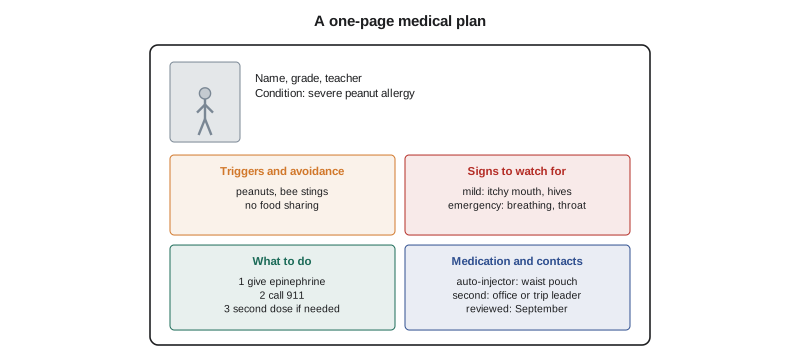
Every plan at the board follows the same one-page layout, so any adult, including a supply teacher or volunteer, can use it quickly:
- The student's photo, name, grade and teacher, and the condition.
- Known triggers and how to avoid them.
- Signs to watch for, split into early or mild signs and emergency signs.
- What to do, in numbered steps, starting with the most urgent.
- Where the student's medication and supplies are kept, including on trips.
- Emergency contacts and the student's health care provider.
- The date the plan was last reviewed and who signed it.
Copies go to every place the student spends time: the classroom, the office, the supply teacher folder, the lunchroom supervisor's binder, the gym, the bus driver where the plan calls for it, and the trip binder. The plan is useful only if the adult who is there when something happens has seen it.
Anaphylaxis
For students at risk of anaphylaxis, the priorities are avoiding exposure, recognizing a reaction early and giving epinephrine without delay. Avoidance in schools is about reducing risk, not promising an allergen-free environment, which no school can guarantee. The board asks families not to send common allergens in classrooms where a student with that allergy is present, discourages food sharing, keeps food out of activities like crafts unless the ingredients are checked, and reviews menus for class parties, cooking activities and trips. Students who are old enough carry their own auto-injector, usually in a waist pouch, and a second one is kept in the office or with the trip leader.
On trips, anaphylaxis risks multiply: unfamiliar food at a restaurant or cafeteria, other people's snacks on the bus, stinging insects at a park, and long distances to hospital. The trip plan names the adult responsible for each student at risk, who stays with the student's group and carries or checks the second auto-injector. Restaurants and food providers are contacted in advance about allergens. Because epinephrine wears off within about 10 to 20 minutes and symptoms can return, every trip that goes far from emergency services carries a second auto-injector for each student at risk, and the leader knows how long an ambulance would take to arrive.
Asthma
Asthma is the most common chronic condition among students. Triggers include colds, exercise, cold air, smoke, pollen, dust and strong smells. Most students manage well with a reliever inhaler, usually blue, which they should be able to reach quickly: ideally carried with them, or kept in a known place nearby. Physical education teachers and coaches let students with asthma warm up gradually, use their inhaler before exercise if their plan says so, and stop when symptoms start. On trips, inhalers travel with the student, not in a bag under the bus, and adults watch for triggers such as campfire smoke, barns and cold mornings.
Type 1 diabetes
Students with type 1 diabetes need insulin every day and have to balance food, activity and insulin to keep their blood sugar in range. Many use continuous glucose monitors that send readings to a phone, and insulin pumps. The main emergency in school is low blood sugar (hypoglycemia), which can come on quickly with exercise, missed meals or too much insulin. Signs include shakiness, sweating, paleness, confusion, irritability and unusual behaviour. The response is fast-acting sugar, such as juice or glucose tablets, if the student can swallow safely, followed by a recheck. A student who is unconscious or cannot swallow needs 911 and, if their plan includes it and a trained adult is present, glucagon. High blood sugar develops more slowly but matters too, especially during illness.
Supervision matters most at transitions: before and after physical activity, at lunch, on long bus rides and during trips where meals are later or different. Students with diabetes are never sent alone to the office or the nurse when they feel low; someone goes with them. Their phone, which may run their monitor, is allowed where other phones are not. On trips, the student's supplies, snacks and a backup kit travel with them, and the adult responsible knows the plan for lows and highs and when to call the family.
Epilepsy and seizures
Seizures take many forms: some cause shaking and loss of consciousness, others only staring, confusion or unusual movements for a few seconds. A student's plan describes what their seizures usually look like, what is typical for them and when to call 911. The general first aid is to keep the student safe, time the seizure, not restrain them or put anything in their mouth, and roll them onto their side when the shaking stops. Some students have a prescribed rescue medication, given by trained staff if a seizure lasts longer than a set time.
For supervision planning, epilepsy matters most around water, heights and fatigue. Students with epilepsy should swim only with constant, one-to-one supervision by an adult who knows their plan, and climbing activities need a careful look at the student's seizure control and the safety systems used. Lack of sleep and missed medication are common seizure triggers on overnight trips, so the plan for medication times and lights-out matters.
Training
Plans work only if adults are trained to use them. The board trains all staff each year to recognize and respond to anaphylaxis, asthma, diabetes emergencies and seizures, including how to use an epinephrine auto-injector with a trainer. Staff who are named in a specific student's plan, such as for glucagon or seizure rescue medication, get additional training. Volunteers on trips are briefed on any plans for students in their group and shown where the medication is.
Checking coverage for a trip
Before every trip, the leader checks that every student with a plan is covered: a trained adult assigned to their group, their medication packed and in date, and the plan in the binder. The program below shows the check for Aaron's conservation area trip.
# Trip medical coverage check (invented data).
plans = [
    # student, condition, medication packed and in date?, assigned adult, adult trained?
    ("Maya",  "anaphylaxis (peanut, bee)", True,  "Aaron",   True),
    ("Leo",   "asthma",                    True,  "Mrs. Ruiz", True),
    ("Noor",  "type 1 diabetes",           True,  "Jenna",   True),
    ("Eli",   "epilepsy",                  False, "Mr. Chen", True),
    ("Sofia", "anaphylaxis (tree nut)",    True,  "Mrs. Ruiz", False),
]
for s, cond, med, adult, trained in plans:
    issues = []
    if not med: issues.append("medication missing or expired")
    if not trained: issues.append(f"{adult} not trained")
print(f"{s:6} {cond:27} {'OK' if not issues else 'FIX: ' + '; '.join(issues)}")Maya anaphylaxis (peanut, bee) OK Leo asthma OK Noor type 1 diabetes OK Eli epilepsy FIX: medication missing or expired Sofia anaphylaxis (tree nut) FIX: Mrs. Ruiz not trained
Two problems show up. Eli's seizure rescue medication has expired, and his family is called to bring a new supply before the trip. Sofia's assigned adult, a parent volunteer, has not had the auto-injector training. Aaron moves Sofia to his own group, since he is trained, and arranges for Priya to show the volunteer how to use an auto-injector so she can help in an emergency.
Worked problem
The birthday cupcakes
Show solution
- A parent arrives at Willow Park at lunch with homemade cupcakes for her son's birthday, for the whole Grade 3 class. Maya, who has a severe peanut allergy, is in the class.
- The lunchroom supervisor has the medical alert card and sees Maya's plan. She thanks the parent, explains that food for the class needs to be checked first, and asks whether the cupcakes have nuts or were made in a kitchen with nuts.
- The parent is not sure. The supervisor suggests the cupcakes go home with the family for an after-school celebration, and that the class can sing to her son now.
- The teacher later reminds families of the class guideline: birthday celebrations without food, or store-bought treats with ingredient labels checked by the teacher.
- Maya's mother is told about the near miss and thanks the school.
Answer: The supervisor knew the plan, checked before food was shared and found a kind alternative, avoiding an exposure without singling anyone out.
Other medical needs
The four conditions above get the most attention because they are common and can turn deadly fast, but they are not the only medical needs in a school. Students may have heart conditions that limit exercise, bleeding disorders, sickle cell disease, cystic fibrosis, feeding tubes, tracheostomies, mobility impairments, or mental health conditions such as severe anxiety, eating disorders or a history of self-harm. The same planning approach applies to each: a written plan developed with the family and health care providers, copies wherever the student goes, adults who know the plan, and a check before every trip that the plan can be followed at the destination.
Mental health needs deserve particular care on trips and overnight stays, where routines change, privacy is limited and the usual supports are far away. A student's plan may include warning signs, what helps, medications, and who to contact. The trip leader decides with the family and the student's support team, in advance, whether the trip can meet the student's needs and what supports will go along. A student who talks about suicide or self-harm on a trip is never left alone, and the leader follows the board's procedures, including contacting the family and crisis services.
Families as partners
Plans depend on accurate information from families, and families are the experts on their child. The board asks families to tell the school about new diagnoses, medication changes and hospital visits, and to provide medication that is in date, in its original labelled container. Schools in turn tell families promptly about any reaction, seizure, low blood sugar or asthma attack at school or on a trip, even a mild one, because these events can mean the plan needs to change. At Willow Park, Priya Nair sends each family with a plan a reminder in August to review it with their health care provider before school starts, and the principal meets with families of students newly diagnosed during the year.
Common mistakes
MistakePromising families the school is allergen-free.
InsteadReduce risk, recognize reactions early and have epinephrine ready.
MistakePacking a student's inhaler in a bag under the bus.
InsteadKeep rescue medication with the student or the assigned adult.
MistakeSending a student who feels low to the office alone.
InsteadSomeone goes with a student with diabetes who feels unwell.
MistakeLetting a student with epilepsy swim with general supervision.
InsteadProvide constant, one-to-one supervision in the water.
MistakeKeeping plans only in the office.
InsteadCopies go everywhere the student spends time, including trips and supply teacher folders.
Summary and key terms
- Anaphylaxis, asthma, diabetes and epilepsy are common and can become emergencies within minutes.
- Each student has a plan, reviewed every year, that fits on one page and goes everywhere they spend time.
- Anaphylaxis planning reduces exposure, recognizes reactions early and keeps epinephrine close.
- Asthma relievers stay with the student; diabetes needs care at transitions and someone always goes with a student who feels low.
- Epilepsy needs one-to-one supervision in water and attention to sleep and medication on trips.
- All staff are trained yearly, and leaders check medical coverage before every trip.
- Medical plan
- A plan for a student with a medical condition, setting out triggers, signs, steps, medication and contacts.
- Anaphylaxis
- A severe allergic reaction that can be fatal and needs epinephrine at once.
- Hypoglycemia
- Low blood sugar, which can cause confusion and unconsciousness in a student with diabetes.
- Rescue medication
- A prescribed medication given during an emergency, such as epinephrine or seizure medication.
- Continuous glucose monitor
- A device that measures blood sugar constantly and sends readings to a phone or receiver.
Practice problems
Work each problem on paper first, then reveal the answer to check.
What are the four prevalent medical conditions schools plan for?
Show answer
Anaphylaxis, asthma, diabetes and epilepsy.
Why does a trip far from emergency services carry a second auto-injector per student at risk?
Show answer
Epinephrine wears off within about 10 to 20 minutes and symptoms can return before help arrives.
What should happen when a student with diabetes feels low in class?
Show answer
Give fast-acting sugar if they can swallow and follow the plan; someone goes with them if they need to leave the room.
What supervision does a student with epilepsy need when swimming?
Show answer
Constant, one-to-one supervision by an adult who knows their plan.
What two problems did Aaron's coverage check find?
Show answer
Eli's rescue medication had expired, and Sofia's assigned volunteer was not trained.
Lesson quiz · 5 questions
Score 60% or more to complete this lesson.
Create a free account to save your progress, take quizzes and earn a certificate.