
HSE-363 · Lesson 5 of 12 · 20 min
Getting there: buses, vans, cars and walking trips
Getting students from one place to another is one of the riskiest parts of school life. Daily bus routes carry millions of students safely, and school buses are among the safest ways to travel, but the moments around the bus, crossing a road, stepping off at a stop, crowding at the loading zone, are where children are most often hurt. Trips add charter coaches, rented vans, volunteer drivers, public transit and walking routes through busy streets. This lesson covers the supervision and planning that go with each.
The daily school bus
In Ontario, most school bus service is planned by the student transportation consortium, a body that school boards in an area set up to share routes and contracts, and is delivered by private bus operators. The operator is responsible for the vehicle and the driver; the consortium sets routes, stops and rules; and the school is responsible for students at the school end of the trip, at the loading zone, and for teaching students how to ride safely. Under the Highway Traffic Act, drivers in both directions must stop for a school bus with its red lights flashing on an undivided road, and the fines for passing one are heavy.
The danger zone
Most deaths and serious injuries in school bus travel happen outside the bus, not inside it, and many involve the bus itself: a child who drops something near the wheels and bends to pick it up, a child who crosses in front of the bus too close for the driver to see, or a child whose clothing catches in the door. The area around a stopped bus where the driver has the most difficulty seeing a child is called the danger zone, usually described as about three metres in every direction.
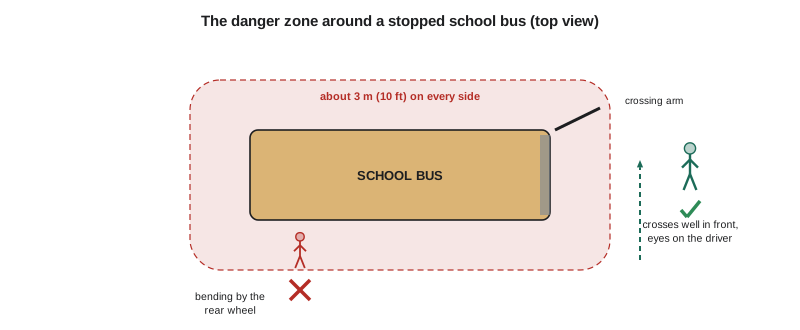
Students are taught a few rules early and repeatedly: wait well back from the curb until the bus has stopped and the door opens; walk at least ten giant steps in front of the bus to cross, after the driver signals; never go back for something dropped near the bus, but tell the driver; check for loose drawstrings and backpack straps that could catch in the door. Kindergarten and Grade 1 students practise these steps with a real bus each September.
Bus loading zones
At school, the loading zone at dismissal is busy with buses, parents' cars, walkers and cyclists all at once. Willow Park separates them: buses use a dedicated lane along the front of the school, parents use a drop-off loop at the side, and walkers leave by the back gate. Staff on bus duty wear vests, stand where they can see the doors and the road, and keep students behind a painted line until their bus has stopped. The last staff member does not leave the loading zone until every bus has gone and any student who missed their bus is back inside with an adult.
Missed buses and wrong buses are common. Young students are given a colour or animal symbol for their bus, and a staff member checks names against bus lists for kindergarten and Grade 1 at dismissal. If a student misses the bus, the office calls the family; the student is never sent to walk home unless the family agrees.
Bus evacuation and behaviour
Students on regular routes practise a school bus evacuation each year, usually in the fall, so they know how to open the emergency exits and leave quickly and calmly through the front door, the rear door or the windows. The practice includes students with disabilities, whose evacuation plans name who helps them and in what order. Riding rules focus on safety: stay seated facing forward, keep the aisle clear, keep hands and heads inside, use quiet voices so the driver can hear, and follow the driver's instructions. Serious or repeated misbehaviour on the bus is reported to the school, which works with the family and the student transportation consortium to address it.
Charter buses for trips
For trips, the board uses only approved bus operators, who must hold the operating authority required for commercial carriers in Ontario, keep vehicles inspected and use drivers with the right licence class and a clean record. The trip leader confirms the booking, the pick-up time and place, the number of passengers and the route, including stops. On the day, the leader checks that the bus is the one booked, asks the driver to brief students on emergency exits and seat belts if fitted, and does a head count before the bus leaves and at every stop.
Vans and private vehicles
Small vans and private cars give flexibility for small groups, sports teams and students with mobility needs, but they carry more risk than buses and need tighter rules. The board's policy is typical:
- Vehicles that carry more than ten passengers, such as large 15-passenger vans, are not used, because they are more likely to roll over and are not built to school bus standards.
- Staff driving board-owned or rented vehicles must hold a valid licence with a clean driving record, complete the board's driver training, and take breaks on longer drives.
- Volunteer drivers using their own cars must be approved in advance: a valid licence, a driver's abstract showing a clean record, proof of insurance with at least the liability amount the board requires, and a signed driver form.
- Every student wears a seat belt, and younger students use booster seats as Ontario law requires: generally until they are eight years old, weigh 36 kilograms or are 145 centimetres tall.
- No driver transports a single student alone unless the family has agreed in writing and the principal has approved it.
- Drivers go directly to the destination, follow the planned route and do not carry students in vehicles with fewer seat belts than passengers.
Walking trips and public transit
Walking to a nearby park, library or store is a simple trip, but it still needs a plan. The route is checked in advance for busy crossings and narrow sidewalks. Students walk in pairs with an adult at the front and an adult at the back, cross only at lights or marked crossings with an adult stepping out first, and are counted at each crossing. Younger classes often use a walking rope or wear the same coloured vests. Public transit trips add crowded platforms, doors that close on a timer and the risk of students being separated. The leader briefs students on what to do if they are left on or off a train: stay where they are, or get off at the next stop and wait on the platform, and tell a transit employee. Every student carries a card with the teacher's phone number and the school's name.
Head counts
Every transport plan depends on knowing that every student is where they should be. Losing a student at a rest stop, leaving one asleep on a bus or not noticing that one boarded the wrong bus are among the most serious and most preventable trip failures. The board requires named head counts, not just counting bodies: each adult checks the names on their group list at departure, at every transfer and stop, and on return. Two counts by different adults are needed before a bus leaves any stop, and the driver walks the bus at the end of every trip to check for anyone left on board.
The program below compares the names checked at each stop of a trip with the trip list and reports anyone missing or unexpected, which is how the trip app Willow Park uses works behind the scenes.
# Named head counts: compare check-ins at each stop with the trip list.
trip_list = {"Ava", "Ben", "Chloe", "Dev", "Ella", "Finn", "Grace", "Hugo"}
checkins = {
    "Depart school":  {"Ava", "Ben", "Chloe", "Dev", "Ella", "Finn", "Grace", "Hugo"},
    "Arrive museum":  {"Ava", "Ben", "Chloe", "Dev", "Ella", "Finn", "Grace", "Hugo"},
    "Leave museum":   {"Ava", "Ben", "Chloe", "Dev", "Ella", "Grace", "Hugo", "Sam"},
}
for stop, seen in checkins.items():
    missing = sorted(trip_list - seen)
    extra = sorted(seen - trip_list)
    status = "all present" if not missing and not extra else f"MISSING {missing} EXTRA {extra}"
print(f"{stop:15} {len(seen)} counted {status}")Depart school 8 counted all present Arrive museum 8 counted all present Leave museum 8 counted MISSING ['Finn'] EXTRA ['Sam']
The count leaving the museum is still eight, which is exactly why counting heads is not enough. Finn is missing, and Sam, a student from another school's group in the same lobby, has wandered onto the list. A named check catches both problems before the bus leaves.
Worked problem
The student left at the rest stop
Show solution
- Returning from a Grade 8 trip to the capital, the bus stops at a highway service centre for twenty minutes. The group has 52 students and five adults.
- At the end of the stop, the adults count 52 heads on the bus. One adult realizes the count includes a student who boarded from a different school group sharing the service centre.
- A named check against the group lists shows that one of their own students, Lily, is missing. She is found in the washroom line inside, waiting with a friend from the other school.
- The trip leader asks the other school's teacher to take her student back, and the bus leaves with the right 52 students.
- The trip report recommends that each adult checks names, not numbers, and that the group uses a single meeting point inside the service centre ten minutes before departure.
Answer: Counting heads gave the right number with the wrong people; a named check against each adult's list found the missing student.
When something goes wrong on the road
Breakdowns, crashes and bad weather happen to school groups too, and the trip leader needs to know the plan before the bus leaves. The board's trip binder includes a one-page road emergency card:
- Breakdown: students stay on the bus unless the driver or emergency services say it is unsafe, such as smoke, fuel leaking or the bus stopped in a dangerous spot. If they must get off, they leave by the door away from traffic and wait well off the road, behind a barrier if there is one, while adults take a named head count. The leader calls the school and the bus company, which sends a replacement.
- Crash: the driver and leader check for injuries, call 911 if anyone is hurt, keep students seated unless there is fire or another danger, and do a named head count. The leader calls the principal, who contacts families, and nobody posts details or photos online. Every student involved is checked, because some injuries show up later.
- Weather: the board cancels buses and trips when roads are unsafe. A trip leader who sees conditions worsening during the day talks with the driver and the principal about leaving early, waiting it out at a safe stop, or staying overnight in an emergency.
- Student illness: a student who becomes unwell on the bus is seated near the front with an adult; for anything serious, the bus stops safely and the leader calls 911.
Leaders carry the group list with emergency contacts, medical plans and medications, a fully charged phone and a backup battery, and the bus company's dispatch number. On long trips in winter, the board also asks the operator to confirm the bus carries blankets and that students bring warm clothing, even when the forecast looks fine.
Common mistakes
MistakeLetting young students cross close in front of the bus.
InsteadTeach them to cross at least ten giant steps ahead after the driver signals.
MistakeCounting heads instead of checking names.
InsteadEach adult checks the names on their group list at every stop.
MistakeUsing a 15-passenger van for a team trip.
InsteadUse buses or vehicles that carry ten passengers or fewer, as policy requires.
MistakeAsking a parent to drive students without approval.
InsteadApprove volunteer drivers in advance: licence, record, insurance and forms.
MistakeLeaving the loading zone before every bus has gone.
InsteadStay until the last bus leaves and any student who missed it is inside with an adult.
Summary and key terms
- Most serious school bus injuries happen outside the bus, in the danger zone around it.
- Students learn to wait back, cross well in front and never retrieve dropped items near the bus.
- Loading zones separate buses, cars and walkers, with staff on duty until the last bus leaves.
- Charter operators must be approved and licensed, and leaders check the bus and brief students.
- Vans over ten passengers are not used; volunteer drivers must be approved and use seat belts and booster seats.
- Named head counts at every stop catch missing and extra students.
- Danger zone
- The area around a stopped bus, about three metres on every side, where the driver may not see a child.
- Loading zone
- The area where students board and leave buses, supervised by staff at school.
- Named head count
- A check of each student's name against a group list, rather than a count of bodies.
- Driver's abstract
- A record of a driver's convictions and suspensions, used to approve volunteer drivers.
- Booster seat
- A seat that raises a child so the adult seat belt fits correctly.
Practice problems
Work each problem on paper first, then reveal the answer to check.
Where do most serious school bus injuries happen?
Show answer
Outside the bus, in the danger zone around it, often while boarding, leaving or crossing.
What should a student do if they drop something near the bus?
Show answer
Leave it and tell the driver; never bend down near the bus to pick it up.
Why does the board not use 15-passenger vans?
Show answer
They are more likely to roll over and are not built to school bus standards.
What must a volunteer driver provide before driving students?
Show answer
A valid licence, a clean driving record, proof of insurance and a signed driver form.
At the museum, the count was eight but the list did not match. What does that show?
Show answer
Counting heads can hide a missing student and an extra one; names must be checked.
Lesson quiz · 5 questions
Score 60% or more to complete this lesson.
Create a free account to save your progress, take quizzes and earn a certificate.