
HSE-363 · Lesson 4 of 12 · 21 min
Supervision ratios and planning
How many adults are enough? It is one of the first questions staff ask when planning recess duty, a gym class, a museum trip or a canoe expedition, and one of the most common questions in an injury review. There is no single number that works everywhere. The right ratio depends on the students, the activity, the site and the skills of the adults. This lesson explains how the board sets ratios, how schools plan duty schedules and trip staffing around them, how volunteers fit in, and what happens when an adult is missing on the day.
Why there is no single legal ratio
Ontario law does not set a general student-to-adult ratio for supervision in schools. Class size rules govern how many students are in a class, but they are not safety ratios. Instead, the duty under Regulation 298 to provide supervision is met through board policies and recognized guidelines, especially the Ophea safety standards for physical activity, which set out supervision levels and, for higher-risk activities such as swimming, skating and canoeing, specific ratios and qualifications. Where an activity has a ratio in those standards, the board treats it as the minimum.
The board's ratios are minimums, not targets. A plan can always add adults, and it should when the factors from lesson 1 point that way: younger students, a riskier activity, an unfamiliar site, students with known needs, or adults who are new to the activity.
The board's ratio table
The table below shows the board's minimum ratios for common situations. The numbers are the board's own; other boards and districts use similar, but not identical, figures. 'Adult' means a staff member or an approved volunteer, and every outing must include at least one staff member who is in charge.
| Situation | Kindergarten to Grade 3 | Grade 4 to Grade 8 | Grade 9 to Grade 12 |
|---|---|---|---|
| Recess or lunch, per zone | 1 per 50, at least 2 adults in the yard | 1 per 75, at least 2 adults | Hallway and cafeteria duty by schedule |
| Day trip, low risk (museum, theatre) | 1 per 6 | 1 per 10 | 1 per 15 |
| Day trip, moderate risk (farm, hike on marked trails) | 1 per 5 | 1 per 8 | 1 per 12 |
| Swimming at a supervised pool | 1 per 4 in the water area, plus lifeguards | 1 per 8, plus lifeguards | 1 per 12, plus lifeguards |
| Overnight trip | Not offered | 1 per 8, at least 2 adults of different genders where students of different genders attend | 1 per 10, same rule |
| Canoe or wilderness trip | Not offered | Not offered | 1 per 6, with certified leaders; never fewer than 2 adults |
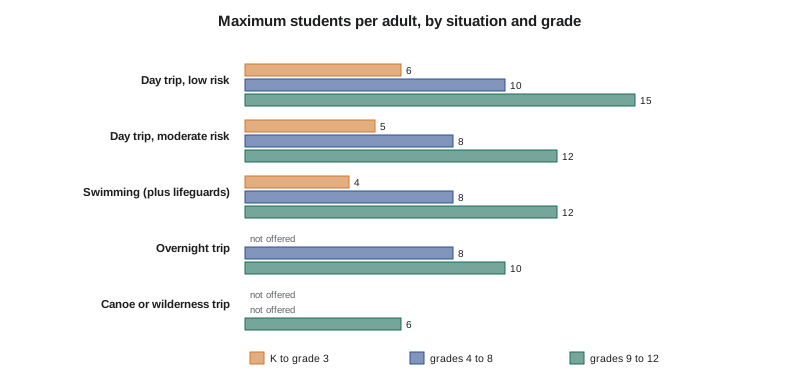
Two rules in the table deserve special attention. First, there must always be at least two adults on any outing, so that one can deal with an emergency while the other stays with the group. A single teacher with a class on a trip has nobody to send for help and nobody to watch the others while they care for an injured student. Second, for overnight trips, the adult team must be able to supervise sleeping areas appropriately, which usually means adults of more than one gender when the group includes students of more than one gender.
Students who need more support
Ratios assume a typical group. When a class includes students who need more support, the planning has to account for them separately. A student with a one-to-one support plan, a student with a history of running away, or a student with a medical condition who needs an adult close by is not part of the general ratio. Willow Park plans these students first and then calculates the general ratio for the rest of the class.
This is not optional. The Ontario Human Rights Code requires boards to include students with disabilities in trips and activities with appropriate accommodation, and a student's Individual Education Plan (IEP) may already describe the support they need. Leaving a student behind because there is no extra adult is a last resort and must be discussed with the family and the principal well in advance.
Planning staff numbers for a trip
Aaron Fisk is planning a day trip to a conservation area for his Grade 6 class of 27. The program below calculates the adults he needs, starting with students who need their own adult and then applying the board's ratio for a moderate-risk trip to the rest, and making sure the minimum of two adults and at least one staff member is met.
import math
# Adults needed for a trip: individual supports first, then the general ratio.
def adults_needed(students, one_to_one, ratio, min_adults=2):
    general = students - one_to_one
    for_general = math.ceil(general / ratio)
    total = max(one_to_one + for_general, min_adults)
    return one_to_one, for_general, total

trips = [
    ("Grade 6 conservation area (moderate)", 27, 1, 8),
    ("Grade 2 museum visit (low risk)",      22, 2, 6),
    ("Grade 11 canoe trip (wilderness)",      16, 0, 6),
]
for name, n, ones, ratio in trips:
    a, b, t = adults_needed(n, ones, ratio)
print(f"{name:38} {n} students: {a} individual + {b} general = {t} adults")Grade 6 conservation area (moderate) 27 students: 1 individual + 4 general = 5 adults Grade 2 museum visit (low risk) 22 students: 2 individual + 4 general = 6 adults Grade 11 canoe trip (wilderness) 16 students: 0 individual + 3 general = 3 adults
Aaron needs five adults: one assigned to a student in his class with a one-to-one plan, and four for the other 26 students at one adult for every eight. The Grade 2 museum visit needs six, and the canoe trip needs three, though the board's canoe rules add other requirements covered in lesson 7, such as certified leaders. The calculation is the starting point; the trip plan then assigns each adult a named group of students and a role.
Volunteers
Parents and community volunteers make many trips and events possible, but they are not staff, and the board treats them differently in several ways:
- Every volunteer who works directly with students must provide a vulnerable sector check, the police record check used for people working with children, before their first activity, and an offence declaration each year after that.
- Volunteers receive a short briefing before each trip: the schedule, their group, the rules, the meeting points, what to do if a student is missing or hurt, and how to reach the teacher in charge.
- Volunteers are not left alone with a single student out of sight of others, do not give medication except an epinephrine auto-injector in an emergency if trained, and do not discipline students beyond redirecting them. They report problems to the teacher.
- Volunteers do not drive students in their own vehicles unless the board's driver requirements are met, which are covered in lesson 5.
A volunteer's own child in the group is a common complication. Parents naturally focus on their own child. Willow Park assigns parent volunteers to a group that does not include their child whenever possible, and makes sure every volunteer understands that they are responsible for the whole group assigned to them.
Duty schedules
Inside the school, supervision is organized through duty schedules for the yard, hallways, lunchroom, bus loop and before and after school. A good schedule does four things: it covers every place and time where students are present; it puts more adults where and when the risk is higher; it is posted where everyone can see it; and it names who covers when someone is absent.
Duty schedules also have to respect collective agreements, which in Ontario often limit the minutes of supervision teachers can be assigned each week. Principals balance these limits by using support staff, lunchroom supervisors and administrators, and by adjusting bell times. The supervision still has to happen; the agreements affect who does it.
Absences are where schedules most often fail. A supply teacher who does not know about yard duty leaves a zone empty. Willow Park's daily absence sheet lists each absent staff member's duties alongside their classes, the office assigns cover before the first bell, and every supply teacher folder includes the duty schedule, the yard map and the medical alert card.
When an adult is missing on the day
Even with careful planning, a volunteer cancels the night before a trip or a staff member calls in sick. The board's rule is that the ratio is met on the day or the plan changes. The options, in order, are to find a replacement adult, to reduce the riskier parts of the trip, to split the group so part stays at school with another teacher, or to postpone. Going ahead with fewer adults than the minimum is not one of the options.
Worked problem
The volunteer who did not come
Show solution
- On the morning of the conservation area trip, one of Aaron's four parent volunteers texts that her car will not start.
- With one fewer adult, Aaron would have three adults for the general group of 26 students: about nine students per adult, above the board ratio of eight for a moderate-risk trip.
- He tells Priya Nair, who checks the office list of cleared volunteers and calls two. One can come and arrives before the bus leaves.
- Aaron gives her the volunteer briefing, a list of her five students, the schedule and his phone number.
- If no replacement had been found, the plan was to skip the off-trail pond study and keep the whole class together on the main trail with the remaining adults, or to postpone.
Answer: The ratio is met on the day or the plan changes; a backup list of cleared volunteers and a prepared fallback make the decision quick.
Events outside the school day
Dances, concerts, games, open houses and graduation events bring large crowds, families, younger siblings and visitors into the school, often in the evening. They need their own supervision plan, because the usual duty schedule does not apply. Marion Clarke's checklist for evening events at Pinecrest Secondary School covers:
- Staff numbers based on expected attendance, with a staff member in charge and a second administrator or senior staff member as backup.
- Assigned posts: entrances, washrooms, the gym floor, the parking lot at the end, and a roaming pair.
- Clear rules on who may attend, such as students of the school and signed-in guests for dances, and on re-entry once someone leaves.
- A plan for students who arrive or appear impaired, including calling the family and, where there is a medical concern, calling 911.
- First aid supplies, an AED within reach and a list of students with medical plans who are likely to attend.
- A plan for the end of the event: lights on, supervised exits, staff staying until the last student has been picked up or has left as permitted by the family.
The two-adult principle and professional boundaries
Good supervision also protects students from harm by adults. Most staff and volunteers are trustworthy, but abuse in schools and youth programs has repeatedly happened where one adult could be alone with a child for long periods, out of sight of others. The board follows a two-adult principle wherever practical: interactions with individual students happen where other people can see or hear, with the door open or a window in the door, and private conversations take place in visible spaces such as a corner of the library or an office with a glass panel.
When a one-to-one situation cannot be avoided, such as a student who needs help in the washroom or a counselling conversation, the staff member follows the student's plan, tells another adult where they are, and keeps records where required. Staff do not drive individual students home, communicate with students through personal social media or private messaging, or give students personal gifts, except as the board's policy allows. These rules protect students and they also protect staff from false allegations.
If a staff member sees another adult breaking these boundaries, or has reason to suspect a student is being harmed by anyone, they report it. In Ontario, the duty to report suspected abuse goes directly to a children's aid society and cannot be passed to the principal instead. The board also expects staff to tell the principal.
Common mistakes
MistakeTreating the minimum ratio as the target.
InsteadAdd adults when age, risk, site or individual needs call for it.
MistakeCounting a student with a one-to-one plan in the general ratio.
InsteadPlan individual supports first, then apply the ratio to the rest.
MistakeRunning a trip with only one adult.
InsteadAlways have at least two adults, so one can handle an emergency.
MistakeGiving volunteers a group without a briefing.
InsteadBrief every volunteer on the plan, the rules and emergencies.
MistakeGoing ahead with fewer adults than the minimum.
InsteadFind a replacement, scale back, split the group or postpone.
Summary and key terms
- There is no single legal ratio; board policy and recognized guidelines set minimums.
- Ratios tighten as students get younger and activities get riskier.
- Every outing needs at least two adults, including a staff member in charge.
- Students who need individual support are planned first, outside the general ratio.
- Volunteers need checks, briefings and clear limits on their role.
- Duty schedules must cover every place and time, including absences, and the ratio is met on the day or the plan changes.
- Supervision ratio
- The maximum number of students one adult may supervise in a given situation.
- Record check
- A police record or background check for people who will work with children, required before volunteering.
- One-to-one support
- An adult assigned to a single student who needs constant support.
- Duty schedule
- The posted plan showing which adult supervises which area at each time.
- Elopement
- A student leaving a supervised area without permission, often suddenly.
Practice problems
Work each problem on paper first, then reveal the answer to check.
Why must every outing have at least two adults?
Show answer
So one can deal with an emergency while the other stays with the group.
A class of 22 Grade 2 students includes two with one-to-one plans. Using a ratio of 1 per 6, how many adults are needed?
Show answer
Two for the individual plans plus four for the other 20 students, so six adults.
Name two limits on what volunteers do.
Show answer
Any two of: not alone with one student out of sight, no medication except emergency epinephrine if trained, no discipline beyond redirecting, no driving unless requirements are met.
What did Willow Park add to every supply teacher folder?
Show answer
The duty schedule, the yard map and the medical alert card.
A volunteer cancels and the ratio cannot be met. What are the options?
Show answer
Find a replacement, scale back the riskier parts, split the group, or postpone.
Lesson quiz · 5 questions
Score 60% or more to complete this lesson.
Create a free account to save your progress, take quizzes and earn a certificate.