
HSE-363 · Lesson 10 of 12 · 20 min
Medications at school and on trips
Many students take medication during the school day: stimulants for ADHD at lunch, antibiotics for a week, inhalers before gym, insulin before meals, seizure medications, antidepressants, and emergency medications that may never be used. On trips, especially overnight trips, staff may be responsible for doses that families normally handle at home. Medication errors in schools are usually small, such as a missed dose or a dose given late, but some are serious: the wrong student's medication, a double dose, or a controlled drug that goes missing. This lesson covers how the board handles medication safely, both in the building and away from it.
The rules for giving medication
Ontario does not have a single law that sets out how schools give medication, apart from the specific rules for anaphylaxis and asthma. PPM 161 and the board medication procedure fill that gap. Staff give medication only when the family has completed and signed a medication authorization form, and, for prescription medication, the medication comes in the pharmacy's original container with a label showing the student's name, the medication, the dose and the times. The board does not give a first dose of a new medication at school, so that any reaction happens at home. Staff do not give over-the-counter medication, such as pain relievers, without the same written request, and never give medication from their own supply.
Medication is given by staff who have been trained by the board and named on the student's form or plan. Few Ontario schools have a nurse on staff, so the principal assigns and oversees the trained staff, with advice from families and public health nurses where needed.
The five rights
Health care workers use a simple check before giving any medication, often called the five rights. The board trains staff to use the same check every time:
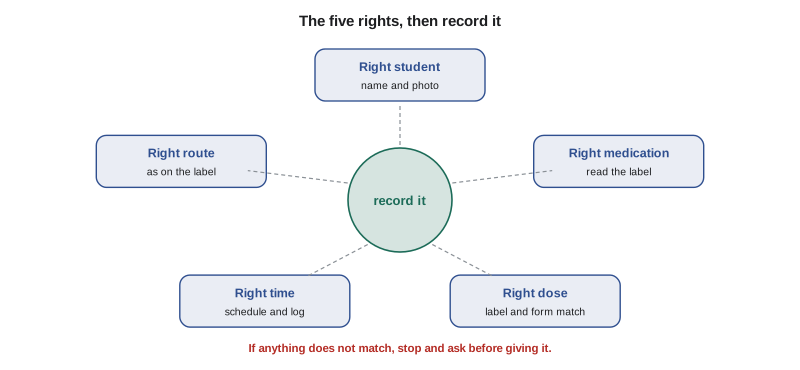
- Right student: confirm the student's identity using their name and photo, not just by recognizing them. In a busy office at lunch, two students named Liam can be at the counter at the same time.
- Right medication: read the pharmacy label and match it to the form.
- Right dose: give exactly the dose on the label and form. If the dose has changed, the family provides a new label and form before staff give the new dose.
- Right time: check the schedule and the medication log to make sure the dose has not already been given and is due now.
- Right route: by mouth, inhaled, injected or applied, as labelled.
After giving the medication, staff record it at once in the medication log: date, time, dose, and their initials. If anything does not match, the label is unclear, the student says 'this pill looks different', or the log shows a dose already given, staff stop and check with the family or the principal before giving anything.
Storage
Most medication is stored in a locked cabinet in the office or health room, so that students cannot get into other students' medication. Emergency medications are the exception. Epinephrine auto-injectors, reliever inhalers, glucose and seizure rescue medication must be reachable in seconds, so they are carried by the student when the plan allows, or kept in an unlocked, clearly marked location known to staff, such as a labelled pouch in the classroom. Medications that need refrigeration, such as some insulin, are kept in a dedicated fridge, not with staff lunches.
Controlled medications, such as stimulants for ADHD, need extra care because they are sometimes misused or sold. The board counts them when they arrive from the family, with the family member present, stores them double-locked, and keeps a running count in the log. Any discrepancy is reported to the principal the same day.
Self-carry
Students who are old enough and able to manage their own medication may carry it, when the family and the student's health care provider agree. This is the norm for epinephrine auto-injectors and asthma inhalers once students can use them reliably, and common for insulin pumps and diabetes supplies. Students who carry medication are told not to share it, and staff know which students carry what, so they can find it in an emergency. Self-carry of other medications, such as daily pills, is decided case by case, because of the risk of loss, sharing or misuse.
Errors and near misses
Mistakes happen even with good systems. What matters is what happens next. If a student receives the wrong medication or dose, misses a dose, or gets a dose twice, the staff member checks the student and calls 911 if they show any concerning signs, calls Poison Control for advice on what to watch for, tells the principal and the family at once, and writes an incident report. The board treats medication errors and near misses, such as catching a wrong dose just before giving it, as chances to fix systems, not to blame individuals. Common fixes include photos on every log page, a 'do not disturb' rule while preparing doses, and keeping look-alike medications on separate shelves.
Medication on trips
Trips move medication out of the controlled setting of the office into backpacks, buses and cabins, and they bring doses that are normally given at home. The board's trip procedure covers:
- Planning: the leader lists every student who takes medication during the trip hours, including morning and evening doses for overnight trips, and confirms the form and supply for each.
- Packing: each student's medication goes in a labelled bag with its original container, the form, and a copy of the log page. Emergency medication travels with the student or the assigned adult, never in luggage under the bus.
- Carrying: one named adult is responsible for daily medications and their log. Controlled medications are counted at departure and on return, and kept locked, for example in a lockable pouch.
- Timing: doses are given at the times on the label, adjusted for travel only with the family's written direction. On trips across time zones, the leader works out the schedule in advance with families.
- Temperature: insulin and some other medications must not get too hot or freeze. They are kept out of hot buses, tents and car dashboards and in insulated cases.
- Return: unused medication is returned to the family, with the log, and any discrepancy is reported.
Leah Tremblay's canoe trip includes students who take medication morning and evening. The program below builds her daily medication schedule for the trip and checks it against her log at the end of day two, flagging any dose that was missed.
# Overnight trip medication schedule and log check (invented data).
schedule = {
    "Amara": ["08:00", "20:00"],           # daily antibiotic, 2 doses
    "Ben":   ["07:30"],                    # morning stimulant (controlled)
    "Dana":  ["08:00", "13:00", "20:00"],  # 3 doses with meals
}
log_day2 = {
    "Amara": ["08:05", "20:10"],
    "Ben":   ["07:35"],
    "Dana":  ["08:00", "20:05"],
}
for student, times in schedule.items():
    given = log_day2.get(student, [])
    missed = len(times) - len(given)
    status = "all doses logged" if missed == 0 else f"{missed} dose(s) not logged - check and call family"
    print(f"{student:6} due {len(times)}, logged {len(given)}: {status}")

# controlled medication count for Ben's stimulant
start, given_total, returned = 4, 2, 2
print("Ben count:", "matches" if start - given_total == returned else "DISCREPANCY - report today")Amara due 2, logged 2: all doses logged Ben due 1, logged 1: all doses logged Dana due 3, logged 2: 1 dose(s) not logged - check and call family Ben count: matches
Dana's lunchtime dose on day two was missed; the group was on the water, and the adult with the medication bag was in another canoe. Leah calls Dana's family on the satellite phone for advice, which is to give the next dose at the usual time and not to double up. Her trip report recommends that lunchtime medication always travels in the same canoe as the student who needs it.
Worked problem
The two students named Liam
Show solution
- At lunch, two Grade 4 students named Liam come to the Willow Park office at the same time. One takes a stimulant medication at noon; the other is there to drop off a note.
- The supply teacher office assistant, new to the school, takes the medication bag labelled Liam and starts to hand a pill to the boy closest to the counter.
- She stops to check the photo on the log page, as she was trained, and realizes it is the other Liam.
- She gives the medication to the right student, records it, and tells Priya Nair what nearly happened.
- Priya adds last names in large print to the front of each medication bag, and the school adds the near miss to its training example for new office staff.
Answer: Checking the photo for the right student caught the error before it happened, and reporting the near miss led to a simple system fix.
Teams, clubs and evening events
Medication plans do not stop at 3:30. Students on sports teams, in clubs, at rehearsals and at evening events may need emergency medication or a scheduled dose outside the school day, when the office is closed and the usual staff have gone home. The board expects coaches and club advisors to have the plans for their students, to know who carries an auto-injector or inhaler, and to take a first aid kit and any team emergency medications to every practice and game. For away games, the coach checks that students' emergency medications are packed before the bus leaves, the same as for any trip. A coach who discovers at an away tournament that a student with asthma has left her inhaler at home calls the family before she plays, not after an attack.
Naloxone
Opioid overdoses, including from counterfeit pills, have reached secondary school students. Many Ontario boards now keep naloxone kits in secondary schools and train staff to use them, and the board has a kit in the health room and with the first aid kit at evening events at Pinecrest Secondary School. Naloxone reverses an opioid overdose for a short time and does no harm if the person has not taken opioids, so staff who suspect an overdose give it, call 911, and start rescue breathing or CPR as trained.
Expiry dates and the end of the year
Medications expire, and an expired auto-injector or rescue medication may not work as well when it is needed. Priya Nair checks expiry dates on every medication in the Willow Park office at the start of each month, and families get a reminder a month before a student's medication expires. At the end of the school year, families collect their children's medications. Medication that is not collected is disposed of safely through a pharmacy take-back program, never in the garbage or down the drain, and the disposal is recorded in the log, with two staff members witnessing the disposal of any controlled medication.
Sharps, such as used auto-injectors, insulin pen needles and lancets, go into an approved sharps container in the health room, not the classroom garbage. Used auto-injectors are handed to paramedics, who need to know the dose and time, or placed in the sharps container afterward.
Common mistakes
MistakeGiving medication based on a phone call or a note in a lunch bag.
InsteadGive medication only with a signed form and the original labelled container.
MistakeRecognizing the student instead of checking the photo and name.
InsteadConfirm identity using the name and photo every time.
MistakeLocking emergency medication away with daily medications.
InsteadKeep epinephrine, inhalers, glucose and rescue medication reachable in seconds.
MistakePacking a trip's daily medications in the luggage bay.
InsteadOne named adult carries daily medications and the log; emergency medications stay with the student.
MistakeQuietly fixing a medication mistake without telling anyone.
InsteadCheck the student, call for advice, tell the principal and family, and report it.
Summary and key terms
- Medication is given only with a signed form and the original labelled container, by trained, named staff.
- The five rights are checked every time: student, medication, dose, time and route, followed by recording.
- Daily medications are locked away; emergency medications are reachable in seconds.
- Controlled medications are counted on arrival, double-locked and tracked with a running count.
- Errors and near misses are reported and used to fix systems.
- On trips, one adult carries daily medications and the log, timing and temperature are planned, and counts are reconciled on return.
- Medication authorization form
- The signed request from a family, and where required a prescriber, to give a medication at school.
- Five rights
- Right student, right medication, right dose, right time and right route.
- Medication log
- The record of every dose given: date, time, dose and initials.
- Controlled medication
- A medication with a risk of misuse, such as stimulants, needing extra storage and counting rules.
- Near miss
- An error caught before it reached the student, reported so the system can be improved.
Practice problems
Work each problem on paper first, then reveal the answer to check.
Why does the board not give the first dose of a new medication at school?
Show answer
So that any reaction to the new medication happens at home, with the family.
List the five rights.
Show answer
Right student, right medication, right dose, right time and right route.
Which medications are not locked away, and why?
Show answer
Emergency medications such as epinephrine, inhalers, glucose and seizure rescue medication, because they must be reachable in seconds.
What should staff do if a student receives the wrong dose?
Show answer
Check the student, call 911 if there are concerning signs, call Poison Control, tell the principal and family, and report it.
What change did Leah recommend after Dana's missed dose?
Show answer
Lunchtime medication always travels in the same canoe as the student who needs it.
Lesson quiz · 5 questions
Score 60% or more to complete this lesson.
Create a free account to save your progress, take quizzes and earn a certificate.