
HSE-363 · Lesson 3 of 12 · 21 min
Active supervision: classrooms, hallways and yard duty
Most of the supervision students receive happens in ordinary places at ordinary times: the yard before school, the hallways between classes, the lunchroom, the washrooms, the gym change rooms and the bus loop at dismissal. These are also the places where most student injuries and most conflicts happen, because students are moving, unstructured and mixed across ages. This lesson is about supervising those spaces well. The core idea is active supervision: adults who are positioned well, moving, scanning and engaging with students, instead of standing in one place waiting for something to go wrong.
Levels of supervision
Safety guidelines for schools describe supervision in levels, so that staff and plans can be precise about what is expected. The board uses three:
| Level | What it means | Examples |
|---|---|---|
| Constant visual supervision | The adult is physically present and watching the activity at all times, close enough to step in immediately. | Swimming, rock climbing, trampoline, early stages of a gymnastics skill, a student on a one-to-one plan |
| On-site supervision | The adult is present at the activity area but does not have to watch every student every second; they move around and are immediately available. | A class doing a lab, a ball game in the gym, students working in groups in a shop |
| In-the-area supervision | The adult is nearby, readily accessible and checks in regularly, but is not always in sight of every student. | Students running laps around the school, a group of senior students doing a scavenger hunt on school grounds, cross-country course practice |
The level comes from the same factors covered in lesson 1: the students' age and ability, the activity's risk, the site and the group size. A plan that simply says 'supervised' is not specific enough. A plan that says 'constant visual supervision at the climbing wall, on-site supervision at the other stations' tells everyone what is expected.
The five habits of active supervision
Research in schools and child care has identified a handful of habits that make supervision work. They are easy to describe and take practice to do consistently:
- Position: stand where you can see the most students and the riskiest areas, with your back to a wall or fence rather than to the group. Avoid clustering with other supervisors.
- Move: walk unpredictable routes through your zone. Students behave differently when an adult might appear at any moment.
- Scan: look across the whole area every few seconds, and look up and around rather than at one game or one conversation.
- Interact: greet students, ask how things are going, praise good play and step in early when a game starts to get rough. Students who know an adult are more likely to report problems.
- Anticipate: know the hot spots and the times when trouble usually starts, such as the first minutes after the bell, the end of lunch, the arrival of a new game or a change in weather.
Phones are the most common obstacle to all five habits. The board's rule is that personal phone use is not part of duty time. A phone is carried for emergencies and to call the office, not to check messages. A supervisor who is looking at a screen is not scanning.
Yard duty
Recess and before-school yard duty are where active supervision matters most, especially in elementary schools. Willow Park's yard has a paved area for ball games, a creative play structure, a field, a small wooded area along the fence and a portable classroom near the back gate. The school divides the yard into zones and assigns a supervisor to each, with the busiest zones staffed more heavily.
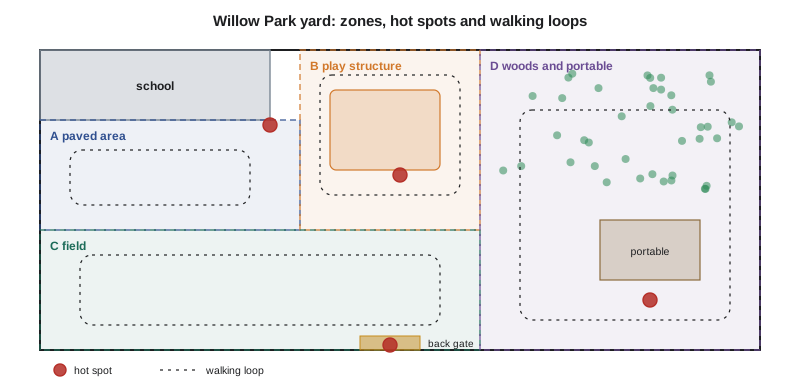
Every yard supervisor at Willow Park carries the same kit: a high-visibility vest so students can find an adult quickly, a phone or radio to reach the office, a small first aid pouch with gloves, and a laminated card listing students in the yard who have life-threatening allergies, seizure plans or other medical alerts, with where their medication is kept. The supervisor arrives on time, because the minutes before an adult arrives are when the roughest play happens, and does not leave until the next supervisor or the bell takes over.
Yard rules work best when they are few, clear and enforced consistently by everyone. Willow Park's include: stay inside the fence; no tackling or play fighting; one person at a time at the top of the slide; snowballs only at the target wall; come to an adult right away if someone is hurt. When a game is getting too rough, the supervisor stops it early and calmly, before someone is hurt, instead of waiting for tears.
Weather changes the yard. Ice on the paved area, deep snow at the fence line, slippery play equipment after freezing rain, extreme cold, heat and poor air quality all require decisions about whether to go out, how long to stay out and which areas to close. The board sets thresholds for indoor recess based on wind chill, the humidex and the Air Quality Health Index (AQHI), and the principal makes the call each day. Supervisors close icy areas with cones and report hazards to the custodian right away.
Indoor recess needs supervision too. A classroom of Grade 3 students with nowhere to run is not unsupervised just because they are indoors. The board assigns indoor recess supervisors, often by having one adult cover two adjacent rooms with the door open between them, and keeps a set of quiet indoor activities in each room.
Hallways, washrooms and change rooms
In secondary schools, the hallways between classes are the largest unstructured space. Teachers at Pinecrest Secondary School are expected to stand at their classroom doors during class changes, where they can see the hallway and the room at the same time. This simple habit cuts down on pushing, crowding at stairwells and late arrivals, and puts an adult within a few metres of almost every student.
Washrooms and change rooms raise a particular tension between supervision and privacy. Staff should not watch students change, but these rooms are also where bullying, vaping and assaults can happen. The board's approach is to supervise the entrance and the common area, to check in by voice before entering, to enter promptly if there is noise or a report of trouble, and to have a second adult present or nearby whenever possible. Gym teachers stagger class endings so that change rooms are not crowded and the teacher can be at the door.
The lunchroom
At Willow Park, students eat in their classrooms with lunchroom supervisors moving between rooms, while Pinecrest Secondary School has a cafeteria. Either way, the lunchroom combines crowding, food, allergies and choking risks. Supervisors know which students have severe food allergies and where their epinephrine auto-injectors are, discourage food sharing, make sure younger students sit while eating, and know how to respond to choking. In elementary schools, the board expects the classroom teacher to brief lunchroom supervisors on any student in the room with a medical plan.
Leaving a class
A teacher who leaves a class alone, even briefly, leaves a gap in supervision. If a teacher must leave, for example to deal with an injured student in the hallway, the board expects them to get another adult to cover first, using the classroom phone or by asking a neighbouring teacher to keep an eye on both rooms. Sending a student to the office with a message is acceptable for routine matters, but younger students should go in pairs, and a student who is upset, injured or unwell is always accompanied by an adult or escorted by a responsible pair to an adult.
Dismissal and release
The end of the day is a high-risk time, especially for young children. Willow Park releases kindergarten and Grade 1 students only to a known adult, keeps a list of authorized pickups and any custody orders in the office, and keeps any child whose adult has not arrived inside with a staff member until someone authorized comes. Staff do not release a child to someone not on the list, even a familiar-looking relative, without confirming with the parent or guardian. If an adult arriving to pick up a child appears impaired, staff delay release, try to reach another authorized adult, and call police if the adult insists on driving away with the child.
Measuring coverage
Willow Park's principal wanted to know whether one supervisor per zone was enough. The program below estimates, for each zone, how long a supervisor takes to walk the loop and the longest time any part of the zone goes unobserved, assuming the supervisor can see well within a radius of about 20 metres.
# Yard zone coverage: walking-loop time and longest unobserved gap (invented measurements).
WALK = 1.0       # m/s, a slow walking pace while scanning
SEE = 20         # m, radius within which a supervisor reliably sees what is happening
zones = {
    "A paved area":     {"loop_m": 90,  "far_point_m": 18},
    "B play structure": {"loop_m": 60,  "far_point_m": 12},
    "C field and gate": {"loop_m": 260, "far_point_m": 55},
    "D woods/portable": {"loop_m": 140, "far_point_m": 30},
}
for z, d in zones.items():
    loop_t = d["loop_m"] / WALK
    # if the far point is beyond sight from the loop, it is only seen once per loop
    gap = 0 if d["far_point_m"] <= SEE else loop_t
    note = "always in view" if gap == 0 else f"far point unseen for up to {gap/60:.1f} min"
print(f"{z:18} loop {loop_t/60:4.1f} min {note}")A paved area loop 1.5 min always in view B play structure loop 1.0 min always in view C field and gate loop 4.3 min far point unseen for up to 4.3 min D woods/portable loop 2.3 min far point unseen for up to 2.3 min
Zones A and B are small enough that one supervisor sees everything from the loop. Zone C, the field with the back gate, has parts that go unseen for more than four minutes, and zone D has the area behind the portable unseen for more than two. The school added a second supervisor in zone C during lunch recess, when the field is busiest, and moved zone D's loop so the supervisor walks behind the portable each time.
Worked problem
The game that kept getting rougher
Show solution
- During lunch recess at Willow Park, a group of Grade 5 students starts a tag game near the play structure that turns into tackling.
- Aaron Fisk, on duty in zone B, sees it on his scan, walks over and stops the game calmly before anyone is hurt. He reminds the group of the no-tackling rule and suggests a different game.
- Ten minutes later, he sees the same group drifting toward the wooded strip, where zone D's supervisor is on the far side of the portable. He radios her, and she changes her loop.
- After recess, he tells the students' teacher, who talks with the group about the rule.
- At the next staff meeting, the yard team agrees that tag games stay on the paved area, where they are easier to watch.
Answer: Scanning caught the game early, interaction stopped it before an injury, communication covered a gap in another zone, and the pattern led to a simple rule change.
Students who need more during unstructured time
Recess and lunch are often the hardest parts of the day for students with autism, anxiety, impulsivity or communication needs. The noise, the crowding and the lack of structure can lead to meltdowns, wandering or conflict. Willow Park plans for this rather than reacting to it. Jenna Kowalchuk and the resource teacher write a short unstructured-time plan for each student who needs one, and yard supervisors receive a one-page summary at the start of each term:
- Who the student is, with a photo, and which adult is assigned to them at recess, if any.
- What the student enjoys and where they are usually calm, such as the swings or the quiet bench.
- Early signs of distress, such as covering ears, pacing or heading for the fence.
- What helps, such as a choice of two activities, a quiet space indoors or a short walk with an adult.
- What to do if the student leaves the yard, including who to call and the route they usually take.
Students who are known to run, sometimes called elopement, need a plan that names who watches them at transitions, which gates are kept closed, and how the office is alerted. The first minutes after a student is missing are the most important, so Willow Park practises a missing-student procedure with yard staff each fall: one adult searches the student's known routes, the office calls the family and police at once if the student is not found quickly, and the rest of the yard continues to be supervised.
Common mistakes
MistakeStanding in one spot near the door, chatting with another supervisor.
InsteadSpread out, move through your zone and scan continuously.
MistakeChecking messages on your phone during duty.
InsteadCarry the phone for emergencies only.
MistakeArriving at yard duty a few minutes late.
InsteadBe in place before students arrive; the first minutes are the roughest.
MistakeLeaving a class alone to deal with a hallway problem.
InsteadGet another adult to cover before you leave the room.
MistakeReleasing a young child to a familiar face who is not on the pickup list.
InsteadConfirm with the parent or guardian before releasing the child.
Summary and key terms
- Constant visual, on-site and in-the-area supervision describe precisely what an activity needs.
- Active supervision means positioning, moving, scanning, interacting and anticipating.
- Yard supervisors arrive on time, wear vests, carry a phone and medical alert card, and enforce a few clear rules.
- Teachers at doorways during class changes put an adult near almost every student.
- Washrooms and change rooms are supervised at the entrance, balancing privacy and safety.
- Classes are never left alone, and young children are released only to authorized adults.
- Active supervision
- Supervising by positioning, moving, scanning, interacting and anticipating, rather than watching from one spot.
- Constant visual supervision
- An adult present and watching the activity at all times, close enough to step in at once.
- On-site supervision
- An adult present at the activity area, moving about and immediately available.
- In-the-area supervision
- An adult nearby and readily accessible who checks in regularly but is not always in sight.
- Hot spot
- A place or time where injuries or conflicts happen more often, needing closer attention.
Practice problems
Work each problem on paper first, then reveal the answer to check.
What are the five habits of active supervision?
Show answer
Position, move, scan, interact and anticipate.
What does a Willow Park yard supervisor carry?
Show answer
A high-visibility vest, a phone or radio, a first aid pouch and a medical alert card.
Why do teachers at Pinecrest Secondary School stand at their doors during class changes?
Show answer
They can see the hallway and the room at once, which reduces crowding and puts an adult near almost every student.
What should a teacher do before leaving the class to deal with a problem in the hallway?
Show answer
Get another adult to cover, such as a neighbouring teacher or the office.
What did the coverage program show about zone C, and what changed?
Show answer
Parts of the field went unseen for over four minutes, so a second supervisor was added at lunch.
Lesson quiz · 5 questions
Score 60% or more to complete this lesson.
Create a free account to save your progress, take quizzes and earn a certificate.