
HSE-363 · Lesson 1 of 12 · 21 min
Duty of care: the careful parent and the standard of care
Every school day, parents hand their children over to adults they may never have met and trust that those adults will keep them reasonably safe. That trust has a legal name: the duty of care. It is the reason a teacher counts heads before a bus leaves a museum, the reason a yard supervisor walks toward a group of students instead of watching from the doorway, and the reason a coach takes an athlete out of a game after a hard hit. This course is about how school staff meet that duty in the places where it is hardest to meet: on the playground, in hallways and lunchrooms, on buses, on field trips and overnight trips, and when a student has a medical condition that could turn serious in minutes.
The course follows staff in the invented Riverbend District School Board, the same setting used in HSE-360, HSE-361 and HSE-362. Pinecrest Secondary School is a 1968 building with about 1,350 students, two gyms, shops and labs, and an outdoor education program that runs canoe and camping trips. Willow Park Elementary is a kindergarten to Grade 8 school with 480 students, a resource room for students with special education needs, a busy playground and a drop-off loop that turns chaotic every morning at 8:40.
The people in this course
- Marion Clarke is the principal of Pinecrest Secondary School.
- Ruth Bellamy is the principal of Willow Park Elementary.
- Sam Whitford teaches physical education at Pinecrest Secondary School and coaches the senior basketball and soccer teams.
- Leah Tremblay teaches outdoor education and geography at Pinecrest Secondary School and leads the canoe trips.
- Aaron Fisk teaches a Grade 6 class at Willow Park and organizes most of its field trips.
- Jenna Kowalchuk is an educational assistant in Willow Park's resource room.
- Priya Nair is Willow Park's office administrator, who keeps the medical plans, the consent forms and the trip binders.
- Daniel Lefebvre is the board's health and safety officer and reviews high-risk trip proposals for all 34 schools.
What the duty of care means
A duty of care is a legal obligation to take reasonable steps to protect another person from harm that you can foresee. It is not a promise that nothing bad will ever happen. Children fall off monkey bars while a supervisor is standing three metres away; a student can twist an ankle on a nature walk that was planned and supervised perfectly. The law does not ask staff to prevent every injury. It asks whether they acted as a reasonable person in their position would have acted, given what they knew or should have known.
Schools owe students a duty of care because of the relationship. Students are required to attend, they are often young, and they are placed under the authority of staff who decide where they go, what they do and how closely they are watched. The older idea behind this is in loco parentis, a Latin phrase meaning 'in the place of a parent'. While a student is in the school's care, staff take on some of the protective role a parent would play.
The careful parent standard
For more than a century, courts in Canada and other Commonwealth countries have described the standard expected of teachers as that of a careful or prudent parent. The idea comes from an 1893 English case and was adopted by the Supreme Court of Canada. The question the court asks is: what would a careful parent have done in these circumstances, with this many children, of this age, doing this activity?
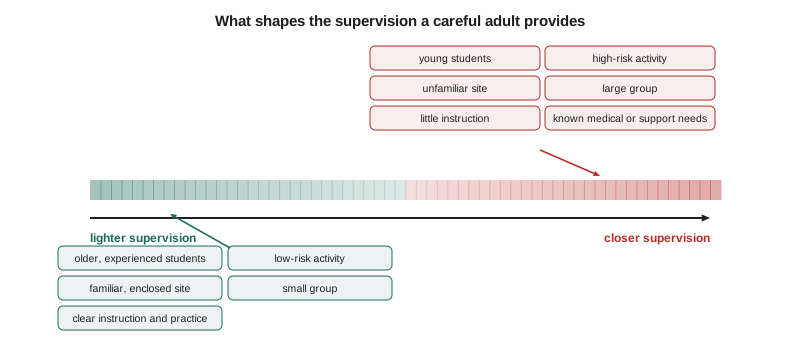
The careful parent standard is flexible on purpose. A careful parent watching one seven-year-old at a public pool behaves differently from a careful parent letting a sixteen-year-old walk to a friend's house. In the same way, the care expected from a teacher depends on the situation. The courts have repeatedly pointed to a set of factors:
- The age, maturity and ability of the students. Younger children need closer supervision; so do students with impulsive behaviour, limited communication or limited awareness of danger.
- The nature of the activity and how dangerous it is. Gymnastics, swimming, shop work and contact sports carry more risk than reading in a library.
- The number of students being supervised and the number of adults.
- The instruction the students have received and how well they have learned it.
- The condition and suitability of the equipment and the site.
- What the staff knew or should have known about particular students, such as a history of seizures, a severe allergy or a habit of wandering off.
- Accepted practice in schools, including the board's own policies and recognized safety guidelines.
The Supreme Court of Canada refined the standard in Myers v. Peel County Board of Education (1981), a case about a student hurt on the gymnastics rings. The court accepted the careful parent test but said it has to be applied with the circumstances in mind, including the number of students, the nature of the exercise, the student's age and skill, the quality of the equipment and the supervision and instruction given. For activities that need special skill, such as gymnastics, the standard also reflects what a teacher with that training is expected to know. We will look at the case more closely in the next lesson.
Duties written into law and policy
In Ontario, the duty of care is also written into legislation. The Education Act makes the principal responsible for the care of pupils and for maintaining proper order and discipline in the school. Regulation 298 sets out duties in more detail. Section 11 requires principals, among other things, to provide for the supervision of pupils during the times when the school buildings and playgrounds are open to them, and to care for pupils and school property. Section 20 requires teachers to carry out the supervisory duties assigned by the principal and to ensure that all reasonable safety procedures are carried out in the courses and activities for which they are responsible. The board adds its own policies on supervision, field trips, medical conditions and concussions, and most Ontario boards follow the Ophea safety standards for physical activity for physical education, sports and outdoor activities.
Policies matter for two reasons. First, they turn the general duty into specific expectations that staff can follow: how many adults go on a trip, what forms must be signed, who carries the epinephrine. Second, in a negligence claim, a court will look at whether staff followed the board's own rules. Breaking a written policy is not automatically negligence, and following it is not automatically a defence, but a policy is strong evidence of what reasonable care looks like in that board.
When the duty begins and ends
The duty of care is not limited to the bell schedule or the classroom. It follows the relationship. The board treats staff as responsible for students in all of these situations:
- From the time the school yard is supervised in the morning until students are dismissed, including recess, lunch and class changes.
- On school buses and at bus loading zones, shared with the bus company and driver.
- On field trips, sports trips, overnight trips and outdoor education programs, from the moment students gather until they are picked up at the agreed time and place.
- At school-sponsored events outside school hours, such as dances, concerts, games and club meetings.
- In virtual learning, where staff still have duties to respond to bullying, threats and disclosures of harm.
The edges are where problems tend to arise. A school that opens its doors at 8:00 but has no supervisor in the yard until 8:25 has a gap; so does a team that finishes practice at 5:30 when one student's ride is late. The board's rule is simple to state: if the school has set up a situation in which students are present and depending on adult supervision, an adult must be there. Schools publish the times when yard supervision begins and ends, and a staff member waits with any student whose ride is late after a school activity, with a second adult nearby or in sight.
Worked problem
The early arrivals at Willow Park
Show solution
- Willow Park's doors open at 8:30 and yard supervision starts at 8:25. Over September, Ruth Bellamy notices that about 25 students are dropped off between 8:00 and 8:20, before any adult is outside.
- She checks the board policy, which says the school is responsible for students once supervision begins, and that the school must tell families the supervision times clearly.
- She cannot simply ignore the early arrivals: the school knows they are there, they are young, and the drop-off loop is busy with cars.
- She sends a letter and a phone message to all families restating the supervision times, works with the parent council to start a before-school program run by a licensed child care provider in the gym from 7:30, and asks the caretaker on the early shift to report any students waiting alone at the doors.
- For the two weeks while the program starts, she assigns a staff member to the yard from 8:10 by adjusting duty times.
Answer: Once the school knows that young students are regularly present, it takes reasonable steps: clear communication, an alternative program and interim supervision.
Foreseeability and reasonable steps
Two ideas sit at the centre of almost every supervision question. The first is foreseeability: could a reasonable person in the staff member's position have foreseen that this kind of harm might happen? A child running onto a road from an unfenced field is foreseeable. A meteor strike is not. The second is reasonable steps: given the risk that was foreseeable, what would a careful person have done about it? The answer depends on how likely the harm is, how serious it would be, how easy it would have been to prevent, and what the activity is worth.
Staff sometimes worry that the duty of care means they must refuse any activity with risk. It does not. Schools are expected to offer physical education, sports, science experiments, shop classes and trips, because these are valuable, and the law accepts that they carry some risk. What the law expects is that staff plan the activity, teach students how to take part safely, use suitable equipment, supervise at the right level, and respond properly when something goes wrong.
The program below shows a simple way the board helps staff think about supervision for an activity. Each factor is scored from 1 (lower need) to 3 (higher need), and the total suggests the level of supervision to plan for. It is a planning aid, not a formula that replaces judgement.
# Supervision planning aid: score each factor 1 (lower need) to 3 (higher need).
FACTORS = ["age and maturity", "activity risk", "site familiarity", "group size",
           "instruction given", "known individual needs"]

def level(scores):
    total = sum(scores.values())
    if total <= 9:
        return total, "general supervision: adult present and moving through the area"
    if total <= 13:
        return total, "on-site supervision: adult with the group, scanning continuously"
    return total, "in-the-area or constant supervision: adult beside the activity, extra adults or specialists"

activities = {
    "Grade 8 library research": dict(zip(FACTORS, [1, 1, 1, 2, 1, 1])),
    "Grade 2 recess, fenced yard": dict(zip(FACTORS, [3, 2, 1, 3, 1, 2])),
    "Grade 11 canoe trip, day 1": dict(zip(FACTORS, [2, 3, 3, 2, 2, 2])),
}
for name, sc in activities.items():
    total, text = level(sc)
print(f"{name:28} score {total:2} -> {text}")Grade 8 library research score 7 -> general supervision: adult present and moving through the area Grade 2 recess, fenced yard score 12 -> on-site supervision: adult with the group, scanning continuously Grade 11 canoe trip, day 1 score 14 -> in-the-area or constant supervision: adult beside the activity, extra adults or specialists
The library session scores low and needs only general supervision. The Grade 2 recess scores in the middle: the yard is fenced and familiar, but the children are young and there are many of them. The canoe trip scores high because the activity is risky, the site is unfamiliar and the students are still learning, which is why canoe trips need specialist leaders and extra adults. The levels in the program match the supervision terms used in the Ophea safety standards for physical activity, which we will use throughout the course.
Duty of care and the rest of the course
The rest of the course applies these ideas to specific situations. Lesson 2 looks at what happens when the duty is not met, using real cases. Lessons 3 and 4 cover everyday supervision and planning ratios. Lessons 5 to 8 deal with buses, field trips, high-risk trips and the forms that go with them. Lessons 9 and 10 cover students with medical conditions and medications. Lesson 11 covers concussions and other injuries, and lesson 12 covers what to do when something goes wrong, from the first minutes to the review afterward.
Common mistakes
MistakeBelieving the duty of care means preventing every injury.
InsteadThe duty is to take reasonable steps against foreseeable harm, not to guarantee safety.
MistakeAssuming the duty ends at the bell or the school fence.
InsteadThe duty follows the relationship: buses, trips, events and supervised times before and after class.
MistakeSupervising every activity the same way.
InsteadMatch supervision to the students, the activity, the site and the group size.
MistakeTreating board policies as paperwork.
InsteadPolicies set out what reasonable care looks like and are strong evidence in any claim.
MistakeCancelling valuable activities because they carry some risk.
InsteadPlan, teach, equip and supervise so the activity can go ahead safely.
Summary and key terms
- Schools owe students a duty to take reasonable steps against harm that can be foreseen.
- The standard is that of a careful parent or reasonable adult in the same role, applied to the circumstances.
- Age, activity risk, numbers, instruction, equipment and known individual needs shape what is reasonable.
- Staff teaching specialized activities are held to the standard of someone with that training.
- Law and board policy turn the general duty into specific expectations.
- The duty covers supervised times before and after school, buses, trips and school events.
- Duty of care
- A legal obligation to take reasonable steps to protect another person from foreseeable harm.
- In loco parentis
- Latin for 'in the place of a parent': the protective role staff take on while students are in their care.
- Careful parent standard
- The test of what a careful or prudent parent would have done in the same circumstances.
- Foreseeability
- Whether a reasonable person could have predicted that a kind of harm might happen.
- Standard of care
- The level of care a reasonable person in the same role would have shown in the circumstances.
Practice problems
Work each problem on paper first, then reveal the answer to check.
Does the duty of care require staff to prevent every injury?
Show answer
No. It requires reasonable steps against harm that could be foreseen, given the circumstances.
Name four factors that affect the level of supervision expected.
Show answer
Any four of: age and maturity, activity risk, group size and adult numbers, instruction given, equipment and site, known individual needs, accepted practice and policy.
Why are physical education and shop teachers judged by a higher standard than an ordinary parent for some activities?
Show answer
Because the activities need special skill, and courts expect a teacher with that training to know and apply it.
Willow Park students arrive at 8:00 but supervision starts at 8:25. What did the principal do?
Show answer
Restated supervision times to families, set up a before-school program and assigned interim yard supervision from 8:10.
What two ideas sit at the centre of most supervision questions?
Show answer
Foreseeability of harm and whether reasonable steps were taken to prevent it.
Lesson quiz · 5 questions
Score 60% or more to complete this lesson.
Create a free account to save your progress, take quizzes and earn a certificate.