
HSE-321 · Lesson 9 of 12 · 28 min
Energized work: justification and permits
Every critical facility will, sooner or later, receive a request to work on equipment while it is energized. It may come from a customer who does not want a maintenance window, from a project manager whose schedule is slipping, from an operations manager who would rather not run the load on a single path overnight, or from a technician who has done the task live many times before at other sites. HSE-224 Lesson 1 explains why energized work is the last resort, and Lesson 6 of that course explains energized electrical work permits. This lesson applies both to the specific pressures of data centres, where the business case for energized work is often presented strongly and where the ability to say no, and to offer a better alternative, is a core skill for anyone with authority over electrical work.
The rule
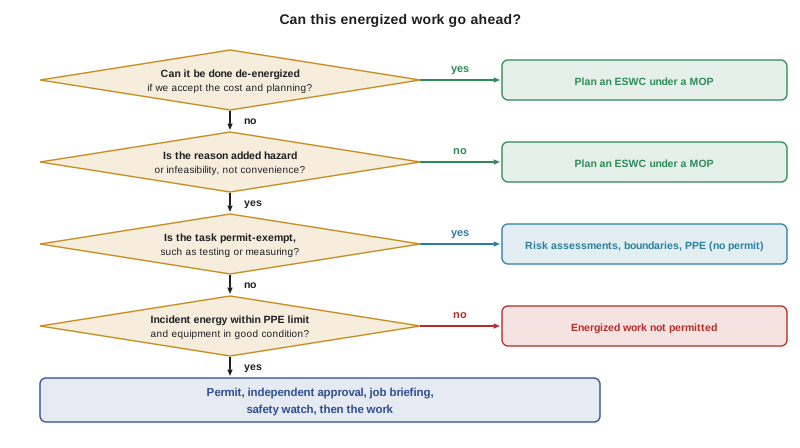
Both CSA Z462 and NFPA 70E start from the same rule: energized electrical conductors and circuit parts must be put into an electrically safe work condition before a worker performs work inside the limited approach boundary or interacts with equipment where there is an increased likelihood of an arc flash. Energized work is permitted only in two circumstances.
- Additional hazards or increased risk. De-energizing would introduce additional hazards or increased risk, for example by interrupting life support equipment, deactivating emergency alarm systems or shutting down ventilation for hazardous locations.
- Infeasibility. The task is infeasible in a de-energized state because of equipment design or operational limitations, for example diagnostics and testing that require the circuit to be energized, such as voltage measurement, troubleshooting or commissioning tests that need power.
Both standards add that energized work may also be done where the circuit operates at less than 50 V and the risk assessment shows no increased exposure to electrical burns or explosion from arcs. And both are explicit that the employer's convenience, the cost of a shutdown or a production schedule do not by themselves make de-energizing infeasible.
Infeasible or inconvenient?
The hardest part of applying the rule in a data centre is separating tasks that are genuinely infeasible to do de-energized from those that are merely inconvenient. A useful question is: could this task be done with the equipment de-energized if the facility accepted the cost, effort and planning that would require? If the answer is yes, the task is not infeasible.
| Request | Usual classification | Why |
|---|---|---|
| Measure voltage on a busway to troubleshoot an alarm | Infeasible de-energized | The measurement requires the circuit to be energized |
| Infrared scan of a switchboard through IR windows | No exposure; not energized work in the boundary | Covers stay closed; no permit needed if no boundary is crossed |
| Infrared scan with covers removed | Infeasible de-energized, but avoidable | Requires energy, but IR windows would remove the exposure |
| Install a breaker in an RPP to avoid a maintenance window | Inconvenient, not infeasible | The RPP can be isolated with the loads on their other feed |
| Replace a busway tap-off unit because the customer refuses downtime | Inconvenient, not infeasible | The busway section can be isolated under a MOP |
| Tighten a hot connection found by thermography | Inconvenient, not infeasible | Tightening is repair work; plan an isolation |
| Add a feeder to a switchboard that has no maintenance bypass | Often argued as infeasible | Usually a design limitation to be solved with a planned shutdown or temporary feed, not live work |
| Commissioning test of a new UPS under load | Infeasible de-energized | The test requires energy, but test connections are made dead |
The pattern is clear. Diagnostic and testing tasks often genuinely require energy, although they can usually be done without opening equipment, by using IR windows, monitoring systems, permanently installed meters or absence-of-voltage testers. Installation, repair and modification tasks almost never require energy. They require planning.
The single-corded load argument
One argument comes up more than any other in data centres: 'This equipment is single-corded and cannot go down, so the panel feeding it must be worked on energized.' The argument deserves a careful answer.
First, it is a statement about the business risk of an outage, not about the feasibility of de-energizing. The equipment can be de-energized; the owner does not want it to be. Second, there are usually ways to protect the load without exposing a worker: a static transfer switch or rack-mounted automatic transfer switch to give the load two sources, a temporary feed from another panel installed under a separate isolation, migrating the workload to other equipment, or a short, planned outage agreed with the customer. Third, if none of those is possible, the facility should ask why critical equipment was installed with a single point of failure, and fix that, rather than transferring the risk to the electrician.
Weighing the risk honestly also helps. An arc flash during energized work can kill or disable the worker and destroy the equipment, causing exactly the outage that the energized work was meant to avoid, plus a much longer recovery. A planned, short outage under a MOP is a known, controlled event.
Energized work on busway tap-offs
Plug-in busway is designed so that tap-off units can be installed and removed while the busway is energized. Manufacturers provide procedures for this, and the tap-off units include features such as interlocks that keep the unit's switch open while it is being plugged in and grounding contacts that engage first. Because the system is designed for it, many operators treat live tap-off installation as acceptable. It is still energized work inside the limited approach boundary, often from a ladder or lift, with some arc flash risk if the unit is misaligned, damaged or plugged in with its switch closed. Sites take different positions:
- Some require the busway section to be de-energized for every tap-off installation, using the facility's redundancy to keep the loads on their other feed.
- Some allow live installation of tap-offs under a standing risk assessment and a specific procedure, by trained and qualified persons, with the tap-off switch verified open, arc-rated PPE appropriate to the busway label and the area below closed.
- Most require de-energizing for any tap-off that is damaged, that shows signs of overheating or that must be removed after a fault.
Whatever the site decides, the decision should be made by the electrical safety program, in writing, with a risk assessment, not left to the person on the ladder. Where the decision is to allow live installation, both standards still require the shock and arc flash risk assessments and appropriate PPE, and the site program should say whether a permit is required for each instance or whether the standing assessment covers it.
The energized electrical work permit
When energized work is justified, both standards require an energized electrical work permit, with limited exemptions. The permit must include at least:
- A description of the circuit and equipment to be worked on and its location.
- A description of the work to be done.
- The justification for why the work must be done energized.
- A description of the safe work practices to be used.
- The results of the shock risk assessment, including the voltage, the limited and restricted approach boundaries and the necessary shock protection.
- The results of the arc flash risk assessment, including the available incident energy or PPE category, the arc flash boundary and the necessary PPE.
- The means used to restrict access of unqualified persons to the work area.
- Evidence that the job briefing has been completed, including a discussion of any job-specific hazards.
- Energized work approval by the responsible management or safety officer or owner.
Permits are not required for certain tasks performed by qualified persons, such as testing, troubleshooting and voltage measuring; thermography and visual inspections that do not cross the restricted approach boundary; access to and egress from an area with energized equipment when no electrical work is done and the restricted approach boundary is not crossed; and general housekeeping and miscellaneous non-electrical tasks that do not cross the restricted approach boundary. These tasks still require the risk assessments, boundaries and PPE that apply; they are exempt only from the permit.
Who approves
The approval signature is the key control in the permit, and in a critical facility it must belong to someone who has both the authority and the independence to refuse. Common practice is to require approval by a senior facility or operations manager, and in many organizations also by a safety professional or the electrical safety program owner. The person requesting the work, and the person doing it, should not be the approver.
The approver should test the justification, not just sign it. Useful questions include: Why can this not be done de-energized? What would it take to de-energize, and what would that cost? Can the task be redesigned to avoid opening the equipment? What is the incident energy, and is it within the site's PPE limit? Is the equipment in good condition? Who will be the safety watch, and can they de-energize the equipment quickly if needed? What will we do if an arc flash occurs?
A permit risk check
Many operators use a simple scoring tool alongside the permit, to help approvers see at a glance whether a request needs more scrutiny. The program below shows an illustrative version that flags weak justifications and high-risk conditions. It is a prompt for discussion, not a substitute for the risk assessments the standards require.
# Illustrative energized work request screening (not a substitute for the risk assessments).
WEAK = ("customer", "schedule", "downtime", "overtime", "avoid outage", "convenien", "single path")
STRONG = ("measure", "troubleshoot", "diagnos", "test", "commission")

def screen(req):
    flags, score = [], 0
    j = req["justification"].lower()
    if any(w in j for w in WEAK) and not any(s in j for s in STRONG):
        flags.append("justification reads as convenience: send back to plan an ESWC")
        score += 5
    if req["incident_energy"] > req["site_ppe_limit"]:
        flags.append("incident energy exceeds site PPE limit: energized work not permitted")
        score += 10
    if not req["equipment_good"]:
        flags.append("equipment condition doubtful")
        score += 4
    if req["approver"] in (req["requester"], req["worker"]):
        flags.append("approver is not independent")
        score += 3
    if not req["safety_watch"]:
        flags.append("no safety watch assigned")
        score += 2
    return score, flags

requests = [
    {"id": "EW-101", "justification": "Customer refuses downtime for tap-off replacement",
     "incident_energy": 3.1, "site_ppe_limit": 40, "equipment_good": True,
     "requester": "Lee", "worker": "Dana", "approver": "Emeka", "safety_watch": "Farah"},
    {"id": "EW-102", "justification": "Measure voltage to troubleshoot RPP alarm",
     "incident_energy": 1.8, "site_ppe_limit": 40, "equipment_good": True,
     "requester": "Dana", "worker": "Dana", "approver": "Emeka", "safety_watch": "Farah"},
    {"id": "EW-103", "justification": "Add feeder in main switchboard to avoid outage",
     "incident_energy": 58.0, "site_ppe_limit": 40, "equipment_good": False,
     "requester": "Lee", "worker": "Dana", "approver": "Lee", "safety_watch": ""},
]
for r in requests:
    score, flags = screen(r)
print(f"{r['id']} score {score:2d}: " + ("; ".join(flags) if flags else "no screening flags"))EW-101 score 5: justification reads as convenience: send back to plan an ESWC EW-102 score 0: no screening flags EW-103 score 24: justification reads as convenience: send back to plan an ESWC; incident energy exceeds site PPE limit: energized work not permitted; equipment condition doubtful; approver is not independent; no safety watch assigned
Request EW-101 is sent back because its reason is the customer's wish to avoid downtime. EW-102 is a measurement task that genuinely needs energy and is exempt from a permit, although the risk assessments and PPE still apply. EW-103 fails on almost every count, above all because the incident energy is beyond any PPE the site provides. A tool like this cannot judge a justification, but it makes the common failure patterns hard to overlook.
Worked problem
Responding to a customer request for live work
A colocation customer at Cedar Ridge asks for a new 415 V tap-off unit to be installed on the Hall 2 A-side busway above their cage tomorrow, and insists that the busway must not be de-energized because their AI training job cannot be interrupted. Their racks are dual-corded with B-side feeds on a separate busway. How should the facility respond?
Show solution
- Classify the request: installing a tap-off is installation work, and the customer's reason is avoiding interruption, which is convenience, not infeasibility.
- Recognize that de-energizing the A-side busway section does not interrupt the customer's racks, because they are dual-corded and will run on the B side, provided the B side has capacity and every rack is genuinely dual-corded.
- Check the B-side capacity and the other customers on the A-side section, and write a MOP to isolate the section, install the tap-off and restore power, scheduled with the customers affected.
- If the site program allows live tap-off installation under a standing risk assessment, the facility may still choose it, but the decision rests with the program, not the customer, and all the risk assessment, PPE and access controls apply.
- Explain the decision to the customer in terms of their own interest: an arc flash on the busway would cause a far longer outage than a planned isolation that their dual-corded racks will ride through.
Answer: Treat the request as installation work with a convenience justification, plan a de-energized installation under a MOP using the racks' B-side feeds, and decide any live installation under the site program rather than the customer's wishes, explaining the reasons to the customer.
Common mistakes
MistakeAccepting "the customer will not allow downtime" as a justification for energized work.
InsteadTreat it as a business preference; plan an isolation using redundancy, temporary feeds or a planned outage.
MistakeLetting the requester or the worker sign the energized work approval.
InsteadRequire approval by an independent manager with authority to refuse.
MistakeAssuming permit-exempt tasks need no risk assessment or PPE.
InsteadApply the shock and arc flash risk assessments, boundaries and PPE; only the permit is exempt.
MistakeLeaving the decision on live busway tap-off installation to whoever is on the ladder.
InsteadDecide it in writing in the site program, with a risk assessment, procedure and conditions.
MistakeApproving energized work where incident energy exceeds the site's highest PPE rating.
InsteadDo not permit energized work on that equipment; de-energize it or reduce incident energy first.
Summary and key terms
- Energized work is permitted only where de-energizing creates additional hazards or increased risk, or is infeasible because of equipment design or operational limitations.
- Convenience, cost, schedules and customer preferences do not make de-energizing infeasible.
- Diagnostic and testing tasks may genuinely need energy; installation and repair almost never do.
- The single-corded load argument is about business risk and should be answered with transfer switches, temporary feeds, workload moves or planned outages.
- Live busway tap-off installation must be decided by the site program with a risk assessment, not by the person doing the work.
- Permits record the justification, risk assessments, practices, access controls, briefing and an independent approval; some testing tasks are exempt from the permit but not from the risk assessments.
- Energized electrical work permit
- A document that justifies, plans and authorizes work on or near energized equipment.
- Infeasibility
- A condition in which a task cannot be performed de-energized because of equipment design or operational limitations.
- Additional hazards or increased risk
- A condition in which de-energizing would itself create greater danger, such as shutting down life safety systems.
- Single-corded load
- Equipment with only one power supply connection, which loses power if that feed is interrupted.
- Tap-off unit
- A plug-in device that connects a load to a busway.
- Standing risk assessment
- A documented risk assessment covering a repeated task under defined conditions.
- Energized work approver
- The independent person with authority to approve or refuse an energized work permit.
- Job briefing
- A discussion before work that covers hazards, procedures, controls, PPE and emergency arrangements.
Practice problems
Work each problem on paper first, then reveal the answer to check.
State the two circumstances in which energized work is permitted.
Show answer
When de-energizing introduces additional hazards or increased risk, or when the task is infeasible de-energized because of equipment design or operational limitations.
What question helps separate infeasible from inconvenient?
Show answer
Could the task be done de-energized if the facility accepted the cost, effort and planning required?
Is installing a breaker in an RPP to avoid a maintenance window infeasible de-energized?
Show answer
No; it is inconvenient. The RPP can be isolated with loads on their other feed.
Give three ways to protect a single-corded load without energized work.
Show answer
A static or rack transfer switch, a temporary feed, migrating the workload, or a planned outage.
Why is live busway tap-off installation still energized work?
Show answer
It is done inside the limited approach boundary on an energized system, with some arc flash risk.
List five required elements of an energized electrical work permit.
Show answer
Circuit and equipment, work description, justification, safe work practices, shock and arc flash assessment results, access restrictions, job briefing evidence and approval.
Name two tasks exempt from the permit when done by qualified persons.
Show answer
Testing, troubleshooting and voltage measuring; thermography and visual inspection without crossing the restricted approach boundary.
What still applies to permit-exempt tasks?
Show answer
The shock and arc flash risk assessments, boundaries and PPE.
Who should approve energized work in a critical facility?
Show answer
An independent senior manager, often with a safety professional, not the requester or the worker.
What should happen when incident energy exceeds the site's PPE limit?
Show answer
Energized work must not be done; de-energize or reduce the incident energy first.
Lesson quiz · 5 questions
Score 60% or more to complete this lesson.
Create a free account to save your progress, take quizzes and earn a certificate.