
HSE-321 · Lesson 11 of 12 · 28 min
Maintenance, inspection and thermography
Electrical safety depends on equipment doing what it was designed to do. The arc flash study assumes that every circuit breaker and relay will trip within its published time when a fault occurs. The rule that normal operation of equipment is unlikely to cause an arc flash assumes the equipment is properly maintained. The isolation plan assumes that a breaker opened and locked is really open. When maintenance is neglected, every one of these assumptions weakens. This lesson explains why maintenance is an electrical safety control in critical facilities, how maintenance programs are organized under the current standards, and how inspection techniques such as infrared thermography can find problems without exposing workers.
Condition of maintenance
Both CSA Z462 and NFPA 70E require the risk assessment to consider the condition of maintenance of the equipment. A breaker that has not been exercised for many years may have stiff mechanisms or dried lubricants that slow its opening, and its trip unit may not have been tested. If it clears a fault in 0.5 s instead of the 0.08 s the study assumed, the incident energy could be about six times what the label says. The worker reading the label would be wearing PPE rated far below the actual hazard.
This is why poor maintenance is not just a reliability problem in a data centre. It undermines the arc flash label, the PPE selection and the decision that normal operation is safe. Equipment with an unknown maintenance history, or with overdue testing, should be treated with caution: many programs require that equipment overdue for maintenance be assumed to have an increased likelihood of arc flash for operating tasks, or that the label be reviewed before it is relied on.
Maintenance standards
In Canada, CSA Z463, Maintenance of electrical systems, sets out how to plan, organize and carry out an electrical maintenance program, and CSA Z462 requires that equipment be maintained in accordance with the manufacturer's instructions or industry consensus standards so that the risk of failure is reduced. As of 2026 the current edition of CSA Z463 is the third, published in 2024. It covers the program elements, the assessment of equipment condition and criticality, maintenance tasks and intervals for common equipment types, and documentation. Many Canadian data centres also use the testing specifications of the InterNational Electrical Testing Association (NETA) to define how tests are performed and what results are acceptable.
A central idea in current maintenance standards is that intervals depend on equipment condition. Equipment is assessed and placed in a condition category, typically something like good, fair or poor, based on its physical state, the environment it operates in, its criticality and its history. Intervals for equipment in good condition can be longer than the base intervals; intervals for equipment in poor condition must be shorter. A data centre's critical power equipment usually has high criticality, which pushes toward thorough, regular maintenance even when physical condition is good.
from datetime import date, timedelta

# Illustrative maintenance scheduling by condition category (invented base intervals).
BASE_MONTHS = {"LV breaker exercise and trip test": 36, "Protective relay test": 36,
               "Thermographic survey": 12, "Busway joint inspection": 36}
FACTOR = {"good": 1.5, "fair": 1.0, "poor": 0.5}   # longer, base, shorter (illustrative)

assets = [
    ("SWBD-A main breaker", "LV breaker exercise and trip test", "fair", date(2023, 11, 10)),
    ("SWBD-A feeder F7", "LV breaker exercise and trip test", "poor", date(2025, 2, 3)),
    ("MV relay R-A1", "Protective relay test", "good", date(2022, 5, 20)),
    ("Hall 2 busway BW-A2", "Thermographic survey", "fair", date(2025, 8, 14)),
    ("Hall 1 busway BW-A1", "Busway joint inspection", "poor", date(2025, 6, 1)),
]
TODAY = date(2026, 10, 1)
for name, task, cond, last in assets:
    months = BASE_MONTHS[task] * FACTOR[cond]
    due = last + timedelta(days=round(months * 30.4))
    status = "OVERDUE" if due < TODAY else "due " + due.isoformat()
print(f"{name:20s} {task:34s} {cond:5s} every {months:4.1f} months -> {status}")SWBD-A main breaker LV breaker exercise and trip test fair every 36.0 months -> due 2026-11-08 SWBD-A feeder F7 LV breaker exercise and trip test poor every 18.0 months -> OVERDUE MV relay R-A1 Protective relay test good every 54.0 months -> due 2026-11-17 Hall 2 busway BW-A2 Thermographic survey fair every 12.0 months -> OVERDUE Hall 1 busway BW-A1 Busway joint inspection poor every 18.0 months -> due 2026-11-30
In this invented example, the feeder breaker in poor condition and the busway with poor joints have their intervals halved and are both overdue, while the relay in good condition has a longer interval. A real program would use the standard's tables and the site's own assessment, but the logic shows why condition assessment matters: it focuses effort where failure is most likely.
Maintenance tasks in critical facilities
Maintenance of critical power equipment covers many tasks, often performed by specialist testing firms or manufacturers during planned maintenance windows. The most safety-relevant include:
- Circuit breaker exercise and testing. Operating breakers to keep mechanisms free, and testing trip units by primary injection (passing test current through the breaker) or secondary injection (testing the trip unit electronics), to confirm the breaker will clear faults within its curve.
- Protective relay testing. Confirming that relays on medium-voltage switchgear and transformers operate at the correct settings and times, and that the settings match the coordination and arc flash study.
- Connection inspection and torque checks. Checking bolted connections in switchgear, busway and UPS cabinets, ideally guided by thermography so that only suspect connections are opened.
- Insulation resistance and other electrical tests. Testing cables, transformers and switchgear insulation, and, for medium-voltage equipment, partial discharge testing, which can detect insulation deterioration before it fails.
- Cleaning and environmental checks. Removing dust, which can contribute to tracking and faults, and checking for moisture, corrosion and pests.
- UPS preventive maintenance. Manufacturer-led inspection, firmware updates, capacitor and fan replacement at recommended intervals and functional testing (Lesson 7).
- Generator and transfer switch maintenance and testing. Engine maintenance, load testing and transfer testing (Lesson 8).
- Battery maintenance and testing. Covered in HSE-322.
Most of these tasks require the equipment to be de-energized, so they are done during planned maintenance windows using the facility's redundancy, under MOPs with switching orders and full isolation. That is the right approach: the maintenance program and the redundancy design should be built together, so that every piece of equipment can be taken out of service at the required interval without energized work.
Infrared thermography
Infrared thermography uses a camera that detects infrared radiation to produce an image of surface temperatures. Loose or corroded connections, overloaded conductors, unbalanced phases and failing components often run hotter than they should, and a thermal image can reveal them before they fail. Thermography is one of the most valuable inspection tools in a data centre because it is done with the equipment energized and carrying load, which is when heating problems show.
The difficulty is that a thermal camera cannot see through metal covers or most glass. Traditional thermography therefore required removing covers from energized switchgear, which exposes the thermographer to shock and arc flash hazards and is energized work that requires the risk assessments, boundaries and PPE. Two developments have greatly reduced that exposure in critical facilities.
Infrared windows. IR windows are ports made of materials that transmit infrared, such as certain crystals or polymers, installed in switchgear covers and busway joints so that the thermographer can view the connections with the covers closed. With windows, a thermographic survey of a main switchboard involves no exposure to energized parts. Windows have limits: the field of view is restricted, the window material reduces the signal, and the thermographer must be trained to compensate. But for critical equipment they are now common practice, especially when specified at design.
Continuous thermal monitoring. Wireless temperature sensors attached to busway joints, cable terminations and breaker connections report temperatures continuously to the building management or electrical power monitoring system. They detect problems between surveys and remove the need to approach the equipment at all. Many AI halls with high-current busway include continuous joint monitoring from the start.
Interpreting thermal findings
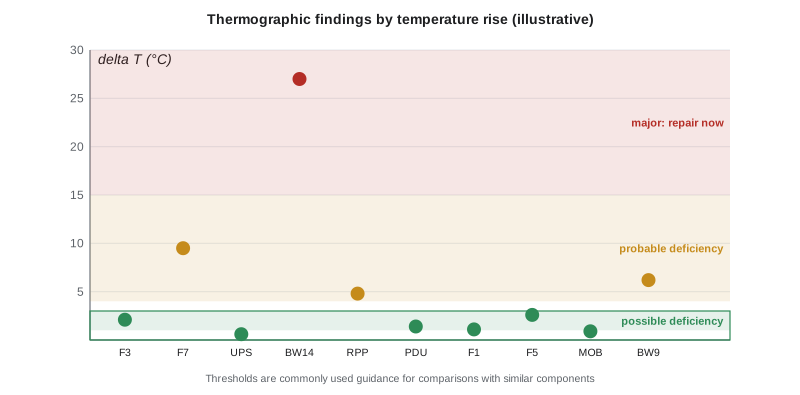
Thermographic findings are usually classified by temperature difference: either between a component and a similar component under similar load (for example, the same connection on another phase) or between the component and the ambient air. Maintenance testing specifications such as NETA's give commonly used thresholds. For comparisons between similar components, a difference of about 1 to 3 °C indicates a possible deficiency that warrants investigation, about 4 to 15 °C indicates a probable deficiency to be repaired as time permits, and more than about 15 °C indicates a major discrepancy needing immediate repair. Thresholds for comparison with ambient are higher. These figures are guidance; the site program should state the thresholds it uses and the actions that follow.
Load matters. A connection that is barely warm at 20% load may be dangerously hot at full load, so surveys should be done when the equipment is reasonably loaded, often recommended as at least 40% of rated load, and the load at the time of the survey should be recorded so findings can be compared over time.
# Illustrative classification of thermographic findings (delta T versus a similar component).
def classify(delta_t):
    if delta_t > 15:
        return "major: repair immediately (plan isolation now)"
    if delta_t >= 4:
        return "probable deficiency: repair as soon as practical"
    if delta_t >= 1:
        return "possible deficiency: investigate, re-scan"
    return "no action"

findings = [("SWBD-A feeder F3, phase B lug", 2.1, 62), ("SWBD-A feeder F7, phase A lug", 9.5, 71),
            ("UPS-A1 output breaker, phase C", 0.6, 55), ("Busway BW-A2 joint 14", 27.0, 68),
            ("RPP A-12 main lug, phase A", 4.8, 44), ("PDU A-2-3 transformer secondary, phase B", 1.4, 35)]
for name, dt, load in findings:
    note = "" if load >= 40 else "  (load below 40%: re-scan at higher load)"
print(f"{name:40s} dT {dt:5.1f} C at {load:3d}% load -> {classify(dt)}{note}")SWBD-A feeder F3, phase B lug dT 2.1 C at 62% load -> possible deficiency: investigate, re-scan SWBD-A feeder F7, phase A lug dT 9.5 C at 71% load -> probable deficiency: repair as soon as practical UPS-A1 output breaker, phase C dT 0.6 C at 55% load -> no action Busway BW-A2 joint 14 dT 27.0 C at 68% load -> major: repair immediately (plan isolation now) RPP A-12 main lug, phase A dT 4.8 C at 44% load -> probable deficiency: repair as soon as practical PDU A-2-3 transformer secondary, phase B dT 1.4 C at 35% load -> possible deficiency: investigate, re-scan (load below 40%: re-scan at higher load)
The busway joint at 27 °C above similar joints needs immediate action, but immediate repair does not mean energized repair. As Lesson 9 explained, tightening a hot connection is repair work, so the right response is to reduce the load on that section if possible, increase monitoring and plan an urgent isolation of the busway section using the facility's redundancy. The PDU reading, taken at 35% load, should be repeated at higher load before it is trusted.
Other inspection technologies
Several other techniques help find problems without exposure. Airborne ultrasound detects the sound of arcing, tracking and corona, especially in medium-voltage equipment, and can be used through small ports. Online partial discharge monitoring detects insulation deterioration in medium-voltage cables and switchgear. Breaker and relay monitoring in modern trip units and protective relays records operations, trip times and wear, giving early warning that a device is slowing down. Power quality monitoring identifies harmonics and imbalances that cause overheating. Together, these let a critical facility plan its maintenance from evidence rather than guesswork.
After a fault
When a protective device clears a fault in a data centre, the pressure to restore power is intense. But a breaker that has interrupted a high fault current, especially near its interrupting rating, may be damaged, and the equipment downstream may still be faulted. Both standards require that, after a protective device opens a circuit because of a fault, the circuit is not manually re-energized until it has been determined that the equipment and circuit can be safely energized. In practice, the operations team should switch the load to its alternate path, isolate the faulted section, investigate the cause, inspect the breaker according to the manufacturer and test as needed before restoring. Repetitive closing onto a fault is a recognized cause of arc flash injuries.
Worked problem
Responding to a hot busway joint
A continuous monitoring sensor on busway BW-A2 in Hall 2 at Cedar Ridge reports that joint 14 is running 27 °C hotter than the adjacent joints at 68% load, and the temperature has risen 6 °C in a week. The busway feeds 14 AI racks, all dual-corded with B-side feeds on BW-B2. The site maintenance specialist suggests tightening the joint bolts tonight with the busway energized, because the joint covers have access holes. How should the facility respond?
Show solution
- Classify the finding: more than 15 °C above similar components and rising is a major discrepancy needing urgent action.
- Reject energized tightening: it is repair work, inconvenient but not infeasible to do de-energized, and the joint may be close to failure, which raises arc flash likelihood.
- Reduce risk immediately: confirm all 14 racks are dual-corded and that BW-B2 has capacity, consider shifting load from the A side, close the area below the joint and increase monitoring.
- Plan an urgent isolation of BW-A2 under a MOP with a switching order, transferring the racks to their B-side feeds, establishing an ESWC on the busway section and repairing the joint according to the manufacturer.
- After repair, re-scan under load, review the trend data for other joints on the same run and record the finding in the maintenance history.
Answer: Treat the joint as urgent, refuse energized tightening, reduce load and exposure immediately, isolate BW-A2 under an urgent MOP using the racks' B-side feeds, repair it de-energized and verify with a follow-up scan.
Common mistakes
MistakeRelying on arc flash labels for equipment whose breakers have never been tested.
InsteadConsider the condition of maintenance; untested devices may clear slower than the study assumes.
MistakeRemoving switchgear covers for routine thermography when IR windows could be installed.
InsteadInstall IR windows or continuous monitoring on critical equipment to remove the exposure.
MistakeScanning lightly loaded equipment and recording "no findings".
InsteadScan at adequate load, often at least 40%, and record the load with each finding.
MistakeTightening a hot connection energized because it needs urgent attention.
InsteadReduce load, increase monitoring and plan an urgent de-energized repair.
MistakeReclosing a breaker that tripped on a fault to restore the load quickly.
InsteadTransfer the load, isolate and investigate, and re-energize only when it is safe.
Summary and key terms
- Maintenance is an electrical safety control: unmaintained devices clear slower, invalidating labels and PPE selection.
- CSA Z463:24 sets out maintenance programs in Canada, and CSA Z462 requires equipment to be maintained.
- Maintenance intervals depend on equipment condition and criticality, and most tasks are done de-energized in planned windows using redundancy.
- Infrared thermography finds heating problems under load; IR windows and continuous monitoring remove the need to open energized equipment.
- Findings are classified by temperature difference, at adequate load, and urgent findings lead to urgent de-energized repairs, not energized ones.
- After a fault, equipment is not re-energized until it has been determined safe to do so.
- Condition of maintenance
- The state of equipment in terms of whether it has been maintained according to the manufacturer or consensus standards.
- Primary injection test
- A circuit breaker test that passes test current through the breaker's main contacts.
- Secondary injection test
- A test of a breaker's electronic trip unit using a test signal.
- Infrared thermography
- Imaging of surface temperatures using infrared radiation to find abnormal heating.
- Infrared window
- A port in an equipment cover that transmits infrared so thermography can be done with covers closed.
- Continuous thermal monitoring
- Sensors that report temperatures of connections continuously to a monitoring system.
- Partial discharge
- Small electrical discharges in deteriorating insulation, detectable before failure.
- Delta T
- The temperature difference between a component and a reference, used to classify thermal findings.
Practice problems
Work each problem on paper first, then reveal the answer to check.
Why does poor maintenance increase arc flash hazard?
Show answer
Devices may clear faults more slowly than the study assumes, increasing incident energy above the label.
If a breaker clears in 0.5 s instead of 0.08 s, roughly how much higher is the incident energy?
Show answer
About six times higher, since incident energy is roughly proportional to arcing time.
What is the current edition of CSA Z463 as of 2026?
Show answer
CSA Z463:24, the third edition.
How does equipment condition affect maintenance intervals?
Show answer
Good condition can lengthen intervals; poor condition requires shorter intervals.
What is the difference between primary and secondary injection testing?
Show answer
Primary injection passes current through the breaker; secondary injection tests the trip unit with a signal.
Why must thermography be done under load?
Show answer
Heating from defects shows only when current flows; at low load a defect may not be visible.
How do IR windows improve safety?
Show answer
They let thermography be done without removing covers, so there is no exposure to energized parts.
Classify a finding 9 °C above a similar component.
Show answer
A probable deficiency to be repaired as soon as practical.
What is the correct response to a major thermal finding?
Show answer
Reduce load and exposure, increase monitoring and plan an urgent de-energized repair.
What must happen before re-energizing a circuit after a fault trip?
Show answer
Determine that the equipment and circuit can be safely energized, after investigation and inspection.
Lesson quiz · 5 questions
Score 60% or more to complete this lesson.
Create a free account to save your progress, take quizzes and earn a certificate.