
HSE-321 · Lesson 10 of 12 · 28 min
PPE, arc-rated clothing and tools
Personal protective equipment is the last line of defence in the hierarchy of controls. It does not prevent an arc flash or a shock; it reduces the injury when the other controls have failed. HSE-224 Lessons 8 and 9 explain arc ratings, layered clothing systems, PPE categories, rubber insulating gloves and insulated tools and test instruments in detail. This lesson focuses on how PPE is selected, provided and used in critical facilities, where electrical rooms are hot and loud, incident energies at main switchgear are high, DC systems are common and many different crews share the same PPE stations.
PPE as part of the plan, not a substitute for it
In a data centre, the PPE decision follows from everything covered so far. If the work is done in an electrically safe work condition, the equipment is not energized and no arc flash or shock PPE is needed for the work itself, although it is needed for the steps that establish the condition: opening covers to test, testing for absence of voltage and, in some cases, operating switching devices. If energized work is justified and permitted, the PPE is selected from the arc flash and shock risk assessments. In both cases, engineering controls such as energy-reducing maintenance switching and remote operation should already have reduced the exposure as far as possible.
A common error is to treat PPE as the main control: to reason that, because the site has 40 cal/cm² (167 J/cm²) suits, any task up to that level can be done energized. That reverses the hierarchy. PPE selection comes after the decisions to eliminate, substitute and engineer out the hazard, not before.
Arc-rated clothing and PPE categories
Arc-rated clothing is tested to determine its arc rating, the incident energy at which there is a 50% probability of the onset of a second-degree burn through the fabric (the arc thermal performance value, ATPV) or of the fabric breaking open (the energy breakopen threshold, EBT). The rating is marked on the garment in cal/cm². When the incident energy analysis method is used, the arc rating of the clothing system must be at least the incident energy at the working distance shown on the label or in the study. When the PPE category method is used, the standards' tables assign a category to each task and equipment type, within stated limits of fault current and clearing time, and each category has a minimum arc rating.
| PPE category | Minimum arc rating | Typical clothing system |
|---|---|---|
| 1 | 4 cal/cm² (16.75 J/cm²) | Arc-rated long-sleeve shirt and pants or coverall, arc-rated face shield or hood, hard hat, safety glasses, hearing protection, leather or rubber gloves as required |
| 2 | 8 cal/cm² (33.5 J/cm²) | As category 1 with higher-rated clothing and an arc-rated face shield and balaclava, or an arc flash hood |
| 3 | 25 cal/cm² (104.7 J/cm²) | Arc flash suit jacket, pants and hood, arc-rated gloves, hard hat, eye and hearing protection |
| 4 | 40 cal/cm² (167.5 J/cm²) | Heavier arc flash suit and hood, arc-rated gloves, hard hat, eye and hearing protection |
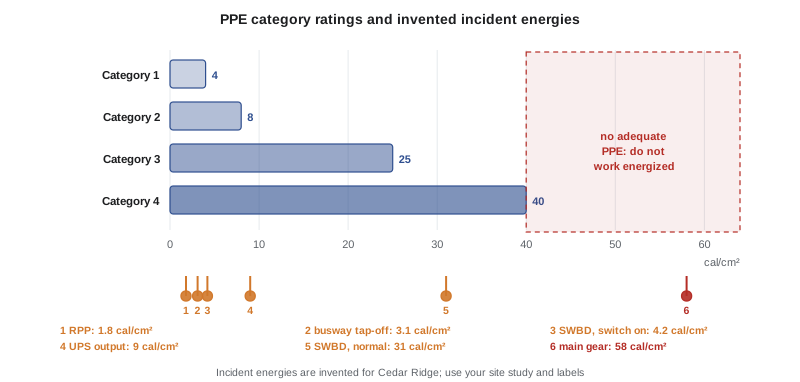
In data centres, most sites use the incident energy method, because they have arc flash studies and because the category tables have limits on fault current and clearing time that large data centre systems often exceed. The label tells the worker the incident energy at the working distance, and the worker selects clothing with an arc rating at least that high. Where a site uses a few standard clothing systems, for example daily-wear clothing rated around 8 to 12 cal/cm² and a 40 cal/cm² suit for higher energies, the program should say clearly which system covers which range.
Daily-wear arc-rated clothing
Many critical facilities require their electricians and critical environment technicians to wear arc-rated clothing as their normal work uniform, typically shirts and pants or coveralls rated around 8 cal/cm² or more. Daily wear has several advantages: the worker is already protected when an unexpected task arises, such as an alarm that needs investigating, and the worker does not have to change into separate clothing for low-energy tasks. It does not replace the higher-rated suits needed for higher incident energies, and it must be worn correctly: sleeves down, shirts tucked in or coveralls closed, with no meltable fabrics such as polyester or nylon worn underneath.
Heat, noise and communication
Arc flash suits and hoods are hot. Electrical rooms in data centres are often warm, and UPS rooms, generator enclosures and the hot side of busway runs can be hotter still, as HSE-320 Lesson 6 described. A worker in a 40 cal/cm² suit in a warm room can develop heat stress quickly. HSE-243, Heat and Cold Stress, explains how to assess and control it. In critical facilities, practical controls include planning heavy-PPE tasks for the coolest part of the night, keeping tasks in full suits short, providing cooling vests compatible with arc-rated clothing, and planning work and rest periods.
Hoods also reduce vision and hearing. Arc flash hood windows are tinted and can limit peripheral vision, and the hood muffles speech. Combined with the noise of transformers, cooling fans and UPS systems, this makes the three-way communication that switching requires (Lesson 8) harder. Sites address this with good lighting, hoods with ventilation fans and clear windows rated for the task, hearing protection that fits under the hood and, in some cases, communication headsets designed for use with arc-rated PPE.
Shock protection: gloves and other equipment
Shock protective equipment protects against contact with energized parts. The most important item is the rubber insulating glove, worn with leather protectors over it to protect the rubber from cuts and punctures. Gloves are classified by the maximum voltage they are designed for, and they must be selected for the voltage of the equipment.
| Glove class | Maximum use voltage AC | Maximum use voltage DC | Typical data centre use |
|---|---|---|---|
| 00 | 500 V | 750 V | Branch circuits, RPPs and busway at 208 V or 415 V; DC systems up to 750 V |
| 0 | 1,000 V | 1,500 V | Low-voltage switchboards and UPS at 600 V or 480 V; DC systems up to 1,500 V, including 800 V DC |
| 1 | 7,500 V | 11,250 V | Some medium-voltage tasks with additional protection |
| 2 | 17,000 V | 25,500 V | Medium-voltage systems up to about 17 kV |
| 3 | 26,500 V | 39,750 V | Medium-voltage systems up to about 26.5 kV |
| 4 | 36,000 V | 54,000 V | Medium-voltage systems up to about 36 kV |
Gloves must be air-tested and visually inspected before each use, and they must be electrically tested at regular intervals: before first issue and at least every six months afterwards, with gloves that have been tested but not issued for 12 months needing to be retested before use. The test date must be marked on or traceable to the gloves. In a data centre with shared PPE stations, gloves are a common weak point: a pair left in a station may be past its test date, may be the wrong class for the equipment, or may have been damaged by the previous user. Many sites issue gloves to individuals and track test dates centrally.
Other shock protective equipment includes insulating blankets and covers for nearby energized parts, insulated mats, and insulated and insulating tools. Insulated hand tools for live work are made and tested to recognized standards, commonly rated for 1,000 V AC and 1,500 V DC, and are marked accordingly.
from datetime import date

# Illustrative glove selection and test-date check (ASTM D120 maximum use voltages).
CLASSES = [("00", 500, 750), ("0", 1000, 1500), ("1", 7500, 11250),
           ("2", 17000, 25500), ("3", 26500, 39750), ("4", 36000, 54000)]

def glove_class(volts, dc=False):
    for name, ac_max, dc_max in CLASSES:
        if volts <= (dc_max if dc else ac_max):
            return name
    return None

def test_ok(last_test, today, issued=True):
    days = (today - last_test).days
    return days <= (183 if issued else 365)

TODAY = date(2026, 10, 1)
tasks = [("RPP branch breaker, 208 V", 208, False), ("Busway tap-off, 415 V", 415, False),
         ("Switchboard, 600 V", 600, False), ("Switchboard, 480 V", 480, False),
         ("UPS battery string, 545 V DC", 545, True), ("MV switchgear, 13.8 kV", 13800, False)]
for name, v, dc in tasks:
    print(f"{name:30s} -> class {glove_class(v, dc)} gloves or higher")

pairs = {"Station 2 pair A": date(2026, 2, 20), "Dana's issued pair": date(2026, 6, 15)}
for pair, tested in pairs.items():
print(f"{pair:20s} tested {tested}: {'in date' if test_ok(tested, TODAY) else 'OUT OF DATE - do not use'}")RPP branch breaker, 208 V -> class 00 gloves or higher Busway tap-off, 415 V -> class 00 gloves or higher Switchboard, 600 V -> class 0 gloves or higher Switchboard, 480 V -> class 00 gloves or higher UPS battery string, 545 V DC -> class 00 gloves or higher MV switchgear, 13.8 kV -> class 2 gloves or higher Station 2 pair A tested 2026-02-20: OUT OF DATE - do not use Dana's issued pair tested 2026-06-15: in date
The program shows that class 00 gloves are the minimum for the branch circuits, the busway and the battery string's DC voltage, while the switchboards need class 0, so many sites simply issue class 0 gloves for all low-voltage work. Medium-voltage switchgear needs class 2 gloves or higher, and specialist procedures. It also catches a pair in a shared station whose last test was more than six months ago.
Test instruments
Test instruments used in data centres must be rated for the voltage and the measurement category of the circuit. Measurement categories describe the transient overvoltages an instrument can withstand: CAT III covers distribution-level equipment such as switchboards, panelboards and busway, and CAT IV covers the origin of the installation, such as the service entrance and utility connections. A meter used on main switchgear should be rated at least CAT III 1,000 V, and many sites standardize on CAT IV 600 V or higher ratings for work near the service. For DC systems the meter must also be rated for DC at the system voltage. Probes, leads and clips must carry ratings at least as high as the meter's, with finger guards and minimal exposed metal.
HSE-224 Lesson 9 covers meter features and inspection. In a critical facility, two additional points matter. First, because absence-of-voltage testing must be done live-dead-live, the site needs a reliable known source near each work location, such as a proving unit carried with the meter. Second, because AI facilities may introduce higher DC voltages, the meter fleet must be checked against any new system before work begins on it.
PPE stations and shared equipment
Most data centres keep PPE at stations near electrical rooms: arc flash suits and hoods in several sizes, face shields, gloves and protectors, insulated tools, meters and proving units, insulating blankets, barricade tape and signs. Shared PPE needs a system to keep it usable.
- Inspect suits and hoods for contamination, damage and window scratches; launder according to the manufacturer.
- Track glove test dates and remove out-of-date gloves.
- Store PPE clean, dry and out of direct sunlight, with hoods hung so windows are not scratched.
- Keep a range of sizes, because ill-fitting suits restrict movement and gaps reduce protection.
- Provide hygienic hood liners or individually issued balaclavas.
- Inventory the station regularly, and after every major maintenance window.
Contractors bring their own PPE in many cases. The host's program should say whether contractor PPE is acceptable, how it is checked and what happens when it does not meet the site's requirements, for example if a contractor's suit is rated lower than the label at the equipment they are to work on.
Other PPE in electrical spaces
Electrical work in data centres also calls for non-conductive hard hats, safety glasses or goggles under face shields and hoods, hearing protection, safety footwear with electrical hazard ratings where the site requires them, and fall protection when working at height on busway or cable tray. Ladders used near energized equipment must be non-conductive, such as fibreglass, and kept clean and dry. Battery work requires additional PPE for chemical hazards, which HSE-322 covers.
Worked problem
Selecting PPE for an absence-of-voltage test
At Cedar Ridge, an electrician must open a cubicle door in the A-side 600 V switchboard to test for absence of voltage after the feeder has been switched off and locked. The label shows 31 cal/cm² at 610 mm (24 in) with normal settings and 4.2 cal/cm² with the maintenance switch on. The room is warm at 29 °C (84 °F). What PPE is needed for the test, and what else should be considered?
Show solution
- Until absence of voltage is verified, the parts inside are treated as energized, so arc flash and shock PPE are required for the test.
- Engage the energy-reducing maintenance switch, as the MOP specifies, so the 4.2 cal/cm² value applies; select clothing rated at least 4.2 cal/cm², for example the daily-wear system if it is rated 8 cal/cm², plus an arc-rated face shield and balaclava or hood.
- Select class 0 rubber insulating gloves with leather protectors, checked for test date and air-tested, a CAT III 1,000 V or better meter with a proving unit, safety glasses, hearing protection and a non-conductive hard hat.
- If the maintenance switch could not be engaged, the 31 cal/cm² value would apply, requiring a 40 cal/cm² suit, and heat stress in the warm room would become a serious concern; keep that task short and plan rest.
- After absence of voltage is verified and the condition is established, the arc flash PPE can be removed for the work on the de-energized parts, while the rest of the room remains energized and its boundaries still apply.
Answer: With the maintenance switch on, arc-rated clothing of at least 4.2 cal/cm² with face and head protection, class 0 gloves with protectors, a suitably rated meter and proving unit, eye and hearing protection. Without it, a 40 cal/cm² suit and heat stress controls. PPE for the test is removed only once the ESWC is verified.
Common mistakes
MistakeReasoning that energized work is acceptable because the site owns 40 cal/cm² suits.
InsteadApply the hierarchy: justify, de-energize, engineer out and only then select PPE.
MistakeWearing a polyester base layer under arc-rated clothing.
InsteadWear only non-melting or arc-rated layers under arc-rated clothing.
MistakeTaking gloves from a shared station without checking their class and test date.
InsteadCheck class, test date and condition, and air-test gloves before each use.
MistakeUsing a meter rated only for AC on a battery or DC bus.
InsteadUse a meter, probes and leads rated for DC at the system voltage and the right measurement category.
MistakeIgnoring heat stress in full arc flash suits in warm electrical rooms.
InsteadPlan heavy-PPE tasks for cooler times, keep them short, provide compatible cooling and rest.
Summary and key terms
- PPE is the last line of defence and is selected after justification, de-energizing and engineering controls.
- Data centres mostly use the incident energy method, selecting clothing with an arc rating at least equal to the label's incident energy.
- Many critical facilities require daily-wear arc-rated clothing, with higher-rated suits for higher incident energies.
- Heat, reduced vision and noise in hoods affect safety and communication and need planning.
- Rubber insulating gloves are selected by class for the voltage, inspected before each use and tested at least every six months; class 0 covers low-voltage AC and DC systems.
- Meters must suit the voltage, measurement category and DC where applicable, and shared PPE stations need active management.
- Arc rating
- The incident energy a fabric or system can withstand, expressed as ATPV or EBT in cal/cm².
- ATPV
- Arc thermal performance value: the incident energy giving a 50% probability of onset of a second-degree burn through the material.
- EBT
- Energy breakopen threshold: the incident energy giving a 50% probability of the material breaking open.
- PPE category
- A level from 1 to 4 in the standards' tables that sets minimum arc-rated PPE for listed tasks.
- Daily-wear arc-rated clothing
- Arc-rated work clothing worn as a normal uniform.
- Rubber insulating gloves
- Gloves made of insulating rubber, classified by maximum use voltage, worn with leather protectors.
- Measurement category
- A rating (CAT II, III or IV) for the transient overvoltages a test instrument can withstand.
- Proving unit
- A portable known voltage source used to verify a meter before and after a test.
Practice problems
Work each problem on paper first, then reveal the answer to check.
Where does PPE sit in the hierarchy of controls?
Show answer
Last, after elimination, substitution, engineering and administrative controls.
What are the minimum arc ratings for PPE categories 1 to 4?
Show answer
4, 8, 25 and 40 cal/cm².
Why do most data centres use the incident energy method?
Show answer
They have arc flash studies, and their fault currents and clearing times often exceed the category tables' limits.
Give two benefits of daily-wear arc-rated clothing.
Show answer
Workers are protected for unexpected tasks and need not change for low-energy tasks.
Name two controls for heat stress in arc flash suits.
Show answer
Schedule tasks for cooler times, keep them short, provide compatible cooling vests and plan rest.
What glove class is usually used for 600 V and 480 V switchboards?
Show answer
Class 0, rated to 1,000 V AC.
How often must in-service rubber insulating gloves be electrically tested?
Show answer
Before first issue and at least every six months afterwards.
What measurement category should a meter used on switchboards have?
Show answer
At least CAT III at a suitable voltage, often CAT III 1,000 V.
What must be checked before using a meter on a DC battery bus?
Show answer
That the meter, probes and leads are rated for DC at the system voltage.
List three tasks in managing a shared PPE station.
Show answer
Inspect and launder suits, track glove test dates, store PPE properly, stock sizes and inventory regularly.
Lesson quiz · 5 questions
Score 60% or more to complete this lesson.
Create a free account to save your progress, take quizzes and earn a certificate.