
HSE-244 · Lesson 6 of 12 · 28 min
Gas detection I: detectors, sensors and alarms
Because hydrogen sulfide cannot be seen and its smell cannot be trusted, gas detection is the backbone of every hydrogen sulfide program. Detectors warn workers before concentrations become dangerous, show whether an area is safe to enter, and record exposures. They are also machines with limits: sensors age, get poisoned, respond to other gases and can fail without obvious signs. This lesson explains the types of detectors and sensors, how alarms work and how to choose and use them. Lesson 7 covers bump testing, calibration, fixed monitoring and the limits of detection. Gas testing in confined spaces in general is covered in HSE-211; this lesson focuses on what is specific to hydrogen sulfide.
Types of detectors
Personal monitors are small, single-gas or multi-gas detectors clipped to a worker's clothing near the breathing zone. A single-gas hydrogen sulfide monitor is the most common personal protection in oil and gas and wastewater work. Many are disposable units with a fixed life of two or three years and no calibration needed, only regular bump tests; others are serviceable and need periodic calibration.
Multi-gas portable detectors, often called four-gas meters, usually measure oxygen, flammable gas as a percentage of the lower explosive limit (% LEL), carbon monoxide and hydrogen sulfide. They are used for pre-entry testing and continuous monitoring in confined spaces, and some workers wear them all shift. Some models add sensors for sulfur dioxide, ammonia or other gases.
Area monitors are portable units, often on a tripod or wheeled case, placed in a work area to give a loud alarm and flashing beacon that everyone nearby can hear and see. They are useful for temporary work such as tank cleaning, turnaround maintenance and well servicing.
Fixed detection systems are permanently mounted sensors wired or wirelessly connected to a control panel. They watch buildings, compressor rooms, pump stations, wellheads, tank farms and process units continuously, and they can trigger alarms, beacons, ventilation fans, shutdown valves and remote notifications. Lesson 7 describes how they are designed and maintained.
Sampling instruments such as colorimetric detector tubes and laboratory analysis measure concentrations at a point in time or over a period. Tubes are useful for checking gases a meter cannot measure, or as a backup, but they give a single reading and are not a warning device.
How hydrogen sulfide sensors work
Most portable and many fixed hydrogen sulfide detectors use electrochemical sensors. Inside the sensor, the gas diffuses through a membrane to an electrode where it reacts, producing a tiny electric current proportional to the concentration. Electrochemical sensors are specific, sensitive at low ppm, use little power and are relatively cheap. Their weaknesses are a limited life (usually two to three years), drift over time, sensitivity to extreme temperatures and humidity, and the possibility that they slowly lose sensitivity without any warning other than a failed bump test.
Metal oxide semiconductor sensors, used in some fixed systems, change their electrical resistance when hydrogen sulfide is present. They are rugged and tolerate heat and dry conditions, but they are less specific, can be affected by humidity and may need a heated element.
Other technologies include optical and laser-based systems that measure gas across an open path, and lead acetate tape monitors used for continuous measurement of hydrogen sulfide in gas streams. For awareness purposes, what matters is to know what type of sensor your detector uses and its limits as described by the manufacturer.
| Sensor type | Strengths | Limitations | Typical use |
|---|---|---|---|
| Electrochemical | Specific, sensitive at low ppm, low power | Limited life, drift, affected by extremes and some other gases | Personal monitors, multi-gas meters, many fixed systems |
| Metal oxide semiconductor | Rugged, long life, tolerates heat | Less specific, affected by humidity, needs power for heater | Some fixed systems in hot or dry areas |
| Open-path optical | Covers a line rather than a point | Cost, alignment, fog and obstruction | Perimeters and process areas |
| Colorimetric tube | Simple, no power, many gases | One reading only, no alarm, reading judgement | Spot checks and confirmation |
Alarm types and set points
Most hydrogen sulfide detectors have several alarm types. A low alarm and a high alarm sound at instantaneous concentrations set by the employer, often with different tones, vibration and lights. A TWA alarm sounds when the running eight-hour average reaches a set value, and a STEL alarm when the running 15-minute average does. Detectors also give fault alarms for sensor failure, low battery and a missed bump test or calibration, and many give a confidence signal, such as a regular flash or chirp, to show the unit is working.
Alarm set points are a company decision, guided by the applicable exposure limits, the work and the manufacturer's options. Common practice in the North American energy industry has been a low alarm at 10 ppm and a high alarm at 15 ppm, matching older exposure limits; where the 1 ppm TWA and 5 ppm STEL apply, many employers set the low alarm at 5 ppm, or lower, and use the TWA and STEL alarms. Offshore US facilities must sound alarms at 20 ppm. The important thing is that every worker knows what each alarm means and what to do when it sounds.
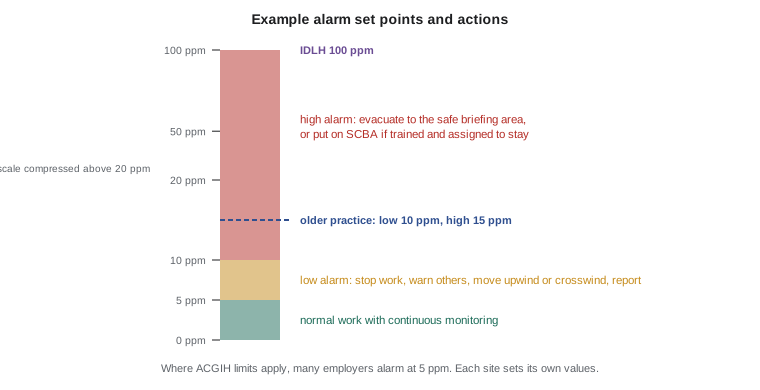
The response to an alarm must be part of the site's procedures. A typical response to a low alarm is to stop work, warn others, move upwind or crosswind to fresh air and report; work resumes only after the source is found and controlled or the area is assessed by someone with breathing apparatus. A typical response to a high alarm is immediate evacuation to the designated safe briefing area, or putting on breathing apparatus if the worker is trained and equipped to stay and control the situation. Lesson 10 covers emergency response.
Choosing and wearing a personal monitor
A personal monitor works only if it measures the air the worker breathes. It should be clipped within about 25 to 30 cm of the nose and mouth, on the collar, chest pocket or shoulder strap, not inside a jacket, in a pocket, on a belt behind the back or left in the truck. In the Odessa incident described in lesson 1, the worker's personal detector was found alarming in his truck.
When choosing monitors, consider the alarm levels needed, whether the alarm is loud and bright enough for the work area (including for workers wearing hearing protection), vibration alerts, datalogging, ruggedness, battery life in cold weather, the bump test and calibration system, and whether the unit is certified for use in hazardous locations where flammable gas may be present. Detectors used in classified areas must carry the appropriate certification marks.
Reading a detector correctly
A detector reads the concentration where its sensor is, not where the worker is about to put their head. Gas concentrations can change dramatically over short distances, especially near a leak or an opening. Approach areas slowly, watching the reading. Test at different heights when checking a space, since hydrogen sulfide tends to collect low, and remember that a sampling pump and hose need time for the gas to travel to the sensor, typically a couple of seconds per metre of hose plus the sensor's response time.
# How long to wait for an accurate reading when sampling through a hose (illustrative).
hose_m = 6.0               # length of sampling hose
seconds_per_m = 2.0        # typical rule of thumb for pump transit
sensor_t90_s = 30          # time for sensor to reach 90 % of final reading
wait = hose_m * seconds_per_m + sensor_t90_s
print(f"Wait at least {wait:.0f} s at each sampling level")
for level in ("top", "middle", "bottom"):
print(f" sample at {level}: hold {wait:.0f} s, record highest reading")Wait at least 42 s at each sampling level sample at top: hold 42 s, record highest reading sample at middle: hold 42 s, record highest reading sample at bottom: hold 42 s, record highest reading
Never read a detector that is showing a fault, an overdue bump test or calibration, or a dead battery as if it were working. A detector in fault mode may show zero.
Interference and cross-sensitivity
Electrochemical hydrogen sulfide sensors can respond to other gases. Some gases, such as sulfur dioxide, nitrogen dioxide and some mercaptans, can make the reading higher or lower than the true hydrogen sulfide concentration, and very high concentrations of some gases can temporarily or permanently damage the sensor. Carbon monoxide sensors can respond to hydrogen sulfide, which is why some multi-gas detectors include a filter on the CO sensor. Manufacturers publish cross-sensitivity tables; workers should know which gases in their work could affect readings.
Exposure to very high concentrations of hydrogen sulfide, such as during a release, can saturate a sensor, leave it slow to recover or shorten its life. After any high exposure, the detector should be bump tested or calibrated before it is used again.
Flammable gas readings
A four-gas meter's % LEL sensor, usually a catalytic bead or infrared sensor calibrated to methane, measures flammability, not toxicity. A reading of 1 % LEL for methane corresponds to about 500 ppm of methane. Hydrogen sulfide at toxic concentrations of tens or hundreds of ppm will barely register on the LEL sensor. Workers must read the hydrogen sulfide channel in ppm for toxicity, and the LEL channel for fire and explosion risk. Hydrogen sulfide can also poison catalytic bead LEL sensors over time, which is one reason bump tests check every sensor.
Worked problem
Placing a personal monitor
A truck driver keeps her personal hydrogen sulfide monitor clipped to her belt under her parka because it is cold. She loads at tank batteries where she must climb to the tank top to open the hatch. Is this effective?
Show solution
- The monitor should be within about 25 to 30 cm of the nose and mouth to measure the breathing zone.
- Under a parka, the sensor is shielded from the air; gas may not reach it, and the alarm may be muffled.
- At the hatch, vapour rises past her face while the monitor on her belt reads lower.
- Cold can slow sensor response and shorten battery life; the manufacturer's temperature range should be checked.
Answer: No. Clip the monitor outside the outer layer on the collar or chest, choose a unit rated for the cold, and keep it visible and audible.
Worked problem
Interpreting a reading during entry testing
An entrant tests a valve chamber from the surface with a multi-gas meter and a 3 m hose. At the top the hydrogen sulfide reading is 0 ppm after 10 seconds. The entrant lowers the probe to the bottom and reads 2 ppm after 10 seconds. Is the chamber safe?
Show solution
- With 3 m of hose, transit time is about 6 seconds, and the sensor needs time to reach its final reading, often 20 to 30 seconds or more.
- Ten seconds at each level is too short to get an accurate reading.
- The reading was still rising at the bottom, where hydrogen sulfide collects.
Answer: Not yet known. Hold the probe at each level for the full response time, record the highest stable reading, and continue monitoring during entry as HSE-211 describes.
Common mistakes
MistakeWearing a personal monitor on the belt or under a jacket.
InsteadClip it within about 25 to 30 cm of the nose and mouth, outside clothing.
MistakeReading the % LEL channel to judge toxic risk.
InsteadRead the hydrogen sulfide channel in ppm; the LEL sensor measures flammability.
MistakeTaking a quick reading through a long hose.
InsteadAllow hose transit time plus sensor response time at each level.
MistakeUsing a detector that shows a fault or overdue bump test.
InsteadDo not use it; a faulty detector can read zero in deadly gas.
MistakeTreating every alarm set point as universal.
InsteadKnow your site's set points and the action required for each alarm.
Summary and key terms
- Personal monitors, multi-gas detectors, area monitors and fixed systems each have a role in hydrogen sulfide protection.
- Most portable sensors are electrochemical: specific and sensitive, but with limited life, drift and cross-sensitivity.
- Detectors have low, high, TWA, STEL and fault alarms; set points are a company decision tied to applicable limits.
- Every worker must know what each alarm means and what action it requires.
- Personal monitors must be worn in the breathing zone, outside clothing.
- Allow for hose transit and sensor response time, and test at several heights.
- The % LEL channel measures flammability, not toxicity; read hydrogen sulfide in ppm.
- Personal monitor
- A small detector worn near the breathing zone to warn the wearer.
- Multi-gas detector
- A portable instrument measuring several gases, commonly O₂, LEL, CO and H₂S.
- Area monitor
- A portable detector with loud alarms placed to protect a work area.
- Fixed detection system
- Permanently mounted sensors connected to alarms and controls.
- Electrochemical sensor
- A sensor producing a current proportional to the gas concentration through a chemical reaction.
- Set point
- The concentration at which an alarm is triggered.
- Cross-sensitivity
- A sensor's response to gases other than the one it is meant to measure.
- T90 response time
- The time a sensor takes to reach 90 per cent of its final reading.
- Breathing zone
- The air within about 25 to 30 cm of a worker's nose and mouth.
- Confidence signal
- A regular beep or flash showing a detector is on and working.
Practice problems
Work each problem on paper first, then reveal the answer to check.
Name the four main types of hydrogen sulfide detectors.
Show answer
Personal monitors, multi-gas portable detectors, area monitors and fixed detection systems.
What kind of sensor is most common in portable hydrogen sulfide monitors?
Show answer
Electrochemical.
Give two limitations of electrochemical sensors.
Show answer
Any two of limited life, drift, sensitivity to temperature and humidity extremes and cross-sensitivity.
Where should a personal monitor be worn?
Show answer
Within about 25 to 30 cm of the nose and mouth, outside clothing.
What alarms does a typical personal monitor have?
Show answer
Low, high, TWA, STEL and fault alarms, plus often a confidence signal.
What is a typical response to a low alarm?
Show answer
Stop work, warn others, move upwind or crosswind to fresh air and report.
Why must readings be held at each level when using a hose?
Show answer
Gas takes time to travel through the hose and the sensor needs time to respond.
Why does the % LEL channel not show toxic hydrogen sulfide levels?
Show answer
Toxic concentrations are tiny compared with the flammable range; the LEL sensor measures flammability.
What should be done after a detector is exposed to a very high concentration?
Show answer
Bump test or calibrate it before further use.
Why is a detector in fault mode dangerous?
Show answer
It may show zero even in a toxic atmosphere.
Lesson quiz · 5 questions
Score 60% or more to complete this lesson.
Create a free account to save your progress, take quizzes and earn a certificate.