
HSE-244 · Lesson 10 of 12 · 27 min
Emergency response: the hydrogen sulfide emergency
A hydrogen sulfide emergency can unfold in seconds: an alarm sounds, a worker staggers or collapses, a cloud drifts across a site. What people do in the first minute decides whether there is one casualty or several, and whether a collapsed worker survives. This lesson describes the standard response that hydrogen sulfide training teaches, how rescue should be organized, what awareness-level first aid involves and how releases affecting the public are handled. It is awareness training. It does not certify anyone in first aid or rescue; workplaces must have trained first aid attendants or responders and rescue teams as their regulations require.
The response sequence
Hydrogen sulfide training programs use slightly different wording, but they share the same sequence. The order matters, and the first step is always self-protection.
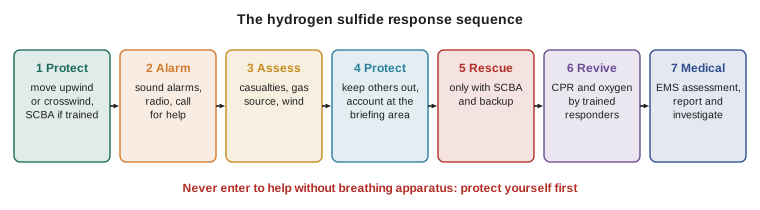
Step 1, protect yourself. When an alarm sounds or you see someone collapse, hold your breath if you can, and move away from the release, upwind or crosswind, to fresh air. Do not run downwind or into low areas. If you are trained and your role includes it, put on breathing apparatus.
Step 2, raise the alarm. Sound the site alarm, call on the radio or phone, and tell the control room, supervisor or emergency services what has happened, where and how many people are involved. Use the site's emergency phone numbers and procedures.
Step 3, assess. From a safe position, work out what you can: where the gas is coming from, whether it is still being released, which way the wind is blowing, how many people are affected and where they are. Check detector readings from a safe distance.
Step 4, protect others. Keep others away from the area. Go to the safe briefing area and account for everyone. Stop vehicles and visitors from approaching. If the release could affect people off site, follow the emergency response plan for notifying authorities and the public.
Step 5, rescue. Only trained rescuers wearing positive-pressure SCBA, with a backup team ready, may enter the hazardous area to remove casualties. Rescuers should approach from upwind, use the buddy system and move casualties to fresh air quickly, using the safest method that fits the situation.
Step 6, revive. Once in fresh air, trained responders assess the casualty, support breathing and start CPR if needed, and give oxygen if they are trained and equipped to do so.
Step 7, medical aid. Every person exposed to a significant concentration, and every person who lost consciousness, must be assessed by emergency medical services or a doctor, even if they seem to recover. Report and investigate the incident.
Why self-protection comes first
It can feel wrong to walk away from a collapsed co-worker. But the person who collapsed was overcome by an atmosphere that is likely still there, and an unprotected rescuer will usually be overcome within seconds. Lesson 1 described the rescuer trap: in manure pit, sewer and tank incidents, would-be rescuers make up a large share of the dead. The fastest way to help is to raise the alarm and get protected rescuers there quickly. Sites must plan so that SCBA and trained people are close enough to reach a casualty within minutes.
Rescue planning
Rescue cannot be improvised. For every hydrogen sulfide area, the employer should plan who will perform rescue, with what equipment, and how quickly. The plan should consider how long it would take for rescuers with SCBA to reach each work location, how casualties would be removed from confined spaces, tank tops, pits and elevated platforms, what retrieval systems and lifelines will be used, and how to call outside responders if the site relies on them. Confined space rescue requirements, including retrieval systems and rescue team capability, are covered in HSE-211.
Time is critical because a person who stops breathing begins to suffer brain damage within about four to six minutes. A rescue plan that depends on a fire department 30 minutes away is not adequate for an entry where knockdown is possible. That is why many hydrogen sulfide entries require a standby rescue team on site with SCBA donned or ready.
# Will the planned rescue arrive in time? (illustrative)
steps = {
    "recognize collapse and raise alarm": 0.5,
    "rescuers don SCBA (staged at briefing area)": 1.5,
    "travel to casualty": 2.0,
    "remove casualty to fresh air": 2.0,
}
elapsed = 0
for step, minutes in steps.items():
    elapsed += minutes
    print(f"{step:45s} t = {elapsed:4.1f} min")
print("Target: casualty breathing support within about 4 to 6 minutes of collapse")
print("Plan OK" if elapsed <= 6 else "Plan too slow: stage SCBA closer or have standby rescuers")recognize collapse and raise alarm t = 0.5 min rescuers don SCBA (staged at briefing area) t = 2.0 min travel to casualty t = 4.0 min remove casualty to fresh air t = 6.0 min Target: casualty breathing support within about 4 to 6 minutes of collapse Plan OK
Removing a casualty
Rescuers must decide how to move a casualty as quickly and safely as possible. Options include dragging with a blanket or harness, lifting with a retrieval system from a confined space, carrying with a two-person lift, or using a stretcher. In a hydrogen sulfide rescue, speed usually matters more than perfect spine protection, because the casualty will die without fresh air, but rescuers should take reasonable care, especially after falls. Rescuers also need to watch their own air supply and stay with their buddy.
Sites should practise rescue drills regularly, including SCBA donning, casualty removal from realistic locations and communication. Drills reveal problems such as rescuers who cannot fit through a manway wearing SCBA, stretchers that cannot turn a corner, and radios that do not work inside buildings.
Awareness-level first aid
Trained first aid attendants and emergency responders provide care after a casualty is in fresh air. For awareness purposes, the main points are these.
Breathing first. Check whether the casualty is breathing. If not, call for emergency medical services if this has not been done and start CPR, according to current first aid training. Hydrogen sulfide is not usually a significant risk to rescuers giving CPR once the casualty is in fresh air, but responders should use a barrier device or bag-valve mask as their training directs, and avoid breathing gas from the casualty's lungs or clothing.
Oxygen. Trained responders give high-concentration oxygen to casualties of hydrogen sulfide poisoning. Supplemental oxygen helps tissues recover once exposure has stopped.
Eyes. Flush eyes with clean water for eye irritation, and seek medical advice for persistent pain, blurred vision or light sensitivity.
Monitoring. Even a casualty who wakes quickly may deteriorate hours later from fluid in the lungs. Keep them at rest, do not let them drive, and transfer them to medical care.
There is no simple antidote for hydrogen sulfide that first aiders can give. Hospital treatment is mainly supportive, with oxygen and breathing support. Some antidotes have been used in hospitals, but evidence is limited and they are matters for physicians.
Large releases and the public
Large releases from sour wells, pipelines or facilities can affect people off site. Energy regulators require licensees to prepare emergency response plans. In Alberta, Directive 071 requires plans for sour operations that identify residents and public facilities within the emergency planning zone, describe how they will be notified, and set out protective actions: sheltering in place, where people stay indoors with windows and doors closed and ventilation off, or evacuation, where people leave the area by routes away from the gas. Air monitoring units track the plume, and road blocks keep people out. Ignition of a release, which converts hydrogen sulfide to sulfur dioxide, may be ordered as a last resort under the plan.
Workers on site must know their roles under the plan: who calls whom, who closes valves or starts shutdowns, who goes to road blocks, who accounts for people, and who meets outside responders. Plans should be exercised regularly with local emergency services.
After the emergency
Every hydrogen sulfide incident, including near misses where an alarm sounded and no one was hurt, should be reported and investigated. Investigations look for the source of the release, why it happened, whether detection worked, whether people responded as planned, and what can prevent it happening again. Detectors exposed to high concentrations must be bump tested or calibrated, SCBA cylinders refilled and equipment inspected before the area returns to normal work. Workers involved may need support after a traumatic event.
Serious incidents must be reported to the provincial or federal OHS regulator, and releases from regulated energy facilities to the energy regulator, as required by law. Records of exposures, symptoms and medical follow-up should be kept.
Worked problem
Responding to a collapse at a lift station
Two operators are working at a lift station. One goes down the wet well ladder to check a float switch and collapses at the bottom. The other, at the hatch, hears his personal monitor alarm at 50 ppm. What should the operator at the hatch do?
Show solution
- Step back from the hatch, upwind, and do not enter.
- Call 911 or the emergency number and the supervisor: possible hydrogen sulfide, one worker down in a wet well.
- If the station has a ventilation fan and it can be started from outside safely, start it; stop pumps only if the procedure says so.
- If the collapsed worker is wearing a harness attached to a retrieval system, attempt non-entry rescue by winching them out.
- Otherwise, wait for responders with SCBA and guide them in.
Answer: Raise the alarm and use non-entry rescue if available. Never climb down without breathing apparatus.
Worked problem
A release during a pigging operation
During a pig receiver opening on a sour pipeline, the area monitor alarms high and the operator smells rotten eggs briefly, then nothing. The wind is from the west. What should the crew do?
Show solution
- Treat the loss of smell as a sign of high concentration.
- Do not move east: with a west wind, the gas drifts east. Move west (upwind) or north or south (crosswind) to the briefing area.
- Sound the alarm and notify the control room so the line can be isolated.
- Account for everyone at the briefing area.
- Re-entry is only for trained workers in SCBA to isolate the source, following the plan.
Answer: Evacuate upwind or crosswind, alarm, account and isolate under the emergency plan.
Practising the response
Responses that are not practised fall apart under stress. Sites should run short alarm drills regularly, so that workers recognize the alarms, move to the right briefing area by the right route and account for each other, as well as full rescue exercises with outside responders. Each drill should be timed and reviewed: how long it took to raise the alarm, don SCBA, reach the casualty and remove them, and what slowed things down. Lessons learned should be fed back into the emergency plan, equipment placement and training.
Common mistakes
MistakeRushing in to pull out a collapsed worker without SCBA.
InsteadProtect yourself, raise the alarm and let trained rescuers with SCBA enter.
MistakeEvacuating downwind because it is the nearest exit.
InsteadMove upwind or crosswind, away from the plume.
MistakeRelying on outside responders far away for entries where knockdown is possible.
InsteadPlan rescue that can reach casualties within minutes, often with standby rescuers on site.
MistakeLetting a revived casualty drive home.
InsteadTransfer to medical care; lung fluid can develop hours later.
MistakeTreating an alarm with no injuries as a non-event.
InsteadReport and investigate every alarm and near miss.
Summary and key terms
- The response sequence is protect yourself, raise the alarm, assess, protect others, rescue, revive and get medical aid.
- Self-protection comes first because unprotected rescuers are often overcome within seconds.
- Rescue must be planned so trained rescuers with SCBA can reach casualties within minutes.
- Awareness-level first aid focuses on breathing, CPR, oxygen by trained responders, eye flushing and medical follow-up.
- Large releases can require sheltering in place or evacuation of the public under emergency response plans.
- Every incident and alarm should be reported, investigated and followed by equipment checks.
- Self-protection
- Moving to safety and protecting yourself before attempting to help others.
- Non-entry rescue
- Removing a casualty from a confined space without entering, for example with a winch and harness.
- Standby rescue team
- Trained rescuers with SCBA ready at the work site during hazardous work.
- Shelter in place
- Staying indoors with doors, windows and ventilation closed during a release.
- Evacuation
- Moving people out of an area threatened by a release.
- Muster
- Gathering at a briefing area so everyone can be accounted for.
- CPR
- Cardiopulmonary resuscitation, chest compressions and rescue breaths for someone not breathing.
- Bag-valve mask
- A hand-held device for giving rescue breaths without mouth-to-mouth contact.
- Ignition
- Deliberately burning a sour gas release, converting hydrogen sulfide to sulfur dioxide.
- Emergency response plan
- A written plan for responding to emergencies, including public protection.
Practice problems
Work each problem on paper first, then reveal the answer to check.
List the seven steps of the hydrogen sulfide response sequence.
Show answer
Protect yourself, raise the alarm, assess, protect others, rescue, revive and medical aid.
Why does self-protection come first?
Show answer
The atmosphere that overcame the casualty is likely still present and would overcome an unprotected rescuer.
Which way should you move when evacuating a release?
Show answer
Upwind or crosswind, away from the plume and out of low areas.
Who may enter to rescue a casualty in a hydrogen sulfide atmosphere?
Show answer
Trained rescuers wearing positive-pressure SCBA, with backup.
Why must rescue reach casualties within minutes?
Show answer
Brain damage begins within about four to six minutes without breathing.
What is non-entry rescue?
Show answer
Removing a casualty from a space without entering, using a retrieval system.
What first aid do trained responders give after removal to fresh air?
Show answer
Check breathing, CPR if needed, high-concentration oxygen, eye flushing and transfer to medical care.
What does sheltering in place involve?
Show answer
Staying indoors with windows and doors closed and ventilation off.
What should happen to detectors after a high exposure?
Show answer
They should be bump tested or calibrated before reuse.
Why investigate alarms where nobody was hurt?
Show answer
They reveal releases and control failures that could kill next time.
Lesson quiz · 5 questions
Score 60% or more to complete this lesson.
Create a free account to save your progress, take quizzes and earn a certificate.