
HSE-244 · Lesson 3 of 12 · 27 min
Where hydrogen sulfide is found
Hydrogen sulfide forms in two main ways. Biologically, bacteria that live without oxygen, called sulfate-reducing bacteria, use sulfate as a substitute for oxygen and give off hydrogen sulfide. They thrive in sewage, manure, sludge, stagnant water, wet organic waste and the bottoms of tanks. Geologically, over millions of years, reactions in deep reservoirs between hydrocarbons and sulfate minerals, along with bacterial action, have produced sour oil and gas. Industrial processes also create or release it: pulp making, leather tanning, petroleum refining, viscose rayon production and some mining and metal refining operations. Knowing the source tells you where the gas will be released and when.
Oil and gas
In Canada, sour gas is concentrated in the Western Canada Sedimentary Basin, especially in Alberta and northeastern British Columbia, where some deep reservoirs contain more than 20 per cent hydrogen sulfide and a few contain much more. Saskatchewan's heavy oil and conventional oil fields also produce sour gas and oil, and solution gas from oil batteries can be very sour. Gas processing plants strip hydrogen sulfide from the gas and convert it to elemental sulfur, which is why large yellow sulfur blocks and piles are a feature of the Alberta landscape.
Hydrogen sulfide in oil and gas operations can appear at almost every stage:
Drilling: sour zones can release gas into the drilling fluid, which brings it to surface at the shale shakers, mud tanks and flare line. Well testing and completions: drill stem tests, swabbing, flowback and fracturing operations bring reservoir fluids to surface. Production: separators, treaters, tanks, compressors and pipelines carry sour gas, oil and produced water. Trucking: drivers load and unload sour crude and produced water and open hatches to gauge tanks. Gas processing: plants concentrate hydrogen sulfide in acid gas streams before converting it to sulfur. Maintenance: opening vessels, changing filters and pigging lines can release trapped gas and iron sulfide.
Detailed well-site and facility procedures are covered in HSE-331 and HSE-332. For awareness purposes, the most common exposure points in production are tank hatches, sample points, vents, open-ended lines, filter housings, pig launchers and receivers, and any vessel being opened for maintenance.
Sewers and wastewater
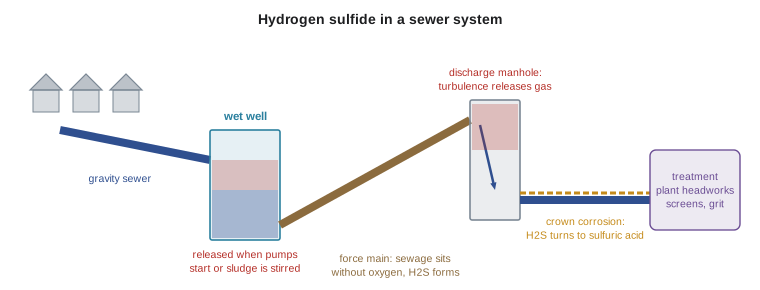
Sewage contains sulfate from drinking water and organic sulfur compounds from human waste. When sewage sits without oxygen, sulfate-reducing bacteria in the slime layer on pipe walls produce hydrogen sulfide. Long force mains, where pumped sewage sits in a full pipe for hours, are notorious. Warm weather speeds the process. The gas dissolves in the sewage and comes out where the flow becomes turbulent.
Typical release points in a collection system and treatment plant include: wet wells at lift stations, especially when pumps start; the discharge end of force mains; drop manholes and hydraulic jumps; siphons and junction chambers; headworks and screening rooms at treatment plants; grit chambers; sludge holding tanks, thickeners and digesters; and dewatering buildings where sludge is pressed or centrifuged.
Hydrogen sulfide also causes major damage to sewers. Bacteria on the moist crown of concrete pipes and manholes convert the gas to sulfuric acid, which eats away the concrete, a process often called crown corrosion. Workers may see soft, pasty concrete and exposed reinforcing steel. The same chemistry corrodes electrical equipment and instruments in pump stations, which can disable fans, alarms and gas detectors.
Agriculture: manure storage
Liquid manure stored in pits under barns, in outdoor tanks and in lagoons generates hydrogen sulfide, methane, ammonia and carbon dioxide. Concentrations in the air above stored manure are usually modest while the manure sits undisturbed. The danger comes when the manure is agitated before pumping out. Agitation can release hydrogen sulfide in a burst, driving concentrations in a barn or pit from a few ppm to hundreds or thousands of ppm within minutes. Livestock and people in the barn above an under-floor pit have died during agitation.
Manure gas incidents often involve family members and neighbours on small farms, where formal confined space programs may not exist. The farm safety associations in every province and state publish guidance with the same core rules: never enter a manure pit or tank without testing, ventilation, breathing apparatus and a rescue plan; ventilate barns and keep people and animals out during agitation; and never attempt a rescue without breathing apparatus.
Pulp and paper
In the kraft pulping process, wood chips are cooked in a solution containing sodium sulfide. Hydrogen sulfide and other reduced sulfur compounds, such as methyl mercaptan, are released in digesters, blow tanks, evaporators, recovery boilers and the collection systems that gather these gases. The characteristic smell of a pulp mill comes from these compounds. Workers can be exposed during maintenance on the gas collection system, in the sewer and effluent treatment areas, and during upsets. Mills that use sulfite processes or treat sludge in lagoons have similar hazards.
Other industries
| Industry or setting | How hydrogen sulfide forms or is released | Typical exposure points |
|---|---|---|
| Tanneries and leather processing | Sulfide chemicals used to remove hair, and acid mixing with sulfide wastes | Drums, pits, effluent channels |
| Food processing | Decay of protein-rich waste; blood, offal and fish processing | Waste pits, drains, effluent tanks |
| Fishing vessels | Rotting fish and bilge water in enclosed holds | Fish holds, bilges, refrigerated seawater tanks |
| Refineries and chemical plants | Sour crude processing, hydrotreating, amine and sulfur recovery units | Sample points, drains, tank roofs, maintenance |
| Mining and tunnelling | Groundwater and rock containing sulfides; decay in flooded workings | Sumps, old workings, water inflows |
| Geothermal and hot springs | Volcanic and geothermal gases | Wells, low ground, enclosed buildings |
| Landfills and composting | Decay of waste, especially drywall (gypsum) in wet landfills | Leachate systems, gas wells, trenches |
| Ships and barges | Cargoes of sour crude, asphalt, molten sulfur; decaying cargo | Cargo tanks, ullage openings |
| Asphalt and molten sulfur | Gas released from heated material | Tank vents, loading racks |
| Construction and utilities | Digging in old fill, swamps, contaminated soil; utility vaults | Trenches, vaults, manholes |
Landfills deserve a note. When gypsum drywall is buried in wet conditions, the sulfate in it feeds bacteria that produce hydrogen sulfide. Construction and demolition landfills have had odour complaints and occasional high readings in trenches and leachate systems because of this.
When releases happen
Across all these settings, hydrogen sulfide exposures cluster around certain activities. Recognizing these triggers is often more useful than memorizing a list of industries:
Opening: hatches, manways, valves, flanges, filter housings, sample points and bleed valves. Agitating: mixing manure, stirring sludge, cleaning tanks, running pumps or jetting sewers. Pumping and transferring: loading and unloading trucks, emptying wet wells, draining vessels. Heating: cooking, steaming out vessels, warm weather. Changing chemistry: adding acid to sulfide-containing waste, which releases hydrogen sulfide very quickly. Entering: confined spaces, pits, trenches, vaults and holds. Equipment failure: leaks, ruptures, failed seals, power failures that stop ventilation.
Acid and sulfide: a dangerous mix
One trigger deserves special attention. Many wastes and process streams contain dissolved sulfide that stays in solution while the liquid is alkaline. If acid is added, the sulfide converts to hydrogen sulfide gas almost instantly. Deaths have occurred when acidic waste was dumped into a sewer or tank containing sulfide waste, and when cleaning chemicals were mixed in drains. Tanneries, chemical plants, oil field waste handling and vacuum truck operations are at particular risk. The rule is simple: never mix unknown wastes, keep acids away from sulfide-bearing wastes, and check compatibility before transferring liquids into a tank or truck.
# Fraction of dissolved sulfide present as H2S gas-forming species at different pH
# (first dissociation constant pKa1 about 7.0 at 25 C; second step ignored).
pKa1 = 7.0
for pH in (5, 6, 7, 8, 9, 10):
    frac_h2s = 1 / (1 + 10 ** (pH - pKa1))
print(f"pH {pH:2d}: {frac_h2s*100:5.1f} % of dissolved sulfide as H2S")pH 5: 99.0 % of dissolved sulfide as H2S pH 6: 90.9 % of dissolved sulfide as H2S pH 7: 50.0 % of dissolved sulfide as H2S pH 8: 9.1 % of dissolved sulfide as H2S pH 9: 1.0 % of dissolved sulfide as H2S pH 10: 0.1 % of dissolved sulfide as H2S
The calculation shows why pH matters so much. At pH 9 or 10, almost all dissolved sulfide is in an ionic form that stays in the water. At pH 7, about half is hydrogen sulfide. Below pH 6, nearly all of it is hydrogen sulfide, ready to escape into the air. A small amount of acid in a large volume of sulfide waste can turn a low-odour liquid into a lethal gas source.
Building an inventory
A good hydrogen sulfide program starts with an inventory of where the gas could be present and what activities could release it. For each location, the inventory should record the source, the expected concentration range from monitoring data or process information, the release triggers, the controls in place and the training and equipment needed. The inventory feeds the hazard assessment, the detector placement plan, the confined space list from HSE-211 and the emergency response plan. Lesson 12 builds such an inventory for an invented site.
Worked problem
Identifying release triggers at a lift station
A municipal lift station receives sewage from a 3 km force main. Operators visit weekly to check pumps and clean float switches. List the likely hydrogen sulfide release points and triggers.
Show solution
- Source: the long force main lets sewage sit without oxygen, so gas forms in the pipe.
- Release point: where the force main discharges, flow becomes turbulent and dissolved gas comes out.
- Wet well: gas collects above the liquid, especially when pumps are off and the level is high.
- Triggers: opening the hatch, pump starts, cleaning floats and disturbing sludge.
- Secondary hazard: corrosion of fans, alarms and detectors in the station.
Answer: Treat the wet well and discharge manhole as hydrogen sulfide areas. Monitor before and during visits, ventilate, and avoid entering the wet well without confined space controls.
Worked problem
A vacuum truck transfer
A vacuum truck has collected spent caustic wash water containing dissolved sulfide. The driver is told to empty it into a tank that holds acidic waste from another process. What is the hazard?
Show solution
- The spent caustic is alkaline, keeping sulfide in solution.
- Mixing it with acidic waste will drop the pH.
- As pH falls below about 7, the dissolved sulfide converts rapidly to hydrogen sulfide gas.
- The gas will be released at the tank vent and the truck's discharge point, possibly at very high concentrations.
Answer: Do not mix. Confirm waste compatibility before any transfer, and treat sulfide and acid wastes as incompatible.
Common mistakes
MistakeTreating undisturbed manure storage as the main danger.
InsteadThe biggest releases happen during agitation and pump-out.
MistakeThinking only oil and gas workers need H₂S awareness.
InsteadWastewater, farm, pulp, tannery, food, fishing and utility workers are exposed too.
MistakeMixing wastes because both are going to the same disposal site.
InsteadAdding acid to sulfide waste releases hydrogen sulfide almost instantly; check compatibility.
MistakeAssuming a lift station is safe because the pumps are running normally.
InsteadPump starts and turbulence release gas, and corrosion can disable alarms and fans.
MistakeExpecting gas analysis of a well to predict tank vapour concentrations.
InsteadDissolved gas can build up in tank vapour spaces far above the gas-phase content.
Summary and key terms
- Hydrogen sulfide forms biologically from sulfate-reducing bacteria and geologically in sour oil and gas reservoirs.
- In oil and gas it appears in drilling, testing, production, trucking, processing and maintenance.
- In sewers it forms in force mains and wet wells and is released at turbulent points; it also corrodes concrete and equipment.
- Manure storage releases large bursts of hydrogen sulfide during agitation.
- Pulp mills, tanneries, food processing, fishing vessels, refineries, mines, landfills and utilities can all have hydrogen sulfide.
- Common release triggers are opening, agitating, pumping, heating, adding acid, entering and equipment failure.
- Lowering the pH of sulfide-bearing liquid converts dissolved sulfide to hydrogen sulfide gas.
- Sulfate-reducing bacteria
- Bacteria that live without oxygen and produce hydrogen sulfide from sulfate.
- Force main
- A pressurized sewer pipe carrying pumped sewage, where sewage can sit without oxygen.
- Wet well
- The chamber at a lift station where sewage collects before being pumped.
- Crown corrosion
- Destruction of concrete at the top of sewers by sulfuric acid formed from hydrogen sulfide.
- Agitation
- Mixing stored manure or sludge before pumping, which releases trapped gases.
- Kraft process
- A pulping process using sodium sulfide that releases reduced sulfur gases.
- Produced water
- Water brought to surface with oil and gas, which can carry dissolved hydrogen sulfide.
- Thief hatch
- A hatch on top of a tank used for gauging and sampling.
- Spent caustic
- Used alkaline solution that may contain dissolved sulfide.
- Release trigger
- An activity or event that causes hydrogen sulfide to be released into the air.
Practice problems
Work each problem on paper first, then reveal the answer to check.
What two broad processes produce hydrogen sulfide?
Show answer
Biological breakdown by sulfate-reducing bacteria and geological formation in sour reservoirs.
Name four places in a sewer system where hydrogen sulfide is commonly released.
Show answer
Any four of wet wells, force main discharges, drop manholes, siphons, headworks, grit chambers, digesters and dewatering buildings.
Why are long force mains a problem?
Show answer
Sewage sits without oxygen for hours, so bacteria produce hydrogen sulfide in the pipe.
When is manure storage most dangerous?
Show answer
During agitation and pump-out, when trapped gas is released in a burst.
List three oil and gas activities where hydrogen sulfide exposure is likely.
Show answer
Any three of drilling, well testing, tank gauging, truck loading, opening vessels, changing filters and pigging.
What happens to dissolved sulfide when acid is added?
Show answer
It converts to hydrogen sulfide gas almost instantly.
At about what pH is half of the dissolved sulfide present as hydrogen sulfide?
Show answer
About pH 7.
Why can drywall in a landfill produce hydrogen sulfide?
Show answer
Bacteria in wet conditions use the sulfate in gypsum to produce it.
What is crown corrosion?
Show answer
Concrete at the top of sewers eaten away by sulfuric acid formed from hydrogen sulfide.
What should a hydrogen sulfide inventory record for each location?
Show answer
Source, expected concentrations, release triggers, controls, training and equipment.
Lesson quiz · 5 questions
Score 60% or more to complete this lesson.
Create a free account to save your progress, take quizzes and earn a certificate.