
HSE-244 · Lesson 1 of 12 · 28 min
Why hydrogen sulfide kills
Hydrogen sulfide is one of the few workplace hazards that can kill a healthy adult within a few breaths. It is a colourless gas, it is heavier than air, it is produced naturally wherever organic matter breaks down without oxygen, and it is present in large quantities in some oil and gas reservoirs. At low concentrations it smells strongly of rotten eggs. At the concentrations that kill, it often has no smell at all, because it paralyzes the sense of smell within seconds to minutes. People have walked into it believing the air was clear.
This course is an awareness course for workers, supervisors and anyone who may enter an area where hydrogen sulfide could be present. It explains the properties of the gas, where it is found, how it harms the body, what the law requires, how it is detected, how workers protect themselves and how to respond to a release. It does not certify anyone. In the Canadian energy industry, the common qualification is H2S Alive, an eight-hour course certified by Energy Safety Canada that includes hands-on practice with breathing apparatus, gas detection and rescue; the certificate is valid for three years. Many employers outside oil and gas also require it or a similar course. Employers must still give site-specific training on their own hazards, detectors, alarms and emergency procedures.
Hydrogen sulfide is often written H₂S, and workers often say "H-two-S" or "sour gas". This course uses all three. Sour gas strictly means natural gas that contains hydrogen sulfide, but in the field it is often used for any gas mixture or fluid that contains it.
A gas that hides in plain sight
Most toxic gases at work come from a process someone chose to run: a solvent, a fuel, a welding operation. Hydrogen sulfide is different. It forms on its own. Bacteria that live without oxygen break down sulfur compounds in sewage, manure, rotting vegetation, wet wood pulp and fish waste, and they release hydrogen sulfide as a by-product. Deep underground, the same chemistry, together with reactions between hydrocarbons and sulfate minerals, has filled some oil and gas reservoirs with gas that is several per cent, and occasionally more than a quarter, hydrogen sulfide.
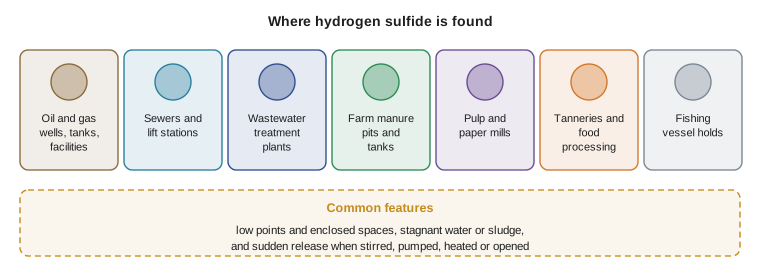
That means hydrogen sulfide turns up in places people do not think of as chemical workplaces. A municipal lift station, a farm manure pit, a fish hold on a boat, a sewer manhole, a tank of drilling mud, a truck carrying produced water, a hot spring and a pulp mill digester can all hold enough gas to kill. The gas collects in low places, behind closed doors, in pits and inside tanks, and it can be released suddenly when sludge is stirred, water is pumped, a valve is opened or a line fails.
How it kills
Hydrogen sulfide is a chemical asphyxiant. It does not simply push oxygen out of the air the way nitrogen does. Instead, once it is absorbed into the blood, it blocks an enzyme called cytochrome c oxidase that every cell uses to turn oxygen into energy. Cells starve even when there is oxygen in the blood. The brain and heart are affected first. At high concentrations, the gas acts on the part of the brain that controls breathing, and breathing simply stops. That is the "knockdown": a worker collapses, often after one or two breaths, and dies within minutes unless rescued and resuscitated.
At lower concentrations the gas irritates the eyes, nose, throat and lungs, causes headaches, nausea and dizziness, and with longer exposure can cause fluid in the lungs. Lesson 4 describes the health effects in detail. For now, the important point is that the gap between "unpleasant" and "deadly" is small, and a worker cannot tell which side of it they are on by smell or by how they feel.
The smell trap
Most people can smell hydrogen sulfide at a fraction of a part per million. That sensitivity sounds like a built-in warning, and at low levels it is. The problem is what happens at higher levels. Above roughly 100 ppm, the gas deadens the nerve that carries smell within a few minutes; at higher concentrations, the loss is almost immediate. Even at low concentrations, people stop noticing the smell after a while because of ordinary smell fatigue. A worker who notices the rotten-egg smell has disappeared may be in a much more dangerous atmosphere, not a safer one.
Every hydrogen sulfide program therefore starts from one rule: never use your nose as a detector. The only reliable way to know the concentration is to measure it with a working, bump-tested gas detector, as covered in lessons 6 and 7.
The rescuer trap
Hydrogen sulfide incidents have a cruel pattern. One person collapses. A co-worker, family member or passer-by sees them and runs in to help, without breathing apparatus, and collapses too. Sometimes a third person follows. Investigations of manure pit, sewer and oil field incidents repeatedly find that more than half of the people who die were trying to rescue someone else. The urge to help is human and admirable, but entering an atmosphere that has just knocked someone down, without protection, turns one casualty into two or three.
That is why H₂S training always teaches the same order: protect yourself first, raise the alarm, assess, and rescue only with the right breathing apparatus and backup. Lesson 10 covers emergency response in detail.
How often does it happen?
Canada does not publish a national count of hydrogen sulfide deaths at work; compensation boards report fatalities by cause in different ways, and many incidents are recorded under broader headings such as confined spaces or toxic exposure. The cases that are reported show the same settings again and again: oil batteries and well sites, manure pits on farms, sewers and lift stations, and tanks. In May 2014, for example, a 38-year-old oil field worker working alone at an oil battery in southeast Saskatchewan was found dead, and the coroner confirmed hydrogen sulfide as the cause. Farm deaths in manure pits, often involving family members trying to rescue one another, have prompted repeated safety campaigns across the Prairies, Ontario and Quebec.
The numbers in any year are small compared with falls or vehicle incidents. What makes hydrogen sulfide stand out is how fast it kills, how often it kills more than one person in the same incident, and how preventable those deaths are with testing, ventilation, breathing apparatus and procedures that people actually follow.
Big releases
Most deaths involve one to three people in a small space. Large releases from wells and pipelines are rarer but can threaten whole communities. Sour gas blowouts in Alberta in the 1980s, including the long-burning Lodgepole well blowout of 1982, in which two workers died, led to a public inquiry and to much of the province's current sour gas regulation. Internationally, a 2003 gas well blowout in Kaixian county, China, released sour gas that killed more than 240 people in nearby villages. These events are why energy regulators require emergency planning zones, public notification and evacuation plans around sour wells and facilities, as described in lesson 5.
# How quickly a small release can fill a pit to a dangerous level (illustrative).
# A 2 m x 3 m x 2 m deep sump receives gas from disturbed sludge.
volume_m3 = 2 * 3 * 2            # 12 m3 of air
release_l_per_min = 0.5          # L of pure H2S gas released per minute
for minutes in (1, 5, 10, 20):
    h2s_l = release_l_per_min * minutes
    ppm = h2s_l / (volume_m3 * 1000) * 1_000_000
print(f"after {minutes:2d} min: about {ppm:6.0f} ppm (if evenly mixed, no ventilation)")after 1 min: about 42 ppm (if evenly mixed, no ventilation) after 5 min: about 208 ppm (if evenly mixed, no ventilation) after 10 min: about 417 ppm (if evenly mixed, no ventilation) after 20 min: about 833 ppm (if evenly mixed, no ventilation)
The model is crude: real gas does not mix evenly, and it pools at the bottom where a worker's face would be when bending down. But it shows why a sump that tested clear can become deadly within minutes once sludge is disturbed and why continuous monitoring, not a single test at the start of the job, is the standard for hydrogen sulfide work.
What this course covers
Lessons 2 to 4 explain the gas itself: its properties, where it is found and how it affects the body. Lesson 5 covers exposure limits and the law. Lessons 6 and 7 cover gas detection, from how sensors work to bump testing and fixed monitoring. Lesson 8 covers respiratory protection, building on HSE-240. Lesson 9 covers safe work practices and controls. Lesson 10 covers emergency response, and lesson 11 covers special situations, including confined spaces, sewers, manure pits and sour facilities. Lesson 12 brings everything together in an H₂S safety plan.
Confined space entry in general is covered in HSE-211, which is a prerequisite for this course, and detailed well-site procedures such as drilling and well servicing in sour areas are covered in HSE-331. Respirator selection, fit testing and supplied air are covered in HSE-240.
Worked problem
Spotting a hidden hydrogen sulfide hazard
A maintenance crew is asked to clean out a wet well at a small town's sewage lift station on a cool spring morning. The supervisor says the station has never had a problem and the crew can work from the ladder with the hatch open. What should the crew consider?
Show solution
- Sewage in a wet well is a classic source of hydrogen sulfide, produced by bacteria in sludge and in force mains where sewage sits without oxygen.
- Cleaning stirs up sludge, which can release a burst of gas even if the air tested clear at the start.
- Hydrogen sulfide is heavier than air, so it collects at the bottom of the well where the work is done.
- The wet well is almost certainly a confined space, so the entry rules in HSE-211 apply: testing, continuous monitoring, ventilation, a permit, an attendant and a rescue plan.
Answer: Past history is no guarantee. The crew needs continuous gas monitoring at the work level, ventilation, a confined space entry plan and rescue arrangements before anyone goes down the ladder.
Worked problem
Breaking the rescuer trap
A farm worker climbs into a manure pump-out pit to clear a blocked intake and collapses. His brother sees him from the barn door. What should the brother do?
Show solution
- Assume the pit holds a toxic atmosphere; a sudden collapse in a manure pit is a hydrogen sulfide emergency until proven otherwise.
- Do not enter. Stay upwind and away from the opening.
- Call emergency services immediately and say it is a possible hydrogen sulfide exposure in a manure pit.
- If there is a mechanical ventilation fan, start it from outside the pit if that can be done safely, and stop any agitation or pumping.
- Wait for responders with breathing apparatus, and guide them in when they arrive.
Answer: Raise the alarm and stay out. An unprotected rescue attempt is the most common way a single death becomes two.
Common mistakes
MistakeRelying on the rotten-egg smell to warn of danger.
InsteadSmell fades with fatigue and is paralyzed at high concentrations; only a working detector tells you the concentration.
MistakeRunning in to help a collapsed co-worker.
InsteadProtect yourself, raise the alarm and let rescuers with breathing apparatus make the rescue.
MistakeAssuming hydrogen sulfide only matters in oil and gas.
InsteadSewers, wastewater plants, manure pits, pulp mills, tanneries and fishing vessels all produce it.
MistakeTreating a clear test at the start of a job as proof the area stays safe.
InsteadDisturbing sludge or liquids can release gas in minutes; monitor continuously.
MistakeTreating this awareness course as a certification.
InsteadIndustry certifications and site-specific training are still required.
Summary and key terms
- Hydrogen sulfide is a colourless, heavier-than-air gas that forms wherever organic matter breaks down without oxygen and occurs in sour oil and gas.
- It is a chemical asphyxiant that blocks cells from using oxygen and can stop breathing within one or two breaths at high concentrations.
- The rotten-egg smell is not a reliable warning because smell fatigues and is paralyzed above roughly 100 ppm.
- Would-be rescuers are a large share of hydrogen sulfide deaths; protect yourself and raise the alarm first.
- Deaths occur in oil and gas, sewers, manure pits, tanks and many other settings, often involving more than one person.
- Large sour gas releases led to emergency planning requirements around sour wells and facilities.
- Hydrogen sulfide (H₂S)
- A toxic, flammable, colourless gas with a rotten-egg smell at low concentrations.
- Sour gas
- Natural gas containing hydrogen sulfide; in the field, often any gas or fluid containing H₂S.
- Chemical asphyxiant
- A substance that prevents the body from using oxygen, even when oxygen is present in the air.
- Cytochrome c oxidase
- An enzyme cells use to produce energy from oxygen; hydrogen sulfide blocks it.
- Knockdown
- Sudden collapse and loss of consciousness caused by a high concentration of hydrogen sulfide.
- Olfactory paralysis
- Loss of the sense of smell caused by hydrogen sulfide at higher concentrations.
- Olfactory fatigue
- Gradual loss of awareness of a smell during continued exposure.
- ppm
- Parts per million by volume, the usual unit for gas concentrations in air.
- H2S Alive
- A common Canadian energy-industry hydrogen sulfide training certificate, certified by Energy Safety Canada.
- ANSI/ASSP Z390.1
- The US consensus standard setting accepted practices for hydrogen sulfide training programs.
Practice problems
Work each problem on paper first, then reveal the answer to check.
Why is hydrogen sulfide called a chemical asphyxiant rather than a simple asphyxiant?
Show answer
It blocks the cells' use of oxygen instead of only displacing oxygen from the air.
Name five workplaces outside oil and gas where hydrogen sulfide can be present.
Show answer
Any five of sewers, lift stations, wastewater plants, manure pits, pulp and paper mills, tanneries, fish holds, food processing and hot springs.
Why is the rotten-egg smell not a reliable warning?
Show answer
People stop noticing it with continued exposure, and above about 100 ppm it paralyzes the sense of smell.
What usually happens at very high concentrations?
Show answer
Rapid collapse and breathing stops, often within one or two breaths.
What is the rescuer trap?
Show answer
Unprotected people entering to help a collapsed worker and becoming casualties themselves.
Give the correct order of response when someone collapses in a possible H₂S area.
Show answer
Protect yourself, raise the alarm, assess, then rescue only with breathing apparatus and backup.
Why can a sump that tested clear become deadly during work?
Show answer
Stirring sludge or pumping liquids can release gas quickly, and the gas collects in low areas.
Why do energy regulators require emergency planning around sour wells?
Show answer
Large releases can travel beyond the site and threaten nearby people and communities.
Which course covers confined space entry in general?
Show answer
HSE-211.
Does this course qualify a worker to enter sour sites?
Show answer
No. Industry certification and site-specific training are still required.
Lesson quiz · 5 questions
Score 60% or more to complete this lesson.
Create a free account to save your progress, take quizzes and earn a certificate.