
HSE-240 · Lesson 6 of 12 · 29 min
Selecting respirators: protection factors, IDLH and oxygen
Selection turns the exposure assessment into a decision. The question is simple to state: which approved respirator will keep the concentration inside the facepiece below the exposure limit, in this atmosphere, for this task and this worker? Answering it requires three tools: the hazard ratio, assigned protection factors and the limits set by oxygen levels and by atmospheres that are immediately dangerous to life or health.
The hazard ratio and required protection
Start by comparing the expected concentration with the exposure limit. The ratio tells you the minimum level of protection needed.
If a worker could face 180 ppm of a solvent with a limit of 20 ppm, the respirator must reduce the concentration by at least a factor of 9. The respirator chosen must have an assigned protection factor equal to or greater than that number. Remember from lesson 3 that the expected concentration should be a reasonable upper estimate, not the average, and should consider short-term peaks against the STEL or ceiling.
Assigned protection factors
An assigned protection factor (APF) is the workplace level of protection that a properly functioning respirator, or class of respirators, is expected to provide to properly fitted and trained users. It is a conservative planning value drawn from workplace protection studies, not the best result from a laboratory test. An APF of 10 means the respirator is expected to reduce the concentration inside the facepiece to one-tenth of the outside concentration or less.
| Respirator class | Quarter mask | Half mask | Full facepiece | Helmet or hood | Loose-fitting facepiece |
|---|---|---|---|---|---|
| Air-purifying (non-powered) | 5 | 10 (includes filtering facepieces) | 50 | — | — |
| Powered air-purifying (PAPR) | — | 50 | 1,000 | 25 or 1,000* | 25 |
| Supplied-air, demand mode | — | 10 | 50 | — | — |
| Supplied-air, continuous flow | — | 50 | 1,000 | 25 or 1,000* | 25 |
| Supplied-air, pressure-demand | — | 50 | 1,000 | — | — |
| SCBA, demand mode | — | 10 | 50 | 50 | — |
| SCBA, pressure-demand | — | — | 10,000 | 10,000 | — |
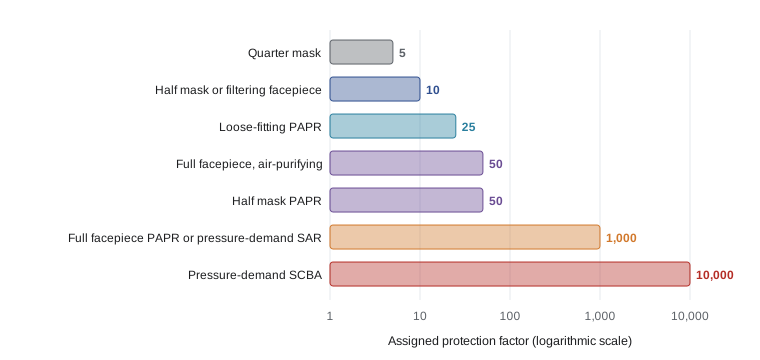
Two conditions apply to every APF. First, it assumes a complete program: the respirator is approved, selected correctly, fit-tested if tight-fitting, worn properly the whole time and maintained. Without a program, real protection can be a small fraction of the APF. Second, the APF covers leakage around the seal and through valves; it does not cover the filter or cartridge being overwhelmed. Cartridges have their own concentration limits and service lives, covered in lesson 7.
Maximum use concentration
The maximum use concentration (MUC) is the highest concentration in which a respirator can be used. It is found by multiplying the APF by the exposure limit.
The MUC is capped in three ways. It must not exceed the IDLH concentration for an air-purifying respirator, because air-purifying respirators are never permitted in IDLH atmospheres. It must not exceed any maximum concentration stated by the cartridge or canister manufacturer. And where a substance-specific regulation sets lower limits for particular respirator types, those apply.
Worked problem
Calculating maximum use concentrations
The exposure limit for a vapour is 20 ppm and its IDLH is 500 ppm. Calculate the MUC for a half-mask air-purifying respirator, a full-facepiece air-purifying respirator and a tight-fitting full-facepiece PAPR, each with approved organic vapour cartridges.
Show solution
- Half mask: 10 × 20 = 200 ppm. This is below the IDLH, so the MUC is 200 ppm.
- Full facepiece: 50 × 20 = 1,000 ppm. This exceeds the IDLH of 500 ppm, so the MUC is capped at 500 ppm, and in practice the program should stay well below the IDLH and check the cartridge manufacturer's limit.
- Full-facepiece PAPR: 1,000 × 20 = 20,000 ppm. Again capped by the IDLH at 500 ppm, and by any cartridge limit.
Answer: Half mask 200 ppm; full facepiece and full-facepiece PAPR both capped at 500 ppm by the IDLH. Above 500 ppm only atmosphere-supplying respirators suitable for IDLH conditions may be used.
Immediately dangerous to life or health
An atmosphere is immediately dangerous to life or health (IDLH) when it poses an immediate threat to life, would cause irreversible adverse health effects, or would impair a worker's ability to escape. NIOSH publishes IDLH values for several hundred substances. Examples include about 100 ppm for hydrogen sulphide, 1,200 ppm for carbon monoxide and 300 ppm for ammonia. IDLH values are designed for escape planning and respirator selection; they are not safe exposure levels.
Three kinds of atmosphere are treated as IDLH for respirator selection.
| Atmosphere | Why it is IDLH | Examples |
|---|---|---|
| Concentration at or above the IDLH value | Toxic effects could kill or incapacitate quickly | Large ammonia release; hydrogen sulphide in a sewer |
| Oxygen-deficient atmosphere | Workers can collapse within a few breaths without warning | Tank purged with nitrogen; argon in a welding pit; fermentation in a silo |
| Unknown atmosphere | The concentration cannot be measured or reasonably estimated | Emergency response; entry to an untested space |
For IDLH atmospheres, CSA Z94.4 and Canadian regulations require respirators that supply air independently of the surrounding atmosphere: pressure-demand SCBA with a full facepiece, or a pressure-demand airline respirator with an auxiliary self-contained escape supply. Air-purifying respirators, including PAPRs, are not permitted. A standby person outside the atmosphere, with communication and rescue equipment, is expected, and confined space regulations add specific entry and rescue requirements covered in HSE-216.
Oxygen-deficient atmospheres
Normal air contains about 20.9 per cent oxygen. As the oxygen level falls, judgment and coordination are impaired, and below about 10 per cent unconsciousness can come within seconds, often without any warning sensation. Air-purifying respirators remove contaminants but cannot add oxygen, so they are useless, and dangerously misleading, in an oxygen-deficient atmosphere.
Canadian regulations generally treat an atmosphere with less than 19.5 per cent oxygen as oxygen-deficient for respirator selection; Alberta's OHS Code, for example, requires atmosphere-supplying protection below 19.5 per cent. Confined space rules in Ontario and other provinces set an acceptable range of 19.5 to 23 per cent, the upper limit reflecting the fire hazard of oxygen-enriched air. CSA Z94.4 also discusses the effect of altitude, where the partial pressure of oxygen is lower even at 20.9 per cent.
Worked problem
An oxygen reading and a respirator choice
Before cleaning a process vessel, a monitor at the manway reads 18.8 per cent oxygen and 15 ppm of a solvent with a limit of 50 ppm. The crew plans to use full-facepiece air-purifying respirators with organic vapour cartridges because the solvent is below its limit. What is wrong?
Show solution
- 18.8 per cent oxygen is below 19.5 per cent, so the atmosphere is oxygen-deficient.
- An air-purifying respirator cannot add oxygen, regardless of how low the solvent is.
- Something is displacing or consuming oxygen, such as an inert gas purge or rusting, and the level could fall further inside the vessel.
- The space must be ventilated and retested, and if entry is necessary before oxygen is restored, atmosphere-supplying respirators suitable for IDLH conditions and confined space procedures are required.
Answer: The low oxygen reading rules out air-purifying respirators. Ventilate, find the cause, retest and treat the vessel as an IDLH confined space until oxygen is normal.
A selection procedure
Respirator selection can be organized as a series of questions. The figure shows the logic most programs use.
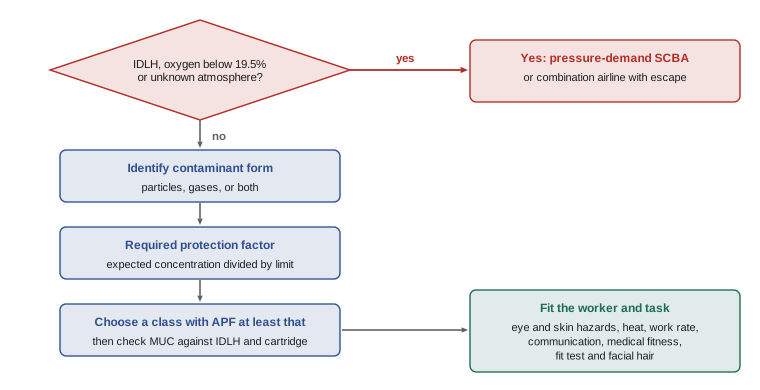
| Step | Question | Why it matters |
|---|---|---|
| 1 | Is the atmosphere IDLH, oxygen-deficient or unknown? | Determines whether only atmosphere-supplying respirators are allowed |
| 2 | What contaminants are present and in what form? | Determines filter, cartridge or supplied air |
| 3 | What is the required protection factor? | Sets the minimum APF |
| 4 | Does the MUC respect the IDLH, cartridge limits and specific regulations? | Prevents overloading air-purifying respirators |
| 5 | Does the contaminant have warning properties, and is there a reliable change schedule? | Affects whether air-purifying cartridges are practical |
| 6 | Is eye protection or skin protection needed? | May favour a full facepiece or hood |
| 7 | What are the task, work rate, temperature, duration and communication needs? | Affects comfort and wear time |
| 8 | Can the worker wear it: medical fitness, fit, facial hair, eyewear? | Ensures the respirator works for this person |
Worked problem
Selecting for a mixed exposure
A spray painter's breathing-zone concentration, estimated from past sampling, is up to 0.8 mg/m³ of a paint particulate with a limit of 0.1 mg/m³, and up to 120 ppm of a solvent with a limit of 50 ppm (IDLH 2,000 ppm). The paint is an eye irritant. Which respirator class is needed?
Show solution
- Particulate: 0.8 ÷ 0.1 = 8, so APF of at least 8.
- Solvent: 120 ÷ 50 = 2.4, so APF of at least 2.4.
- The higher requirement governs: APF at least 8. A half mask (APF 10) would meet it numerically, but with little margin.
- The paint irritates the eyes, so a full facepiece or a PAPR hood with a face shield is preferable.
- Both forms are present, so the respirator needs combination organic vapour cartridges with particulate prefilters, plus a change schedule.
Answer: A full-facepiece air-purifying respirator (APF 50) or a PAPR hood (APF 25 or more) with combination organic vapour and particulate filters gives adequate margin and eye protection.
Beyond the numbers
Numbers set the minimum, but the best respirator is the one workers will wear correctly for the whole exposure. Heat, heavy work, long shifts, the need to talk on radios, use of hard hats and welding helmets, and the wearer's comfort all affect wear time. A PAPR with an APF of 25 that a worker wears all shift may protect far better in practice than a full facepiece with an APF of 50 that is lifted every few minutes to wipe sweat. Involve workers in trials when choosing models, and offer more than one model and size.
Selection is also not a one-time decision. Reselect when the exposure assessment changes, when a new process or material is introduced, when a worker cannot pass a fit test or develops a medical problem, or when program evaluation shows that the selected respirator is not being worn correctly.
Common mistakes
MistakeSelecting against the average concentration.
InsteadSelect against a reasonable upper estimate, including peaks relative to the STEL or ceiling.
MistakeUsing MUC = APF × OEL without checking the IDLH.
InsteadCap the MUC for air-purifying respirators at the IDLH and at cartridge limits.
MistakeUsing an air-purifying respirator because the contaminant is below its limit, even though oxygen is low.
InsteadTreat oxygen below 19.5 per cent as IDLH and use atmosphere-supplying respirators.
MistakeTreating the APF as guaranteed protection without a program.
InsteadAPFs assume approval, fit testing, training, correct wear and maintenance.
MistakePicking the respirator with the highest APF regardless of the task.
InsteadChoose a respirator workers can wear correctly for the whole exposure, with adequate margin.
MistakeEntering an unknown atmosphere with a cartridge respirator.
InsteadTreat unknown atmospheres as IDLH until measured.
Summary and key terms
- The required protection factor is the expected concentration divided by the exposure limit.
- An assigned protection factor is the conservative workplace protection expected from a respirator class within a complete program.
- Common APFs are 10 for half masks, 50 for full facepieces, 25 for loose-fitting PAPRs, 1,000 for full-facepiece PAPRs and pressure-demand supplied air, and 10,000 for pressure-demand SCBA.
- The maximum use concentration is APF times the limit, capped for air-purifying respirators at the IDLH and cartridge limits.
- IDLH, oxygen-deficient and unknown atmospheres require pressure-demand SCBA or a combination supplied-air respirator with escape supply, plus standby and rescue arrangements.
- Air-purifying respirators cannot add oxygen and must never be used below 19.5 per cent oxygen.
- Selection also considers eye and skin hazards, task, environment, comfort and the individual worker.
- Hazard ratio
- The expected concentration divided by the exposure limit; the minimum protection factor needed.
- Assigned protection factor (APF)
- The workplace level of protection a respirator class is expected to provide within a complete program.
- Maximum use concentration (MUC)
- The highest concentration in which a respirator may be used, usually APF times the exposure limit, subject to caps.
- IDLH
- Immediately dangerous to life or health: an atmosphere that threatens life, causes irreversible harm or impairs escape.
- Oxygen-deficient atmosphere
- An atmosphere with less than 19.5 per cent oxygen by volume.
- Oxygen-enriched atmosphere
- An atmosphere with more oxygen than normal, which increases fire risk.
- Standby person
- A trained worker stationed outside an IDLH atmosphere to maintain communication and start rescue.
- Combination respirator
- A supplied-air respirator with an auxiliary self-contained air supply for escape.
- Contaminant warning properties
- Odour, taste or irritation that warns of a contaminant before harmful exposure.
Practice problems
Work each problem on paper first, then reveal the answer to check.
A worker may face 300 ppm of a vapour with a 25 ppm limit. What is the required protection factor?
Show answer
300 ÷ 25 = 12.
Which respirator classes could meet a required protection factor of 12?
Show answer
Any class with an APF of at least 12, such as a full-facepiece air-purifying respirator (50) or a loose-fitting PAPR (25), subject to IDLH and cartridge limits.
Calculate the MUC of a half mask for a substance with a 5 ppm limit.
Show answer
10 × 5 = 50 ppm, if below the IDLH and cartridge limit.
A full facepiece APR gives an MUC of 2,500 ppm but the IDLH is 1,000 ppm. What is the usable MUC?
Show answer
1,000 ppm at most, and in practice the program should stay well below the IDLH.
Name the three kinds of atmosphere treated as IDLH.
Show answer
At or above the IDLH concentration, oxygen-deficient, and unknown.
What respirators are permitted in IDLH atmospheres?
Show answer
Full-facepiece pressure-demand SCBA, or a pressure-demand supplied-air respirator with an auxiliary self-contained escape supply.
Why can't an air-purifying respirator be used at 18 per cent oxygen?
Show answer
It cannot add oxygen; the atmosphere is oxygen-deficient and treated as IDLH.
A painter needs APF 8 for particulates and the paint irritates the eyes. What is a good choice?
Show answer
A full-facepiece APR or a PAPR hood with combination filters.
Why might a PAPR with APF 25 protect better in practice than a full facepiece with APF 50?
Show answer
Workers may wear the more comfortable PAPR continuously, while a hot full facepiece may be lifted often.
Give two triggers for reselecting respirators.
Show answer
A changed exposure assessment, new materials or processes, failed fit tests, medical problems or evaluation showing poor wear.
Lesson quiz · 5 questions
Score 60% or more to complete this lesson.
Create a free account to save your progress, take quizzes and earn a certificate.